










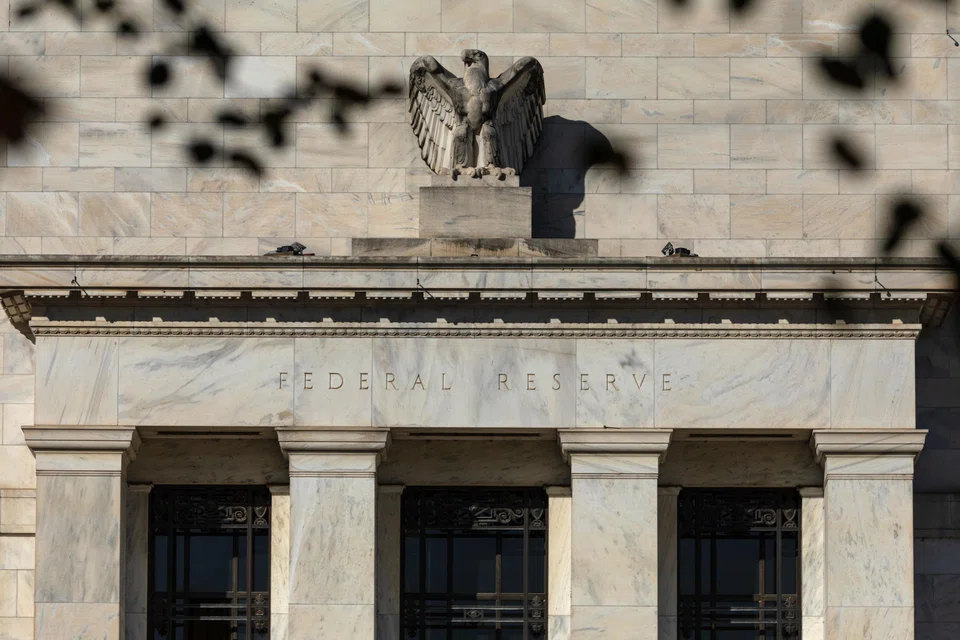
The Federal Open Market Committee (FOMC) voted eleven to one on Wednesday, March 18, 2026 to hold the benchmark federal funds rate unchanged in a target range of 3.5% to 3.75%, extending a policy pause that has now lasted since the third of three consecutive rate cuts in late 2025. The decision — officially implemented effective March 19, 2026 — was widely expected by markets and analysts, given the extraordinary level of uncertainty confronting policymakers as they try to simultaneously navigate elevated inflation, a softening labour market and the macroeconomic consequences of an active military conflict in the Middle East that has sent oil prices surging and complicated the already delicate process of returning inflation to the Fed’s 2% target.
The lone dissent came from Fed Governor Stephen Miran, appointed last year to fill an unexpected vacancy. Fed Chair Jerome Powell, whose term expires on May 15, 2026, held a press conference following the two-day meeting at which he was unusually candid about the difficulty of the Fed’s position. “The forecast is that we will be making progress on inflation,” he told reporters, “not as much as we had hoped, but some progress on inflation.” The remark captured the essence of the Fed’s dilemma: the path toward lower inflation remains intact in officials’ projections, but the pace of progress has slowed materially — and the oil shock adds a new inflationary impulse whose magnitude and duration are impossible to forecast with confidence.
Markets move fast; don’t get left behind. We’ve paired the Serrari Group Market Index with a curated Marketplace and a comprehensive Wealth Builder Course to ensure you have the data—and the skills—to act on it.
The Dot Plot: One Cut Still Expected, but the Distribution Has Shifted
The most closely watched aspect of the March meeting was not the rate decision itself — which was priced at 99.1% probability of a hold by futures markets heading into the meeting — but the updated Summary of Economic Projections (SEP), including the so-called “dot plot” that reflects the anonymous rate expectations of the 19 individual FOMC members. The dot plot’s median estimate for the federal funds rate at end-2026 remained at 3.4%, unchanged from the December projection — implying a single 25 basis-point cut before year end.
However, as Powell noted at the press conference, the median didn’t change — but the distribution underneath it shifted meaningfully. “If you notice, the median didn’t change, but there was actually some movement toward — a meaningful amount of movement — toward fewer cuts by people,” he said. “Four or five people went from two cuts to one cut.” This internal migration within the dot plot reflects individual FOMC members’ response to the oil shock: some who had previously expected two cuts now expect only one, acknowledging that energy-driven inflationary pressures may delay the pace of disinflation.
Revised Economic Projections: Growth Up, Inflation Up, Unemployment Steady
The March SEP update contained several notable revisions to officials’ economic outlook. On growth, the median projection for GDP in 2026 rose to 2.4% from the 2.3% forecast released in December — a modest upgrade that reflects the resilience of US consumer spending despite elevated borrowing costs and geopolitical uncertainty. Growth is projected at 2.3% in 2027, three-tenths of a percentage point above the prior forecast.
The inflation outlook received the most attention. Officials raised their median projection for the personal consumption expenditures (PCE) price index — the Fed’s preferred inflation gauge — to 2.7% for 2026, on both a headline and core basis, compared with prior projections of 2.4%. The upward revision reflects the anticipated pass-through of higher energy costs into headline inflation and, through secondary effects, into core inflation via transportation costs, manufacturing inputs and logistics. The Fed’s actual PCE data through January 2026 already showed 2.8% headline inflation and 3.1% core PCE — still uncomfortably above the 2% target. Officials see inflation falling back toward target by 2027 and 2028 as tariff effects and the war’s energy impact gradually fade.
The unemployment rate projection remained steady at 4.4% for end-2026, while the longer-run projection was held at 4.2% — signals that the Fed does not expect the labour market to deteriorate sharply even as growth moderates.
The Iran War and the Energy Price Shock
Central to the Fed’s deliberations is the US-Israel military conflict with Iran, which has disrupted global oil flows through the Persian Gulf — a waterway through which a significant share of global oil exports transit. Brent crude futures topped $109 a barrel at points during the March 18 session, while West Texas Intermediate has surged from pre-conflict levels. The average US national gas price jumped above $3.84 on March 18 — its highest since September 2023 — with the sharpest single-week increase in more than two decades.
Powell was asked repeatedly during the press conference whether the Fed would “look through” the oil shock — treating energy-driven inflation as transitory rather than requiring a policy response — or whether it would take the more hawkish view that energy inflation risks spilling over into broader price expectations. His answer was carefully calibrated. He said it was too soon to assess the full economic impact of the conflict, that the Fed would continue monitoring data and that while the central bank’s projections assume the inflationary effects of the conflict fade over time, that assumption is inherently uncertain given that no one can predict the war’s duration or ultimate scope.
JPMorgan economists, in a note published ahead of the decision, warned that “there is never a good time for an adverse supply shock, but ideally the starting point would be low and stable inflation. That will not be the case in this episode.” The Fed has not confronted an oil shock of this severity since the 1973 Arab-Israeli War, which triggered the notorious stagflation episode of that decade. When asked directly about stagflation, Powell pushed back firmly: “I always have to point out that that was a 1970s term, at a time when unemployment was in double figures and inflation was really high.” The current US economy, he argued, enters this shock from a much stronger starting position.
Context is everything. While you follow today’s updates, use the Serrari Market Index and Marketplace to spot emerging shifts. Need to sharpen your edge? Our Wealth Builder Course turns these insights into a professional-grade strategy.
Markets React: Equities Fall, Yields Tick Up
Markets reacted with measured disappointment to the Fed’s messaging. US equities fell at their session lows, with the Dow Jones Industrial Average sliding more than 600 points, while the S&P 500 and Nasdaq Composite declined approximately 0.9%. The muted reaction to a well-telegraphed hold reflected investors’ focus on Powell’s comment that the Fed was not making as much progress on inflation as hoped — a signal that the timeline for rate cuts may be pushed later into 2026 than the market had previously assumed.
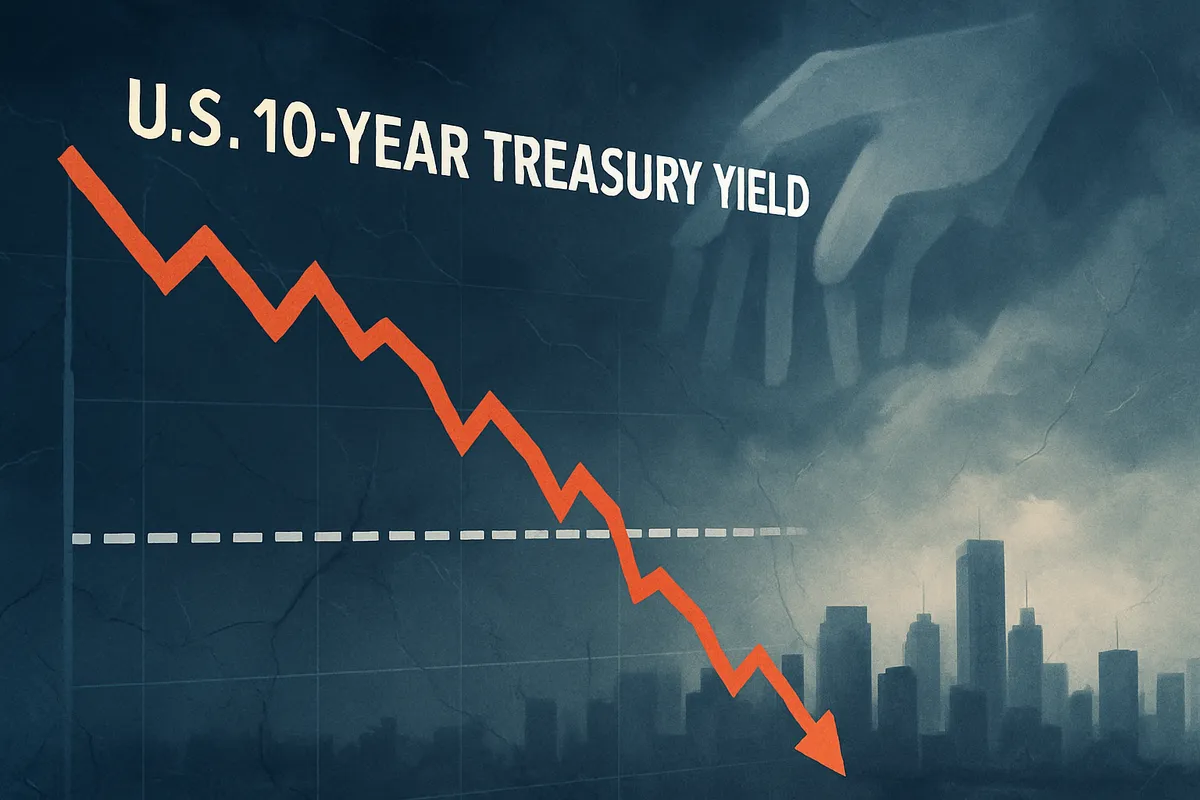
The 10-year Treasury yield had been trading at approximately 4.23% heading into the announcement, having declined from recent highs as the oil shock’s disinflationary growth impact was weighed against its direct inflationary impulse. After the meeting, yields drifted modestly higher as markets priced in the revised inflation outlook. Separately, the 10-year yield had fallen earlier in the week to around 4.18% following the Fed’s initial dovish “dot plot” signal — a decline that reflected the market’s initial read that one cut in 2026 remained the base case.
The Powell Succession and the Fed’s Political Context
Adding an unusual layer of institutional complexity to March’s FOMC meeting is the impending change of Fed leadership. Chair Jerome Powell’s term expires on May 15, 2026, and Kevin Warsh — Trump’s nominee to succeed him — has been described as more open to rate cuts but notably more hawkish on shrinking the Fed’s balance sheet than his predecessors. Powell addressed the succession question at the press conference, stating he has “no intention of leaving the board until the investigation is well and truly over with transparency and finality” — a reference to the Justice Department investigation into the Federal Reserve’s headquarters renovation project. He also indicated that Senator Thom Tillis of North Carolina is holding up Warsh’s nomination in the Senate Banking Committee until the DOJ probe is resolved.
Meanwhile, President Trump has publicly pressed Powell to cut rates, citing rising energy prices as a burden on American households and businesses. The Fed’s independence from political pressure — enshrined in its statutory mandate and operational structure — means that Trump’s public commentary does not directly influence FOMC decisions, but it adds to the political texture of a moment in which the Fed’s credibility is being tested by multiple simultaneous challenges.
The Broader Investment Implication
Goldman Sachs Asset Management’s Lindsay Rosner, head of multi-sector fixed income investing, offered a measured assessment: “The Fed will remain in ‘wait-and-see’ mode for now, pending clarity on developments in the Middle East. Despite higher inflation forecasts, the FOMC retains an easing bias, with a narrow majority on the committee expecting cuts to resume this year. We still see room for two ‘normalization’ cuts in 2026, although June is more likely than May given the current environment.” This assessment captures the market consensus: the rate cut cycle is delayed, not derailed, and the Fed’s fundamental orientation remains toward normalisation rather than tightening.
For investors across asset classes — from equities to fixed income to emerging markets — the Fed’s pause extends the higher-for-longer rate environment that has defined global financial conditions since 2022. In Kenya, where the CBK has been cutting rates on a different trajectory driven by domestic disinflation, the US rate environment matters because it shapes global risk appetite, dollar strength and the relative attractiveness of emerging market assets. A Fed that keeps rates elevated for longer means continued pressure on currencies like the Kenyan shilling and a higher bar for emerging market debt to attract foreign portfolio flows. The next Fed meeting, scheduled for early May 2026, will be Powell’s last — and markets will be watching to see whether his successor brings a different message.
Your financial future isn’t something you wait for—it’s something you build.
The real question is: when do you begin?
Move beyond simply staying informed.
Navigate the markets with clarity—track trends through the Serrari Group Market Index, uncover opportunities in the Serrari Marketplace, and build practical knowledge with our Curated Wealth Builder Course.
Stay connected to what truly matters.
Get daily insights on macro trends and financial movements across Kenya, Africa, and global markets—delivered through the Serrari Newsletter.
Growth opens doors.
Advance your career through professional programs including ACCA, HESI A2, ATI TEAS 7 , HESI EXIT , NCLEX – RN and NCLEX – PN, Financial Literacy!🌟—designed to move you forward with confidence.
See where money is flowing—clearly and in real time.
Track Money Market Funds, Treasury Bills, Treasury Bonds, Green Bonds, and Fixed Deposits, alongside global and African indexes, key economic indicators, and the evolving Crypto and stablecoin landscape—all within Serrari’s Market Index.
Photo Source: Google
By: Montel Kamau
Serrari Financial Analyst
19th March, 2026
Article, Financial and News Disclaimer
The Value of a Financial Advisor
While this article offers valuable insights, it is essential to recognize that personal finance can be highly complex and unique to each individual. A financial advisor provides professional expertise and personalized guidance to help you make well-informed decisions tailored to your specific circumstances and goals.
Beyond offering knowledge, a financial advisor serves as a trusted partner to help you stay disciplined, avoid common pitfalls, and remain focused on your long-term objectives. Their perspective and experience can complement your own efforts, enhancing your financial well-being and ensuring a more confident approach to managing your finances.
Disclaimer: This article is for informational purposes only and does not constitute financial advice. Readers are encouraged to consult a licensed financial advisor to obtain guidance specific to their financial situation.
Article and News Disclaimer
The information provided on www.serrarigroup.com is for general informational purposes only. While we strive to keep the information up to date and accurate, we make no representations or warranties of any kind, express or implied, about the completeness, accuracy, reliability, suitability, or availability with respect to the website or the information, products, services, or related graphics contained on the website for any purpose. Any reliance you place on such information is therefore strictly at your own risk.
www.serrarigroup.com is not responsible for any errors or omissions, or for the results obtained from the use of this information. All information on the website is provided on an as-is basis, with no guarantee of completeness, accuracy, timeliness, or of the results obtained from the use of this information, and without warranty of any kind, express or implied, including but not limited to warranties of performance, merchantability, and fitness for a particular purpose.
In no event will www.serrarigroup.com be liable to you or anyone else for any decision made or action taken in reliance on the information provided on the website or for any consequential, special, or similar damages, even if advised of the possibility of such damages.
The articles, news, and information presented on www.serrarigroup.com reflect the opinions of the respective authors and contributors and do not necessarily represent the views of the website or its management. Any views or opinions expressed are solely those of the individual authors and do not represent the website's views or opinions as a whole.
The content on www.serrarigroup.com may include links to external websites, which are provided for convenience and informational purposes only. We have no control over the nature, content, and availability of those sites. The inclusion of any links does not necessarily imply a recommendation or endorsement of the views expressed within them.
Every effort is made to keep the website up and running smoothly. However, www.serrarigroup.com takes no responsibility for, and will not be liable for, the website being temporarily unavailable due to technical issues beyond our control.
Please note that laws, regulations, and information can change rapidly, and we advise you to conduct further research and seek professional advice when necessary.
By using www.serrarigroup.com, you agree to this disclaimer and its terms. If you do not agree with this disclaimer, please do not use the website.
www.serrarigroup.com, reserves the right to update, modify, or remove any part of this disclaimer without prior notice. It is your responsibility to review this disclaimer periodically for changes.
Serrari Group 2025