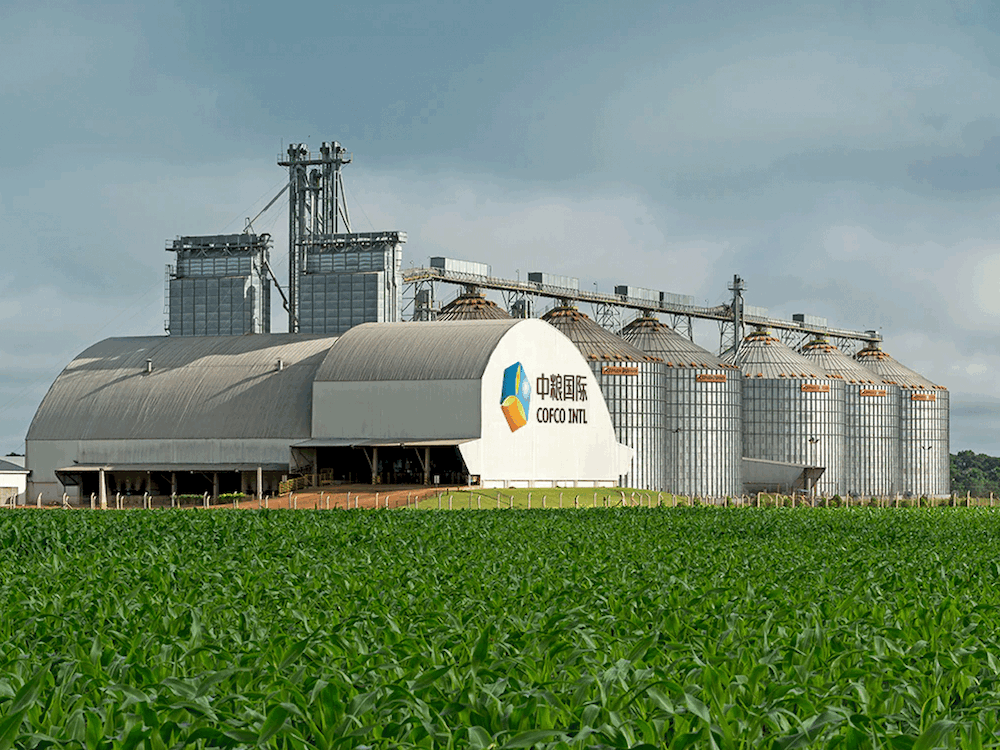
Global agribusiness COFCO International has secured a $435 million sustainability-linked revolving credit facility from Standard Chartered, marking a major development in the evolution of sustainable finance within agricultural supply chains.
Announced on March 19, the financing agreement represents a significant shift in how sustainability-linked loans are structured within the global commodities sector. Unlike most sustainability-linked financing instruments—which traditionally focus on emissions reduction or environmental performance—this facility ties borrowing costs directly to social responsibility and resilience outcomes within agricultural supply chains.
The deal places a strong emphasis on responsible sourcing, labour safeguards, and governance across agricultural supply networks, particularly within key South American markets that play a critical role in global grain and oilseed production.
For global food systems, the transaction signals a growing recognition that sustainability in agriculture goes beyond carbon emissions alone. Increasingly, lenders and investors are looking closely at supply chain governance, labour practices, and long-term resilience in food production systems.
By directly linking financing costs to measurable improvements in these areas, the loan structure introduces a financial mechanism designed to strengthen transparency and accountability across commodity supply chains.
Markets move fast; don’t get left behind. We’ve paired the Serrari Group Market Index with a curated Marketplace and a comprehensive Wealth Builder Course to ensure you have the data—and the skills—to act on it.
A New Model for Sustainability-Linked Finance
Sustainability-linked loans have become one of the fastest-growing instruments within sustainable finance over the past decade. Unlike green bonds or traditional green loans—which restrict funding to specific environmentally beneficial projects—sustainability-linked loans connect the cost of borrowing to a company’s performance against predefined sustainability targets.
The $435 million facility secured by COFCO International represents an innovative step forward within this evolving financial landscape.
In this case, the loan’s financial terms—including interest margins—will adjust depending on whether the company meets certain sustainability-related performance targets. These targets focus specifically on improving governance and labour standards within the agricultural supply chains that underpin global commodity markets.
This structure reflects a broader shift among financial institutions toward linking capital access more directly to responsible business practices.
For investors and lenders, such mechanisms help ensure that sustainability commitments translate into tangible improvements across operations and supply chains.
For companies like COFCO, the financing structure creates incentives to strengthen oversight and transparency within complex global agricultural networks.
Why Responsible Supply Chains Matter in Global Agriculture
The importance of responsible sourcing within agriculture has grown significantly in recent years as global food supply chains have come under increasing scrutiny.
South America, in particular, plays a pivotal role in global food systems. Countries such as Brazil and Argentina are among the world’s largest exporters of soybeans, corn, and other key agricultural commodities used for food production and livestock feed.
However, agricultural expansion in the region has also raised concerns about environmental degradation, labour practices, and land-use governance.
Commodity traders like COFCO International sit at the centre of these supply chains, connecting farmers, processors, and global markets.
Ensuring that agricultural commodities are sourced responsibly—while protecting workers’ rights and strengthening supply chain oversight—has therefore become an important priority for both governments and financial institutions.
The new sustainability-linked loan aims to address these concerns by embedding social and governance performance indicators directly into corporate financing structures.
By doing so, the agreement encourages measurable improvements in how agricultural commodities are produced, sourced, and traded.
Financing Tied to Measurable Sustainability Targets
At the core of the financing agreement are two externally verified key performance indicators (KPIs) designed to strengthen supply chain accountability.
First, the facility encourages an increase in the volume of grains and oilseeds certified under recognized responsible agriculture standards. These include the company’s COFCO Responsible Agriculture Standard, which sets guidelines for environmental stewardship, traceability, and responsible sourcing.
Second, the loan promotes stronger supplier due diligence and improved labour protections within Brazilian soy and corn supply chains.
These metrics focus on strengthening monitoring systems, ensuring that suppliers comply with labour standards, and enhancing oversight of agricultural sourcing practices.
Under the structure of the loan, the cost of financing will adjust depending on COFCO’s progress in achieving these goals.
If the company meets or exceeds the agreed sustainability targets, it may benefit from more favourable borrowing conditions. If the targets are not met, financing costs may increase.
This mechanism ensures that sustainability performance becomes directly connected to financial outcomes.
COFCO Emphasizes Responsible Agriculture Commitments
For COFCO International, the financing arrangement reflects the company’s broader strategy to integrate sustainability into its operational and financial frameworks.
“This facility represents a deep integration of our sustainability goals with corporate financial management,” said Helen Song, Chief Financial Officer at COFCO International.
She noted that the structure reinforces the company’s longstanding commitment to responsible sourcing and supply chain safeguards across key agricultural markets.
By linking financing to measurable progress in certified sourcing and supplier due diligence, the agreement aims to support the continued expansion of responsible and certified sustainable agricultural supply chains.
The approach also helps improve market access for producers who meet recognized sustainability standards, providing additional incentives for farmers to adopt responsible agricultural practices.
Context is everything. While you follow today’s updates, use the Serrari Market Index and Marketplace to spot emerging shifts. Need to sharpen your edge? Our Wealth Builder Course turns these insights into a professional-grade strategy.
Standard Chartered Expands Sustainable Finance Strategy
For Standard Chartered, the deal reflects a strategic expansion of the bank’s sustainable finance portfolio.
While many sustainable finance transactions have historically focused on climate mitigation and emissions reduction, this agreement places greater emphasis on social resilience and supply chain governance.
“This pioneering Sustainability-Linked Loan reflects our commitment to progress commerce in a way that delivers real impact for communities and supports a just transition,” said Wan Thonh, Head of Coverage for Singapore and ASEAN at Standard Chartered.
The bank has increasingly positioned itself as a major player in sustainable finance, particularly across emerging markets in Asia, Africa, and the Middle East.
In 2025, the bank announced that it had surpassed its target of generating $1 billion in annual income from sustainable finance activities, reflecting strong growth in demand for climate-aligned and ESG-linked financing solutions.
The loan with COFCO represents the bank’s first sustainability-linked loan focused specifically on social resilience outcomes, marking a significant milestone within its sustainable finance strategy.
Expanding the Scope of ESG Financing
According to Marisa Drew, Chief Sustainability Officer at Standard Chartered, sustainability-linked finance has historically concentrated on reducing greenhouse gas emissions and managing environmental risks.
However, the evolving nature of global supply chains means that social risks and operational resilience are becoming increasingly important components of sustainable finance.
“Leveraging our sustainable finance expertise to help close Standard Chartered’s first social resilience-themed sustainability-linked loan is an important step,” Drew said.
She explained that the bank worked closely with COFCO to design a financing structure that addresses risks within agricultural supply chains, particularly those related to labour standards and supplier oversight.
By integrating these factors into the loan’s performance metrics, the agreement broadens the scope of ESG financing beyond environmental indicators alone.
South America’s Role in Global Food Supply
The focus on South America reflects the region’s growing importance within global agricultural markets.
These commodities are critical inputs for global food production, livestock feed, and biofuel industries.
However, the region’s agricultural sector is also increasingly exposed to climate volatility, environmental pressures, and social governance challenges.
Extreme weather events linked to climate change have disrupted harvests in recent years, while concerns about land-use practices and labour conditions have attracted greater scrutiny from regulators and investors.
Against this backdrop, strengthening supply chain governance and improving resilience across agricultural networks has become a key priority for companies operating within the sector.
The sustainability-linked loan between COFCO and Standard Chartered is designed to support these efforts.
The Growing Importance of Sustainability-Linked Loans
The agreement also reflects broader growth in the global market for sustainability-linked loans.
Over the past decade, these instruments have gained popularity among corporations seeking to integrate sustainability goals into their financial structures.
According to industry data, sustainability-linked lending has expanded rapidly across sectors ranging from energy and manufacturing to agriculture and transportation.
The appeal of these loans lies in their flexibility. Companies can use the funds for general corporate purposes, while still committing to measurable sustainability improvements.
For financial institutions, the structure helps align lending activities with environmental and social objectives without limiting how borrowers deploy capital.
As a result, sustainability-linked loans have become a key component of the broader sustainable finance ecosystem.
Outlook: A Turning Point for Sustainable Agricultural Finance
The $435 million sustainability-linked loan secured by COFCO International represents more than just a financing agreement.
It signals an important evolution in how financial markets approach sustainability within the global food system.
By focusing on responsible sourcing, labour safeguards, and supply chain resilience, the transaction highlights the growing recognition that sustainable agriculture requires attention to both environmental and social factors.
For Standard Chartered, the deal demonstrates how financial institutions can design innovative financing structures that encourage responsible practices across complex global supply chains.
For COFCO, the agreement strengthens its ability to support sustainable agriculture while maintaining access to international capital markets.
As climate risks, supply chain disruptions, and regulatory pressures continue to reshape the global food industry, financing structures like this may become increasingly common.
If widely adopted, sustainability-linked financing could play a crucial role in ensuring that agricultural supply chains remain resilient, transparent, and socially responsible in the decades ahead.
Your financial future isn’t something you wait for—it’s something you build.
The real question is: when do you begin?
Move beyond simply staying informed.
Navigate the markets with clarity—track trends through the Serrari Group Market Index, uncover opportunities in the Serrari Marketplace, and build practical knowledge with our Curated Wealth Builder Course.
Stay connected to what truly matters.
Get daily insights on macro trends and financial movements across Kenya, Africa, and global markets—delivered through the Serrari Newsletter.
Growth opens doors.
Advance your career through professional programs including ACCA, HESI A2, ATI TEAS 7 , HESI EXIT , NCLEX – RN and NCLEX – PN, Financial Literacy!🌟—designed to move you forward with confidence.
See where money is flowing—clearly and in real time.
Track Money Market Funds, Treasury Bills, Treasury Bonds, Green Bonds, and Fixed Deposits, alongside global and African indexes, key economic indicators, and the evolving Crypto and stablecoin landscape—all within Serrari’s Market Index.