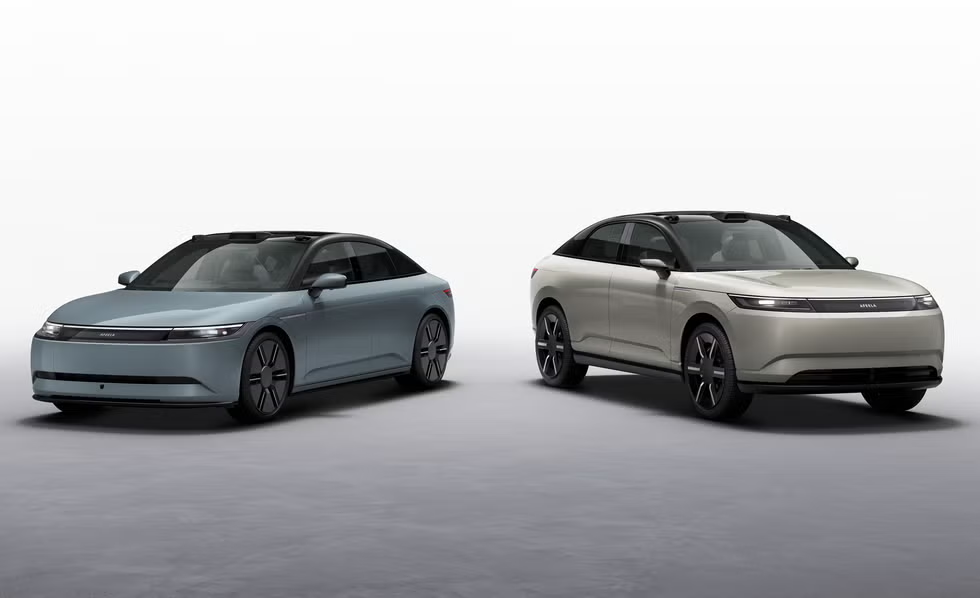
The ambitious plan by Sony Group and Honda Motor to launch a high-tech electric sedan has come to an abrupt halt. The two Japanese giants announced that they will discontinue development of the Afeela 1, the flagship model of their joint venture Sony Honda Mobility.
The decision marks a significant shift for a partnership that once promised to combine Sony’s expertise in entertainment, gaming, and software with Honda’s decades of automotive engineering. The Afeela project had been promoted as a next-generation electric vehicle designed not just for mobility, but as a digital platform for entertainment and connected services.
Originally expected to debut in California later this year with a price tag of up to $102,900, the sedan was envisioned as a direct competitor to premium electric vehicles produced by companies such as Tesla and emerging Chinese automakers.
Instead, the cancellation underscores a broader reality facing the global auto industry: the once explosive growth of the electric vehicle market has begun to slow, forcing automakers to rethink costly electrification strategies.
Markets move fast; don’t get left behind. We’ve paired the Serrari Group Market Index with a curated Marketplace and a comprehensive Wealth Builder Course to ensure you have the data—and the skills—to act on it.
The Collapse of an Ambitious EV Collaboration
When Sony and Honda announced their partnership in 2022, the electric vehicle sector was at its peak. Investors were pouring billions into EV startups, and legacy automakers were racing to electrify their fleets.
The collaboration aimed to create a new kind of car—one defined as much by software and entertainment as by horsepower and engineering.
The Afeela 1 sedan was the centerpiece of that vision. It featured a sleek design, a large digital dashboard stretching across the cabin, and advanced sensors designed to support autonomous driving technologies.
Sony intended to leverage its vast entertainment ecosystem, integrating gaming, movies, and music directly into the vehicle’s interface. Honda, meanwhile, would supply the core automotive platform and manufacturing expertise.
At the time, executives from both companies believed that the future of mobility would increasingly revolve around software-driven services and digital experiences.
But the landscape shifted quickly.
Slowing consumer demand, high vehicle prices, and rising costs of battery production have forced automakers to reevaluate their EV ambitions. For Sony Honda Mobility, the shift proved decisive.
Honda’s Strategic Reset
The cancellation of the Afeela program is closely tied to a broader restructuring underway at Honda.
Earlier this month, Honda revealed that it would record a massive writedown of up to 2.5 trillion yen (approximately $15.7 billion) related to its electric vehicle investments. The charges follow a slowdown in EV demand across North America and the cancellation of several EV projects planned for the U.S. market.
Among the vehicles scrapped were three electric models originally intended for production in the United States, including two models from Honda’s future “0 Series.”
The financial impact is significant. Honda expects to report its first annual loss in decades, forcing the automaker to reconsider how aggressively it should pursue pure battery-electric vehicles.
Instead, the company is shifting more resources toward hybrid technology—an area where demand remains strong and profit margins are more predictable.
This strategic pivot left Sony Honda Mobility without access to several technologies and platforms that had been essential to the Afeela project.
Without those assets, the joint venture concluded that it no longer had a viable path to bring the vehicle to market.
A Vision Born During the EV Boom
The Afeela project was born during a period of extraordinary optimism about electric vehicles.
The first glimpse of Sony’s automotive ambitions actually came earlier, at the Consumer Electronics Show in 2020, when the company unveiled a surprise concept vehicle called the Vision-S.
The prototype featured dozens of sensors, immersive audio technology, and large digital displays throughout the cabin. While initially presented as a technology showcase, the concept generated enormous attention and sparked speculation that Sony might enter the automotive industry.
Two years later, the partnership with Honda made that possibility real.
Together, the companies launched Sony Honda Mobility with the goal of creating “software-defined vehicles”—cars designed to evolve through updates and digital services rather than traditional hardware upgrades.
The Afeela brand was formally unveiled at CES 2023, where the sedan prototype demonstrated a futuristic cockpit and a sleek minimalist design.
Executives framed the vehicle not merely as transportation but as a platform for entertainment, connectivity, and digital services.
The PlayStation Car
One of the most distinctive aspects of the Afeela concept was its integration with Sony’s gaming ecosystem.
The car was designed to support remote access to PlayStation titles through Sony’s Remote Play technology. Drivers and passengers could potentially stream games onto the vehicle’s dashboard displays while charging.
The system would allow users to connect a wireless controller and continue gaming sessions from home consoles while inside the car.
Beyond gaming, the vehicle was expected to offer access to Sony’s massive catalog of movies, television content, and music through built-in streaming services.
Sony also envisioned downloadable features such as customizable lighting effects, digital soundscapes, and personalized driving modes.
These capabilities led some observers to nickname the Afeela sedan the “PlayStation car.”
The concept reflected a broader trend in the auto industry: vehicles becoming digital ecosystems where software services generate ongoing revenue.
A Product Facing Skepticism
Despite its futuristic vision, the Afeela 1 faced skepticism from some analysts and industry observers.
For a car priced at more than $100,000, its projected specifications were considered relatively modest compared with competing luxury EVs.
Sony Honda Mobility estimated the sedan would achieve a driving range of around 300 miles on a single charge.
By comparison, several premium electric models from BMW, Mercedes-Benz, and Volvo are approaching or exceeding 400 miles of range.
Some reviewers also questioned the vehicle’s design and market positioning.
Analysts noted that established EV brands already dominated the high-end electric sedan segment, making it difficult for a newcomer to compete—especially with only a single model.
Even before Honda’s strategic shift, many experts wondered whether the market truly needed another six-figure electric sedan.
Context is everything. While you follow today’s updates, use the Serrari Group Market Index and Marketplace to spot emerging shifts. Need to sharpen your edge? Our Wealth Builder Course turns these insights into a professional-grade strategy.
A Changing U.S. EV Market
The broader electric vehicle landscape in the United States has changed dramatically over the past few years.
Government incentives have fluctuated, supply chains have faced disruptions, and several EV startups have struggled to survive.
At the same time, consumers have begun gravitating toward more affordable electric vehicles rather than premium luxury models.
Automakers across the industry have responded by delaying or canceling expensive EV projects while investing more heavily in hybrid technologies.
This trend has affected even major players.
Several automakers have slowed the rollout of fully electric lineups in favor of a more gradual transition.
Against this backdrop, the Afeela project increasingly looked like a risky investment.
Launching a brand-new luxury EV brand requires billions of dollars in manufacturing, marketing, and infrastructure—a difficult proposition during a market slowdown.
Direct-to-Consumer Sales Controversy
Another unusual aspect of the Afeela strategy involved its planned sales model.
Instead of relying on traditional dealership networks, Sony Honda Mobility intended to sell vehicles directly to consumers online.
The approach mirrored strategies used by Tesla and newer EV brands.
However, the plan sparked resistance from traditional auto dealers.
The legal battle highlighted the broader tension between legacy automotive sales systems and emerging direct-to-consumer models.
Although the dispute had not been fully resolved, the cancellation of the Afeela project effectively removed one more challenger to the dealership model.
Financial Implications for Sony and Honda
Despite the scale of the project, both companies say the financial impact of the cancellation will be manageable.
Honda indicated that discontinuing the Afeela program will not significantly affect its fiscal outlook for the year ending in March.
Sony also stated that it does not expect the decision to materially impact its financial position.
The joint venture will issue full refunds to customers who had already placed reservation deposits for the Afeela 1 in California.
The cancellation also comes shortly after the opening of an Afeela Studio and delivery hub in Torrance, which had been designed as a showroom and customer experience center.
For reservation holders and early enthusiasts, the announcement represents a sudden end to a highly anticipated project.
The Challenge of Building a New Car Brand
The fate of Afeela highlights a broader truth about the automotive industry: building a successful new car brand is extraordinarily difficult.
Even well-funded ventures backed by major corporations face enormous challenges.
Manufacturing vehicles requires vast investments in factories, supply chains, and regulatory compliance. At the same time, brands must build trust with consumers who expect reliability and long-term service support.
In recent years, numerous EV startups have struggled or collapsed under these pressures.
The experience of Sony Honda Mobility shows that even companies with deep technological expertise and strong reputations are not immune to these challenges.
Automotive manufacturing remains one of the most capital-intensive industries in the world.
What Happens Next for the Joint Venture
While development of the Afeela vehicles has ended, the partnership between Sony and Honda has not been formally dissolved.
Both companies say they will continue discussions about the future direction of Sony Honda Mobility.
Possible options could include developing new mobility services, software platforms, or digital technologies related to connected vehicles.
The original vision of software-defined mobility still holds appeal for many companies in the industry.
Even if the Afeela sedan never reaches production, some of its concepts—such as integrated entertainment ecosystems and software-based vehicle upgrades—may influence future automotive designs.
For now, however, the partnership remains in a period of reassessment.
Outlook
The cancellation of the Afeela project is a powerful reminder that the electric vehicle transition is unlikely to follow a smooth, linear path.
While long-term momentum toward electrification remains strong, the industry is entering a phase of recalibration as companies adapt to changing market conditions.
Automakers are increasingly balancing ambitious EV plans with more pragmatic strategies that include hybrids and incremental electrification.
For Sony, the experience highlights the complexity of entering the automotive sector—even with advanced technology and global brand recognition.
For Honda, the move represents a strategic retreat designed to stabilize finances and refocus on profitable vehicle segments.
Whether Sony Honda Mobility ultimately reinvents itself or quietly fades away remains uncertain.
What is clear is that the Afeela project, once envisioned as a symbol of the future of software-driven mobility, will now join a growing list of ambitious electric vehicle concepts that never reached the road.
Your financial future isn’t something you wait for—it’s something you build.
The real question is: when do you begin?
Move beyond simply staying informed.
Navigate the markets with clarity—track trends through the Serrari Group Market Index, uncover opportunities in the Serrari Marketplace, and build practical knowledge with our Curated Wealth Builder Course.
Stay connected to what truly matters.
Get daily insights on macro trends and financial movements across Kenya, Africa, and global markets—delivered through the Serrari Newsletter.
Growth opens doors.
Advance your career through professional programs including ACCA, HESI A2, ATI TEAS 7 , HESI EXIT , NCLEX – RN and NCLEX – PN, Financial Literacy!🌟—designed to move you forward with confidence.
See where money is flowing—clearly and in real time.
Track Money Market Funds, Treasury Bills, Treasury Bonds, Green Bonds, and Fixed Deposits, alongside global and African indexes, key economic indicators, and the evolving Crypto and stablecoin landscape—all within Serrari’s Market Index.