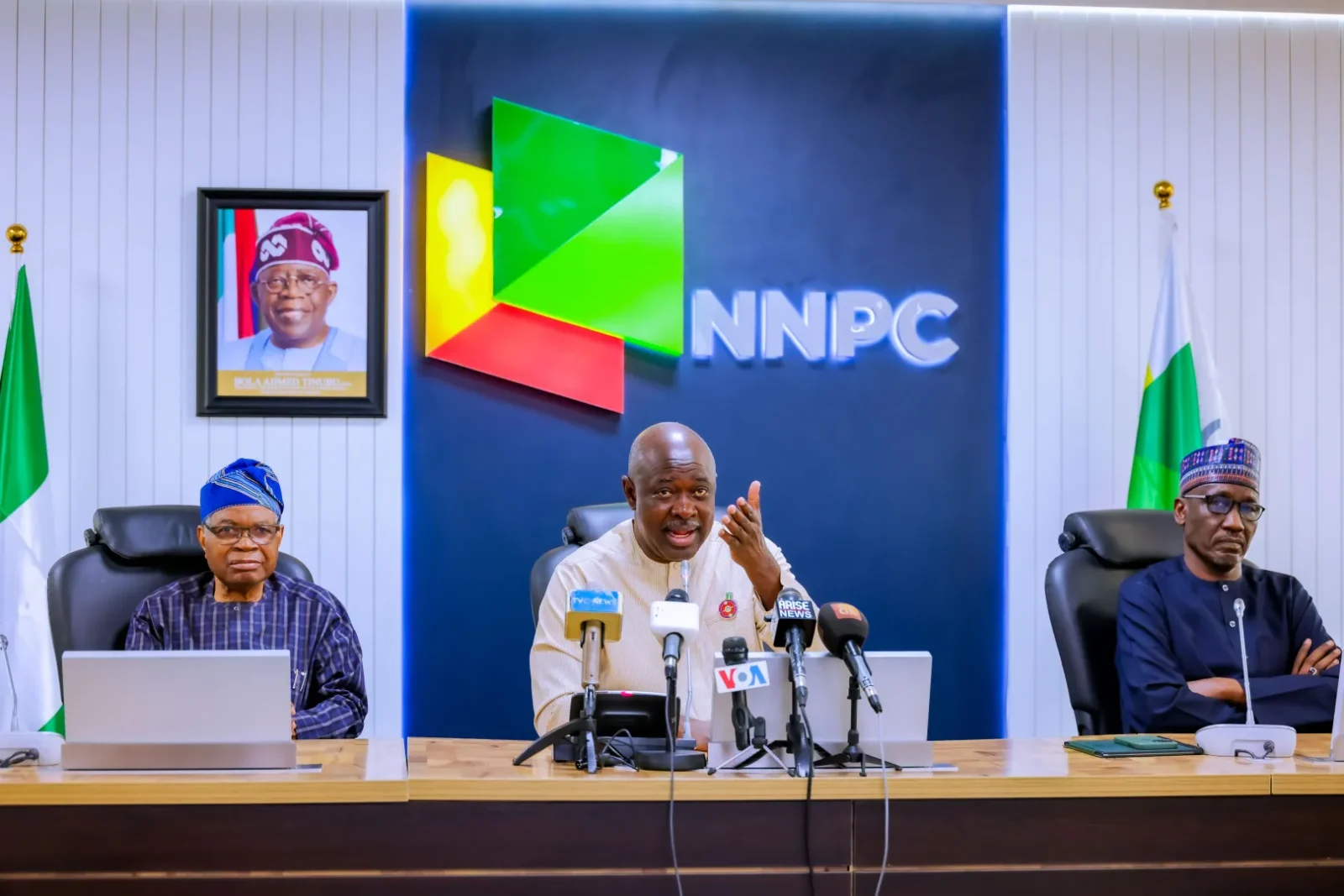
As a devastating conflict in the Middle East chokes off roughly a fifth of the world’s daily oil supply, Nigeria’s state oil company is positioning itself to help fill the gap. Speaking on the sidelines of the CERAWeek by S&P Global conference in Houston on Monday, NNPC Group CEO Bashir Bayo Ojulari said Nigeria can increase crude oil production by approximately 100,000 barrels per day over the next few months.
“We are building that capacity,” Ojulari told Reuters. “Last year we averaged maybe 1.6 or 1.7 million barrels per day. This year we’re hoping to average 1.8 million bpd. So we can contribute.” When asked whether Nigeria could help compensate for the supply shortfall created by the ongoing U.S.-Israeli war on Iran, Ojulari was measured but optimistic, noting that Nigeria is “not like Saudi Arabia” but can still play a meaningful role in stabilising global markets.
The remarks come at a moment of extraordinary tension in the world’s energy system. The conflict that erupted on February 28, 2026, when the United States and Israel launched coordinated airstrikes on Iran, has triggered what the head of the International Energy Agency has called the greatest global energy security challenge in history. Iran’s retaliatory actions have effectively closed the Strait of Hormuz — the narrow waterway through which roughly 20 million barrels of oil transit daily — to commercial shipping, sending crude prices surging above $100 per barrel in early March.
Markets move fast; don’t get left behind. We’ve paired the Serrari Group Market Index with a curated Marketplace and a comprehensive Wealth Builder Course to ensure you have the data—and the skills—to act on it.
The disruption has been staggering. According to analysis from the American Action Forum, Saudi Arabia, the United Arab Emirates, Iraq, and Kuwait have been forced to suspend shipments of as much as 140 million barrels of oil, while Qatar declared force majeure on its massive LNG exports after Iranian drone attacks. The World Economic Forum has warned that the impact is most acute for energy-importing economies in Europe and Asia, with prolonged closure threatening higher inflation and renewed supply-chain volatility worldwide.
For Nigeria — Africa’s largest oil producer and a member of OPEC that operates outside the Strait of Hormuz’s chokepoint — the crisis represents both opportunity and challenge.
Ojulari’s Transformation Agenda
Ojulari’s comments at CERAWeek were not made in isolation. The former Shell Nigeria executive, who was appointed by President Bola Tinubu in April 2025 to lead the state oil company’s commercial transformation, has been on a mission to overhaul NNPC’s operations since taking the helm. During an onstage interview at the conference, he revealed that NNPC had completed a full portfolio review of its business last year and is now implementing changes focused on improving execution and delivering projects on budget and on time.
The portfolio review is part of a broader mandate handed down by President Tinubu, who has set ambitious production goals for Nigeria’s oil sector: 2 million barrels per day by 2027 and 3 million by 2030, along with $30 billion in new upstream investments. At the Nigeria International Energy Summit in Abuja earlier this year, Ojulari outlined plans to revamp NNPC’s refining operations by partnering with companies that have proven track records in petrochemical operations.
One of the early wins under Ojulari’s leadership came in December 2025, when NNPC’s subsidiary, NEPL, achieved a record output of 355,000 barrels per day — its strongest performance since 1989. Ojulari described the milestone as evidence that Nigeria’s energy revival is no longer aspirational but already underway, crediting operational discipline, asset optimisation, and stronger partnerships for the achievement.
The company has also been restructuring its upstream partnerships. At the International Energy Week in London, Ojulari signalled that NNPC is reshaping its joint venture relationships to prioritise commercial outcomes, a significant shift for a company that has historically been criticised for inefficiency and political interference.
The Quota Gap: Nigeria’s Persistent Challenge
Despite the optimistic rhetoric, Nigeria’s oil sector faces deep structural challenges that temper expectations for rapid production growth. OPEC has maintained Nigeria’s production quota at 1.5 million barrels per day through December 2026 — a target the country has consistently struggled to meet.
According to OPEC’s latest monthly report, Nigeria’s crude output fell to just 1.31 million barrels per day in February 2026, a 10.69% decline from the 1.45 million bpd recorded in January. That left a production gap of roughly 190,000 bpd below the OPEC allocation — a shortfall that has persisted for seven consecutive months according to secondary source data.
The cumulative cost has been enormous. One analysis estimated that Nigeria forfeited approximately N1.76 trillion (roughly $1.08 billion) in potential crude oil revenue between January 2025 and January 2026 due to its inability to produce at or above its OPEC allocation. A separate assessment by Niger Delta stakeholders found that the country lost 93.74 million barrels of crude in the first eight months of 2025 alone, translating to approximately $6.85 billion in revenue at prevailing prices.
The causes of Nigeria’s production shortfalls are well documented: pipeline vandalism and crude oil theft in the Niger Delta, aging infrastructure requiring constant maintenance, delays in upstream project execution due to funding constraints and regulatory bottlenecks, and community-related disputes that disrupt operations. While the Nigerian military has claimed significant progress in combating pipeline vandalism, with the 6 Division reporting zero cases of violent vandalism since January 2025, NNPC itself claimed 100% crude oil pipeline availability in June 2025 — a narrative that sits uneasily alongside the persistent production shortfalls recorded in subsequent months.
The disconnect between security claims and actual output figures suggests that Nigeria’s production challenges extend beyond theft and sabotage. Underinvestment in field maintenance, the transition of onshore assets from international oil majors to indigenous operators, and the complex logistics of managing a mature oil basin all contribute to the gap.
Context is everything. While you follow today’s updates, use the Serrari Market Index and Marketplace to spot emerging shifts. Need to sharpen your edge? Our Wealth Builder Course turns these insights into a professional-grade strategy.
The Dangote Factor
One element that could fundamentally alter Nigeria’s oil calculus is the Dangote Petroleum Refinery. The $20 billion facility in Lagos — the world’s largest single-train refinery — reached its full designed capacity of 650,000 bpd in February 2026, a landmark achievement for Africa’s energy sector.
The refinery’s impact on Nigeria’s petroleum trade is already visible. Central Bank of Nigeria data shows that the facility drove $3.74 billion in crude imports into the country in 2025, fundamentally reshaping Nigeria’s traditional role as a raw crude exporter. Refined petroleum product imports dropped nearly 29% as locally processed fuel entered the domestic market in increasing volumes.
With the Middle East crisis disrupting global supply chains, the Dangote refinery has taken on heightened strategic importance. Bloomberg reported that the facility is seeking to buy more crude from NNPC to soften the impact of rising fuel costs, with Dangote Refinery CEO David Bird noting that while the plant receives about five cargoes of crude monthly from NNPC, it could easily handle thirteen or more. Several African nations, including South Africa, Ghana, and Kenya, have approached the refinery for fuel supply agreements as they seek alternatives to disrupted Middle Eastern sources.
The facility’s expansion plans are equally ambitious. In late 2025, Honeywell announced a partnership with Dangote to supply advanced technology and equipment that would double the refinery’s processing capacity to 1.4 million barrels per day by 2028, which would make it the world’s largest refinery outright.
For Nigeria’s upstream sector, the growing domestic refining capacity creates an additional market for crude that was previously dependent on export. But it also puts pressure on NNPC and other producers to actually deliver the barrels. S&P Global reported that the refinery completed a planned turnaround of its main gasoline unit in early 2026, expanding the crude distillation unit’s capacity from 650,000 to 700,000 bpd — further increasing the appetite for Nigerian crude.
Gas Ambitions and the AKK Pipeline
Ojulari’s vision for NNPC extends well beyond crude oil. At the CERAWeek sidelines and in previous public appearances, he has emphasized gas as a cornerstone of Nigeria’s energy future. In late 2025, he told CNBC Africa that NNPC had completed welding the main line of the $2.8 billion Ajaokuta-Kaduna-Kano gas pipeline, including the critical River Niger crossing that had stalled progress for years.
The AKK pipeline, first conceived in 2008, is designed to bring natural gas to northern Nigeria for the first time at scale, enabling fertiliser plants, power generation, and industrial parks in cities like Kaduna, Kano, and Abuja. Ojulari described the project as transformative, saying it would catalyse industrialisation in a region where chronic power shortages have stifled manufacturing for decades.
NNPC is also pursuing continental gas connectivity. At the International Energy Week, Ojulari outlined plans for the African Atlantic Gas Pipeline, a proposed network running across West Africa to Morocco, which he described as commercially viable despite its logistical complexity.
The Road to 1.8 Million
Ojulari’s target of averaging 1.8 million barrels per day in 2026 would represent a meaningful step forward for Nigeria’s oil sector — but it remains aspirational given recent performance. The federal government adopted a 2.6 million bpd benchmark for its 2026 budget but uses the more conservative 1.8 million bpd figure for actual fiscal planning, an acknowledgment of the gap between ambition and reality.
Achieving even the 1.8 million bpd average will require overcoming the same challenges that have dogged Nigeria’s oil sector for years — plus navigating new ones. The USDA’s Economic Research Service equivalent for energy — OPEC itself — has set the quota framework, and while Nigeria is exempt from some deeper voluntary cuts agreed upon by other OPEC+ members, the country’s baseline challenges prevent it from reaching even its exempted levels.
The Middle East crisis adds urgency. With Brent crude fluctuating between Chatham House’s assessment of already heavy revenue losses for Gulf exporters and the broader supply disruption, every additional barrel Nigeria can produce has outsized value. The conflict has also spurred OPEC and its allies to agree to raise production by 206,000 bpd starting in April to stabilise markets.
For Ojulari, the CERAWeek appearance served as both a progress report and a pitch to global investors. His emphasis on portfolio reviews, project execution, and commercial discipline signals an effort to recast NNPC’s image from a bureaucratic state enterprise into a competitive, profit-driven energy company. Whether the results on the ground can match the rhetoric will be the test of 2026.
As he put it at the conference: “We are building that capacity.” The question — for Nigeria, for OPEC, and for a world suddenly short of oil — is whether it can be built fast enough.
Your financial future isn’t something you wait for—it’s something you build.
The real question is: when do you begin?
Move beyond simply staying informed.
Navigate the markets with clarity—track trends through the Serrari Group Market Index, uncover opportunities in the Serrari Marketplace, and build practical knowledge with our Curated Wealth Builder Course.
Stay connected to what truly matters.
Get daily insights on macro trends and financial movements across Kenya, Africa, and global markets—delivered through the Serrari Newsletter.
Growth opens doors.
Advance your career through professional programs including ACCA, HESI A2, ATI TEAS 7 , HESI EXIT , NCLEX – RN and NCLEX – PN, Financial Literacy!🌟—designed to move you forward with confidence.
See where money is flowing—clearly and in real time.
Track Money Market Funds, Treasury Bills, Treasury Bonds, Green Bonds, and Fixed Deposits, alongside global and African indexes, key economic indicators, and the evolving Crypto and stablecoin landscape—all within Serrari’s Market Index.