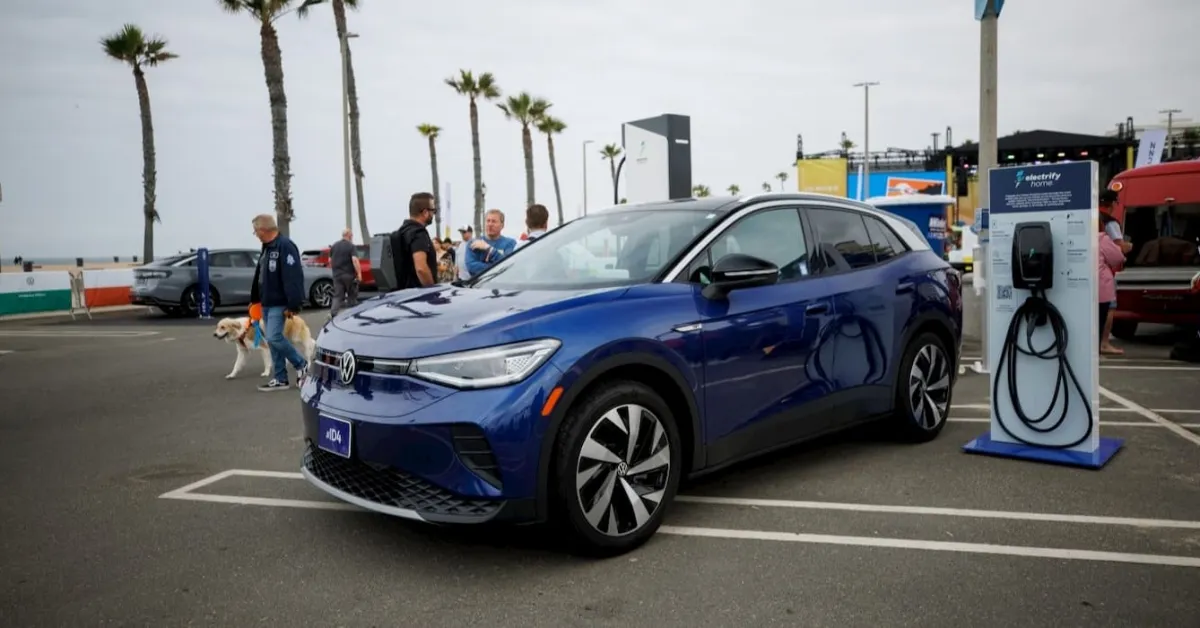
German automaker Volkswagen has announced a large-scale recall affecting nearly 100,000 electric vehicles worldwide, after identifying potential problems with certain battery modules used in several of its electric models.
The recall primarily impacts vehicles from Volkswagen’s growing ID electric vehicle lineup, including the Volkswagen ID.3, Volkswagen ID.4, Volkswagen ID.5, and the Volkswagen ID.Buzz.
In addition to these models, the recall also covers nearly 20,000 units of the Cupra Born, a model produced by Volkswagen Group’s performance-oriented brand Cupra.
According to Germany’s vehicle regulator, the Kraftfahrt-Bundesamt (KBA), the affected vehicles were produced between February 2022 and August 2024. The authority issued recall notices earlier this month after Volkswagen identified battery modules that may not fully meet the company’s technical specifications.
The announcement highlights the challenges automakers continue to face as they rapidly scale up production of electric vehicles, where complex battery systems remain one of the most technically demanding components.
Markets move fast; don’t get left behind. We’ve paired the Serrari Group Market Index with a curated Marketplace and a comprehensive Wealth Builder Course to ensure you have the data—and the skills—to act on it.
Battery Module Issue Could Reduce Range
Volkswagen stated that the issue involves specific battery modules within the vehicles’ high-voltage battery packs.
While the defect is not expected to affect every vehicle included in the recall, the company said that certain modules may not fully comply with internal quality standards. In some cases, this could lead to reduced battery performance or potential safety risks.
Drivers of affected vehicles might notice a yellow warning light appearing on the dashboard, accompanied by a noticeable reduction in the car’s driving range.
In rare circumstances, there is also a potential risk of overheating, which could increase the likelihood of a fire. However, Volkswagen emphasized that no injuries or accidents linked to the issue have been reported so far.
The company described the recall as a precautionary measure designed to identify and address any problematic battery modules before they cause further issues.
Battery safety has become a major priority across the automotive industry as electric vehicles become more widespread. While EV battery incidents remain rare, manufacturers typically act quickly to investigate any potential risk involving high-voltage battery systems.
Inspection, Software Update, and Module Replacement
To address the issue, Volkswagen will conduct a comprehensive inspection process for affected vehicles.
Owners will be asked to bring their cars to authorized dealerships where technicians will carry out several corrective steps.
The recall procedure will include:
- Installing a software update to the battery management system
- Conducting a detailed diagnostic analysis of the battery modules
- Replacing any individual modules that fail to meet performance requirements
The software update will help improve how the vehicle monitors battery performance, allowing the system to detect abnormalities more effectively.
If technicians identify a module that does not meet specifications, it will be replaced individually, rather than replacing the entire battery pack. This approach reduces repair costs and ensures that vehicles can return to service more quickly.
According to Volkswagen, customers with affected vehicles have already begun receiving notifications, and dealerships are preparing to begin the inspection process.
The recall is registered under KBA reference number 16271R for Volkswagen ID models. Internally, the company refers to the recall campaign using the code 93MI.
A separate recall campaign has also been issued for the Cupra Born under KBA reference number 16269R, with Volkswagen internally labeling the action 93S4.
Earlier Recall in the United States
The current recall follows a similar safety action earlier this year in the United States, highlighting ongoing efforts by automakers to monitor battery performance across their electric vehicle fleets.
In January 2026, Volkswagen issued a recall through the National Highway Traffic Safety Administration involving 43,881 units of the Volkswagen ID.4 from model years 2023 to 2025.
In that case, the company warned that certain vehicles could experience battery overheating, which could potentially increase the risk of a fire.
As with the current recall, Volkswagen’s solution involved software updates and inspection of battery components, with replacement of affected parts when necessary.
The repeated recalls do not necessarily indicate widespread failures, but they do illustrate how automakers must continuously monitor electric vehicle systems even after vehicles enter the market.
Questions Over Production Timeline Differences
Although the recall broadly affects vehicles produced between 2022 and 2024, some details surrounding the production timelines have raised questions.
For example, the affected Cupra Born vehicles were built between 7 February 2022 and 21 April 2024.
However, the Volkswagen ID.3, which is produced alongside the Born at Volkswagen’s Zwickau manufacturing plant in Germany, is only affected for vehicles manufactured between 24 June 2023 and 23 August 2024.
The reason behind the difference in production timelines has not yet been explained publicly.
Another inconsistency involves the Volkswagen ID.4 and ID.5 models, which are typically manufactured on a second production line at the same facility.
These vehicles are produced alongside the Audi Q4 e-tron models, yet the Audi vehicles have not been included in the recall issued by German regulators.
Industry analysts suggest the discrepancy could be related to specific batches of battery modules, variations in suppliers, or differences in battery management software used across models.
However, Volkswagen has not provided further clarification on the matter.
Context is everything. While you follow today’s updates, use the Serrari Group Market Index and Marketplace to spot emerging shifts. Need to sharpen your edge? Our Wealth Builder Course turns these insights into a professional-grade strategy.
Limited Impact on the Irish Market
While the recall affects a significant number of vehicles globally, the impact in Ireland is expected to remain relatively small.
Initial estimates suggest that around one percent of Volkswagen ID models sold in Ireland may be affected, which would represent fewer than 200 vehicles.
Volkswagen said it is still waiting for final confirmation on how many Cupra Born vehicles in the Irish market will be included in the recall.
So far, Volkswagen has recorded 18,403 Irish sales of its ID range of electric vehicles.
Meanwhile, the Cupra brand has registered 1,578 units of the Cupra Born in Ireland since the model was introduced.
Customers whose vehicles are affected will be contacted directly by Volkswagen or local dealerships and will be invited to schedule an inspection appointment.
The Challenges of Scaling Electric Vehicle Production
The recall highlights the technical complexity of electric vehicle battery systems, which consist of multiple components working together to store and deliver energy.
Modern EV battery packs contain dozens of modules and hundreds of individual battery cells, all of which must operate safely and efficiently.
Even minor manufacturing variations or deviations from specifications can affect the overall performance of the battery system.
As a result, automakers often implement large-scale recalls when potential issues are detected, even if only a small number of vehicles ultimately require repairs.
The rapid growth of the global EV market has increased the pressure on manufacturers to maintain strict quality control standards across increasingly complex supply chains.
Battery components are often sourced from specialized suppliers, and the integration of these components into vehicles requires careful testing and monitoring.
Automakers must also continuously update software systems that manage battery performance, temperature regulation, and charging behavior.
Volkswagen’s Broader Electric Strategy
The recall comes at a critical time for Volkswagen as the company continues to expand its electric vehicle portfolio.
Over the past several years, Volkswagen has invested billions of dollars into the development of its ID series of electric vehicles, which are built on the company’s dedicated MEB electric vehicle platform.
These models are intended to play a central role in Volkswagen’s long-term strategy to transition away from internal combustion engines and reduce emissions across its vehicle lineup.
The ID family now includes multiple vehicle types, ranging from compact hatchbacks and SUVs to electric vans such as the ID.Buzz.
Volkswagen has also been investing heavily in battery technology, software development, and charging infrastructure to support the growing EV ecosystem.
However, as electric vehicle production expands rapidly, automakers must remain vigilant in identifying and addressing technical issues that could affect safety or reliability.
Volkswagen Emphasizes Precaution and Customer Safety
Despite the scale of the recall, Volkswagen has emphasized that the action is being taken as a precautionary measure.
According to the company, the inspection program will ensure that every affected vehicle meets Volkswagen’s strict safety and performance standards.
“To rule out potential risks, we are checking all affected cars as a precaution,” a company spokesperson said.
Customers have already been informed about the recall and will receive instructions on how to arrange inspections through their local dealerships.
During the inspection process, technicians will update the software systems and evaluate the performance of each battery module.
If a module is found to be defective or does not meet specifications, it will be replaced before the vehicle is returned to the customer.
Volkswagen maintains that once the inspections and updates are completed, the vehicles will continue to operate safely and normally.
Outlook
The recall underscores the growing importance of battery safety as electric vehicles become a larger part of the global automotive market.
As manufacturers push to accelerate EV adoption and governments introduce stricter emissions regulations, electric vehicles are expected to play an increasingly central role in the transition toward cleaner transportation.
However, the rapid pace of innovation also means automakers must continue refining battery technologies and monitoring performance closely.
Large-scale recalls such as this one demonstrate the industry’s commitment to addressing potential issues quickly, ensuring that electric vehicles remain both safe and reliable for consumers.
For Volkswagen, the recall represents another step in navigating the complex transition from traditional combustion engines to a fully electrified future.
Your financial future isn’t something you wait for—it’s something you build.
The real question is: when do you begin?
Move beyond simply staying informed.
Navigate the markets with clarity—track trends through the Serrari Group Market Index, uncover opportunities in the Serrari Marketplace, and build practical knowledge with our Curated Wealth Builder Course.
Stay connected to what truly matters.
Get daily insights on macro trends and financial movements across Kenya, Africa, and global markets—delivered through the Serrari Newsletter.
Growth opens doors.
Advance your career through professional programs including ACCA, HESI A2, ATI TEAS 7 , HESI EXIT , NCLEX – RN and NCLEX – PN, Financial Literacy!🌟—designed to move you forward with confidence.
See where money is flowing—clearly and in real time.
Track Money Market Funds, Treasury Bills, Treasury Bonds, Green Bonds, and Fixed Deposits, alongside global and African indexes, key economic indicators, and the evolving Crypto and stablecoin landscape—all within Serrari’s Market Index.