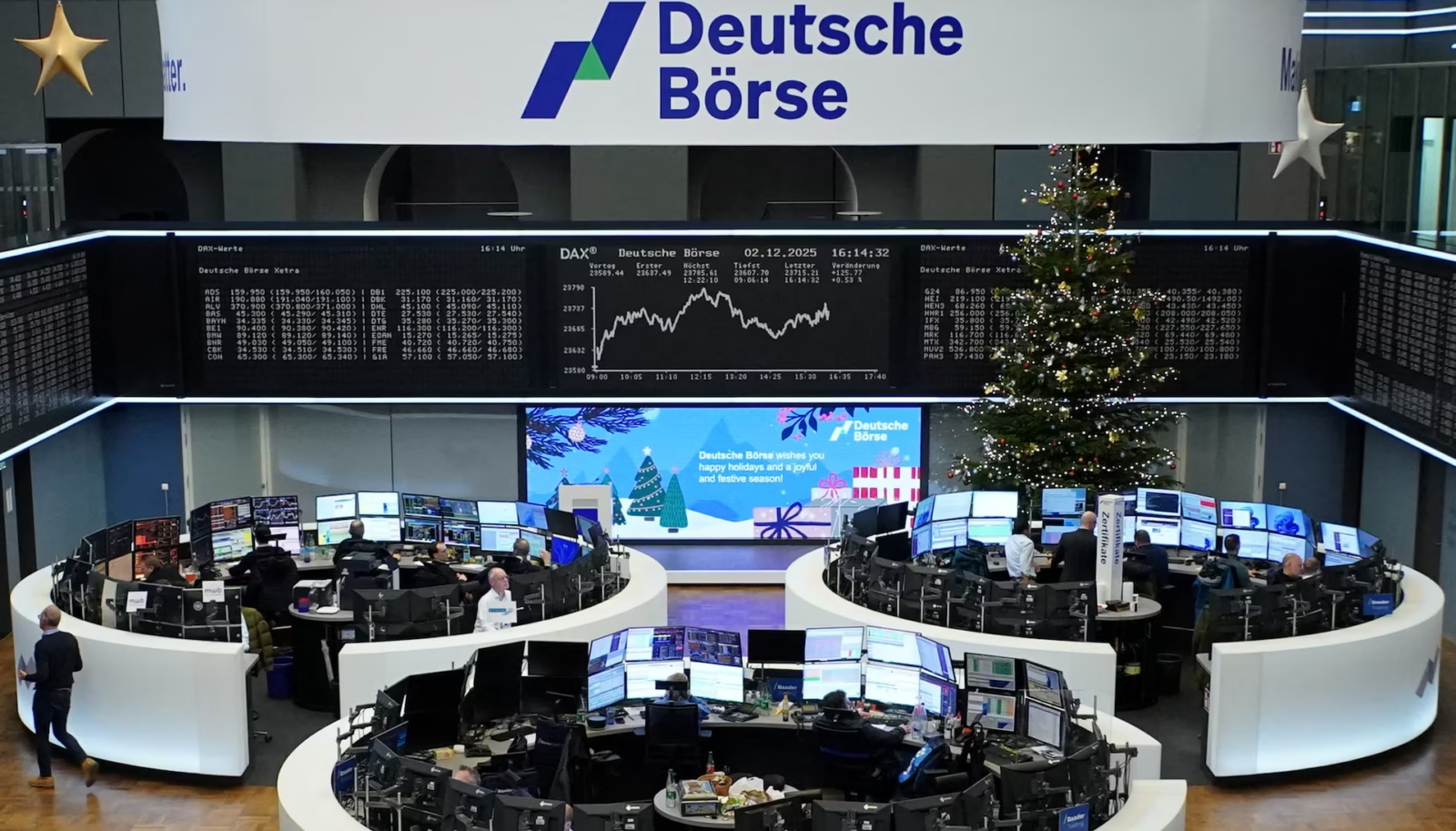
European equity markets showed signs of recovery at the end of the week, with the Stockholm Stock Exchange opening Friday’s session on a positive note. After experiencing a sharp decline in the previous trading session, Swedish equities staged a technical rebound, reflecting a broader pattern seen across major European bourses.
The benchmark OMXS30 rose approximately 0.78% to 2,931.72 in early trading, signaling renewed investor confidence, albeit within a still fragile market environment. Trading activity was moderately strong, with shares worth around SEK 1.4 billion exchanged shortly after the market opened.
This rebound, while encouraging, raises important questions about the underlying drivers of market movements, the sustainability of the recovery, and the broader macroeconomic and sector-specific forces shaping European equities.
Markets move fast; don’t get left behind. We’ve paired the Serrari Group Market Index with a curated Marketplace and a comprehensive Wealth Builder Course to ensure you have the data—and the skills—to act on it.
A Technical Rebound: What Does It Mean?
The rise in the Stockholm market is best understood as a technical rebound rather than a fundamental shift in market direction.
A technical rebound typically occurs after a sharp decline, when investors step in to buy stocks that may have been oversold. This can be driven by:
- Short-term trading strategies
- Bargain hunting by investors
- Market stabilization after panic selling
However, such rebounds do not necessarily indicate a long-term upward trend. Instead, they often reflect temporary corrections within a broader cycle of volatility.
The fact that other European markets also recorded similar upward movements suggests that this was part of a regional recovery pattern, rather than a Sweden-specific development.
Sector Performance: Real Estate and Materials Lead, Energy Lags
One of the most notable features of the trading session was the divergence in sector performance.
Top Performers
- Real Estate: +0.9%
- Basic Materials: +0.9%
These sectors tend to be sensitive to interest rates and economic expectations. Their positive performance may indicate:
- Improved sentiment around economic growth
- Expectations of stable or declining interest rates
- Increased investor appetite for cyclical assets
Underperformer
- Energy: -2.1%
The energy sector lagged significantly behind, suggesting potential weakness in oil and gas prices or profit-taking following previous gains.
This divergence highlights an important point: even when markets rise overall, sector-level dynamics can vary significantly.
Stock-Level Movements: Winners and Losers
Within the OMXS30, individual stocks displayed mixed performance.
Top Gainers
- Nibe Industrier AB (Nibe B): +4.4%
- Skanska AB (Skanska B): +1.6%
Nibe’s strong performance suggests renewed investor interest, potentially driven by favorable expectations in industrial or energy-efficient solutions.
Skanska’s gains were supported by a major contract win, which will be discussed further below.
Weak Performers
- Alfa Laval: -0.3%
- SCA (SCA B): +0.1% (flat performance)
These relatively modest movements indicate that not all stocks participated equally in the rebound.
Corporate Developments Driving Market Sentiment
Beyond general market trends, company-specific news played a significant role in shaping investor behavior.
Epiroc Secures African Mining Order
Epiroc announced a contract worth SEK 380 million from a mining client in Africa.
The stock rose 1.3%, reflecting investor optimism about:
- Continued demand for mining equipment
- Expansion opportunities in African markets
- Strength in the global commodities sector
This development highlights the importance of emerging markets in driving revenue growth for European industrial companies.
Skanska Wins Major US Contract
Skanska AB secured a SEK 1.5 billion project in the United States, reinforcing its strong international presence.
Such contracts are significant because they:
- Provide revenue visibility
- Support long-term growth
- Enhance investor confidence
The announcement contributed to the stock’s positive performance during the session.
Note Shares Decline Despite Guidance
Note AB saw its stock fall 3.2%, making it one of the session’s weakest performers.
The decline came despite the company issuing forward-looking guidance, including:
- Expected operating margin of 9.5–10.5%
- First-quarter sales forecast of SEK 930–960 million
- Anticipation of a weaker start to the year followed by gradual improvement
The negative reaction suggests that investors may be:
- Concerned about short-term performance
- Skeptical about the pace of recovery
- Reacting to acquisition-related uncertainty
This illustrates how forward guidance, even when reasonably positive, can still trigger sell-offs if expectations are not met.
Why This Market Movement Matters
The rebound in the Stockholm Stock Exchange carries broader implications for investors and financial markets.
Indicator of Market Sentiment
Short-term rebounds often reflect shifts in investor sentiment rather than fundamental changes.
The positive opening suggests that:
- Investors are willing to re-enter the market after declines
- Confidence has not completely eroded despite volatility
European Market Alignment
The fact that other European markets also moved higher indicates a coordinated regional response, possibly driven by:
- Global macroeconomic developments
- Stabilization in bond yields
- Reduced immediate geopolitical fears
Sector Rotation Signals
The divergence between real estate, materials, and energy sectors may signal ongoing sector rotation, where investors shift capital between industries based on changing expectations.
Context is everything. While you follow today’s updates, use the Serrari Market Index and Marketplace to spot emerging shifts. Need to sharpen your edge? Our Wealth Builder Course turns these insights into a professional-grade strategy.
Risks and Challenges
Despite the positive momentum, several risks remain.
Fragility of Technical Rebounds
Technical rebounds are often short-lived.
Without strong fundamental support—such as improved earnings or economic data—the market could resume its downward trend.
Macroeconomic Uncertainty
Global economic conditions remain uncertain, influenced by:
- Inflation trends
- Interest rate policies
- Geopolitical developments
These factors can quickly reverse market gains.
Sector-Specific Risks
Different sectors face unique challenges:
- Real estate is sensitive to interest rates
- Energy depends heavily on commodity prices
- Industrials are tied to global demand
Corporate Execution Risk
Individual company performance will continue to play a critical role.
Missed earnings expectations or weak guidance can lead to sharp stock declines, as seen with Note AB.
Historical Context: European Market Volatility
European equity markets have experienced multiple cycles of volatility over the past decades.
From the global financial crisis to the COVID-19 pandemic and recent geopolitical tensions, markets have repeatedly demonstrated their sensitivity to external shocks.
Technical rebounds, such as the one observed in Stockholm, are a common feature of these cycles.
They often occur during periods of uncertainty, serving as temporary pauses rather than definitive trend reversals.
Looking Ahead: What to Watch
The outlook for the Stockholm Stock Exchange and broader European markets will depend on several key factors.
Corporate Earnings
Upcoming earnings reports will provide insight into:
- Profitability trends
- Demand conditions
- Cost pressures
Interest Rate Developments
Central bank policies will continue to influence market dynamics, particularly for interest-sensitive sectors like real estate.
Geopolitical Stability
Regional and global tensions remain a major variable affecting investor sentiment.
Sector Trends
Monitoring sector performance can provide clues about where investors are allocating capital.
Conclusion
The Stockholm Stock Exchange’s rebound, with the OMXS30 rising 0.78%, reflects a short-term recovery following recent declines.
While the gains were supported by strong performances in real estate and materials, weakness in the energy sector highlights ongoing market divergence.
Corporate developments—including contract wins by Skanska AB and Epiroc, as well as the decline in Note AB—demonstrate the importance of company-specific factors in shaping market outcomes.
However, investors should approach such rebounds with caution. Without strong fundamental support, these gains may prove temporary.
As markets continue to navigate a complex landscape of economic uncertainty, sector shifts, and geopolitical risks, the ability to distinguish between short-term movements and long-term trends will remain critical for investors.
Your financial future isn’t something you wait for, it’s something you build.
The real question is: when do you begin?
Move beyond simply staying informed.
Navigate the markets with clarity—track trends through the Serrari Group Market Index, uncover opportunities in the Serrari Marketplace, and build practical knowledge with our Curated Wealth Builder Course.
Stay connected to what truly matters.
Get daily insights on macro trends and financial movements across Kenya, Africa, and global markets—delivered through the Serrari Newsletter.
Growth opens doors.
Advance your career through professional programs including ACCA, HESI A2, ATI TEAS 7 , HESI EXIT , NCLEX – RN and NCLEX – PN, Financial Literacy!🌟—designed to move you forward with confidence.
See where money is flowing—clearly and in real time.
Track Money Market Funds, Treasury Bills, Treasury Bonds, Green Bonds, and Fixed Deposits, alongside global and African indexes, key economic indicators, and the evolving Crypto and stablecoin landscape—all within Serrari’s Market Index.