India has introduced updated climate targets through 2035 under its Nationally Determined Contribution, focusing on emissions intensity reduction, clean energy expansion, and stronger carbon sinks. The strategy reflects a strategic balance between economic growth, energy security, and climate action, highlighting a measured pathway to decarbonization in one of the world’s largest emitting economies.
Key Overview
- India targets 47% emissions intensity reduction by 2035 (from 2005 levels).
- Plans to reach 60% non-fossil electricity capacity by 2035.
- Focus remains on intensity-based reductions, not absolute emissions cuts.
- Strategy balances economic growth, energy security, and climate goals.
India has announced a revised climate strategy extending through 2035, outlining how the country plans to reduce emissions while continuing to support economic growth and energy security.
The updated plan, approved by Prime Minister Narendra Modi’s cabinet, forms the country’s latest Nationally Determined Contribution (NDC) under the Paris Agreement. The strategy sets new targets for reducing emissions intensity, expanding clean energy capacity, and strengthening carbon sinks through forest and tree cover.
As the world’s third-largest emitter of greenhouse gases, India’s climate policies carry significant global implications. Together with the United States and China, the country accounts for nearly half of global emissions, making its climate commitments a key factor in determining the pace of global decarbonization efforts.
However, the updated strategy signals a measured and cautious approach. Rather than committing to absolute emissions reductions, India will continue to focus on reducing emissions intensity — the amount of pollution generated per unit of economic output.
The new target aims to cut emissions intensity by 47% from 2005 levels by 2035, building on a previous commitment to reduce the metric by 45% by 2030.
The plan also seeks to increase the share of non-fossil fuel electricity capacity to 60% by 2035, up from just over 52% today.
While these goals demonstrate continued commitment to climate action, analysts say the targets also reflect the difficult balance India faces between economic development, energy demand, and environmental responsibility.
Markets move fast; don’t get left behind. We’ve paired the Serrari Group Market Index with a curated Marketplace and a comprehensive Wealth Builder Course to ensure you have the data—and the skills—to act on it.
A Cautious Approach to Global Climate Commitments
India’s new climate plan arrives at a time when global momentum on climate policy appears to be slowing.
Recent developments — including the United States stepping back from climate action under President Donald Trump and relatively modest emissions targets announced by China — have shifted attention toward India as a potential driver of stronger global climate ambition.
Instead, the updated NDC suggests India will move forward carefully, prioritizing energy security and economic resilience.
Anne-Sophie Cerisola, a veteran climate diplomat and distinguished fellow at Strategic Perspectives, noted that India’s actions carry global significance.
The targets therefore send an important signal not only to industrialized economies but also to other developing nations about how climate commitments might evolve in the coming decade.
India’s strategy was published more than a year after the United Nations’ initial deadline for submitting updated national climate plans.
Some climate advocates have criticized the plan as less ambitious than expected, although others argue that it reflects the complex realities shaping the global energy landscape.
Emissions Intensity Target Raised to 47%
At the center of India’s updated climate plan is its new emissions intensity target.
The country now aims to reduce emissions intensity of GDP by 47% by 2035 compared with 2005 levels.
This represents only a modest increase from the previous goal of 45% by 2030, leading some analysts to characterize the target as cautious.
Unlike absolute emissions reductions, an intensity-based target allows total emissions to continue rising if the economy grows rapidly.
As a result, India’s overall emissions are expected to continue increasing in the coming years, even as the country becomes more energy-efficient.
Climate Action Tracker, which evaluates national climate strategies, noted that focusing on emissions intensity allows the total volume of greenhouse gases entering the atmosphere to keep rising.
The organization said the new target “will allow emissions to continue rising and remain far from the level of ambition that India could achieve in practice.”
Still, the approach reflects India’s status as a rapidly growing economy with rising energy demand.
Government officials say the strategy aims to balance development needs with climate responsibilities, ensuring that industrial growth and job creation are not constrained by overly restrictive emissions policies.
Expanding Clean Power Capacity
Alongside the emissions intensity target, India has committed to increasing the share of non-fossil energy sources in its electricity capacity to 60% by 2035.
This represents a gradual increase from the country’s current level of just over 52% non-fossil capacity.
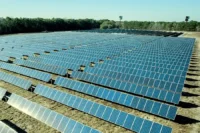
Renewable energy expansion — including solar, wind, and other clean sources — will play a key role in reaching this target.
However, some analysts believe the official commitment may underestimate the pace of change already underway.
Domestic projections from India’s Central Electricity Authority suggest that non-fossil capacity could reach nearly 70% by 2035–2036, indicating that the government’s formal international commitment remains relatively conservative.
Lauri Myllyvirta, lead analyst at the Centre for Research on Energy and Clean Air, said current trends suggest the country could reach its 60% clean power target much earlier than planned.
Under existing policies, he noted, the target could be achieved before 2030 rather than by 2035.
Strengthening Carbon Sinks Through Forest Expansion
India’s updated climate strategy also places greater emphasis on nature-based solutions.
The country plans to expand forest and tree cover to create carbon sinks capable of absorbing up to 4 billion tonnes of CO₂ equivalent by 2035.
This marks a significant increase from earlier estimates of around 2.3 billion tonnes.
Carbon sinks — including forests, wetlands, and soils — play an important role in offsetting emissions by absorbing carbon dioxide from the atmosphere.
Expanding these natural systems is increasingly seen as a complementary strategy alongside technological solutions such as renewable energy and carbon capture.
By strengthening its carbon sinks, India aims to offset a portion of the emissions generated by its growing economy.
Energy Security and Geopolitical Pressures
Government officials say the cautious tone of the new climate targets reflects a rapidly changing global environment.
The updated strategy was shaped in part by geopolitical tensions, supply chain disruptions, and volatility in energy markets, including conflict in West Asia.
Vaibhav Chaturvedi, a senior fellow at the Council on Energy, Environment and Water, said the evolving geopolitical landscape has forced policymakers to rethink the balance between climate ambition and energy security.
“There’s a growing understanding that energy security and prices cannot be taken for granted,” he said.
India remains heavily dependent on coal for electricity generation, as well as imported oil and gas for transportation, cooking, and industrial use.
Ensuring reliable energy supplies while expanding clean energy infrastructure therefore remains a central challenge for policymakers.
Investment Opportunities in the Energy Transition
Despite concerns about ambition, the updated climate targets could help create new opportunities for investment in India’s energy transition.
According to BloombergNEF data, energy transition investments in India reached $67.9 billion in 2025, highlighting growing interest in clean energy technologies.
Jane Ho, head of stewardship for Asia Pacific at BNP Paribas Asset Management, said stable policy signals could attract additional investment.
“Businesses and investors appreciate stability,” she said.
She added that sectors such as energy storage and green hydrogen could see significant expansion as industries like steel and cement begin to transition toward lower-carbon production methods.
Clear climate policies could therefore play a crucial role in unlocking both domestic and international capital for the country’s energy transformation.
Context is everything. While you follow today’s updates, use the Serrari Group Market Index and Marketplace to spot emerging shifts. Need to sharpen your edge? Our Wealth Builder Course turns these insights into a professional-grade strategy.
Focus on Adaptation and Climate Resilience
India’s updated climate strategy also places strong emphasis on adaptation and resilience.
Recognizing that climate impacts are already affecting communities across the country, the government has outlined measures to strengthen disaster preparedness and climate-resilient infrastructure.
These initiatives include:
- Protecting vulnerable coastlines through mangrove restoration
- Monitoring glaciers in Himalayan regions
- Developing heat action plans for cities
- Expanding early warning systems for cyclones and storm surges
- Improving infrastructure resilience against extreme weather events
Officials say these efforts are designed to protect communities from the growing risks associated with climate change.
The government has also highlighted the importance of community engagement through the Lifestyle for Environment (LiFE) initiative, which encourages sustainable practices at the individual level.
Mixed Reactions From Climate Experts
The updated NDC has drawn mixed reactions from climate experts and policy analysts.
Some observers welcomed the targets as a pragmatic step that balances environmental ambition with economic realities.
Aarti Khosla, director of Climate Trends, described the strategy as balanced.
“India’s approach stands out for its balance,” she said. “It prioritizes domestic capability, resilience and long-term sustainability while continuing to advance its climate commitments.”
Others, however, argued that the targets fall short of the ambition needed to accelerate the country’s energy transition.
Labanya Jena, director of the Climate and Sustainability Initiative, said the emissions intensity target may not be sufficiently ambitious given India’s technical capabilities and growing clean energy capacity.
“Taking into account India’s current technical and financial capacities, the government is likely being cautious about these commitments,” she said.
Jena also pointed to the global context, noting that climate ambition has weakened in recent years as several developed countries have slowed their climate policies.
Sectoral Transformation Still Needed
Analysts say that achieving India’s long-term climate goals will require significant changes across multiple sectors of the economy.
In particular, experts have highlighted the need to transform the industrial sector, which recently surpassed power generation as the largest source of emissions in the country.
Melanie Robinson, global climate, economics and finance director at the World Resources Institute, said decarbonizing heavy industry will be critical.
She noted that measures such as improving efficiency standards, switching to cleaner fuels like green hydrogen, and developing low-carbon cement could play a key role in reducing emissions.
Robinson also emphasized the importance of accelerating the adoption of zero-emission vehicles, which could reduce fossil fuel imports while improving air quality and public health.
Financing the Transition
One of the biggest challenges facing India’s climate strategy is financing.
Estimates suggest that achieving the country’s net-zero goal by 2070 could require US$5.2 trillion in investment between 2025 and 2050.
Suranjali Tandon of the National Institute for Public Finance and Policy noted that while international climate finance will be important, it will not be sufficient on its own.
Private sector investment will therefore play a crucial role in supporting India’s energy transition.
Ensuring stable economic growth and strong policy frameworks will be essential to attracting the scale of capital required.
Outlook
India’s updated climate strategy highlights the complex challenges facing emerging economies as they attempt to balance development priorities with global climate goals.
The country’s new targets reflect a pragmatic approach, focusing on emissions intensity reductions, gradual expansion of clean energy, and strengthening natural carbon sinks.
While some critics argue the targets fall short of the ambition needed to limit global warming, others see them as a realistic pathway for a rapidly growing economy with significant energy demand.
As the world’s third-largest emitter and one of the fastest-growing economies, India’s decisions will play a critical role in shaping the global climate trajectory.
In the coming years, progress will likely depend on continued investment in renewable energy, electrification of transport and industry, and stronger international cooperation on climate finance.
If supported by sustained policy momentum and capital investment, India’s transition could accelerate beyond its current targets — helping the country move closer to its long-term goal of achieving net-zero emissions by 2070 while supporting economic growth and energy security.
Your financial future isn’t something you wait for—it’s something you build.
The real question is: when do you begin?
Move beyond simply staying informed.
Navigate the markets with clarity—track trends through the Serrari Group Market Index, uncover opportunities in the Serrari Marketplace, and build practical knowledge with our Curated Wealth Builder Course.
Stay connected to what truly matters.
Get daily insights on macro trends and financial movements across Kenya, Africa, and global markets—delivered through the Serrari Newsletter.
Growth opens doors.
Advance your career through professional programs including ACCA, HESI A2, ATI TEAS 7 , HESI EXIT , NCLEX – RN and NCLEX – PN, Financial Literacy!🌟—designed to move you forward with confidence.
See where money is flowing—clearly and in real time.
Track Money Market Funds, Treasury Bills, Treasury Bonds, Green Bonds, and Fixed Deposits, alongside global and African indexes, key economic indicators, and the evolving Crypto and stablecoin landscape—all within Serrari’s Market Index.