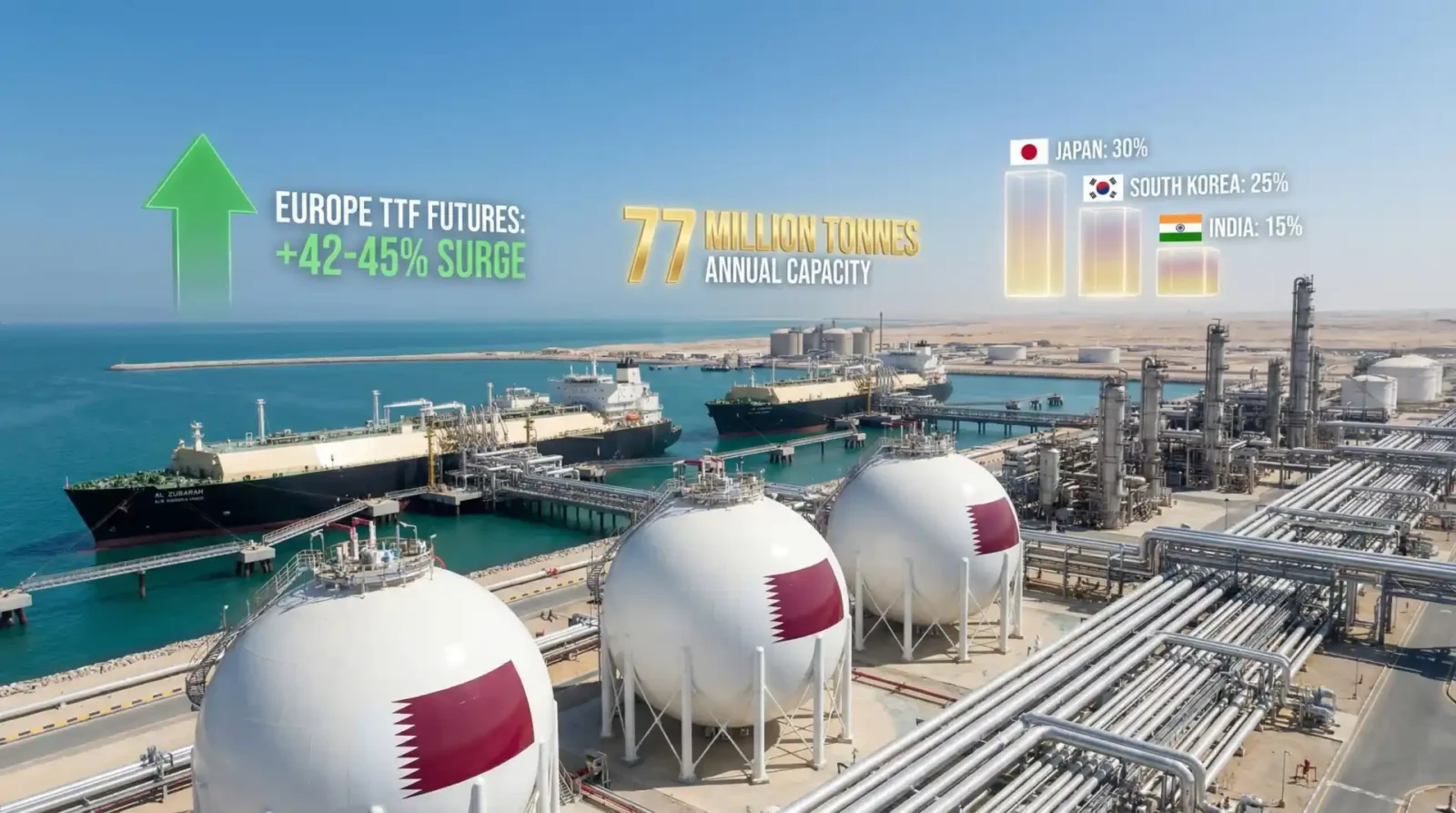
The global energy architecture, already under immense strain from years of geopolitical realignment, suffered its most significant blow in decades on Monday, March 2, 2026. Qatar Energy, the world’s leading exporter of liquefied natural gas (LNG), announced a total cessation of production following targeted drone strikes on its crown jewels: the industrial cities of Ras Laffan and Mesaieed. The removal of approximately 20% of the world’s LNG supply in a single day has pushed European and Asian benchmarks into a vertical climb, mirroring the chaos seen in the early days of the 2022 energy crisis.
Build the future you deserve. Get started with our top-tier Online courses: ACCA, HESI A2, ATI TEAS 7, HESI EXIT, NCLEX-RN, NCLEX-PN, and Financial Literacy. Let Serrari Ed guide your path to success. Enroll today.
The Strike on Ras Laffan: Severing the World’s Gas Artery
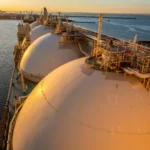
The focal point of the disruption is the Ras Laffan Industrial City, situated roughly 80 kilometers north of Doha. This massive complex is not merely a refinery; it is a global hub that hosts 14 LNG trains with a combined nameplate capacity of 77 million metric tonnes per year. The Qatari Ministry of Defence confirmed that Iranian drones successfully penetrated the site’s air defenses, targeting key energy infrastructure and a critical power plant water tank in nearby Mesaieed.
While QatarEnergy initially described the shutdown as a “precautionary measure,” the reality on the ground appears more severe. Analysts from Argus Media noted that while no casualties were reported, the psychological and structural impact on the world’s largest single-site LNG complex has forced a declaration of force majeure on existing contracts. This legal move allows the state-owned giant to bypass its delivery obligations to major utilities in Germany, Japan, and South Korea, leaving them to compete for a vanishingly small pool of spot-market cargoes.
Market Reaction: A Vertical Leap in Prices
The reaction in the trading pits was instantaneous. By midday Monday, the Dutch Title Transfer Facility (TTF) futures—the benchmark for European gas—had surged by more than 50%, reaching its highest level in over a year. The intraday spike was the largest single-day increase since the onset of the Russia-Ukraine war four years ago.
In Asia, the pain was equally acute. The Platts Japan-Korea Marker (JKM), the standard for spot LNG in the North Pacific, jumped nearly 40% to reach over $15 per mmBtu. For countries like Japan and South Korea, which lack pipeline connections and rely almost entirely on seaborne deliveries, the Qatari blackout represents an existential threat to industrial productivity.
Warren Patterson, head of commodities strategy at ING, warned that if the market begins to price in an extended period of loss from Qatar, the TTF could spike to 100 euros/MWh. Such a scenario would likely trigger widespread industrial curtailments across the Eurozone, which has yet to fully recover from the inflationary shocks of 2022.
The Strait of Hormuz: A De Facto Blockade
The physical damage to the plants is only half of the equation. The broader conflict has resulted in a de facto closure of the Strait of Hormuz, the chokepoint through which 20% of the world’s petroleum liquids and LNG pass daily. Even if Ras Laffan were to resume production tomorrow, getting the product to market is currently a logistical impossibility.
As of March 2, no LNG carriers have transited the strait since the intensification of hostilities on February 28. The withdrawal of commercial operators is being driven by the sudden cancellation of war-risk insurance by major maritime providers. Without insurance, the massive LNG tankers—essentially floating bombs—cannot enter the Persian Gulf.
Strategic Vulnerabilities: Why This Time is Different
The 2026 crisis differs from the 2022 shock in several critical ways. In 2022, the world had spare capacity in the U.S. and the Middle East that could be redirected. In 2026, the global gas market is operating near maximum capacity, and European storage inventories are unusually low for the season.
1. The European Refill Crisis
Europe typically uses the spring and summer months to refill its storage tanks. With Qatari supply offline, European buyers are now forced into a bidding war with Asian giants like China and India. Simone Tagliapietra, an analyst at the Bruegel think tank, stated that the threat to security of supply is “here and now.” If the disruption lasts for more than a month, Goldman Sachs predicts that European gas prices could more than double, potentially reaching levels that would necessitate government-mandated rationing.
One decision can change your entire career. Take that step with our Online courses in ACCA, HESI A2, ATI TEAS 7, HESI EXIT, NCLEX-RN, NCLEX-PN, and Financial Literacy. Join Serrari Ed and start building your brighter future today.
2. The Asian Supply Gap
Asia receives over 80% of the energy that transits through the Strait of Hormuz. The sudden deficit of 20 million barrels of oil equivalent per day has already triggered a sell-off in Asian stock markets, with the MSCI Asia Pacific Index dropping 2%.
3. U.S. Export Limits
While the U.S. has become a leading LNG exporter, its infrastructure is already running at full utilization. QatarEnergy was scheduled to start its Golden Pass expansion project in the U.S. in the coming weeks, but that facility—ironically a partnership with ExxonMobil—will not reach full capacity until 2027. Consequently, the U.S. cannot “bridge the gap” left by the Qatari shutdown in the near term.
The Regional Domino Effect
The strike on Qatar is not an isolated incident. It is part of a coordinated campaign that has also seen shutdowns at Saudi Arabia’s Ras Tanura oil refinery. Furthermore, Israel has been forced to shutter its Leviathan gas field due to security risks, leaving regional players like Egypt scrambling for alternative cargoes.
The International Energy Agency (IEA) estimated global oil demand at 104.87 million barrels per day for February 2026. With the Strait of Hormuz effectively out of play, the world is facing a deficit of 20 million barrels per day. This is not just a price shock; it is a physical shortage of the fuel that powers global shipping and heavy industry.
Global Economic Impact and “Value-at-Risk”
The economic shock is radiating far beyond the energy sector. Nick Ferres, chief investment officer of Vantage Point Asset Management, noted that the current crisis is a larger “value-at-risk” episode than previous skirmishes because it involves direct, successful hits on the most vital infrastructure in the world.
Comparative Price Spikes (March 2, 2026)
| Commodity | Percentage Increase | Market Implications |
| Dutch TTF Gas | +54% | European heating and industrial crisis |
| Asian JKM LNG | +41% | Severe power outages in North Asia |
| Brent Crude Oil | +13% | Global transportation fuel inflation |
| Newcastle Coal | +8.6% | Reversion to coal-fired power in Taiwan/Germany |
Source: Combined data from Bloomberg, Upday, and Energy News Beat.
The Geopolitical Gamble
The timing of the escalation coincides with a high-stakes military gambit. U.S. Secretary of State Marco Rubio downplayed the potential for lasting disruption, claiming the U.S. military has already destroyed much of the Iranian navy. However, market participants remain skeptical. The threat from Iran is no longer just its surface fleet, but its institutionalized and decentralized drone and missile programs, which have proven capable of reaching deep into the sovereign territory of Gulf states.
U.S. President Donald Trump has justified the current bombing campaign as retribution for decades of Iranian actions, but he now faces the political reality of high energy prices just months before the midterm elections.
Conclusion: A New Scenario for Energy Security
The shutdown of Qatar’s LNG output marks the beginning of what Simone Tagliapietra calls a “new scenario” for global energy. For three decades, Qatar was the “bank” of global gas—a reliable, neutral supplier that never completely ceased production. That era ended on Monday morning.
As the conflict continues, the focus shifts to damage assessment. If the repairs at Ras Laffan take months rather than weeks, the industrial stagnation in Europe and Asia will become permanent. Investors and governments alike are now forced to confront the fragility of a global supply chain that routes one-fifth of the world’s energy through a single, 21-mile-wide waterway.
Ready to take your career to the next level? Join our Online courses: ACCA, HESI A2, ATI TEAS 7 , HESI EXIT , NCLEX – RN and NCLEX – PN, Financial Literacy!🌟 Dive into a world of opportunities and empower yourself for success. Explore more at Serrari Ed and start your exciting journey today! ✨
Track GDP, Inflation and Central Bank rates for top African markets with Serrari’s comparator tool.
See today’s Treasury bonds and Money market funds movement across financial service providers in Kenya, using Serrari’s comparator tools.
photo source: Google
By: Montel Kamau
Serrari Financial Analyst
3rd March, 2026