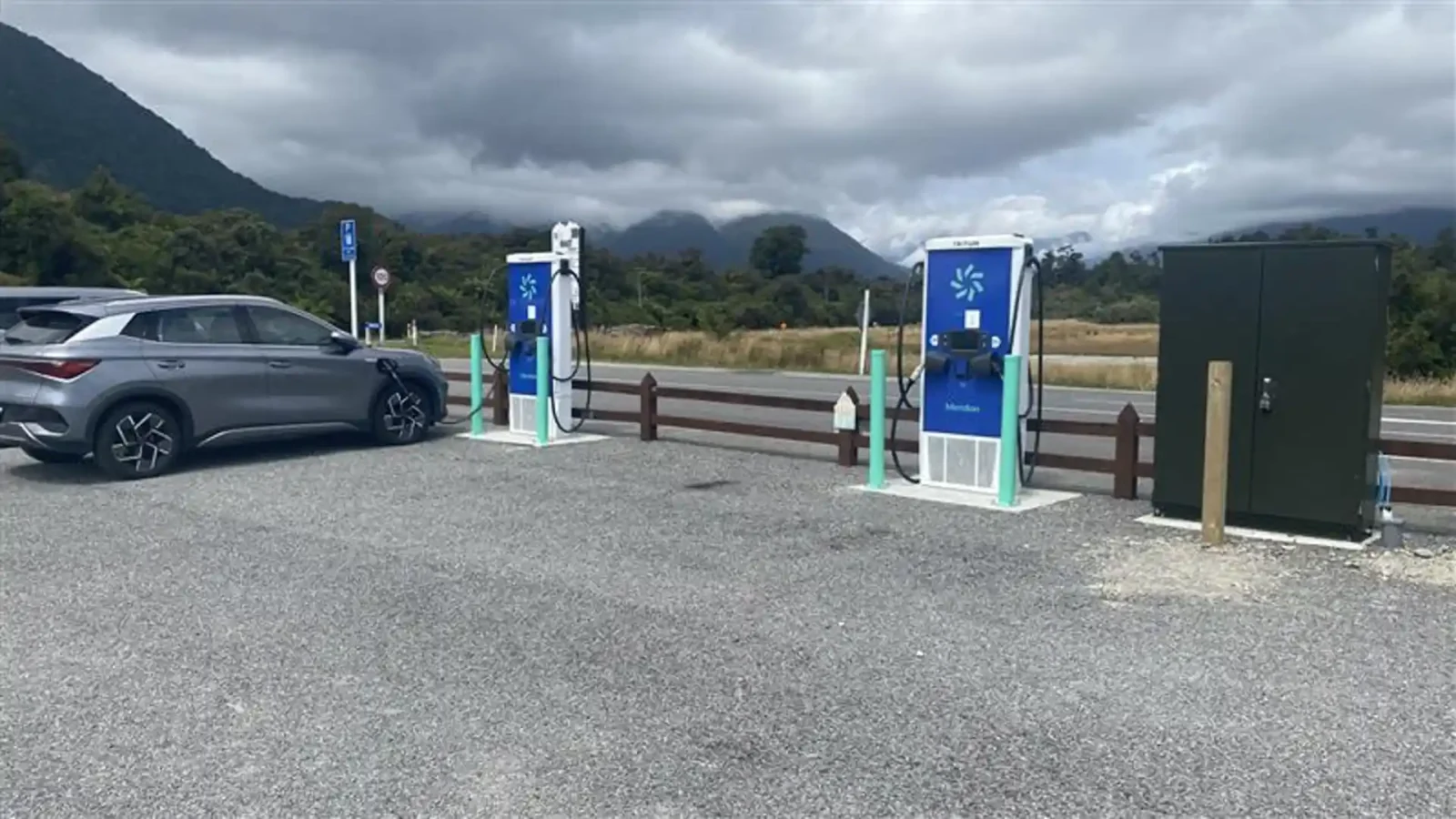
New Zealand is stepping up its transition to clean transportation with a major investment aimed at expanding the country’s electric vehicle charging network. The government has announced $52.7 million in zero-interest loans to support the installation of thousands of new public EV charging stations across the country.
The initiative is designed to remove one of the biggest barriers to electric vehicle adoption: limited charging infrastructure. By significantly expanding access to chargers, the government hopes to encourage more drivers to switch from petrol-powered vehicles to electric alternatives.
The loans will support the rollout of 2,574 new charging points, more than doubling the country’s existing network and marking one of the largest investments in EV infrastructure in New Zealand to date.
Transport Minister Chris Bishop and Energy and Climate Change Minister Simon Watts announced the plan, highlighting its role in accelerating the country’s energy transition while supporting economic efficiency and emissions reductions.
The financing will go to two major energy and infrastructure companies—ChargeNet and Meridian Energy—which together will co-invest $60 million in private capital alongside the government-backed loans.
Combined, the public and private investments will push the total funding for the charging expansion to over $110 million.
Markets move fast; don’t get left behind. We’ve paired the Serrari Group Market Index with a curated Marketplace and a comprehensive Wealth Builder Course to ensure you have the data—and the skills—to act on it.
Breaking the Infrastructure–Demand Deadlock
One of the core challenges in EV adoption is a classic infrastructure dilemma: drivers hesitate to buy electric vehicles without sufficient charging stations, while investors hesitate to build charging stations without enough EV drivers.
According to Bishop, the government’s concessionary loan program is designed specifically to break this cycle.
“The private sector is reluctant to invest in charging infrastructure until there’s sufficient demand,” Bishop said. “But demand won’t grow until the lack of public chargers stops putting buyers off.”
The loan structure lowers the cost of capital for companies installing charging infrastructure while minimizing the financial burden on taxpayers.
On average, each loan will amount to around NZ$20,000 per charging station, covering up to half of installation costs. Because the loans will eventually be repaid, the net cost to the government is estimated at about NZ$10,000 per charger—roughly a quarter of what it would cost if the government provided direct grants instead.
This financing model enables the government to leverage private capital while ensuring the rapid expansion of national infrastructure.
Thousands of Chargers Planned Across the Country
The expansion will add 2,574 new charging points nationwide, representing a significant increase in New Zealand’s EV infrastructure capacity.
Of these installations:
- 1,374 chargers will be DC fast chargers
- 1,200 chargers will be AC chargers
Each type of charger serves different purposes within the EV ecosystem.
DC fast chargers deliver electricity directly to a vehicle’s battery and can typically recharge an EV in 20 to 60 minutes, making them ideal for highways, travel corridors, and locations where drivers stop briefly.
AC chargers operate at slower speeds but are better suited to locations where vehicles remain parked for longer periods, such as workplaces, shopping centres, and residential areas.
By combining both technologies, the charging network will support a range of everyday driving needs—from long-distance travel to daily commuting.
Charging Network to Expand Beyond Major Cities
The government also emphasized that the new charging stations will not be concentrated solely in major urban areas.
About half of the chargers will be installed in the country’s largest metropolitan regions, including:
- Auckland
- Hamilton
- Tauranga
- Wellington
- Christchurch
- Dunedin
The remaining chargers will be distributed across regional communities, ensuring that drivers outside the country’s major cities can also benefit from improved charging access.
This regional expansion is particularly important for rural drivers who often travel longer distances and rely heavily on personal vehicles.
Improving access to charging infrastructure across the country will help ensure that the transition to electric mobility is inclusive and accessible to all communities.
Public Charging Network Set to More Than Double
New Zealand currently has just over 1,800 public charging points, a figure that places the country among the lowest charger-to-EV ratios in the Organisation for Economic Co-operation and Development.
However, the new investment is expected to dramatically improve that situation.
An additional 161 charging points are already under development, and when combined with the newly funded installations, the national total will reach approximately 4,550 public chargers.
This expansion represents a major step toward the government’s long-term target of 10,000 public charging points by 2030.
If achieved, the target would create a national ratio of roughly one charger for every 40 electric vehicles, significantly improving accessibility and convenience for EV owners.
Context is everything. While you follow today’s updates, use the Serrari Group Market Index and Marketplace to spot emerging shifts. Need to sharpen your edge? Our Wealth Builder Course turns these insights into a professional-grade strategy.
Planning Reforms to Accelerate Charger Deployment
Alongside the financing program, the government is introducing regulatory changes aimed at speeding up the installation of charging infrastructure.
Under new planning rules, public EV charging stations will become a permitted activity under the Resource Management Act, meaning developers will generally no longer need to obtain resource consent before installing chargers.
This change is expected to significantly reduce delays and administrative costs associated with infrastructure development.
By simplifying the approval process, the government hopes to accelerate the pace at which charging stations are deployed nationwide.
The loan program itself will be administered by the National Infrastructure Funding and Financing, a government agency responsible for financing strategic infrastructure projects.
Rising EV Demand Driven by Energy Costs
The charging network expansion comes at a time when interest in electric vehicles is increasing across New Zealand.
Recent data suggests that EV adoption is steadily gaining momentum, driven by both environmental awareness and rising fuel costs.
In February 2026, electric vehicle sales were 10.5 percent higher than in the same month the previous year, according to government figures.
Bishop noted that interest in EVs has increased further in recent weeks as geopolitical tensions in the Middle East have contributed to rising global oil prices.
Higher fuel costs are prompting many consumers to reconsider the economics of petrol-powered vehicles.
Electric vehicles, by contrast, often offer significantly lower operating costs because electricity is cheaper than petrol.
Renewable Electricity Strengthens EV Benefits
Another factor supporting the EV transition in New Zealand is the country’s energy mix.
According to Energy and Climate Change Minister Simon Watts, New Zealand’s electricity supply is already dominated by renewable sources.
Much of the country’s electricity is generated from hydropower, geothermal energy, wind, and solar power, making electric vehicles particularly effective in reducing emissions.
Because the electricity powering EVs is largely renewable, switching from petrol to electric vehicles significantly lowers overall carbon emissions.
Watts noted that electric vehicles produce at least 60 percent fewer lifecycle emissions than conventional petrol vehicles, making them a key tool in reducing the country’s transport-related carbon footprint.
In addition to climate benefits, EVs can also reduce household fuel expenses, making them increasingly attractive as a cost-of-living solution.
Public–Private Collaboration Drives Infrastructure Growth
The government’s financing model reflects a broader trend in infrastructure development: leveraging public funds to attract larger private-sector investment.
By providing concessionary loans rather than direct grants, the government is able to stimulate investment while maintaining fiscal responsibility.
Companies like ChargeNet and Meridian Energy play a crucial role in this model, contributing capital and operational expertise to build and manage the charging network.
Public–private partnerships are increasingly being used worldwide to finance infrastructure for the clean energy transition, particularly in sectors such as renewable power, electric mobility, and energy storage.
In the case of New Zealand’s EV charging expansion, the collaboration between government and industry is expected to deliver a nationwide network capable of supporting rapid EV adoption.
Outlook: Building the Foundations of an Electric Transport Future
New Zealand’s investment in EV charging infrastructure marks a critical step toward building a cleaner and more resilient transportation system.
As electric vehicle adoption grows, the availability of reliable and convenient charging infrastructure will become increasingly important. Expanding the national network not only supports current EV drivers but also encourages more consumers to consider switching to electric vehicles.
The government’s target of 10,000 public chargers by 2030 reflects the scale of ambition required to support a fully electrified transport sector.
If achieved, the goal would place New Zealand among the countries with the most comprehensive EV charging networks relative to population.
At the same time, the initiative highlights the role of strategic public investment in accelerating the energy transition. By reducing financial barriers and enabling private-sector participation, governments can help scale the infrastructure needed for a low-carbon future.
As global fuel markets remain volatile and climate targets grow more urgent, investments in electric mobility infrastructure are likely to become increasingly central to national energy strategies.
For New Zealand, expanding its EV charging network represents more than a technological upgrade—it is a foundational step toward a cleaner, more sustainable transport system that benefits both the environment and the economy.
Your financial future isn’t something you wait for—it’s something you build.
The real question is: when do you begin?
Move beyond simply staying informed.
Navigate the markets with clarity—track trends through the Serrari Group Market Index, uncover opportunities in the Serrari Marketplace, and build practical knowledge with our Curated Wealth Builder Course.
Stay connected to what truly matters.
Get daily insights on macro trends and financial movements across Kenya, Africa, and global markets—delivered through the Serrari Newsletter.
Growth opens doors.
Advance your career through professional programs including ACCA, HESI A2, ATI TEAS 7 , HESI EXIT , NCLEX – RN and NCLEX – PN, Financial Literacy!🌟—designed to move you forward with confidence.
See where money is flowing—clearly and in real time.
Track Money Market Funds, Treasury Bills, Treasury Bonds, Green Bonds, and Fixed Deposits, alongside global and African indexes, key economic indicators, and the evolving Crypto and stablecoin landscape—all within Serrari’s Market Index.