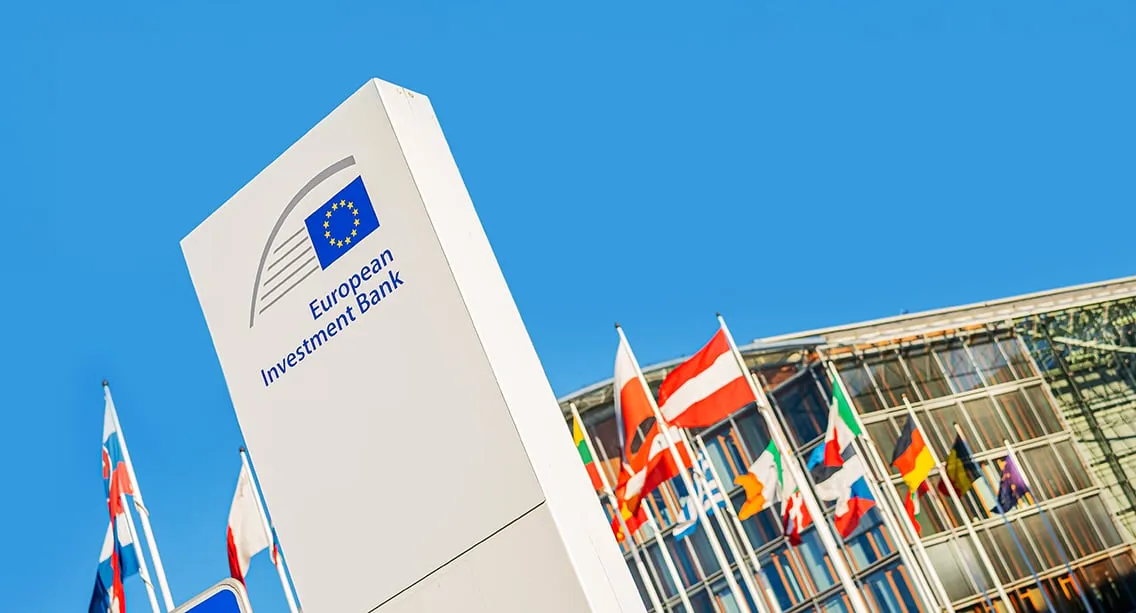
Europe’s development finance arm closed 2025 with one of its most active years on the African continent, deploying €3.1 billion across Africa — a figure representing roughly one-third of the more than €9 billion channelled globally through EIB Global, the European Investment Bank’s international partnerships division. The scale of the commitment reflects a deliberate strategic push by the EU-owned institution to deepen its footprint across African markets at a time when the continent is increasingly seen as both a development priority and a long-term infrastructure investment opportunity.
The announcement confirms Africa’s growing weight within the EIB Group’s global portfolio. Key sectors included support for small and medium-sized enterprises through credit lines to local financial institutions, investments in venture capital funds, sustainable energy, transport infrastructure, water, and health — a diversified spread that underscores the bank’s intent to move beyond infrastructure megaprojects and into the productive core of African economies.
Build the future you deserve. Get started with our top-tier Online courses: ACCA, HESI A2, ATI TEAS 7, HESI EXIT, NCLEX-RN, NCLEX-PN, and Financial Literacy. Let Serrari Ed guide your path to success. Enroll today.
Climate Finance at the Centre
Nearly 46% of EIB Global’s Africa financing in 2025 was directed toward climate action and environmental sustainability, placing it among the highest climate-aligned shares of any major multilateral development bank’s Africa programme. This reflects both the EU’s broader policy commitments under the Global Gateway initiative and the growing recognition that infrastructure investment in Africa must be designed to withstand the accelerating effects of climate change — from water stress to extreme weather to the energy transition.
The top beneficiary countries in 2025 were Morocco, Nigeria, Mauritania, Egypt, and Malawi, with additional financing reaching smaller and often overlooked markets including The Gambia, São Tomé and Príncipe, and Cabo Verde. The inclusion of small island and coastal states signals the EIB’s recognition that vulnerability to climate change does not track neatly with country size or economic weight.
“As the financing arm of the European Union, owned by its 27 member states, we are making a difference where it matters most: in high-impact projects that people can feel on the ground and that communities across Africa can rely on,” said EIB Group President Nadia Calviño.
Sub-Saharan Africa: From Cocoa to Rural Power
Across sub-Saharan Africa, EIB Global’s 2025 project portfolio ranged from agricultural value chain development to marine economy investment, reflecting a strategy that integrates economic productivity with environmental resilience.
Flagship projects in Mauritania and Cabo Verde focused on the blue economy — an emerging sector that encompasses sustainable fishing, maritime logistics, and ocean-based renewable energy. In Côte d’Ivoire, the bank reinforced the cocoa sector, which remains the backbone of the country’s agricultural economy. In Sierra Leone and Guinea, EIB Global backed agricultural value chains with targeted support for SME development, gender equality, and youth employment, addressing the structural barriers that have historically limited smallholder productivity and market access.
In Cameroon, the EIB’s rural electrification programme is expected to improve electricity access for more than 1.6 million people across communities that have long been excluded from national grid coverage. The project represents one of the largest electricity access interventions by a European development institution in Central Africa and aligns with the continent-wide push to close the energy access gap ahead of international climate and development targets.
Health: Vaccines, Guarantees, and a Continental Manufacturing Push
Perhaps the most strategically significant cluster of EIB activity in Africa in 2025 came in the health sector, where the bank moved beyond traditional hospital and clinic financing into the more complex terrain of pharmaceutical manufacturing, immunisation campaigns, and supply chain guarantees.
EIB Global signed a guarantee agreement with MedAccess to expand access to essential medical supplies — including vaccines, diagnostics, medical devices, and nutritional products — across sub-Saharan Africa. The mechanism works by providing MedAccess with a counter-guarantee covering up to 30% of losses it may incur on volume guarantees, effectively de-risking commitments made to manufacturers and encouraging them to serve markets they would otherwise find commercially unattractive.
The MedAccess guarantee falls under the Human Development Accelerator (HDX), a joint programme involving the European Commission, the EIB, and the Gates Foundation, and one of the first operations to be launched under this framework. The HDX model represents an innovation in development finance: rather than simply funding individual health projects, it uses blended finance mechanisms to reshape market incentives and crowd in private investment into underserved health markets.
On vaccine manufacturing, the EIB deepened a pivotal collaboration with BioNTech, the German biotechnology company behind one of the world’s leading mRNA vaccine platforms. The bank and the European Commission provided up to €95 million in blended financing — comprising a €35 million milestone-based grant and a credit facility of up to €60 million — to advance BioNTech’s mRNA vaccine manufacturing facility in Kigali, Rwanda. If successfully operationalised, the Kigali site would become the first commercial mRNA vaccine manufacturing facility on the African continent, strengthening the region’s pandemic preparedness and reducing its dependence on imported vaccines. The bank also continued to support BioNTech’s manufacturing initiatives in Senegal and Ghana, which form part of a broader pan-African local production strategy.
In Angola, EIB Global helped finance the country’s first national vaccination campaign to immunise more than two million girls against cervical cancer — a disease that kills an estimated 67,000 women annually across Africa and disproportionately affects countries with limited screening and healthcare infrastructure.
North Africa: Water Security and Industrial Decarbonisation
In Morocco, EIB Global directed financing toward climate-resilient drinking water infrastructure, with investments designed to improve equitable access to potable water in smaller cities and rural areas that have historically been underserved by national water utilities. The bank also backed post-earthquake reconstruction — a large-scale programme focused on the rehabilitation of schools, hospitals, roads, and essential infrastructure, integrating climate-resilient design and energy efficiency standards into rebuilding programmes affected by the devastating 2023 seismic event.
In Egypt, the EIB’s 2025 portfolio included a €21 million EU grant to advance industrial decarbonisation and enhance recycling capacity — part of Egypt’s broader green transition agenda. The bank also backed the Obelisk project, described as the largest solar photovoltaic and battery storage facility in Africa, and invested in the RMBV North Africa Fund III to stimulate private-sector growth in the region.
One decision can change your entire career. Take that step with our Online courses in ACCA, HESI A2, ATI TEAS 7, HESI EXIT, NCLEX-RN, NCLEX-PN, and Financial Literacy. Join Serrari Ed and start building your brighter future today.
Venture Capital and the Innovation Economy
Beyond infrastructure and health, EIB Global has been methodically building out Africa’s venture capital ecosystem — a market long under-resourced relative to the continent’s entrepreneurial talent base.
In 2025, the bank committed more than €350 million to new investment funds, including vehicles managed by Amethis and Ardian, two asset managers with established Africa strategies. These fund commitments serve a dual purpose: directly deploying capital into high-growth businesses, and building the institutional infrastructure of an active private equity and venture capital market on the continent.
Through the Boost Africa initiative, EIB Global supported the Africa Venture Finance Programme, hosted at Oxford University’s Saïd Business School. In 2025, more than 40 Africa-based venture capital fund managers participated in the programme, which focuses on unlocking investment into innovative companies, youth-led businesses, and female entrepreneurs — segments of the economy with enormous potential but limited access to institutional capital.
Over the past four years, EIB investments have mobilised €73 billion across Africa — a cumulative figure that includes both direct EIB financing and private capital crowded in by the bank’s guarantees, technical assistance, and risk-sharing instruments.
Global Gateway: A Target Reached Two Years Early
A central pillar of the EU’s geopolitical and economic strategy in Africa has been the Global Gateway initiative, unveiled in 2022 as Europe’s answer to infrastructure investment programmes launched by China and the United States in the developing world. In 2025, EIB Global reached the €100 billion investment mobilisation target set under Global Gateway — achieving the goal two full years ahead of the 2027 deadline. Three-quarters of the bank’s investments outside the EU in 2025 supported Global Gateway projects, mobilising more than €20 billion in the year alone.
The milestone is significant not only as a financial achievement but as a signal of institutional credibility. Development finance targets are frequently announced with fanfare but missed due to bureaucratic constraints, political headwinds, and the sheer complexity of deploying capital in frontier markets. Reaching €100 billion ahead of schedule positions the EIB as one of the most operationally effective multilateral institutions in implementing the EU’s strategic agenda in Africa.
Reducing Risk, Mobilising Private Capital
One of the more structural contributions of EIB Global’s Africa work involves improving the quality of risk information available to private investors — a constraint that has long been cited as one of the principal barriers to institutional capital flows into African markets.
The EIB works with the World Bank Group to co-lead the Global Emerging Markets Risk Database (GEMs), a consortium of 29 multilateral development banks and development finance institutions that pools four decades of investment experience in emerging economies. GEMs provides comprehensive credit risk data on default and recovery rates, offering institutional investors evidence-based insight into the actual risk profile of emerging market investments — rather than the perception of risk that has historically driven excessive risk premiums and capital avoidance.
By anchoring investment decisions in evidence rather than assumption, the GEMs database serves a quiet but transformative function in the development finance ecosystem: making it easier for pension funds, insurance companies, and other long-term institutional investors to allocate capital to African infrastructure, health, and technology projects.
A Signal to Private Markets
The EIB’s 2025 Africa results arrive at a moment of renewed competition among multilateral lenders and bilateral investors for influence and impact on the continent. China’s Belt and Road Initiative has matured and in some cases generated debt management challenges for African borrowers. The United States has scaled up its own development finance tools through the DFC. Japan, the Gulf states, and India are all deepening engagement with African economies.
Against this backdrop, EIB Global’s combination of climate-aligned investment, health system financing, venture capital development, and private capital mobilisation tools represents a distinctive model — one that prioritises concessional and blended finance over bilateral lending and ties investment explicitly to EU policy objectives around sustainability, governance, and market development.
Whether the €3.1 billion committed in 2025 translates into the transformative impact the bank projects will ultimately depend on execution — on whether roads get built, vaccines get manufactured, and SMEs access the credit lines that have been signed. But the breadth and ambition of the 2025 portfolio suggests an institution that is genuinely scaling up its African engagement, not simply meeting a target on paper.
Ready to take your career to the next level? Join our Online courses: ACCA, HESI A2, ATI TEAS 7 , HESI EXIT , NCLEX – RN and NCLEX – PN, Financial Literacy!🌟 Dive into a world of opportunities and empower yourself for success. Explore more at Serrari Ed and start your exciting journey today! ✨
Track GDP, Inflation and Central Bank rates for top African markets with Serrari’s comparator tool.
See today’s Treasury bonds and Money market funds movement across financial service providers in Kenya, using Serrari’s comparator tools.
photo source: Google
By: Montel Kamau
Serrari Financial Analyst
2nd March, 2026