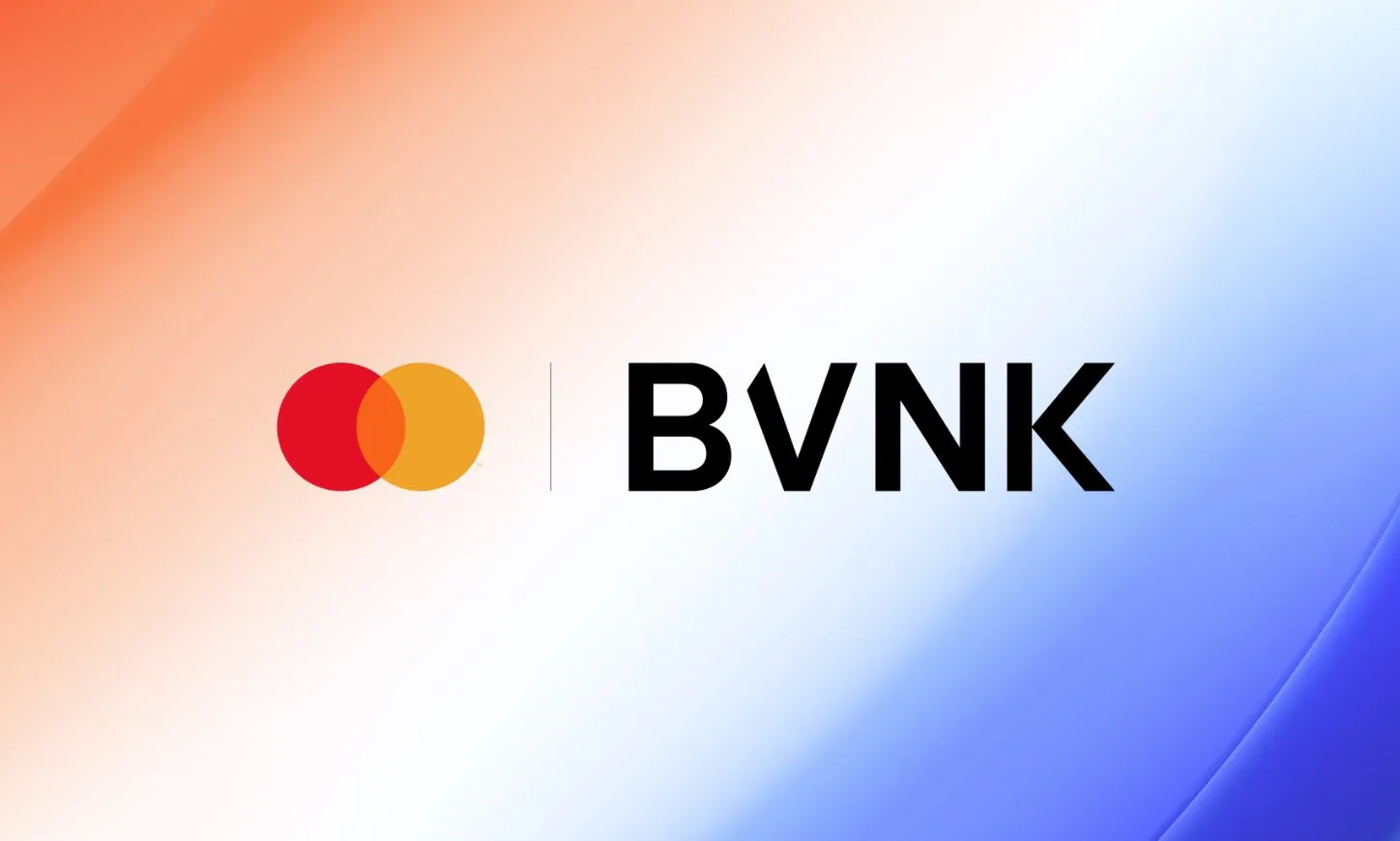
Mastercard has agreed to acquire London-based stablecoin infrastructure firm BVNK for up to $1.8 billion, making it the first major publicly listed traditional payments company to use a direct acquisition to enter the stablecoin infrastructure space. The deal, expected to close in late 2026, follows a wave of stablecoin-related M&A activity and comes as global stablecoin transfer volumes surpassed the combined payment volumes of both Visa and Mastercard in 2025. The acquisition signals a structural, strategic shift in how legacy financial institutions are responding to the rapid rise of blockchain-based payment rails.
Key Overview
- Acquirer: Mastercard Inc.
- Target: BVNK Services Ltd.
- Deal Value: Up to $1.8 billion ($1.5B upfront + $300M earnout)
- Expected Close: Late 2026
- BVNK Founded: 2021
- Countries Served: 130+
- 2025 Payment Volume: $30 billion (annualised)
- BVNK Revenue (2024): ~$40 million
- Total Funding Raised: $90 million+
- MiCA Licence: Secured in Malta, February 2026
The Deal That Is Reshaping Payments
There are moments in financial history when a single transaction reveals, more than any analyst report could, the true direction of an entire industry. Mastercard’s agreement to acquire BVNK — a London-based stablecoin infrastructure company — for up to $1.8 billion is one of those moments.
On the surface, it reads like another corporate acquisition. Dig deeper, and it is a formal declaration from one of the world’s most powerful payments networks that stablecoins are no longer a peripheral experiment. They are becoming foundational infrastructure — and the race to own that infrastructure has officially begun.
The deal structure itself is telling. Mastercard will pay $1.5 billion upfront, with an additional $300 million tied to performance milestones. For context, BVNK generated approximately $40 million in revenue as of late 2024. That puts the acquisition multiple at a staggering 37x revenue — a premium that has less to do with today’s earnings and everything to do with tomorrow’s architecture. Mastercard is not buying a profitable business. It is buying a position in the future of global payments.
Markets move fast; don’t get left behind. We’ve paired the Serrari Group Market Index with a curated Marketplace and a comprehensive Wealth Builder Course to ensure you have the data—and the skills—to act on it.
Historical Context: How We Got Here
To understand why this deal matters so profoundly, it helps to trace the arc of digital payments innovation and the slow, then sudden, rise of stablecoins as a serious financial instrument.
For decades, cross-border payments operated on infrastructure built in a pre-internet era. The SWIFT network, established in 1973, became the backbone of international bank-to-bank messaging. It was reliable but slow, costly, and opaque — a system designed for a world of telex machines and business-day clearing windows. A wire transfer from Nairobi to New York could take three to five business days and cost anywhere between 5% and 10% of the transaction value in fees.
The arrival of fintech platforms in the 2010s — TransferWise (now Wise), Remitly, WorldRemit — began chipping away at those fees, but they were largely working within the same underlying banking rails. They improved the user experience without fundamentally rewriting the plumbing.
Bitcoin, launched in 2009, introduced the concept of moving value across borders without a central intermediary. But its extreme price volatility made it impractical as a payment instrument. You cannot price a shipment of goods in an asset whose value can swing 20% in a single day.
Stablecoins solved that problem. By pegging their value to a fiat currency — most commonly the US dollar — stablecoins offered the programmability and borderlessness of blockchain technology without the volatility risk. Tether (USDT), launched in 2014, was the first major stablecoin. USD Coin (USDC), backed by Circle and Coinbase, followed in 2018 with a stronger regulatory posture and greater institutional appeal.
By the early 2020s, stablecoins were no longer just a crypto-adjacent curiosity. They were being used for real economic activity: remittances in Latin America, treasury management by global enterprises, cross-border payouts to freelancers and gig workers in emerging markets. The infrastructure to support that activity — the on-ramps, off-ramps, custody rails, and compliance tooling — was where the real opportunity lay. That is the gap BVNK was built to fill.
Founded in 2021, BVNK positioned itself as the enterprise-grade plumbing layer for stablecoin payments. Unlike crypto exchanges, which serve retail investors, BVNK’s customers are fintechs, payment service providers, and large enterprises. Its client roster includes Worldpay, Deel, Rapyd, and Flywire — companies that collectively process billions in payments annually. BVNK gave them a way to send, receive, store, and convert stablecoins across more than 130 countries, with institutional-grade compliance and treasury tools.
The Numbers That Forced Mastercard’s Hand
The decision to acquire rather than build was almost certainly driven by one set of numbers above all others: $27.6 trillion.
That was the total stablecoin transfer volume recorded in 2025. To put that figure in perspective, it exceeded the combined payment volume of both Visa and Mastercard for the same period. This was not a forecast or a projection. It was a realised figure — a data point that could not be dismissed as hype.
BVNK alone processed more than $30 billion of that volume in 2025, up from $20 billion as recently as October of the same year. That 50% growth in under three months signals something important: the adoption curve is steepening, not flattening. Enterprises that had been cautiously piloting stablecoin rails were scaling them.
Against that backdrop, Mastercard’s willingness to pay a 37x revenue multiple begins to look less like aggression and more like pragmatism. Every month of delay is a month in which competitors embed themselves more deeply into the infrastructure that enterprises will rely on for the next decade.
A Crowded Race: Competitors Are Not Standing Still
Mastercard is not operating in a vacuum. The stablecoin infrastructure market has attracted every significant player in the payments ecosystem, and the competitive dynamics are moving fast.
Stripe’s acquisition of Bridge — a stablecoin payment rails company — for $1.1 billion was a significant early move. Bridge offered similar on/off-ramp and treasury capabilities to BVNK, and Stripe’s purchase confirmed that the infrastructure layer, not just the consumer interface, was where value would accrue.
On the same day Mastercard announced the BVNK deal, PayPal disclosed an expansion of its stablecoin payment capabilities to 70 countries. PayPal had launched its own stablecoin, PYUSD, in 2023 — a move that was initially met with scepticism but is beginning to find genuine traction as enterprise use cases for programmable dollars expand.
According to S&P Global Market Intelligence, at least 14 stablecoin-related transactions were announced across 2025 alone. The sector has moved from niche to contest in the space of roughly 24 months. The question for incumbents is no longer whether to engage with stablecoin infrastructure but how quickly they can acquire the capabilities to compete.
Interestingly, Coinbase — itself a potential acquirer of BVNK at a reported valuation of up to $2.5 billion — withdrew from talks before the Mastercard deal was struck. Coinbase’s retreat may reflect a strategic choice to build rather than buy, or it may reflect a valuation disagreement. Either way, the fact that both a traditional payments giant and a crypto-native exchange were bidding for the same asset illustrates the convergence underway between legacy finance and the blockchain ecosystem.
Visa, notably, had been an earlier investor in BVNK — a detail that underscores how closely the payments industry has been watching this company’s growth.
Context is everything. While you follow today’s updates, use the Serrari Group Market Index and Marketplace to spot emerging shifts. Need to sharpen your edge? Our Wealth Builder Course turns these insights into a professional-grade strategy.
Why This Matters: The Strategic Significance for Global Finance
The BVNK acquisition is significant for reasons that extend well beyond a single deal announcement.
First, it validates stablecoins as infrastructure, not speculation. For years, stablecoins occupied an ambiguous regulatory and reputational space — associated with crypto trading, DeFi protocols, and occasionally with financial crime. The fact that Mastercard — a company with a $470 billion market capitalisation, 210 million merchant relationships, and decades of regulatory credibility — is willing to pay $1.8 billion for stablecoin infrastructure is a powerful signal to regulators, institutional investors, and enterprise finance teams everywhere that this technology has crossed the threshold from experiment to essential.
Second, it positions Mastercard to monetise the next generation of payment flows. Traditional card networks earn revenue through interchange fees — a percentage of each transaction that passes through their rails. But stablecoin payments, particularly in B2B and cross-border contexts, often bypass card rails entirely. If enterprises increasingly settle invoices, manage treasury, and pay suppliers in USDC or USDT, Mastercard’s card-centric revenue model faces structural pressure. Acquiring BVNK is a hedge against that pressure — a way to ensure Mastercard earns revenue from the new rails, not just the old ones.
Third, BVNK’s regulatory positioning adds material value. In February 2026, BVNK secured a MiCA licence in Malta, allowing it to offer regulated digital asset services across the entire European Union. MiCA — the Markets in Crypto-Assets regulation — is among the most comprehensive stablecoin regulatory frameworks in the world, and a MiCA licence is an asset that cannot be easily replicated. BVNK described its European stack as integrating MiCA-regulated crypto services, EMI-regulated euro payments, and direct access to SEPA infrastructure. For Mastercard, acquiring a MiCA-licensed entity accelerates its path to compliant stablecoin operations across 27 European member states by years.
Fourth, the deal has implications for financial inclusion. BVNK’s capabilities are particularly valuable in corridors where traditional banking infrastructure is thin. Cross-border remittances, B2B supplier payments, and freelancer payouts in emerging markets are use cases where stablecoin rails demonstrably outperform legacy systems on cost and speed. Mastercard’s global distribution, combined with BVNK’s stablecoin infrastructure, could extend financial access to businesses and individuals who are currently underserved by correspondent banking networks.
Risks to Consider
No acquisition of this scale is without meaningful risk, and investors and observers should weigh several considerations carefully.
Regulatory uncertainty remains a live variable. While MiCA provides a framework for Europe, the global regulatory picture for stablecoins is far from settled. The United States, which is the largest single market for dollar-denominated stablecoins, had not passed comprehensive stablecoin legislation as of the announcement. Regulatory changes — particularly those governing reserve requirements, issuer licensing, or permissible use cases — could materially affect BVNK’s business model and the value Mastercard derives from the acquisition.
Integration complexity is substantial. BVNK is a crypto-native firm founded in 2021, operating on technology infrastructure that is architecturally very different from Mastercard’s decades-old card network. Integrating two organisations with different cultures, technology stacks, and operational philosophies within a target timeline is a genuinely difficult exercise. Large financial institution acquisitions of fintech companies have a mixed track record on this dimension.
The earnout structure introduces performance risk. The $300 million in contingent payments tied to performance milestones creates alignment incentives but also introduces complexity. If BVNK’s growth trajectory is disrupted — by competitive pressure, regulatory changes, or integration friction — the earnout targets may not be met, and the deal’s strategic rationale may come under scrutiny.
Concentration risk in stablecoin markets. A substantial portion of stablecoin activity is denominated in a small number of assets, predominantly USDT and USDC. Any crisis of confidence in a major stablecoin — as occurred with TerraUSD in 2022, which collapsed from a $40 billion market capitalization to near zero in under a week — could have cascading effects on the infrastructure providers that facilitate those payments.
Challenges Ahead
Beyond the risks, there are operational and structural challenges that will shape how successfully Mastercard extracts value from this acquisition.
Talent retention is a critical near-term challenge. BVNK’s value is largely embedded in its engineering team and its leadership. Crypto-native talent is highly mobile, and the cultural shift from a fast-moving startup to a large corporation is a known attrition trigger. Mastercard will need to structure its retention arrangements carefully.
Competition from native crypto infrastructure will intensify. Companies like Circle, the issuer of USDC, are building their own payment rails directly. Circle’s IPO ambitions signal an intent to expand beyond stablecoin issuance into the broader payments stack. Mastercard will face competition not just from traditional payment incumbents but from crypto-native players who understand the stablecoin ecosystem at a foundational level.
Interoperability remains an unsolved problem. The stablecoin ecosystem is fragmented across multiple blockchains — Ethereum, Solana, Base, Tron, and others — with limited seamless movement between them. Building infrastructure that works reliably across this fragmented landscape, at enterprise scale and with the compliance requirements that Mastercard’s clients demand, is a significant technical and operational undertaking.
Looking Ahead: The Future of Stablecoin Payments
The incremental opportunities ahead are substantial. Cross-border remittances represent a market currently worth over $800 billion annually, with fee extraction by legacy intermediaries widely regarded as excessive. Stablecoin rails have already demonstrated the ability to reduce transfer costs by 80% or more in certain corridors. As regulatory frameworks mature and enterprise adoption scales, that market is likely to shift substantially toward blockchain-based infrastructure.
B2B payments represent an even larger opportunity. Global B2B payment flows exceed $120 trillion annually. A meaningful portion of that volume involves slow, costly international settlements — exactly the use case where stablecoin rails offer the most compelling improvement over the status quo.
Tokenised deposits — bank deposits represented as digital tokens on a blockchain — are a closely related technology that several central banks and commercial banks are actively developing. The infrastructure BVNK has built for stablecoin payments shares significant architectural overlap with what will be needed to support tokenised deposit flows. Mastercard’s acquisition positions it to serve both markets.
The broader trend is one of convergence. The line between traditional financial infrastructure and crypto-native infrastructure is dissolving — not because crypto has displaced traditional finance, but because the most capable institutions on both sides are building toward the same destination: programmable, borderless, always-on payment rails that operate at internet speed and internet cost.
Mastercard’s acquisition of BVNK is the most direct expression yet of that convergence from the traditional finance side. It will not be the last. As the stablecoin market continues to scale — and with $27.6 trillion in 2025 transfer volume already surpassing the card networks’ combined throughput, there is little reason to expect the growth trajectory to reverse — the pressure on every incumbent payments player to secure a position in this infrastructure will only intensify.
The question is no longer whether stablecoins will matter. The question is who will own the rails when they do.
Your financial future isn’t something you wait for, it’s something you build.
The real question is: when do you begin?
Move beyond simply staying informed.
Navigate the markets with clarity—track trends through the Serrari Group Market Index, uncover opportunities in the Serrari Marketplace, and build practical knowledge with our Curated Wealth Builder Course.
Stay connected to what truly matters.
Get daily insights on macro trends and financial movements across Kenya, Africa, and global markets—delivered through the Serrari Newsletter.
Growth opens doors.
Advance your career through professional programs includingACCA,HESI A2,ATI TEAS 7,HESI EXIT ,NCLEX – RNandNCLEX – PN,Financial Literacy!🌟—designed to move you forward with confidence.
See where money is flowing—clearly and in real time.
Track Money Market Funds, Treasury Bills, Treasury Bonds, Green Bonds, and Fixed Deposits, alongside global and African indexes, key economic indicators, and the evolving Crypto and stablecoin landscape—all within Serrari’s Market Index.