Key Overview
- Ethiopia secured $13.1 billion in investment commitments at the Invest in Ethiopia 2026 Forum held on 26–27 March in Addis Ababa — an eightfold increase over the $1.6 billion signed at the 2025 edition.
- Ming Yang Smart Energy Group, a Chinese renewable energy firm, accounted for the single largest commitment at over $10 billion, focused on green ammonia, hydrogen, and renewable energy infrastructure.
- Other major deals include a $2 billion special economic zone by Global Future Investment, $500 million in steel and pharmaceutical plants by Liaoning Fangda Group, and $150 million in off-grid solar by Sun King.
- The forum drew over 800 participants from more than 50 countries, with investors from China, Poland, India, Singapore, and Kenya signing agreements across manufacturing, energy, mining, agriculture, and real estate.
- Ethiopia’s sweeping economic reforms since July 2024 — including floating the birr, liberalising foreign exchange, and opening financial services — underpin the surge in investor confidence, backed by a $3.4 billion IMF programme.
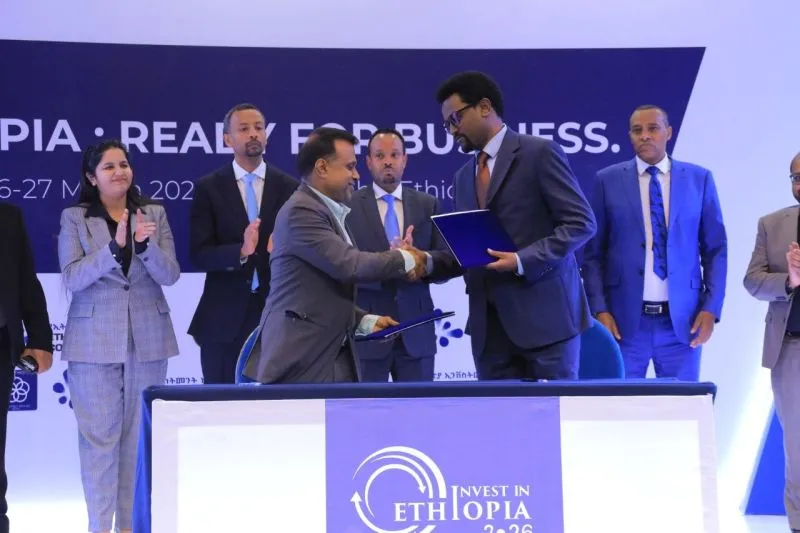
Ethiopia has emerged from a high-profile investment forum with a staggering $13.1 billion in signed commitments — a figure that dwarfs the $1.6 billion secured at the same event just a year ago and marks one of the largest single rounds of investment pledges in the country’s recent history. The deals, inked at the Invest in Ethiopia 2026 Forum held on 26–27 March at the Skylight Hotel in Addis Ababa, span manufacturing, agriculture, energy, construction, mining, and real estate, reflecting broad international confidence in a country still navigating the aftershocks of historic macroeconomic reforms.
The announcement was confirmed by the Ethiopian Investment Commission (EIC) and reported by Reuters from Nairobi on Sunday, with Bloomberg noting that the companies represented investors from China, Poland, India, Singapore, and Kenya who converged in the capital to sign agreements across renewable energy, manufacturing, real estate, mining, and green ammonia.
Markets move fast; don’t get left behind. We’ve paired the Serrari Group Market Index with a curated Marketplace and a comprehensive Wealth Builder Course to ensure you have the data—and the skills—to act on it.
A Forum Designed for Outcomes
The two-day event, themed “Ethiopia: Ready for Business,” drew more than 800 participants from over 50 countries, including investors, policymakers, business leaders, and development partners. It featured policy discussions, sector-specific sessions, business-to-business matchmaking, and a high-level signing ceremony where the headline deals were formalised.
Ethiopian Investment Commissioner Zeleke Temesgen and Deputy Prime Minister Temesgen Tiruneh addressed delegates, describing the gathering as a mechanism to transform national development ambitions into concrete, investable projects. According to the EIC, the newly signed projects are expected to create substantial employment, boost foreign exchange earnings, and facilitate technology transfer across industries the government has prioritised for industrialisation and export growth.
The result was an eightfold increase over the previous forum. Officials said projects from the 2025 edition worth $1.6 billion are now fully operational and contributing to national economic activity — a track record that likely helped bolster investor trust at this year’s event.
Ming Yang: The Anchor Commitment
The single largest commitment came from Ming Yang Smart Energy Group Limited, a Chinese company headquartered in Zhongshan, Guangdong, that ranks among the world’s leading offshore wind turbine manufacturers and has delivered more than 131 gigawatts of renewable energy capacity across over 40 countries. Ming Yang’s pledged projects in Ethiopia exceed $10 billion and focus on developing infrastructure in renewable energy, hydrogen production, and green ammonia, aligning with the company’s broader strategic push into integrated clean energy value chains.
The commitment is consistent with Ming Yang’s recent expansion into international markets. In 2025, the company signed a strategic cooperation framework agreement with Saudi Arabia’s ACWA Power centred on localised manufacturing, integrated energy, and joint development across the Middle East and Central Asia. Its technologies span wind, solar, energy storage, and hydrogen, and it has developed the world’s first 30-megawatt-class pure hydrogen gas turbine. Ethiopia’s abundant renewable energy potential — particularly in wind, solar, and geothermal — makes it a natural fit for the kind of large-scale integrated energy projects Ming Yang specialises in.
Beyond Energy: A Diverse Portfolio of Deals
While Ming Yang’s commitment dominated the headlines, several other significant agreements were signed across a range of sectors.
China’s Liaoning Fangda Group committed more than $500 million to establish steel and pharmaceutical manufacturing plants in Ethiopia, adding to a growing Chinese industrial presence in the country. Global Future Investment Limited pledged $2 billion to develop a special economic zone, a project that aligns with Ethiopia’s broader strategy of expanding industrial parks and export-oriented manufacturing hubs.
In the renewable energy space beyond Ming Yang, Gobez Electric Manufacturing announced plans for a $150 million expansion in solar cell production, while Sun King committed $150 million to install off-grid solar systems for homes and businesses over the next five years. Sun King, the world’s largest off-grid solar company, signed a memorandum of understanding with the EIC to formally enter the Ethiopian market, targeting two million households and businesses in what the company and the EIC described as “one of Africa’s most significant untapped solar markets.” The Kenya-headquartered firm, which already operates in 14 African countries and serves over 100 million people, plans to establish a local subsidiary and is positioning the Ethiopian investment as part of a broader $1.3 billion continental expansion plan through 2030.
Ethiopia’s case is distinctive: despite the country’s capacity to generate and export hydroelectric power — thanks largely to the Grand Ethiopian Renaissance Dam — large portions of its more than 120 million people remain beyond the reach of the national grid. Distributed solar solutions of the kind Sun King provides offer a faster, cheaper alternative to extending centralised transmission infrastructure into remote communities.
India’s Rashmi Group committed $235 million for mining and mineral processing, while Poland-based Quantum Everest pledged $100 million for real estate development — an indication that investor interest now extends well beyond the traditional energy and manufacturing sectors.
Context is everything. While you follow today’s updates, use the Serrari Group Market Index and Marketplace to spot emerging shifts. Need to sharpen your edge? Our Wealth Builder Course turns these insights into a professional-grade strategy.
Economic Reforms: The Catalyst Behind the Confidence
The scale of commitments would have been unthinkable just a few years ago. Ethiopia has undergone what analysts describe as its most dramatic economic reform programme in a generation, driven by a combination of domestic necessity and international pressure.
The centrepiece was the decision in July 2024 to float the Ethiopian birr, ending decades of state-controlled exchange rate management. In the first trading session after the announcement, the birr slumped by roughly 30 per cent against the US dollar, and continued to depreciate sharply in the days that followed. The move was a precondition for securing a four-year Extended Credit Facility worth $3.4 billion from the International Monetary Fund, part of a broader financing package exceeding $10 billion that included support from the World Bank and commitments from bilateral creditors.
The reforms went beyond the exchange rate. Ethiopia opened its financial services sector to foreign competition, began developing capital markets, loosened state control over the banking system, and moved to privatise or partially privatise state-owned enterprises including Ethio Telecom. For foreign investors, the currency liberalisation was particularly significant: the previous fixed-rate regime had created a chronic foreign currency shortage, forcing manufacturers to cut output because they could not obtain the dollars needed for imported inputs and leading exporters to sell at a loss simply to earn hard currency.
The transition has not been painless. The birr’s rapid devaluation triggered a sharp rise in inflation and cost-of-living pressures that hit ordinary Ethiopians hard, prompting the government to announce fuel subsidies and civil servant salary increases. Critics have questioned whether the IMF’s orthodox prescription — floating the currency to let markets determine the exchange rate — is appropriate for an economy with limited institutional capacity and ongoing internal conflicts in the Amhara and Oromia regions. Nevertheless, the reform programme appears to be generating tangible results in terms of foreign investor appetite, as the $13 billion forum outcome demonstrates.
By October 2024, the IMF had completed its first review of the Ethiopian programme, disbursing approximately an additional $340 million and noting that implementation of the reforms was advancing well.
East Africa’s Investment Arms Race
Ethiopia’s blockbuster forum was not the only investment event in the region. Just days earlier, neighbouring Kenya held its own Kenya International Investment Conference (KIICO 2026) on 25–27 March in Nairobi, where President William Ruto announced 20 investment deals worth a combined $2.9 billion expected to create more than 63,000 direct jobs. The Kenyan deals spanned agriculture, manufacturing, mining, healthcare, ICT, real estate, and energy, with agriculture and agro-processing alone accounting for approximately $890 million.
The back-to-back conferences highlight an intensifying competition among East African nations for foreign direct investment. Kenya has leaned into a narrative of macroeconomic stability, pointing to a recent credit rating upgrade from Standard & Poor’s from B- to B and record foreign exchange reserves of $14.6 billion. Ethiopia, for its part, is betting that the scale of its reforms — combined with a youthful population of over 120 million, abundant natural resources, and strategic geographic positioning — will make it one of Africa’s most attractive investment destinations in the coming decade.
Both countries are also investing heavily in flagship infrastructure to signal their ambitions. While Kenya focuses on special economic zones and digital investment platforms, Ethiopia has begun construction on the $12.5 billion Bishoftu International Airport, which is set to become Africa’s largest aviation hub when its first phase is completed by 2030. Ethiopian Airlines, Africa’s biggest carrier with revenues of $7.6 billion in its most recent fiscal year, is managing the project and will fund 30 per cent of the cost, with the African Development Bank committing $500 million and leading efforts to raise an additional $8.7 billion from international lenders.
Industrial Parks and the Execution Challenge
Beyond headline investment figures, the forum outcome reflects a deeper strategy to accelerate Ethiopia’s industrialisation through targeted infrastructure. Central to this approach has been the expansion of industrial parks and special economic zones designed as ready-made hubs for manufacturing and export-oriented industry. In the first half of the 2025/26 fiscal year, these facilities attracted more than $377 million in new investment and generated over $112 million in export revenue, drawing investors from the United States, China, India, the United Kingdom, and other markets.
However, the gap between signed commitments and implemented projects remains a persistent concern. Investment conferences across Africa frequently produce large headline numbers that fail to fully materialise. Addis Ababa-based economic analyst Selam Bekele told the Diplomat that while large-scale investments are critical for addressing unemployment and infrastructure gaps, effective oversight and policy consistency will be essential to translate commitments into tangible outcomes.
The EIC has acknowledged this challenge, emphasising that the forum was designed not merely to attract pledges but to forge lasting partnerships and “ongoing investment engagements.” Whether the $13.1 billion translates into factories built, jobs created, and megawatts generated will depend on Ethiopia’s ability to maintain reform momentum, navigate ongoing security challenges, and deliver the regulatory predictability that long-term investors demand.
Looking Ahead
For Ethiopia, the investment forum represents a potential inflection point. The country has spent much of the past five years grappling with the economic fallout of the Tigray conflict, spiralling debt, and a foreign exchange crisis that starved its productive sectors of capital. The reform programme launched in 2024, however painful in its short-term effects, appears to be reshaping international perceptions of the country’s investability.
The diversity of the signed agreements — from green hydrogen and solar manufacturing to steel plants, mining operations, and special economic zones — suggests that investor interest is no longer confined to a single sector or a single source country. If even a fraction of the $13.1 billion materialises on schedule, Ethiopia will have taken a significant step toward its goal of becoming a manufacturing and clean energy hub for the continent.
As the EIC noted in its statement, the agreements “highlight Ethiopia’s position as a leading investment destination” and signal that the country’s era of economic transformation is no longer a matter of policy papers and IMF conditionalities alone — it is beginning to attract real capital, at real scale.
Your financial future isn’t something you wait for—it’s something you build.
The real question is: when do you begin?
Move beyond simply staying informed.
Navigate the markets with clarity—track trends through the Serrari Group Market Index, uncover opportunities in the Serrari Marketplace, and build practical knowledge with our Curated Wealth Builder Course.
Stay connected to what truly matters.
Get daily insights on macro trends and financial movements across Kenya, Africa, and global markets—delivered through the Serrari Newsletter.
Growth opens doors.
Advance your career through professional programs including ACCA, HESI A2, ATI TEAS 7 , HESI EXIT , NCLEX – RN and NCLEX – PN, Financial Literacy!🌟—designed to move you forward with confidence.
See where money is flowing—clearly and in real time.
Track Money Market Funds, Treasury Bills, Treasury Bonds, Green Bonds, and Fixed Deposits, alongside global and African indexes, key economic indicators, and the evolving Crypto and stablecoin landscape—all within Serrari’s Market Index.