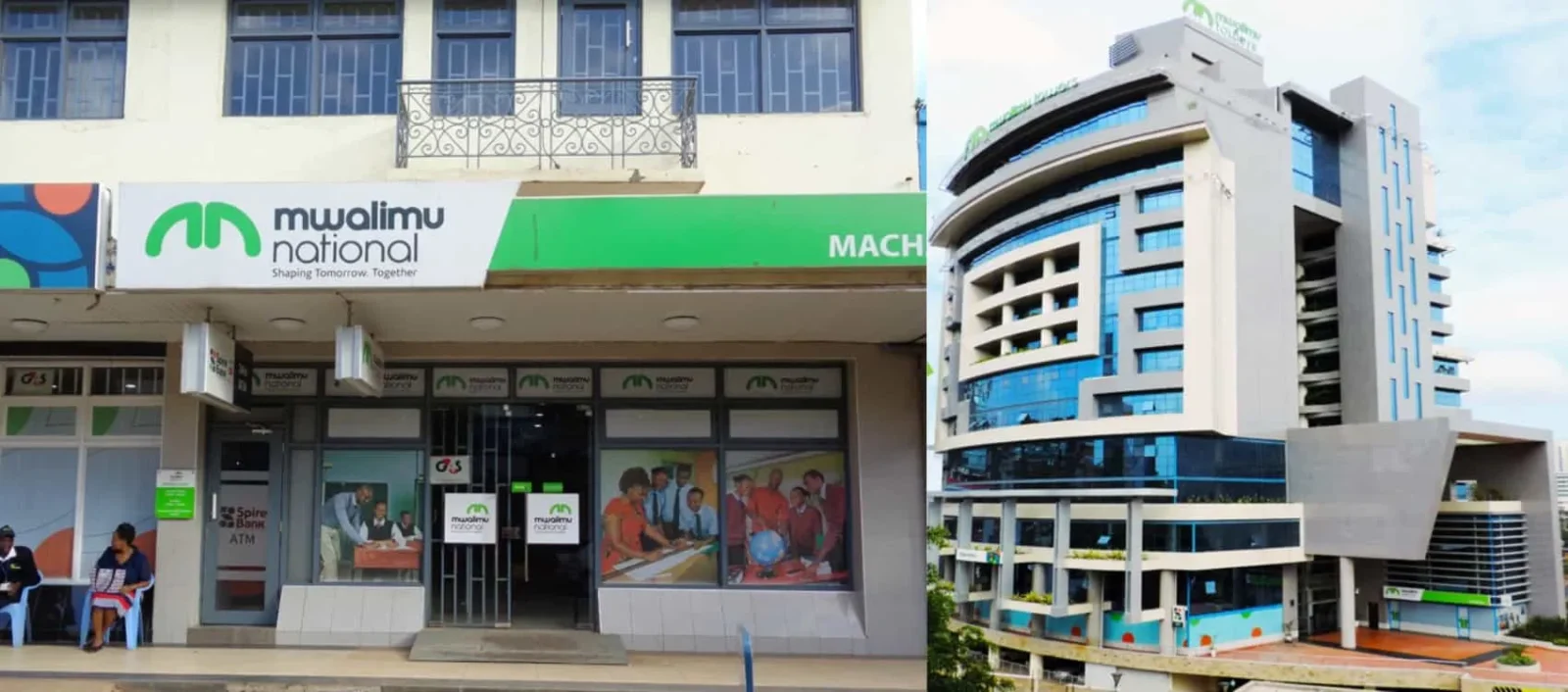
Mwalimu National Deposit-Taking Sacco has booked a Sh960.3 million net impairment charge on financial assets for the year ended December 2025, continuing to absorb the wreckage of its investment in the now-defunct Spire Bank — even as the teachers’ savings cooperative simultaneously reported some of the strongest financial results in its recent history. The two figures together tell a story that is simultaneously encouraging and sobering: a cooperative society that bet its members’ savings on a failing bank, lost spectacularly, and is now clawing its way back to financial health through sheer discipline and a court-supervised write-off plan that will not be complete until 2027.
The Sacco posted a surplus of Sh1.27 billion for 2025, a 76.7 percent increase from Sh718.9 million in 2024, even after absorbing the near-billion-shilling impairment charge. Net interest income rose to Sh3.53 billion from Sh3.18 billion a year earlier, while total assets expanded to Sh76.3 billion from Sh68.9 billion — reflecting what management characterises as continued growth in member lending and deposits. The financial statements were audited by Ernst & Young LLP and approved by the Board of Directors on February 20, 2026, before receiving sign-off from the Sacco Societies Regulatory Authority on February 26, 2026. Interest income — the Sacco’s primary revenue stream — climbed to Sh8.76 billion in 2025, up from Sh7.99 billion the previous year.
But the headline numbers, strong as they are, cannot be fully separated from the shadow that Spire Bank continues to cast over the institution.
Build the future you deserve. Get started with our top-tier Online courses: ACCA, HESI A2, ATI TEAS 7, HESI EXIT, NCLEX-RN, NCLEX-PN, and Financial Literacy. Let Serrari Ed guide your path to success. Enroll today.
The Spire Bank Saga: How Kenya’s Largest Sacco Lost Over Sh13 Billion
The full history of Mwalimu Sacco’s investment in Spire Bank is one of the most consequential — and cautionary — episodes in the recent history of Kenya’s cooperative sector. It began in September 2014, when the Sacco, then already Kenya’s largest by assets, made a bid to acquire a 75 percent stake in Equatorial Commercial Bank — a third-tier lender founded in 1983 as a finance company that had converted to a fully-fledged commercial bank in 1995 and later merged with Southern Credit Banking Corporation in 2010. The controlling shareholder at the time was Naushad Merali, one of Kenya’s most prominent business figures.
The deal was executed in two phases. In the first, Mwalimu acquired a 51 percent stake for Sh1.7 billion. In 2015, it bought an additional 24 percent for Sh700 million, bringing its shareholding to 75 percent and triggering a rebrand of the institution to Spire Bank. The strategic logic, as articulated by Sacco leadership at the time, was straightforward: owning a commercial bank would reduce the fees Mwalimu’s 57,000-plus teacher-members paid for banking services, allow the Sacco to diversify its income streams, and create a financial services group capable of competing more broadly in Kenya’s market.
What followed instead was a decade of compounding losses.
The bank’s troubles were evident almost immediately. At the time of the acquisition, Equatorial Commercial Bank was already recording a pre-tax loss of Sh326.4 million for the year ending December 2014 — a fact that, in hindsight, raises serious questions about the quality of due diligence undertaken before the transaction. The Sacco’s board would later attribute part of the deterioration to Merali himself, accusing the former controlling shareholder of withdrawing Sh1.7 billion in personal deposits from the bank immediately after completing the sale of his shares in 2016 — a withdrawal that is said to have severely damaged the lender’s liquidity position at a critical juncture.
From that point, Spire Bank never recorded an annual profit in a single year during Mwalimu’s ownership. Its loan book shrank, its capital base eroded, and by the time the Central Bank of Kenya completed its assessment in the early 2020s, Spire had accumulated total losses of approximately Sh10 billion — including the conversion of Sh3.4 billion in Mwalimu deposits into equity that was subsequently wiped out. In December 2020, Mwalimu completed the acquisition of the remaining 25 percent stake it did not already own — a tactical move intended to facilitate an eventual sale to a strategic investor by offering 100 percent ownership. That plan never materialised. Attempts to find a buyer, including an approach by a UK-based crypto lender that fell apart, came to nothing.
The Equity Bank Rescue and the Cost of Exit
By 2022, the situation had deteriorated beyond any realistic prospect of independent recovery. Spire Bank’s deposits had shrunk to less than Sh2 billion, its loan book had collapsed, and it was surviving on emergency liquidity support from the Central Bank of Kenya through the reverse repo facility — a measure typically reserved for institutions in acute distress. The National Assembly’s Finance Committee had noted publicly that Spire was reliant on CBK support to keep its doors open. The bank was ranked last out of 39 commercial banks in Kenya by composite market share as of December 2021.
In September 2022, Equity Bank announced it had signed an Assets and Liabilities Purchase Agreement with Spire Bank, agreeing to acquire approximately 20,000 deposit customers with Sh1.3 billion in deposits and 3,700 loan customers with a loan book of approximately Sh945 million. The deal required approvals from multiple layers of authority: shareholders of both Equity Bank and Spire Bank approved the transaction in September 2022, and the Central Bank of Kenya and the Cabinet Secretary for the National Treasury formally approved it on January 23 and 24, 2023 respectively, under Section 9 of the Banking Act. The acquisition took effect on January 31, 2023.
The transaction, while it offered relief to Spire’s depositors and loan customers, came at a direct cost to Mwalimu Sacco. Because the value of the liabilities being transferred to Equity Bank exceeded the assets, Mwalimu was required to pay Equity Bank Sh510.7 million to settle the difference — meaning the Sacco did not receive money from the deal but was instead obligated to pay to exit it. The remaining deposits that were not acquired by Equity Bank — amounting to approximately Sh600 million — were left with Mwalimu to resolve. In total, financial analysis firm Cytonn estimated Mwalimu’s cumulative losses from the Spire Bank investment at approximately Sh7.7 billion at the time of the Equity Bank deal.
One decision can change your entire career. Take that step with our Online courses in ACCA, HESI A2, ATI TEAS 7, HESI EXIT, NCLEX-RN, NCLEX-PN, and Financial Literacy. Join Serrari Ed and start building your brighter future today.
A Six-Year Write-Off Plan — and Where It Stands Now
Rather than forcing Mwalimu to absorb the full remaining investment loss at once — a move that would have severely compromised the Sacco’s capital adequacy and potentially triggered a wider crisis — the Sacco Societies Regulatory Authority (SASRA), in consultation with the Ministry of Co-operatives, approved a structured capital deficiency restoration plan that allows Mwalimu to write off the remaining Sh8 billion investment gradually over a six-year window running from 2022 to 2027.
The write-off schedule has been executed as follows: Sh700 million in 2022, Sh846 million in 2023, and Sh948 million in 2024 — a total of Sh2.49 billion over the first three years of the plan. The Sh960.3 million charge in 2025, confirmed in the latest audited accounts, represents a slight acceleration from 2024’s figure and keeps the institution broadly on the trajectory needed to complete the write-off by 2027. The plan calls for the pace to step up further in 2026, with management previously indicating a target of approximately Sh1.7 billion in write-offs for that year to ensure the full Sh8 billion is cleared within the agreed timeframe.
Mwalimu Sacco CEO Kenneth Odhiambo, who has been at the centre of the institution’s recovery effort, has publicly downplayed the significance of the impairment charges relative to the strength of the underlying loan book. Speaking to journalists after the latest results, he pointed to the Sacco’s bad-loan ratio as context: “Look at it from the perspective of percentage of loan book and how that compares with the Sasra threshold. Ours should be 1.7 percent,” he said, adding a comparison to the broader banking sector. That ratio, if accurate, is significantly below the Sacco industry’s NPL rate of 5.41 percent as of December 2025 as reported by SASRA — itself down from 6.15 percent in 2024 — and far below the 15.43 percent NPL ratio recorded by Kenya’s commercial banking sector over the same period.
The Structural Costs Buried in the Numbers
One aspect of the Spire Bank write-offs that deserves closer examination is what they represent beyond their accounting function. The impairment charges are not simply bad-debt provisions on ordinary member loans that went unpaid — they are the formalised erasure of value that was extracted from members’ savings and poured into a commercial banking venture that returned nothing. The Sh13 billion that Mwalimu invested in Spire Bank over the course of its ownership — a figure that includes direct equity purchases, converted deposits, and capital injections intended to keep the bank alive — came from the contributions of Kenya’s teachers.
Business Daily’s analysis of the 2025 results notes that the steady rise in impairments points to underlying credit risks within Mwalimu’s broader loan portfolio beyond Spire Bank — attributing part of the pressure to teachers struggling to service their loans amid cash-flow pressures, including increased statutory deductions. This layered credit risk picture — Spire Bank legacy losses compounding with more routine member loan stress — is an important dimension of the institution’s financial story that the top-line profit figure can obscure.
The Sacco has also been reorganising its subsidiary structure in response to regulatory pressure. SASRA has required Mwalimu to restructure its insurance and asset management businesses — Mwalimu Risk Insurance Brokers and Mwalimu Asset Management — into separate, independent units, so that their financial performance no longer contaminates the Sacco’s core balance sheet. Management has indicated that the restructuring transactions are to be completed in the near term.
What the Recovery Looks Like
The most compelling argument that Mwalimu is genuinely turning the corner, rather than simply managing a slow-motion collapse, lies in the trajectory of its core financial metrics. Total assets have grown from Sh68.9 billion in 2024 to Sh76.3 billion in 2025. Net interest income has grown consistently. The Sacco has been pursuing a revised operating model focused on recruiting more teachers as members, expanding to the grassroots, developing green financing products, and growing transaction income from digital platforms. Management’s earlier revenue target of Sh13.1 billion for 2025, stated in early 2025, appears broadly achievable given that interest income alone reached Sh8.76 billion and other income sources contributed meaningfully.
The institutional capital to total assets ratio — a key measure of financial health that had dropped below the 8 percent regulatory threshold set by SASRA in 2024, falling to 7.7 percent — is expected to improve as the write-off plan progresses and the Sacco’s earnings are retained rather than distributed. The fact that SASRA approved the gradual write-off schedule rather than forcing an immediate reckoning reflects a regulatory judgement that the Sacco is fundamentally viable and that its membership — Kenya’s teachers — is best served by a managed recovery rather than a disruptive intervention.
The one structural risk that persists is that the Spire Bank write-offs are scheduled to intensify in 2026, with Sh1.7 billion targeted for that year alone. If core lending income continues to grow at the pace seen in 2025, the Sacco should be able to absorb that charge and still post a meaningful surplus. If credit conditions for teachers deteriorate — driven by salary delays, increased statutory deductions, or a softening economy — the combination of elevated write-offs and rising member loan defaults could squeeze profitability more severely than the 2025 numbers suggest.
For now, however, the picture is of an institution that came within reach of a genuine crisis, was rescued by a combination of regulatory flexibility, leadership change, and a rigorous focus on the fundamentals of cooperative lending, and is now in the final years of paying the price for decisions that were made more than a decade ago. The Sh960 million charge in 2025 is not a new problem — it is the latest instalment on an old one. And if Mwalimu Sacco can sustain its current earnings trajectory through 2027, Kenya’s teachers will finally be able to close the chapter on one of the most expensive institutional misjudgements in the history of the country’s cooperative sector.
Ready to take your career to the next level? Join our Online courses: ACCA, HESI A2, ATI TEAS 7 , HESI EXIT , NCLEX – RN and NCLEX – PN, Financial Literacy!🌟 Dive into a world of opportunities and empower yourself for success. Explore more at Serrari Ed and start your exciting journey today! ✨
Track GDP, Inflation and Central Bank rates for top African markets with Serrari’s comparator tool.
See today’s Treasury bonds and Money market funds movement across financial service providers in Kenya, using Serrari’s comparator tools.
Photo Source: Google
By: Montel Kamau
Serrari Financial Analyst
12th March, 2026