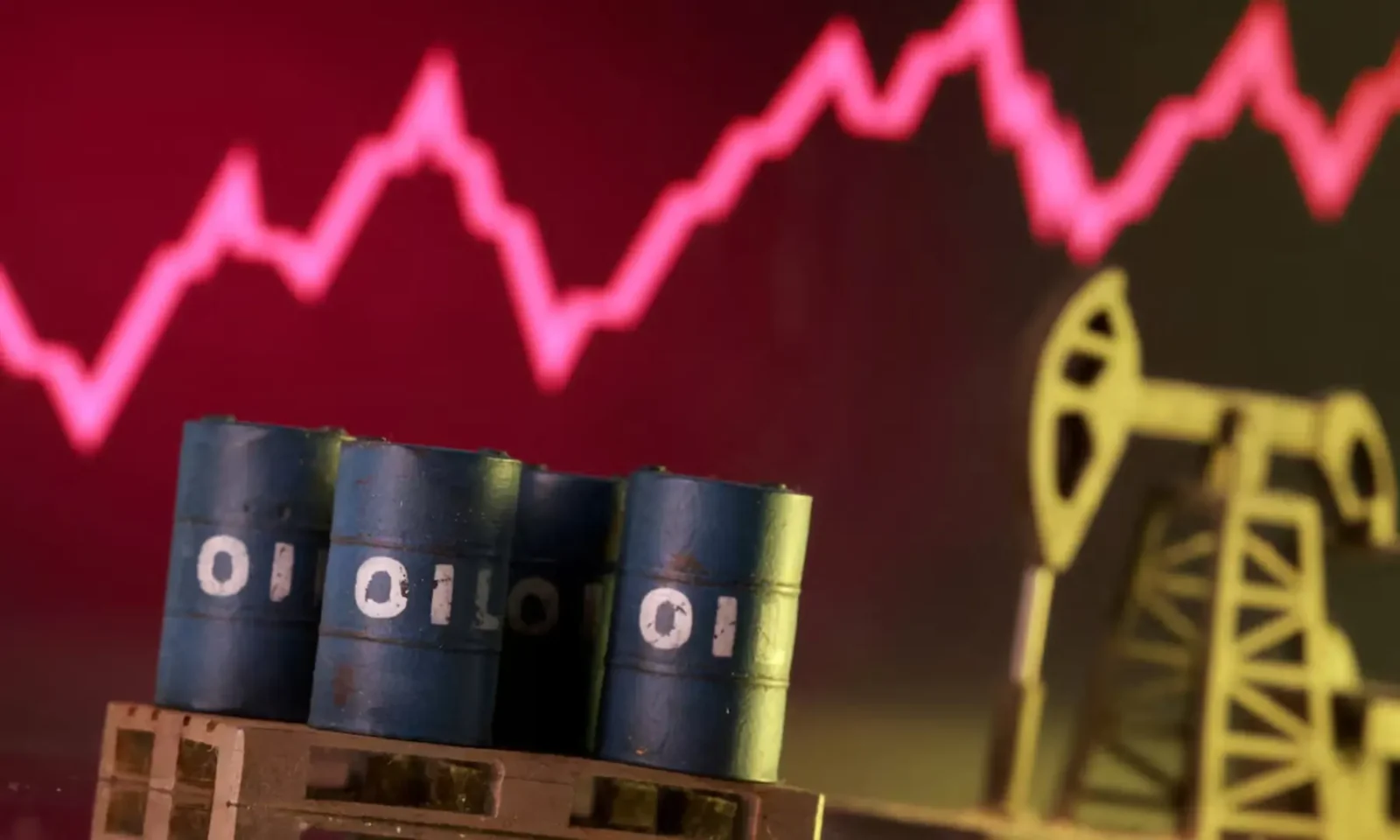
Global markets were caught in a punishing downdraft on Thursday as oil prices surged past $105 a barrel, with Iran’s emphatic denial of any negotiations with Washington deepening fears that the nearly month-long Middle East war is far from over. Stocks tumbled across Asia and Europe, government bond prices slid, and gold continued its bewildering collapse — all while the spectre of a 1970s-style inflation shock loomed ever larger over the global economy.
The catalyst for Thursday’s reversal was a sharp contradiction in diplomatic messaging. U.S. President Donald Trump repeated his claim that Iran was “begging” to make a deal, but Iran’s Foreign Minister Abbas Araghchi countered that Tehran was merely reviewing a U.S. proposal through mediators and had no intention of holding direct talks with Washington. That clash of narratives, combined with reports of thousands of additional American troops being deployed to the region, snapped a three-day rebound in world stocks and sent investors scrambling for safety.
Markets move fast; don’t get left behind. We’ve paired the Serrari Group Market Index with a curated Marketplace and a comprehensive Wealth Builder Course to ensure you have the data—and the skills—to act on it.
The Oil Shock at the Heart of the Crisis
The war, triggered by joint U.S.–Israeli strikes on Iran in late February under what has been dubbed “Operation Epic Fury,” has effectively shut down the Strait of Hormuz — the narrow waterway through which roughly 20% of the world’s seaborne oil and liquefied natural gas normally flows. Iran’s Islamic Revolutionary Guard Corps declared the strait closed to most commercial traffic shortly after the conflict began, and attacks on merchant vessels have made passage perilous for those willing to try.
By Thursday, Brent crude had pushed just above $106 a barrel, while European natural gas prices leapt more than 3% to 54.5 euros per megawatt hour. For the month, oil was up roughly 45% and gas had climbed an extraordinary 70%. The International Energy Agency’s executive director Fatih Birol warned earlier in March that the situation was “very severe” and far worse than the two oil shocks of the 1970s combined with the impact of the Russia-Ukraine war on gas.
Energy market experts have cautioned that the disruption is too large to offset through alternative infrastructure alone. John Kilduff of Again Capital told CNBC that the roughly 20 million barrels per day that normally flow through the Strait cannot be meaningfully redirected, even with measures like the Saudi East-West Pipeline, which can handle only 1 to 1.5 million barrels daily. Kilduff warned that if the closure persists beyond roughly two weeks, oil prices would need to be “repriced considerably higher.”
Goldman Sachs underscored the severity by sharply raising its oil forecasts, expecting Brent to average $110 through March and April, up from a previous estimate of $98. The bank’s analysts added that if Strait flows remain at just 5% of normal for 10 weeks, daily Brent prices would likely surpass their 2008 record level of around $147 per barrel.
An Iranian attack that took out 17% of Qatar’s liquefied natural gas export capacity could take three to five years to be fully repaired, QatarEnergy’s CEO told Reuters on Thursday — a stark illustration of the long-lasting damage the conflict is inflicting on energy infrastructure.
Central Banks Caught Between Inflation and Growth
The energy shock is presenting central banks with an agonising dilemma: tighten monetary policy to combat surging inflation, or hold steady and risk allowing price pressures to become entrenched. So far, the hawkish signals are winning.
In Europe, Bundesbank President Joachim Nagel told Reuters on Thursday that a rate hike at the ECB’s next meeting was “an option”, warning that policymakers should not shy away from early tightening if warranted. His comments built on earlier remarks to Bloomberg where he said a more restrictive monetary policy stance would probably be necessary if medium-term inflation expectations continued to climb. The ECB had held rates unchanged at 2% at its most recent meeting, but the landscape has shifted dramatically since.
Major banks are already positioning for multiple increases. Barclays and J.P. Morgan now expect as many as three rate hikes of 25 basis points each in 2026, penciling in increases in April, June and July — a dramatic reversal from just weeks ago, when the consensus was that rates would stay unchanged through the year. Morgan Stanley forecasts hikes in June and September. Traders are pricing in roughly 72 basis points of tightening from the ECB this year, according to LSEG data.
Across the Atlantic, the Federal Reserve held rates steady at its March meeting in the 3.5%–3.75% range, with Chair Jerome Powell acknowledging an energy shock “of some size and duration” while declining to speculate on what comes next. The Fed’s dot plot still showed a median forecast of one rate cut this year, but a closer look revealed that several officials had shifted toward fewer reductions, with four or five members moving from two projected cuts to one. Futures markets had come into the year pricing in two cuts; by Thursday, traders had fully erased expectations for any Fed easing in 2026 and pushed back bets on the next rate cut to mid-2027.
Morningstar senior U.S. economist Preston Caldwell noted that the inflation shock’s magnitude, combined with rates already near neutral, means it is appropriate for the Fed to stand firm and refrain from further loosening — despite downside risks to the labour market.
In Japan, the two-year government bond yield hit its highest level since 1996 at 1.33% on Thursday, as traders cemented expectations for another Bank of Japan rate hike as early as next month. The BoJ raised rates to a 30-year high of 0.75% in December and has signalled readiness to tighten further, with the Middle East crisis adding to inflationary pressures in a country that sources roughly 70% of its oil imports through the Strait of Hormuz.
Stock Markets Under Siege
Thursday’s selloff was felt most acutely in Asia, where energy-dependent economies bore the brunt. South Korea’s KOSPI slumped 3.2% as worries over rising energy costs battered the export-oriented economy. As a country that imports virtually all its fossil fuels, with roughly 70% of its oil and up to 30% of its LNG coming from the Middle East, South Korea has been among the hardest hit by the crisis. The KOSPI had already suffered its worst single-day decline on record earlier in March — a 12.1% plunge that triggered a circuit breaker — as the conflict’s implications for the semiconductor supply chain compounded the energy fears.
Japan’s Nikkei ended the day down 0.3%, while Hong Kong’s Hang Seng fell 1.9% and China’s blue chips dropped 1.3%. MSCI’s index of Asia-Pacific shares outside Japan was on track for a 9.5% monthly loss, its steepest since October 2022. The S&P 500 fell 1.74% on Thursday and the Nasdaq slid 2.38%, pushing the tech-heavy index into correction territory — down more than 10% from its recent high.
The Philippines, one of Asia’s most exposed economies to oil price shocks, underscored the human toll of the crisis. President Ferdinand Marcos Jr. declared a national energy emergency on Tuesday, warning of “imminent danger” to the country’s energy supply. Pump prices in the archipelago have surged nearly 200%, and the central bank, the Bangko Sentral ng Pilipinas, held a rare off-cycle policy meeting on Thursday, keeping rates at 4.25% but warning that it would hike if second-round inflationary effects materialise.
Context is everything. While you follow today’s updates, use the Serrari Group Market Index and Marketplace to spot emerging shifts. Need to sharpen your edge? Our Wealth Builder Course turns these insights into a professional-grade strategy.
Gold’s Paradox: War, Yet Falling
Perhaps the most counterintuitive development of the crisis has been the collapse in gold — traditionally the quintessential safe-haven asset. The precious metal dropped another 2% on Thursday to $4,421 per ounce, extending a decline of more than 16% for the month. CNN reported it was on course for its worst weekly performance since 1983, a staggering reversal for an asset that hit record highs near $5,589 in January.
The explanation lies in what analysts are calling the “Safe-Haven Paradox”. The very oil shock that would normally drive investors to gold is instead stoking inflation expectations, which in turn are pushing interest rates higher and strengthening the U.S. dollar. Higher real yields make non-yielding gold less attractive relative to bonds, while a stronger dollar raises the cost of gold for international buyers.
The March Federal Reserve meeting proved to be the tipping point, with the Fed’s hawkish hold and refusal to signal rate cuts sending gold into a steep decline. Institutional investors engaged in massive portfolio rebalancing, using gold’s deep, liquid markets to raise cash to meet margin calls on energy-related positions. The SPDR Gold Shares ETF recorded a $2.91 billion outflow in a single day in mid-March, its largest liquidation in over a decade.
Yet physical gold demand has remained elevated, and long-term forecasts remain bullish. J.P. Morgan maintains a year-end target of $6,300 per ounce, while Deutsche Bank is standing by a $6,000 projection.
Currency Markets: The Dollar’s Revival
In foreign exchange markets, the U.S. dollar held near recent highs and was heading for a 2% gain in March, reviving its safe-haven appeal after sliding more than 9% in 2025. The dollar’s strength reflects a confluence of factors: elevated U.S. interest rates, relative insulation from the energy shock thanks to America’s status as the world’s largest oil producer, and a global flight to dollar-denominated safety.
Amrita Sen, founder and director of Market Intelligence at Energy Aspects, told CNBC that the U.S. remains the most shielded of all regions from the energy disruption, given its production capacity. The spread between Brent crude and U.S. WTI recently exceeded $14 a barrel — the steepest in years — reflecting the more acute supply risk facing countries outside the United States.
Germany’s two-year bond yield, a barometer for ECB rate expectations, rose 6 basis points to 2.67% on Thursday, while the U.S. two-year was approaching the psychologically significant 4% level. The Organisation for Economic Cooperation and Development forecast U.S. inflation at 4.2% for 2026, a sharp step up from its prior projection and well above the Fed’s own estimate.
The Path Ahead: Structural Risks and Uncertain Diplomacy
Market participants are increasingly bracing for a prolonged conflict that could reshape energy markets for years. Pascal Koeppel, chief investment officer at Vontobel SFA, warned that if the disruption in the Strait of Hormuz persists, energy prices and inflation could remain elevated, forcing central banks into uncomfortable tightening cycles. He added that the deployment of U.S. ground troops would be a significant escalation that would trigger further risk reduction.
Matthias Scheiber, head of multi-asset at Allspring Global Investments, struck a sober tone: reconciling the objectives of Washington, Jerusalem and Tehran will be exceedingly difficult. “We still think there is a case to make for structurally higher energy prices for the moment,” he said.
Behind the scenes, the diplomatic picture remains murky. A U.K.-led initiative involving 22 countries — including most of NATO, Japan, Australia and the UAE — is working to secure safe passage through the Strait, but progress has been halting. Iran announced on March 26 that vessels from five nations — China, Russia, India, Iraq and Pakistan — would be permitted to transit, a selective loosening that falls far short of restoring normal flows.
Corporate executives are watching with growing anxiety. On a recent CNBC CFO Council call, C-suite leaders set their own informal two-week deadline for a resolution before they would need to begin planning for sustained energy shortages and reining in industrial activity.
For now, however, the world waits — caught between hope for a swift diplomatic breakthrough and fear that the conflict’s economic damage is only beginning to unfold.
Your financial future isn’t something you wait for—it’s something you build.
The real question is: when do you begin?
Move beyond simply staying informed.
Navigate the markets with clarity—track trends through the Serrari Group Market Index, uncover opportunities in the Serrari Marketplace, and build practical knowledge with our Curated Wealth Builder Course.
Stay connected to what truly matters.
Get daily insights on macro trends and financial movements across Kenya, Africa, and global markets—delivered through the Serrari Newsletter.
Growth opens doors.
Advance your career through professional programs including ACCA, HESI A2, ATI TEAS 7 , HESI EXIT , NCLEX – RN and NCLEX – PN, Financial Literacy!🌟—designed to move you forward with confidence.
See where money is flowing—clearly and in real time.
Track Money Market Funds, Treasury Bills, Treasury Bonds, Green Bonds, and Fixed Deposits, alongside global and African indexes, key economic indicators, and the evolving Crypto and stablecoin landscape—all within Serrari’s Market Index.