











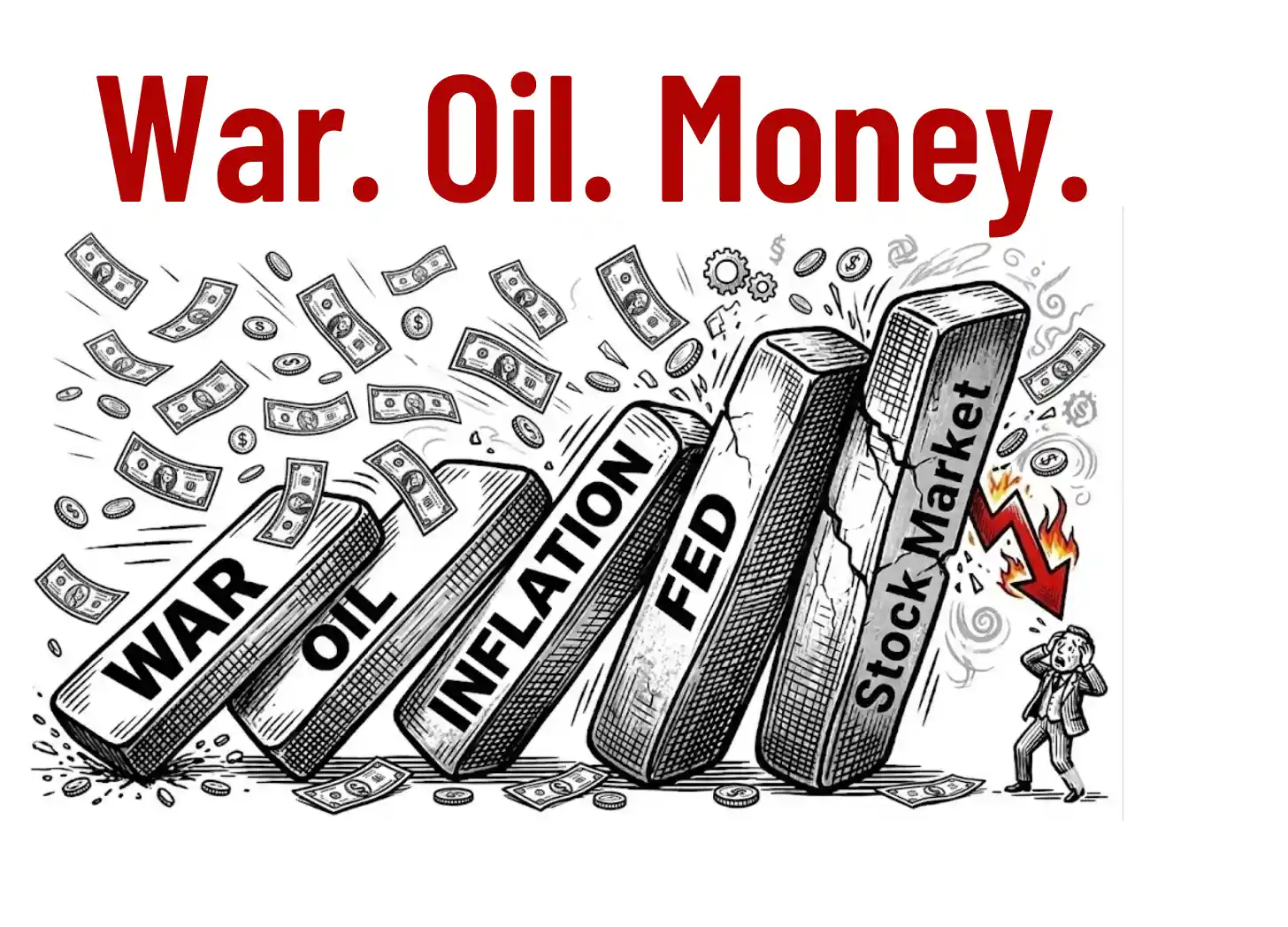
Wall Street opened Wednesday in a state of cautious suspension — caught between a reassuring inflation print, an oil market still in the grip of war-driven volatility, and a string of corporate earnings that told sharply divergent stories about the health of the American economy. Major indexes slipped early, with the S&P 500 falling 0.21% to 6,781.48 and the Dow Jones Industrial Average sliding 0.07% to 47,706.51, even as the Nasdaq Composite managed a fractional gain of 0.01%. Beneath the modest headline moves, however, a more complex picture was taking shape — one defined by a bond market under mounting inflationary pressure, a crude oil rally resuming despite a historic emergency reserve release, and a chip sector renaissance sparked by Oracle’s blockbuster quarterly results.
The Cboe Volatility Index (VIX) climbed 3.25% to 25.74, a sign that investors remain deeply unsettled even as markets search for a floor. The US Dollar Index ticked up 0.25% to 99.07. Bitcoin slipped 1.22% to $69,340. Underneath those numbers is a market in genuine tension: between data that says inflation is behaving and a geopolitical shock that guarantees it soon will not.
Markets move fast; don’t get left behind. We’ve paired the Serrari Group Market Index with a curated Marketplace and a comprehensive Financial Literacy Course to ensure you have the data—and the skills—to act on it.
CPI Comes In As Expected — But Markets Are Already Looking Past It
The morning’s most anticipated event, the February Consumer Price Index report, landed squarely in line with expectations. Headline monthly CPI rose 0.3% and annual CPI climbed 2.4%, both matching the Dow Jones consensus forecast. Core CPI, stripping out food and energy, rose a modest 0.2% month-over-month. On the surface, it was the kind of data that should have calmed nerves — measured, predictable, and only marginally above the Federal Reserve’s 2% inflation target.
But markets did not take comfort. “The market is aggressively pricing out Fed rate cuts this year,” said Kevin Gordon, head of macro research and strategy at the Schwab Center for Financial Research (SCFR). The reason is straightforward: the February data was compiled before the war began on 28 February, meaning it captures virtually none of the energy price shock that has since sent crude surging by more than 30%. Bond traders are already looking ahead to March and April CPI readings, where the pass-through from elevated oil prices will be far harder to ignore.
Within the report, notable details included a 1.3% month-over-month jump in apparel prices — the largest increase since September 2018 — while weakness in used car and car insurance prices helped keep core inflation in check. “Numbers came in as expected, but the market’s looking past this report and what’s next with inflation due to the war in Iran,” said Cooper Howard, director of fixed income research and strategy at SCFR. After the CPI release, futures prices kept odds of a rate cut by mid-year at around 40%, with the Fed’s September meeting seen as the more likely moment for any easing. Chances of a cut at next week’s FOMC meeting remain virtually zero according to the CME FedWatch Tool.
The 10-year Treasury yield climbed to 4.19% on the open, adding 5 basis points — and that move, in SCFR’s assessment, reflected war news far more than inflation data.
Oil Resumes Its Rally: Three Ships Hit, 15 Million Barrels a Day Still Stuck
The day’s dominant market force was once again crude oil. WTI crude rose more than 4% to $87.26 per barrel in morning trading, resuming its rally after Tuesday’s sharp pullback, as fresh attacks on shipping vessels near the Strait of Hormuz underscored that the fundamental supply disruption remains intact. Three carrier ships were struck by projectiles in the region on Wednesday, the UK’s maritime trade monitoring agency confirmed, adding to a growing list of maritime casualties in the Persian Gulf.
The context is stark. Since the US-Israeli military campaign against Iran began under Operation Epic Fury on 28 February, the Strait of Hormuz has been effectively closed to commercial tanker traffic. Around 15 million barrels of oil per day that normally flow through the strait remain bottled up, representing the most severe supply disruption in the history of global energy markets. Export volumes through the Hormuz chokepoint are now running at less than 10% of pre-conflict levels, according to the IEA.
Against that backdrop, Wednesday also brought an announcement of historic proportions: the International Energy Agency confirmed that its 32 member countries had unanimously agreed to release 400 million barrels of oil from strategic reserves — the largest emergency release in the organisation’s 52-year history, and more than double the 182.7 million barrels released after Russia’s full-scale invasion of Ukraine in 2022. The United States said it would contribute 172 million barrels from the Strategic Petroleum Reserve, with the UK pledging 13.5 million barrels and South Korea committing 22.46 million barrels.
Yet crude climbed anyway. The IEA release, however unprecedented in scale, was rapidly framed by analysts as inadequate to the size of the disruption. Investment firm Macquarie called it “a water pistol, not a bazooka,” noting that at the current rate of blockaded supply, 400 million barrels would be absorbed in roughly 26 days. “The strategic reserves are not a permanent solution, of course, and crude oil will continue to trade like a ‘meme stock’ until the solution is peace,” Macquarie added. IEA Executive Director Fatih Birol acknowledged the limitation plainly: “The most important thing for a return to stable flows of oil and gas is the resumption of transit through the Strait of Hormuz.“
The scale of the price swings this week has been dramatic. Brent crude rallied to nearly $120 per barrel on Monday before plunging to near $85 on Tuesday on hopes of a diplomatic resolution, then rebounding again on Wednesday as new attacks materialised. US gas prices have risen nearly 20% over the last 10 days — faster than they rose after the invasion of Ukraine in 2022 — hitting a national average of $3.57 per gallon according to AAA. “For the American consumer, things are getting very real, very fast,” Kevin Gordon of SCFR said.
Reading the War Scenarios: Quick Ceasefire or Prolonged Disruption?
With no resolution in sight, Schwab’s strategists laid out the potential scenarios for the conflict and their market implications in a new analysis published Wednesday. Michelle Gibley, director of international equity research and strategy, and Chris Ferrarone, head of equity research and strategy at SCFR, identified two probable outcomes: a relatively quick transition from major military operations to negotiations, or a gradual de-escalation over several weeks.
The upside scenario — a swift end to military operations followed by the normalisation of energy production and shipping — would likely trigger a rapid market rebound. “History suggests equity markets would rapidly rebound when a ceasefire occurs,” the analysts wrote. In the moderate case, military operations continue at reduced intensity before winding down over several weeks, with oil prices remaining elevated but volatility declining.
The downside, however, was starkly outlined. “Downside risks rise meaningfully in scenarios where global energy supplies face a prolonged disruption with potential spillovers to global growth, inflation, tightening financial conditions, with international markets — especially Europe and Asia — most exposed,” the analysts wrote. This worst-case scenario carries echoes of the 1973 oil embargo that triggered the era of stagflation — a combination of stagnant growth and persistent inflation that left the Fed with no good policy options. “That said, this conflict presents meaningful downside risks, and we don’t believe now is the time to aggressively add risk,” Gibley and Ferrarone concluded.
Context is everything. While you follow today’s updates, use the Serrari Market Index and Marketplace to spot emerging shifts. Need to sharpen your edge? Our Financial Literacy Course turns these insights into a professional-grade strategy.
Oracle Soars: AI Infrastructure Bet Delivers a Decisive Beat
Amid the geopolitical gloom, Oracle delivered a results report that electrified the technology sector. The enterprise software giant surged nearly 10% in pre-market trading after its fiscal third-quarter results, released Tuesday evening after the bell, exceeded consensus estimates on both earnings and revenue while lifting guidance materially higher.
Oracle’s total quarterly revenues rose 22% year-over-year in USD to $17.2 billion, with cloud revenues surging 44% to $8.9 billion. Adjusted earnings per share came in at $1.79, beating the Street’s $1.70 forecast. The company described Q3 as its first quarter in over 15 years where both organic total revenue and non-GAAP EPS grew at 20% or more simultaneously. Most striking was Oracle’s cloud infrastructure revenue, which rose 84% year-over-year to $4.9 billion — an acceleration from the 68% growth recorded in the prior quarter — powered by surging demand for AI computing capacity from clients including OpenAI, Air France-KLM, Lockheed Martin, and SoftBank.
Oracle also significantly upgraded its forward guidance. For fiscal year 2027, the company raised total revenue guidance to $90 billion, up from the prior estimate of approximately $89 billion, and well ahead of the $86.6 billion that LSEG analysts had been pencilling in. Remaining performance obligations — a key measure of contracted future revenue — more than quadrupled year-over-year to $553 billion, an extraordinary backlog that speaks to the voracious institutional demand for AI infrastructure.
JPMorgan responded immediately, upgrading Oracle to Overweight from Neutral with a $210 price target for December 2026, down from $230 but still representing a significant upside case from current depressed levels. Analyst Mark Murphy said the recent “severe selloff improves risk/reward” against a backdrop of what he characterised as “thick investor pessimism.” Murphy also pointed to Oracle’s recent $25 billion debt raise as addressing financing concerns and removing the need for additional bond issuance this year. Barclays separately raised its price target on Oracle to $240 from $230, maintaining its Overweight rating, and saying the Q3 print addressed several key investor concerns. Oracle’s results rippled through the broader chip sector, with memory names like Micron and Western Digital benefiting from renewed AI infrastructure enthusiasm.
Nike Gets a Lifeline: Barclays Says “Worst May Be Behind”
Nike provided another pocket of strength, rising more than 2% in early trading after Barclays delivered an upgrade that amounted to a vote of confidence in the beleaguered sportswear brand’s recovery trajectory. Analyst Adrienne Yih upgraded Nike from Equal-Weight to Overweight and raised her 12-month price target to $73 from $64 — implying potential upside of around 30% from current levels — citing recent operational progress, financial inflections, and disciplined management actions.
Nike’s shares have been under sustained pressure, down nearly 25% over the past 12 months and approximately 13% year-to-date, as the company has navigated a prolonged reset of its wholesale strategy, heightened competition, and concerns about demand in China. But Yih argued that investor sentiment has reached “peak skepticism,” and that the company’s North America reset — its largest region — is progressing largely as planned. The analyst pointed to Nike’s recent progress in inventory management, operational resets, and strategic focus on brand health and margin stabilisation as providing a foundation for a more constructive investment thesis.
Among the risks Yih acknowledged are lingering tariff exposure, geopolitical demand uncertainty, and ongoing pressure in the China market — concerns that the broader consumer discretionary sector shares, particularly as consumers face elevated gas prices that squeeze disposable income. Nike is due to report fiscal third-quarter earnings on March 31, which will be the next hard test of Barclays’ thesis.
Campbell’s Drops: Storm Delays, Soft Snacks, and a Slashed Outlook
Not every earnings story was positive. Campbell’s fell around 4-5% in early trading after the consumer staples giant missed Wall Street expectations on both revenue and earnings and delivered a deeply cautious outlook for the remainder of fiscal 2026.
The packaged food company reported second-quarter net sales of approximately $2.56 billion, down around 4.5% from a year earlier and short of analyst estimates of $2.61 billion. Adjusted earnings per share of $0.51 missed the consensus of $0.57 and represented a 31% decline from the same period last year. The company cited two overlapping headwinds: persistent weakness in the Snacks division as consumers become more deliberate about discretionary purchases, and storm-related shipping delays during the January US cold spell, which management estimated impacted net sales by approximately 1% and adjusted EPS by approximately $0.04 per share.
The full-year guidance update was the harder blow for investors. Campbell’s now expects organic net sales to decline 2% to 1% for fiscal 2026, compared with its previous forecast for a range of down 1% to up 1%. Full-year adjusted EPS guidance was cut to a range of $2.15 to $2.25, down from the prior range of $2.40 to $2.55 — a reduction of approximately 11% at the midpoint. Tariffs emerged as a contributing cost pressure cited by management, adding to a picture of margin compression that analysts described as characteristic of broader pressures facing the packaged food industry.
Campbell’s earnings underline a tension that is building across consumer-facing sectors: while headline inflation data remains relatively contained, the combination of tariff-driven input cost increases, softening discretionary spending, and energy price shocks cascading through supply chains is creating real pressure on volumes and margins — particularly for companies whose products sit at the intersection of everyday staples and discretionary snacking.
Retail Investors Lean In: Schwab’s STAX Index Hits Three-Year High
One notable counterpoint to professional caution came from Schwab’s own retail client data. The Schwab Trading Activity Index (STAX) rose to 57.32 in February, up from 49.96 in January — the biggest month-over-month percentage gain since late 2020 and the highest score since February 2022. The surge suggests that Schwab’s retail client base responded to February’s AI-driven market turbulence not with panic, but with opportunistic buying.
Popular names purchased by retail clients during the period included Nvidia, Microsoft, and Palantir, as well as Amazon and Netflix, reflecting continued conviction in AI and technology themes despite elevated macro uncertainty. On the net-sold side, Meta Platforms, Apple, and Verizon led the list — a rotation that reflects some profit-taking in mega-cap names and a preference for AI infrastructure plays over broader tech exposure.
The STAX data creates an interesting divergence from the professional market view. While Schwab’s strategists counsel against aggressively adding risk given elevated war uncertainty, their retail clients appear to be betting that the AI-driven market narrative will ultimately prevail. That divergence — between institutional caution and retail optimism — is itself a characteristic feature of inflection points in market history.
The Broader Picture: An Economy Caught Between Data and Reality
Wednesday’s market session distilled a broader tension that is likely to define financial markets for weeks, if not months. On one side sits a domestic economy that, by the numbers, is performing reasonably well: inflation is elevated but not spiralling, the labour market remains relatively resilient, and corporate earnings — Oracle’s report being the most vivid example — continue to demonstrate pockets of robust growth.
On the other side sits a geopolitical shock of genuine systemic scale. The Iran conflict has done what few events in recent memory have managed: it has simultaneously raised inflation risks, suppressed growth expectations, and created a policy dilemma for the Federal Reserve that may have no comfortable resolution. If the conflict persists and oil prices remain elevated, the March CPI reading — due next month — will almost certainly show a significant deterioration in the headline inflation rate, further complicating the Fed’s calculus at a moment when it has already held rates steady at 3.50%–3.75% since its January meeting.
The VIX at 25.74 — elevated but not yet at panic levels — suggests markets are pricing in ongoing disruption without yet fully discounting a worst-case scenario. That calibration could change rapidly if diplomatic signals from the region deteriorate, or if the Strait of Hormuz remains closed into April and the next inflation print confirms the pass-through that traders already fear.
For now, the market is doing what markets do best in moments of profound uncertainty: pricing in the possibility of multiple outcomes simultaneously, and leaning on earnings beats and analyst upgrades to provide whatever footing is available.
Don’t just read the news—navigate it. Track trends with the Serrari Group Market Index, discover your next move in the Serrari Marketplace, and master the “how” with our Financial Literacy Course.
Photo Source: Google
By: Montel Kamau
Serrari Financial Analyst
12th March, 2026
Article, Financial and News Disclaimer
The Value of a Financial Advisor
While this article offers valuable insights, it is essential to recognize that personal finance can be highly complex and unique to each individual. A financial advisor provides professional expertise and personalized guidance to help you make well-informed decisions tailored to your specific circumstances and goals.
Beyond offering knowledge, a financial advisor serves as a trusted partner to help you stay disciplined, avoid common pitfalls, and remain focused on your long-term objectives. Their perspective and experience can complement your own efforts, enhancing your financial well-being and ensuring a more confident approach to managing your finances.
Disclaimer: This article is for informational purposes only and does not constitute financial advice. Readers are encouraged to consult a licensed financial advisor to obtain guidance specific to their financial situation.
Article and News Disclaimer
The information provided on www.serrarigroup.com is for general informational purposes only. While we strive to keep the information up to date and accurate, we make no representations or warranties of any kind, express or implied, about the completeness, accuracy, reliability, suitability, or availability with respect to the website or the information, products, services, or related graphics contained on the website for any purpose. Any reliance you place on such information is therefore strictly at your own risk.
www.serrarigroup.com is not responsible for any errors or omissions, or for the results obtained from the use of this information. All information on the website is provided on an as-is basis, with no guarantee of completeness, accuracy, timeliness, or of the results obtained from the use of this information, and without warranty of any kind, express or implied, including but not limited to warranties of performance, merchantability, and fitness for a particular purpose.
In no event will www.serrarigroup.com be liable to you or anyone else for any decision made or action taken in reliance on the information provided on the website or for any consequential, special, or similar damages, even if advised of the possibility of such damages.
The articles, news, and information presented on www.serrarigroup.com reflect the opinions of the respective authors and contributors and do not necessarily represent the views of the website or its management. Any views or opinions expressed are solely those of the individual authors and do not represent the website's views or opinions as a whole.
The content on www.serrarigroup.com may include links to external websites, which are provided for convenience and informational purposes only. We have no control over the nature, content, and availability of those sites. The inclusion of any links does not necessarily imply a recommendation or endorsement of the views expressed within them.
Every effort is made to keep the website up and running smoothly. However, www.serrarigroup.com takes no responsibility for, and will not be liable for, the website being temporarily unavailable due to technical issues beyond our control.
Please note that laws, regulations, and information can change rapidly, and we advise you to conduct further research and seek professional advice when necessary.
By using www.serrarigroup.com, you agree to this disclaimer and its terms. If you do not agree with this disclaimer, please do not use the website.
www.serrarigroup.com, reserves the right to update, modify, or remove any part of this disclaimer without prior notice. It is your responsibility to review this disclaimer periodically for changes.
Serrari Group 2025