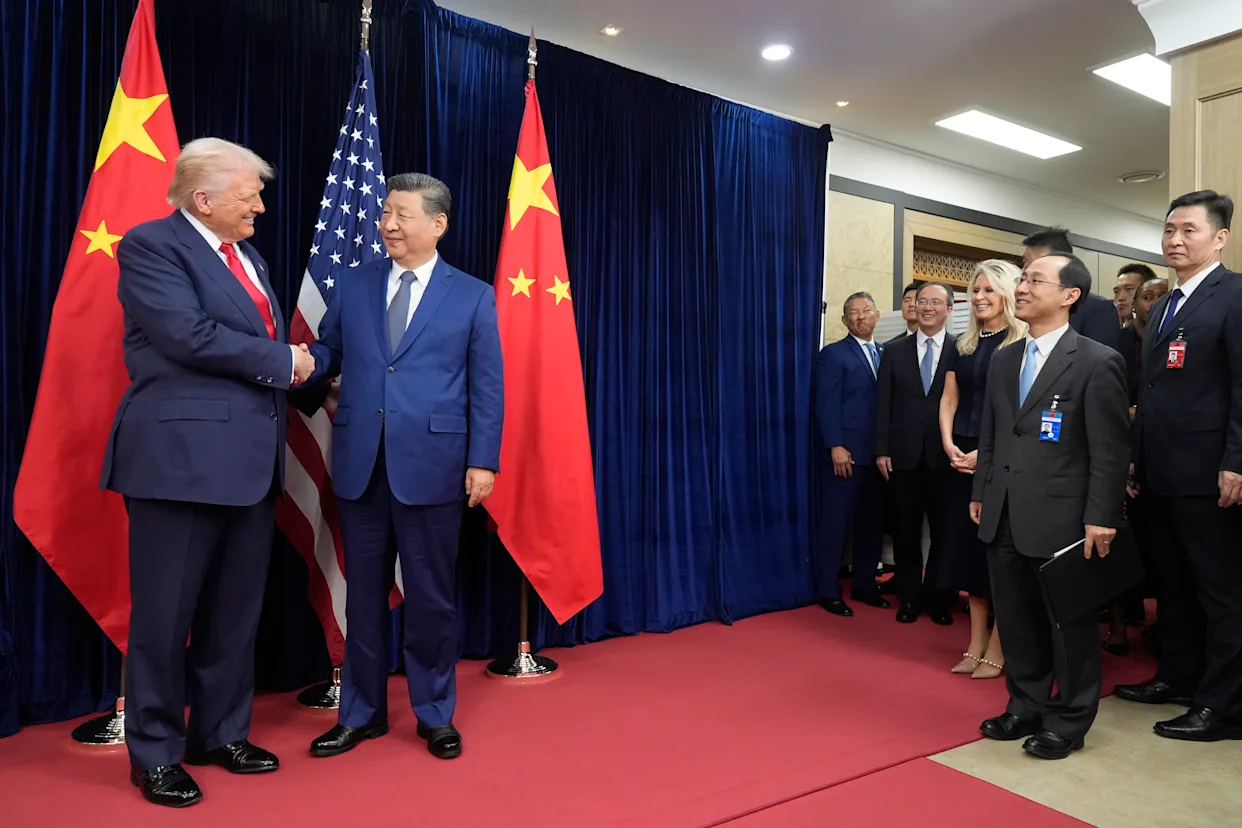
The world’s two largest economies have stepped back from the brink of an all-out trade war after President Donald Trump and Chinese President Xi Jinping reached a comprehensive trade agreement during a historic face-to-face meeting in South Korea. The deal, confirmed by the White House in a detailed fact sheet released following the October 30, 2025 summit at Gimhae Air Base in Busan, addresses several critical flashpoints that had threatened to destabilize global supply chains and escalate economic tensions between Washington and Beijing.
The approximately two-hour meeting, which Trump rated “a 12” on a scale of zero to 10, marked the first in-person encounter between the two leaders in six years and represented the culmination of Trump’s five-day tour of the Indo-Pacific region, which included stops in Malaysia for the ASEAN summit and Japan before arriving in South Korea for the APEC summit.
Build the future you deserve. Get started with our top-tier Online courses: ACCA, HESI A2, ATI TEAS 7, HESI EXIT, NCLEX-RN, NCLEX-PN, and Financial Literacy. Let Serrari Ed guide your path to success. Enroll today.
The Nexperia Chip Crisis: A Global Threat Resolved
Perhaps the most immediate crisis addressed in the agreement involves the export of automotive computer chips from Nexperia, a Dutch-based but Chinese-owned semiconductor manufacturer that plays an outsized role in global automotive supply chains. The company, which is owned by Chinese firm Wingtech Technology, supplies approximately 49 percent of the electronic components used in the European automotive industry and billions of so-called “foundation chips” — transistors, diodes, and power management components — that are essential to basic electrical functions in virtually every vehicle.
The crisis began when the Netherlands invoked a Cold War-era law in late September 2025 to effectively seize control of Nexperia, citing national security concerns and allegations that the company’s Chinese leadership planned to transfer intellectual property and capabilities to China. Beijing retaliated swiftly by imposing export controls on October 9 that prohibited Nexperia’s Chinese facilities from exporting finished components, despite the fact that approximately 70 percent of chips manufactured at Nexperia’s European facilities are sent to China for final assembly and testing before being re-exported globally.
The disruption sent shockwaves through the automotive industry. Major manufacturers including Volkswagen, Nissan Motor, Mercedes-Benz, BMW, and Jaguar Land Rover issued warnings that chip shortages could force temporary production shutdowns within weeks. The European Automobile Manufacturers’ Association (ACEA) described the situation as “critical” and warned that disruption was worsening “by the day,” threatening imminent stoppages at assembly lines across Europe.
According to the White House fact sheet, China has now agreed to “take appropriate measures to ensure the resumption of trade from Nexperia’s facilities in China, allowing production of critical legacy chips to flow to the rest of the world.” China’s Ministry of Commerce confirmed on Saturday, November 1, that it would “comprehensively consider the actual situation of enterprises and grant exemptions to exports that meet the criteria,” signaling a willingness to resolve the standoff that had threatened to cascade through global manufacturing supply chains.
A spokesman for the Chinese Embassy in Washington told the BBC that details of the agreements reached had been shared by “competent authorities,” emphasizing that “China-US economic and trade relations are mutually beneficial in nature” and should “serve as the anchor and driving force for China-US relations, not a stumbling block or a point of friction.”
Rare Earth Minerals: A Strategic De-Escalation
Another critical component of the agreement addresses China’s export controls on rare earth minerals — materials essential for manufacturing everything from fighter jets and cruise missiles to smartphones, electric vehicles, and wind turbines. China dominates the global rare earths market, accounting for approximately 70 percent of the world’s supply, a similar share of America’s imports, and roughly 90 percent of global processing capacity.
Beijing had imposed export controls on seven of the 17 rare earth elements in April 2025 and then dramatically expanded these restrictions on October 9, adding five additional elements and processing equipment. Under the new rules, which were scheduled to take effect on November 8, foreign firms would have required government approval before exporting magnets and certain semiconductor materials containing even trace amounts of Chinese-sourced rare earths.
These restrictions posed an existential threat to numerous industries, particularly defense contractors producing advanced weapons platforms such as F-35 fighter jets and Tomahawk cruise missiles, as well as manufacturers of electric vehicles and renewable energy systems. The controls represented China’s most powerful economic leverage over the United States and its allies, demonstrating Beijing’s willingness to weaponize its dominance in critical materials.
Under the agreement reached in Busan, Beijing has committed to pause these export controls for one year. “All of the rare earth has been settled,” Trump told reporters aboard Air Force One after the meeting. “And that’s for the world, worldwide, you could say this was a worldwide situation, not just a U.S. situation.” Trump indicated that while this represents a one-year agreement, he expects it to be “very routinely extended as time goes by,” suggesting confidence in the durability of the arrangement.
Fentanyl: Addressing America’s Deadliest Drug Crisis
The agreement also tackles one of the most politically sensitive issues in US-China relations: China’s role in the American fentanyl crisis. Fentanyl, a synthetic opioid 50 to 100 times more potent than morphine, has become the leading cause of death for Americans aged 18 to 45. More than 100,000 Americans die annually from drug overdoses, with synthetic opioids like fentanyl accounting for over 70 percent of these deaths since 2021.
While China banned the production of finished fentanyl in 2019 under pressure from the Trump administration during his first term, Chinese chemical manufacturers continued supplying the precursor chemicals necessary to synthesize fentanyl to Mexican drug cartels, particularly the Sinaloa Cartel and Cartel Jalisco Nueva Generación (CJNG). These precursor chemicals, many of which have legitimate industrial uses and are not themselves scheduled as controlled substances, are shipped to Mexico where cartels operate clandestine laboratories to produce finished fentanyl that is then smuggled across the US-Mexico border.
The Drug Enforcement Administration (DEA) and the Department of Justice have repeatedly identified China-based chemical companies as the primary source of these precursor chemicals. In September 2023, the Justice Department indicted eight Chinese chemical companies and 12 executives for crimes related to fentanyl, other synthetic opioids, methamphetamines, and their precursor chemicals. The Treasury Department has sanctioned more than 65 mainland China- or Hong Kong-based persons and entities for illicit fentanyl, xylazine, or nitazenes trafficking.
Under the new agreement, China has committed to taking “significant measures” to address the fentanyl issue, though specific details remain to be finalized. In response, the White House announced it would lower tariffs brought in to curb the import of fentanyl into the United States, reducing them from 20 percent to 10 percent, effective immediately. Treasury Secretary Scott Bessent told CNN on Sunday that while “we don’t want to decouple from China,” Beijing has “shown themselves to be an unreliable partner” on counternarcotics cooperation, suggesting cautious optimism tempered by skepticism about follow-through.
The fentanyl provisions represent a continuation of efforts initiated during the Biden administration, which had achieved some modest success in persuading China to schedule certain precursor chemicals. However, challenges remain substantial. As researchers at the Brookings Institution have documented, the structural characteristics of synthetic drugs—including the ease of developing similar but not scheduled compounds and their precursors—pose immense obstacles to supply-side control, even with enhanced Chinese cooperation.
Agricultural Trade: Soybeans and Market Access
The agreement also resolves a major dispute in agricultural trade that had denied American farmers access to their largest export market. China, the world’s largest importer of soybeans, had halted purchases of American soybeans earlier in 2025 as trade tensions escalated, forcing Trump to revive a bailout program for farmers that had been in place during his first term in office.
Under the new agreement, China has committed to purchasing 12 million tonnes of US soybeans in the final two months of 2025—November and December—and 25 million metric tonnes in each of the following three years (2026, 2027, and 2028). This roughly restores soybean purchases to pre-dispute levels and provides American agricultural producers with critical market certainty for multi-year planning.
Trump indicated that China may also commit to purchasing “large, tremendous amounts” of other farm products, though specific quantities were not detailed in the initial fact sheet. He also suggested that China might buy substantial quantities of oil and gas from Alaska, though those negotiations remain ongoing and no firm agreement has been reached.
However, some analysts expressed skepticism about the agricultural commitments. China’s Ministry of Commerce, in its official statement, simply indicated that the two sides agreed to “expand agricultural trade” without providing the specific tonnage figures outlined by US officials. Piper Sandler analyst Andy Laperriere noted that “Beijing had made promises on soybeans and fentanyl during Trump’s first term,” expressing doubt about whether Trump received meaningful concessions in exchange for lowering tariffs on China.
One decision can change your entire career. Take that step with our Online courses in ACCA, HESI A2, ATI TEAS 7, HESI EXIT, NCLEX-RN, NCLEX-PN, and Financial Literacy. Join Serrari Ed and start building your brighter future today.
Broader Context: De-Escalating a Dangerous Trade War
The agreements reached in Busan represent a significant de-escalation of what had become an increasingly dangerous trade war between the world’s two largest economies. Since Trump entered office in January 2025, he had imposed sweeping tariffs on Chinese imports, particularly targeting goods related to the fentanyl supply chain. Beijing responded with retaliatory tariffs and export controls, creating a tit-for-tat escalation that roiled global markets and created uncertainty for businesses worldwide.
The semiconductor industry had been particularly affected, with US export controls limiting China’s access to advanced chipmaking equipment and artificial intelligence technologies. Chinese export restrictions on rare earths and critical components like Nexperia chips represented Beijing’s counter-pressure, demonstrating that China retained significant leverage through its control of key materials and manufacturing capacity in global supply chains.
The face-to-face meeting between Trump and Xi, held at Gimhae Air Base adjacent to Busan’s international airport, provided an opportunity for direct engagement that phone calls and written correspondence could not replicate. In opening remarks before the closed-door session, Trump praised Xi as “a great leader of a great country” and expressed confidence that the two would have “a fantastic relationship for a long period of time.”
Xi, speaking through an interpreter, acknowledged that it was “normal” for the world’s two leading economies to have “frictions now and then” but emphasized that “you and I at the helm of China-U.S. relations should stay the right course and ensure the steady sailing forward of the giant ship of China-U.S. relations.” The Chinese leader stressed that the two nations “are fully able to help each other succeed and prosper together.”
Trump was accompanied by a high-level delegation including Secretary of State Marco Rubio, Treasury Secretary Scott Bessent, Commerce Secretary Howard Lutnick, Trade Representative Jamieson Greer, White House Chief of Staff Susie Wiles, and Ambassador to China David Perdue. The presence of multiple cabinet secretaries and senior officials underscored the comprehensive nature of the discussions and the administration’s commitment to reaching substantive agreements.
Implementation Challenges and Skepticism
Despite the optimistic tone struck by both leaders immediately after the meeting, significant questions remain about implementation and enforcement. The one-year timeframe for the rare earths agreement suggests that both sides view this as a temporary truce rather than a permanent resolution. Trump indicated that the agreement would be renegotiated annually, creating ongoing leverage points but also potential sources of future friction.
Nicholas Burns, former US Ambassador to China during the Biden administration, cautioned that “the truce reached between the U.S. and China is not a comprehensive deal,” suggesting that many fundamental issues in the bilateral relationship remain unresolved. Analysts have noted that Beijing secured significant concessions—particularly the reduction of fentanyl-related tariffs—without making verifiable commitments that can be easily monitored.
Some experts suggested that China had demonstrated it “wasn’t going to be bullied” during the negotiations. Jayant Menon, a visiting senior fellow at the ISEAS-Yusof Ishak Institute in Singapore, told CNN that China’s measured response to US tariffs had been effective. “We’ve seen President Trump actually pause tariffs, bring in exemptions, change rates, without China doing very much except to respond in a very measured way each time there was some change in the US position,” Menon observed.
The agricultural commitments, while significant in scale, also face questions about enforceability. During Trump’s first term, China similarly committed to large agricultural purchases as part of the Phase One trade deal signed in January 2020. However, those commitments were never fully met, undermined first by the COVID-19 pandemic and later by deteriorating bilateral relations.
Looking Forward: Future Meetings and Ongoing Negotiations
Despite these uncertainties, both leaders committed to continued engagement. Trump announced that he would visit China in April 2026, with Xi reciprocating with a visit to the United States “sometime after that,” potentially to Palm Beach, Florida, or Washington, D.C. This commitment to regular leader-level engagement represents an important symbolic break from the recent period of minimal high-level contact.
The agreement also establishes frameworks for ongoing technical cooperation. On fentanyl, the two countries have re-established a US-China counternarcotics working group that had been dormant during recent periods of tension. This working group will explore venues for cooperation on scheduling additional precursor chemicals, enhancing law enforcement coordination, and improving information sharing about trafficking networks.
Trump told reporters that many issues were resolved during the Busan meeting, leaving “not too many major stumbling blocks” to signing a comprehensive trade deal in the near future. “We have a deal,” Trump declared. “Now, every year we’ll renegotiate the deal, but I think the deal will go on for a long time, long beyond the year.”
Senate Democratic Leader Chuck Schumer offered a more critical assessment, calling Trump’s Asia trip a “total dud” and suggesting that the president was “congratulating himself, patting himself hard on the back, for cleaning up a mess that he created.” Schumer argued that rather than making progress with America’s vital trading partners, Trump had primarily addressed crises of his own making through his aggressive tariff policies.
Global Implications
The agreement’s implications extend well beyond the bilateral US-China relationship. European automotive manufacturers, who had been most immediately threatened by the Nexperia chip shortage, greeted news of China’s willingness to exempt some chip exports with relief. However, the European Automobile Manufacturers’ Association emphasized the need for “swift and pragmatic solutions” to fully restore normal supply chains and prevent future disruptions.
The rare earths agreement has global significance for industries ranging from defense to renewable energy. Countries and companies that had been accelerating efforts to develop alternative supply chains outside China may now reconsider the urgency of those investments, potentially slowing diversification efforts that many governments view as strategically important.
For developing economies throughout Asia, Africa, and Latin America, the de-escalation of US-China tensions provides welcome stability after months of uncertainty. Many emerging markets depend heavily on trade with both the United States and China and had been forced to navigate increasingly difficult choices about supply chain configurations and diplomatic alignment.
Conclusion
The agreements reached between President Trump and President Xi in South Korea represent a significant step back from the precipice of full-scale economic confrontation between the world’s two largest economies. By addressing immediate crises in automotive chips, rare earth minerals, agricultural trade, and fentanyl cooperation, the two leaders have provided breathing room for businesses and governments to plan with greater certainty.
However, substantial challenges remain. The structural tensions driving US-China competition—including disputes over technology transfer, intellectual property protection, market access, human rights, and geopolitical influence—have not been resolved. The agreements reached in Busan are best understood as tactical de-escalations of specific disputes rather than strategic resolutions of the fundamental friction points in the relationship.
Implementation will be key. China’s track record of following through on trade commitments has been mixed, and the Trump administration has shown willingness to quickly reimpose penalties if it perceives Chinese non-compliance. The annual renegotiation framework for the rare earths agreement builds in regular opportunities for either side to reassess and potentially escalate tensions again.
For now, global supply chains can stabilize, farmers can plan planting decisions, and manufacturers can resume normal operations. Whether this represents a durable turning point in US-China relations or merely a temporary pause in an ongoing economic conflict will become clearer in the months ahead as both sides work to implement—or fail to implement—the commitments made at Gimhae Air Base.
Ready to take your career to the next level? Join our Online courses: ACCA, HESI A2, ATI TEAS 7 , HESI EXIT , NCLEX – RN and NCLEX – PN, Financial Literacy!🌟 Dive into a world of opportunities and empower yourself for success. Explore more at Serrari Ed and start your exciting journey today! ✨
Track GDP, Inflation and Central Bank rates for top African markets with Serrari’s comparator tool.
See today’s Treasury bonds and Money market funds movement across financial service providers in Kenya, using Serrari’s comparator tools.
photo source: Google
By: Montel Kamau
Serrari Financial Analyst
3rd November, 2025