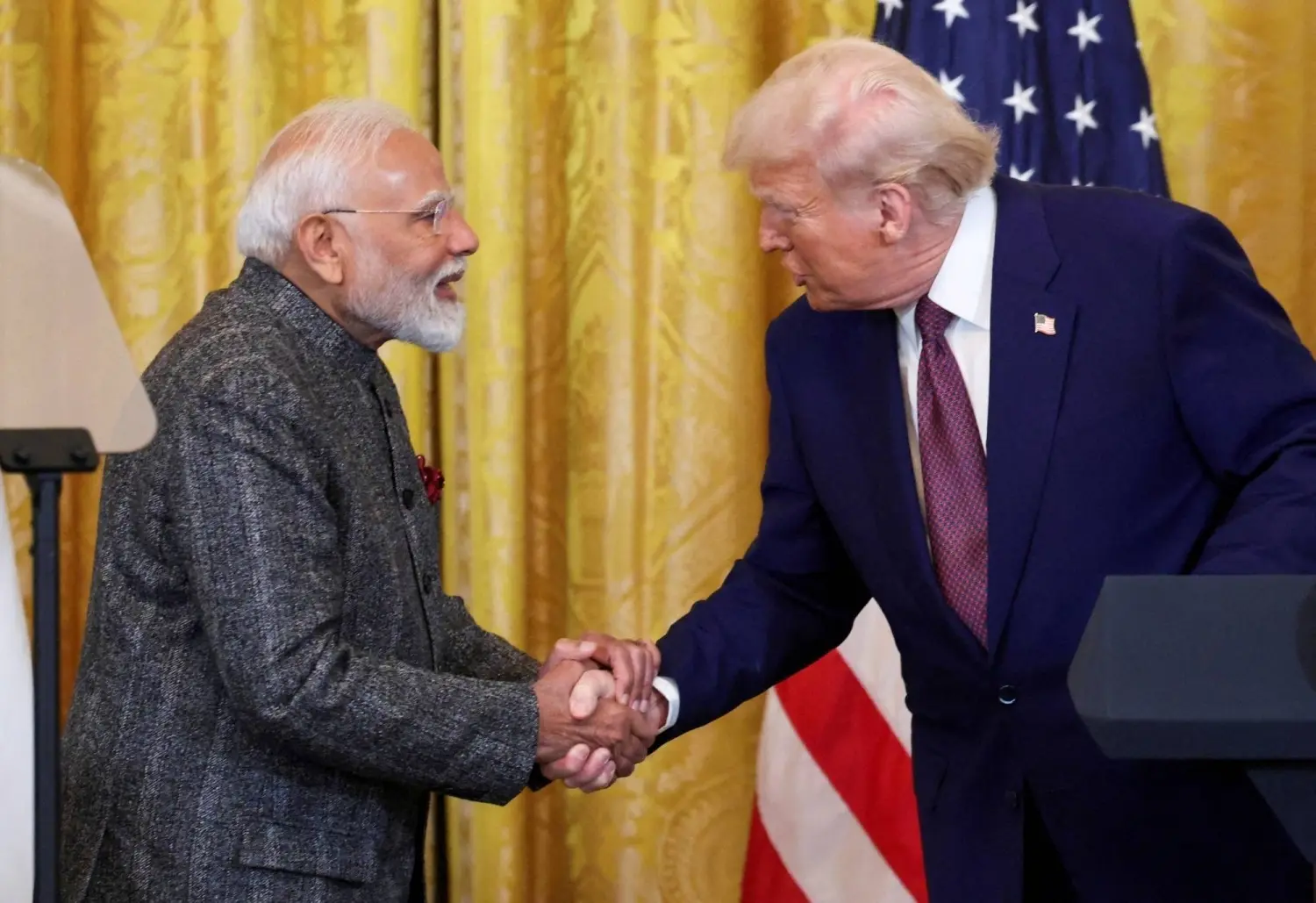
The United States and India took a decisive step toward comprehensive economic integration on Friday, announcing an interim trade framework that marks one of the most significant bilateral economic agreements in recent history. The announcement, which follows months of tense negotiations and escalating tariff disputes, promises to reshape trade flows between the world’s two largest democracies while fundamentally altering India’s energy procurement strategy.
Build the future you deserve. Get started with our top-tier Online courses: ACCA, HESI A2, ATI TEAS 7, HESI EXIT, NCLEX-RN, NCLEX-PN, and Financial Literacy. Let Serrari Ed guide your path to success. Enroll today.
The Framework Agreement: Core Provisions
The interim agreement, detailed in a joint statement released by both governments, establishes a pathway toward a broader Bilateral Trade Agreement (BTA) that officials hope to finalize by March 2026. At its core, the framework addresses the punishing tariff regime that had threatened to derail one of America’s most strategically important relationships in the Indo-Pacific region.
Under the terms of the agreement, Washington has committed to reducing the tariff rate on Indian goods from a crushing 50 percent to 18 percent. This reduction represents more than a simple numerical adjustment—it eliminates what had become a major impediment to Indian exporters across multiple sectors, from textiles and apparel to pharmaceuticals and engineering goods.
The 50 percent tariff had been composed of two separate levies: a 25 percent “reciprocal tariff” imposed on Indian goods as part of President Trump’s broader trade offensive, and an additional 25 percent penalty specifically targeting India’s purchases of Russian oil. With Friday’s announcement, Trump signed an executive order removing the oil-related penalty, conditional on India’s commitment to cease Russian crude imports.
For its part, India has agreed to eliminate or reduce tariffs on all US industrial goods and a wide range of American food and agricultural products. The commitment extends to items including dried distillers’ grains and red sorghum for animal feed, tree nuts, fresh and processed fruit, soybean oil, wine, and spirits—a concession that has already sparked fierce domestic opposition from India’s powerful agricultural lobby.
The Russian Oil Pivot: Geopolitics Meets Energy Security
Perhaps the most geopolitically significant element of the framework concerns India’s energy procurement strategy. For years, India has been one of the largest importers of Russian crude oil, a relationship that intensified dramatically after Russia’s invasion of Ukraine in February 2022.
According to data from maritime analytics firm Kpler, India imported approximately 1,163 thousand barrels per day of Russian oil in January 2026, making Russia the largest single source of crude for Indian refiners. This represented a substantial shift from pre-war levels, when Russian oil constituted merely 2.5 percent of India’s total oil imports in 2021.
The Trump administration had made India’s Russian oil purchases a central point of contention in bilateral relations. In August 2025, Washington imposed a 25 percent penalty tariff on Indian goods specifically because of these oil imports, arguing that India’s purchases were helping to finance Russia’s military operations in Ukraine. US Trade Representative Jamieson Greer repeatedly criticized India’s energy relationship with Moscow, pressing New Delhi to diversify its crude suppliers.
India’s Russian oil imports had become economically significant beyond simple volume metrics. Indian refiners, particularly the massive Jamnagar refinery complex operated by Reliance Industries, had been processing Russian crude at discounted prices and exporting refined petroleum products to global markets, including to the United States and European Union. This arbitrage opportunity allowed India to strengthen its position as the “world’s refinery” while benefiting from substantial cost savings.
Under the new framework, India has committed to halting direct and indirect imports of Russian oil and shifting procurement to American and potentially Venezuelan crude. Trump’s executive order explicitly states that US officials will monitor India’s compliance and recommend reinstating the 25 percent penalty if New Delhi resumes Russian oil purchases.
The $500 Billion Commitment
Beyond tariff reductions, the framework includes an ambitious commitment from India to purchase $500 billion worth of American goods over the next five years. This massive procurement pledge encompasses energy products, aircraft and aircraft parts, precious metals, technology products—including graphics processing units used for artificial intelligence applications—and coking coal.
The sheer scale of this commitment has raised eyebrows among economists and trade analysts. India’s total goods imports stood at $720.24 billion in the 2025 fiscal year, with imports from the United States totaling approximately $45.3 billion. Even at a staggered pace over five years, the $500 billion figure represents a dramatic escalation that some analysts view as aspirational rather than contractually binding.
Alexandra Hermann, lead economist at Oxford Economics, noted that “US President Trump’s claims that India will slash duties to zero, stop importing Russian oil, and raise US imports to US $500 billion have not yet been confirmed by the Indian authorities.” She added that these figures “look unrealistic to us, which in turn raises risks of US backtracking.”
One decision can change your entire career. Take that step with our Online courses in ACCA, HESI A2, ATI TEAS 7, HESI EXIT, NCLEX-RN, NCLEX-PN, and Financial Literacy. Join Serrari Ed and start building your brighter future today.
Agricultural Safeguards and Non-Tariff Barriers
The framework addresses longstanding friction points in US-India trade relations, particularly concerning agricultural market access and regulatory standards. India has agreed to address barriers to trade in American medical devices, eliminate restrictive import licensing procedures for US Information and Communication Technology goods, and determine within six months whether US-developed or international standards will be acceptable for American exports entering the Indian market.
However, Indian Commerce Minister Piyush Goyal emphasized that the agreement safeguards farmers’ interests and rural livelihoods by “completely protecting sensitive agricultural and dairy products.” Goyal stated that imports of genetically modified agricultural products would not be directly allowed, as there was no such provision in the pact. He indicated that certain fruits like apples would be allowed under a tariff quota system rather than unrestricted market access.
Despite these assurances, the agreement’s language regarding agricultural products has generated significant controversy. The joint statement commits India to addressing “long-standing non-tariff barriers to the trade in US food and agricultural products,” a formulation that farmer unions interpret as opening the door to substantial American agricultural imports.
Domestic Political Backlash: Farmer Unions Mobilize
The framework announcement has triggered fierce opposition from India’s agricultural sector, with major farmer organizations calling for nationwide protests and threatening sustained agitation against what they characterize as a betrayal of Indian farmers.
Samyukt Kisan Morcha (SKM), one of India’s most powerful umbrella organizations representing multiple farmers’ associations, has denounced the framework as a “total surrender” of Indian agriculture to American multinational corporations. The organization has demanded the immediate resignation of Commerce Minister Goyal and called for farmers to participate in protests culminating in a general strike on February 12.
SKM leader Jagjit Singh Dallewal highlighted what he described as contradictions between Goyal’s public assurances and the actual language of the joint statement. “While Commerce Minister Piyush Goyal is tweeting that agriculture and the dairy sector will be protected, the India-US joint statement says that India has agreed to discuss and resolve non-tariff barriers imposed on US agricultural and food products,” Dallewal said. “These two positions are contradictory, and the joint statement makes it clear that under US pressure, the Indian government has agreed to open Indian markets to American agricultural products.”
The agricultural sector’s concerns extend beyond abstract trade policy to concrete economic anxieties. India’s farming sector, while contributing just 16 percent to the nation’s GDP, provides livelihood to over 45 percent of the population. This makes farmers a crucial voting bloc, one that Prime Minister Modi’s Bharatiya Janata Party cannot afford to alienate.
Farmer organizations have demonstrated their capacity for sustained mobilization on multiple occasions. In 2021, the Modi government was forced to abandon agricultural reform legislation after year-long protests blocked highways around the national capital and culminated in farmers storming Delhi’s historic Red Fort complex with tractors.
Krishna Prasad, a leader of the All India Kisan Sabha, warned that the trade deal would have a “deep impact on the agriculture sector” by opening markets for items like dried distillers’ grains, red sorghum for animal feed, and soybean oil. He particularly highlighted concerns about the dairy sector and argued that the deal primarily benefits “stagnant” Western economies rather than Indian interests.
The opposition extends across the political spectrum. India’s opposition Congress party called the trade deal a “complete surrender” of national interests, arguing that it was concluded on American terms and would hurt both farmers and traders. Leader of Opposition Rahul Gandhi accused Modi of being “compromised” and having “surrendered on tariffs.”
Economic Impact and Strategic Implications
From an economic perspective, the tariff reduction offers significant relief to Indian exporters who had been struggling under the weight of 50 percent levies. Sectors expected to benefit most immediately include textiles and apparel, which operate on thin margins and had seen orders decline precipitously under the high-tariff regime. The pharmaceutical sector, gems and diamonds industry, and engineering goods manufacturers also stand to gain from improved price competitiveness in the American market.
Nitin Jain, CEO of Kotak Mahindra Asset Management Singapore, characterized the 18 percent tariff as placing India in a “pole position in the race to China +1 opportunity in global supply chains.” The rate is nearly half the tariffs applied to Chinese goods and lower than rates for other Asian competitors including Vietnam and Bangladesh.
Market reactions to the framework announcement were swift and positive. India’s benchmark equity indices rallied on the news, with investors interpreting the agreement as reducing uncertainty and improving the outlook for export-facing sectors. The Indian rupee strengthened against the dollar, reflecting renewed confidence in the bilateral economic relationship.
However, some analysts caution that the agreement’s ultimate impact will depend heavily on implementation details that remain unclear. Paul Donovan, chief economist at UBS Global Wealth Management, commented that the deal “as we know it, would have little effect” without more specificity regarding timelines, enforcement mechanisms, and sector-specific provisions.
The framework also carries significant geopolitical implications beyond its immediate commercial effects. The agreement represents a strategic reset after months of deteriorating relations that had threatened to undermine broader US-India cooperation on issues ranging from China containment to technology transfer and defense collaboration.
Evan Feigenbaum, vice president for studies at the Carnegie Endowment for International Peace, noted that while Washington and New Delhi should be proud of rescuing the relationship, “international politics isn’t the domain of unicorns and leprechauns, and collateral damage can’t simply be wished away.” He highlighted that during the extended period of US-India tensions, other powers—including China, Russia, Pakistan, and the European Union—had “took full advantage” to strengthen their own relationships with India.
The Path Forward
Both governments have indicated that the interim framework represents only the first phase of more comprehensive negotiations. Commerce Minister Goyal stated on Thursday that Washington and New Delhi aim to sign a formal trade agreement in March, after which India’s tariff cuts on American exports would go into effect.
The broader BTA negotiations are expected to address issues typically included in comprehensive free trade agreements, including digital trade rules, intellectual property protections, sanitary and phytosanitary measures, and technical barriers to trade. The two countries have also committed to cooperation on enforcement of export controls on sensitive technologies and addressing “non-market policies of third parties”—a clear reference to China’s economic practices.
For India, the framework offers an opportunity to demonstrate its value as a strategic partner to the United States while positioning itself as a reliable alternative to China in global supply chains. The 18 percent tariff rate provides Indian manufacturers with a competitive advantage that could attract foreign investment seeking to diversify production away from Chinese facilities.
However, significant challenges remain. The energy commitment to replace Russian crude with American and Venezuelan oil could strain India’s import bill and potentially widen its current account deficit, given that Russian crude had been available at substantial discounts to benchmark prices. The feasibility of Venezuela serving as a major alternative supplier is also questionable, as that country’s oil industry requires tens or hundreds of billions of dollars in capital expenditure to modernize facilities and increase production capacity.
The agricultural provisions face an even more uncertain future. With major farmer organizations mobilizing for protests and a general strike, the Modi government will need to carefully navigate between its commitment to the United States and the political imperative of maintaining support from rural voters. The government’s credibility on agricultural issues remains fragile following the 2021 farm law debacle, and any perception that the trade framework threatens farmer livelihoods could trigger sustained political opposition.
Conclusion
The US-India interim trade framework represents a pivotal moment in the bilateral relationship between the world’s oldest and largest democracies. By reducing tariffs, committing to substantial procurement increases, and realigning energy partnerships, the agreement addresses immediate commercial friction while laying groundwork for deeper economic integration.
Yet the framework’s announcement has also exposed fundamental tensions between India’s strategic partnership with the United States and domestic political realities. The fierce opposition from farmer organizations, skepticism about the feasibility of massive procurement commitments, and questions about India’s ability to rapidly shift energy suppliers all suggest that the path from framework to implementation will be neither smooth nor guaranteed.
As both nations move toward finalizing a comprehensive bilateral trade agreement, they will need to demonstrate that the interim framework represents more than political theater—that it can deliver tangible benefits to businesses and workers while managing the legitimate concerns of sectors vulnerable to increased import competition. The coming months will reveal whether this framework marks the beginning of a new era in US-India economic relations or becomes another example of ambitious trade announcements that fail to materialize into transformative change.
Ready to take your career to the next level? Join our Online courses: ACCA, HESI A2, ATI TEAS 7 , HESI EXIT , NCLEX – RN and NCLEX – PN, Financial Literacy!🌟 Dive into a world of opportunities and empower yourself for success. Explore more at Serrari Ed and start your exciting journey today! ✨
Track GDP, Inflation and Central Bank rates for top African markets with Serrari’s comparator tool.
See today’s Treasury bonds and Money market funds movement across financial service providers in Kenya, using Serrari’s comparator tools.
photo source: Google
By: Montel Kamau
Serrari Financial Analyst
10th February, 2026