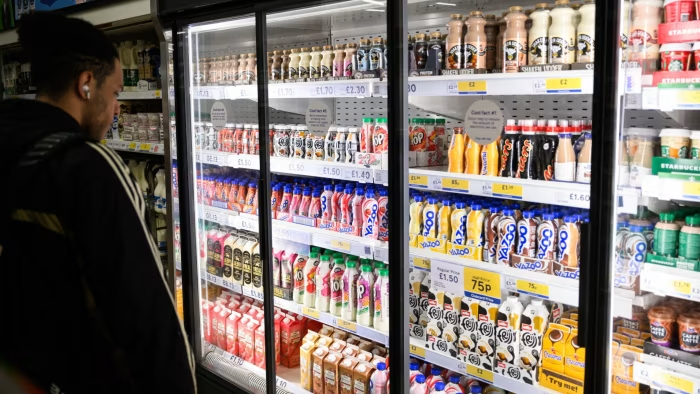
Sweet-toothed consumers across the United Kingdom face paying substantially more for bottled milkshakes and ready-to-drink lattes after the government confirmed ambitious plans for a significantly tougher sugar tax regime. Health Secretary Wes Streeting announced the expansion on November 25, 2025, declaring that the government “will not look away as children get unhealthier” amid rising obesity rates that continue to strain the National Health Service.
The levy, officially known as the Soft Drinks Industry Levy (SDIL), currently applies to drinks with a sugar content of 5 grams per 100 milliliters. However, following an extensive public consultation that ran from April to July 2025, this threshold is being cut to 4.5 grams per 100 milliliters, a move that will bring hundreds of additional products under the tax’s purview and create renewed pressure on manufacturers to reformulate their offerings.
Build the future you deserve. Get started with our top-tier Online courses: ACCA, HESI A2, ATI TEAS 7, HESI EXIT, NCLEX-RN, NCLEX-PN, and Financial Literacy. Let Serrari Ed guide your path to success. Enroll today.
Ending the Milk-Based Drink Exemption
Perhaps most significantly, the health secretary told the Commons that an exemption for milk-based drinks would be terminated, marking a fundamental shift in the government’s approach to tackling excessive sugar consumption among children and young people.
“We’re expanding the soft drinks industry levy to include bottles and cartons of milkshakes, flavoured milk and milk-substitute drinks,” Streeting stated emphatically during his Commons address. “This government will not look away as children get unhealthier and our political opponents urge us to leave them behind.”
According to the government’s consultation outcome document, the changes will not take immediate effect. Instead, there will be another consultation period before the legislation becomes operative on January 1, 2028. This provides drinks manufacturers with a two-year window to either reduce the sugar content of their products through reformulation or prepare to absorb the additional tax costs.
Previously, milk-based drinks enjoyed exemption from the sugar tax because they contain calcium and other nutrients that are encouraged in children’s and young people’s diets. However, mounting evidence about the high sugar content of some of these beverages—with certain products containing sugar levels comparable to traditional fizzy drinks—prompted the government to reconsider this policy position. Under the new framework, a “lactose allowance” will be introduced to account for naturally occurring sugars present in milk, ensuring that the tax targets only added sugars rather than penalizing nutritious dairy products.
Current Tax Structure and Revenue Expectations
At present, the sugar tax is charged at 18 pence per liter on drinks containing between 5g and 8g of total sugar per 100ml, and 24 pence per liter on drinks containing 8g of sugar or more per 100ml. These rates were established when the levy was first introduced and have been subject to periodic uprating to account for inflation.
Under the revised threshold of 4.5 grams per 100 milliliters, significantly more products will be captured by the lower tax band, while the highest band will continue to apply to drinks with extremely elevated sugar content. The Treasury estimates that the changes to the levy could raise between £40 million and £45 million annually once fully implemented in 2028, providing additional revenue that could be directed toward public health initiatives or general government expenditure.
The Original Sugar Tax: A Policy Success Story
The soft drinks industry levy was originally announced by George Osborne, then-Chancellor of the Exchequer, in his March 2016 budget and was subsequently implemented in April 2018. The levy was explicitly designed to incentivize manufacturers to reformulate their products rather than simply serving as a revenue-generating measure, representing a novel approach to public health taxation.
The original sugar tax has been widely deemed a remarkable success by public health experts, researchers, and government officials alike. Between 2015 and 2019, approximately 65% of soft drinks that initially contained more than 5g of sugar per 100ml were reformulated to fall below the threshold. By 2025, almost 90% of soft drinks available for sale in the UK contain less sugar than the level at which the tax applies, demonstrating the policy’s effectiveness in driving industry behavior change.
The levy has led to a 47% average reduction in sugar content of soft drinks in scope between 2015 and 2024, removing approximately 45-46 million kilograms of sugar from the nation’s diet annually. Remarkably, most of this reformulation occurred between the policy’s announcement in 2016 and its implementation in 2018, as manufacturers rushed to avoid the tax by launching lower-sugar alternatives.
Public Health Impact and Dental Health Crisis
The sugar tax’s health benefits extend beyond obesity prevention. Evidence suggests that sugar reductions delivered by the levy could have prevented up to 5,000 cases of obesity in girls in the last year of primary school (aged 10-11 years), with the greatest reductions observed among girls attending schools in the most deprived areas.
The dental health dimension of this policy is particularly salient given ongoing concerns about children’s oral health in England. Tooth decay remains the leading cause of hospital admissions among five- to nine-year-olds in England, consistently outpacing other common childhood conditions including acute tonsillitis. NHS England data revealed that 21,162 children aged 5-9 were admitted to hospital in 2024/2025 due to tooth decay, compared to 13,667 children admitted for acute tonsillitis.
Dr Charlotte Eckhardt, Dean of the Faculty of Dental Surgery at the Royal College of Surgeons of England, described the extension of the sugar levy as a “significant victory for public health.” The FDS had campaigned for the sugar threshold to be cut to 4 grams per 100ml but welcomed the 4.5g compromise as “a major step towards protecting children’s oral health.”
One decision can change your entire career. Take that step with our Online courses in ACCA, HESI A2, ATI TEAS 7, HESI EXIT, NCLEX-RN, NCLEX-PN, and Financial Literacy. Join Serrari Ed and start building your brighter future today.
Industry Response and Reformulation Challenges
The soft drinks industry’s response to the expanded levy has been measured, acknowledging both the commercial challenges and the technical complexities involved in further reformulation. A spokesperson for the Food and Drink Federation welcomed aspects of the government’s approach, stating: “The new proposals take into account the costly and technically complex work that companies have to do to bring healthier products to market.”
During the consultation process, drinks manufacturers had informed officials that they would struggle to develop new, lower-sugar recipes for products containing between 4g and 5g per 100ml, arguing that this range represents the technical limit of what is currently achievable. The dairy industry expressed particular concern about the challenges of reformulating milk-based beverages, where sugar plays multiple roles beyond sweetness, contributing to texture, viscosity, and overall mouthfeel.
Health Inequality Dimensions
A particularly compelling aspect of the sugar tax’s impact concerns its effects on health inequalities. Streeting has repeatedly emphasized this inequality dimension, stating that “an unhealthy start to life holds kids back from day one, especially those from poor backgrounds like mine.” The health secretary argued that childhood obesity “robs children of the best possible start in life, hits the poorest hardest, sets them up for a lifetime of health problems and costs the NHS billions.”
Government data indicates that children’s sugar intake in the UK is more than double the recommended maximum of no more than 5% energy from free sugar, with 12% of total energy in children aged 4-18 years coming from free sugars. For 11-18 year-olds specifically, 17% of free sugars consumed come from soft drinks.
Broader Obesity Strategy Context
The expanded sugar levy represents one component of a broader government strategy to address obesity. The combined health and economic costs of obesity are estimated at £35 billion annually, equivalent to one-third of the UK’s total education spending in 2022-23.
According to the Department of Health, the changes to the sugar levy could remove 17 million calories per day from the nation’s daily intake, helping to prevent cancer, heart disease, and stroke while reducing pressure on the NHS.
Conclusion: Balancing Public Health and Economic Realities
The extension of the UK’s sugar tax to pre-packaged milkshakes and lattes represents a significant evolution of public health policy. The move builds on the demonstrated success of the original Soft Drinks Industry Levy in driving product reformulation and improving health outcomes, particularly among disadvantaged children.
As Health Secretary Streeting emphasized, the ultimate measure of success will be health improvements rather than revenue collected. A levy that raises relatively little money because manufacturers have reformulated their products will have achieved its primary objective far more effectively than one that simply extracts revenue from continuing sales of high-sugar beverages.
Catch up with our latest Headlines:
- African Development Bank Commits $15 Million to Adenia Fund Targeting SME Growth Across Africa
- Amazon’s $15 Billion Indiana Investment Signals Major AI Infrastructure Expansion in the Midwest
- NCBA Group Launches Offshore Investment Platform to Connect Kenyan Investors with Global Markets
- Ethiopia Emerges as Sub-Saharan Africa’s Fastest Growing Economy with 7.2% IMF Growth Projection for 2025
- US September Jobs Report Reveals Mixed Labor Market as Unemployment Reaches Four-Year High Despite Job Gains
- Kenya Secures Duty-Free Agricultural Export Access to Malaysia in Strategic Partnership Agreement
Ready to take your career to the next level? Join our Online courses: ACCA, HESI A2, ATI TEAS 7 , HESI EXIT , NCLEX – RN and NCLEX – PN, Financial Literacy!🌟 Dive into a world of opportunities and empower yourself for success. Explore more at Serrari Ed and start your exciting journey today! ✨
Track GDP, Inflation and Central Bank rates for top African markets with Serrari’s comparator tool.
See today’s Treasury bonds and Money market funds movement across financial service providers in Kenya, using Serrari’s comparator tools.
photo source: Google
By: Montel Kamau
Serrari Financial Analyst
26th November, 2025