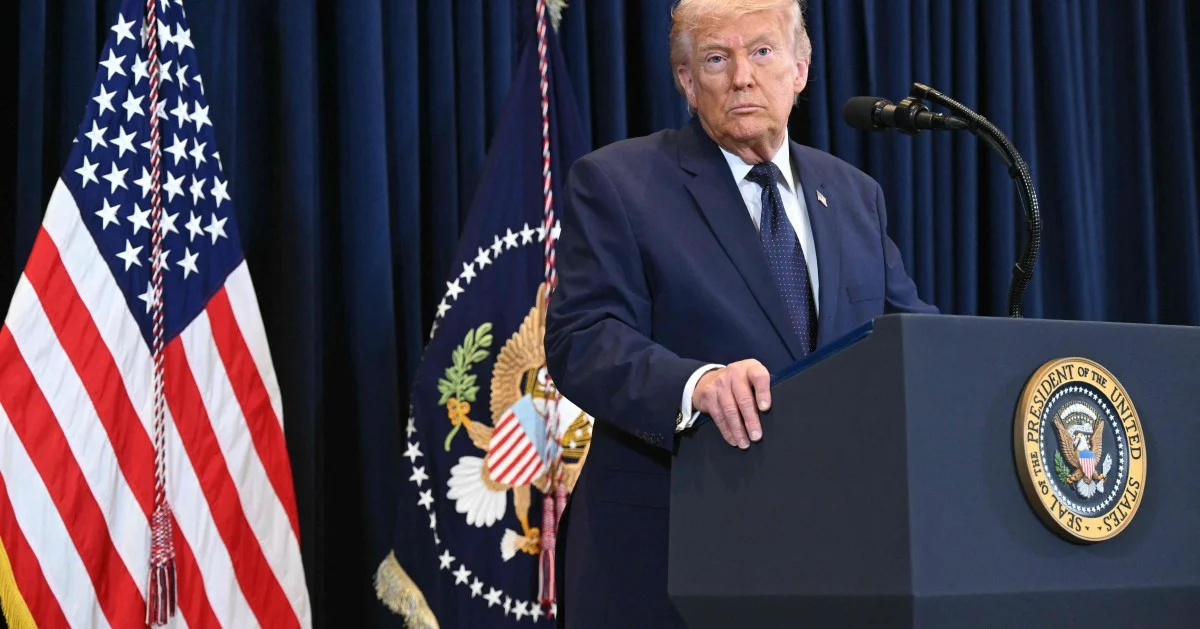












The United States trade deficit collapsed to its lowest level in more than 16 years during October 2025, delivering a dramatic validation of President Donald Trump’s tariff-centric trade strategy while simultaneously raising questions about the sustainability and broader economic implications of this historic trade policy transformation. According to data released Thursday by the Department of Commerce, the overall trade gap plunged 39% to $29.4 billion—the smallest monthly deficit since June 2009, when the United States was just emerging from the financial crisis and Great Recession.
The dramatic contraction came as exports increased 2.6% while imports slipped 3.2%, creating a rare confluence of factors that economists had largely deemed improbable under the Trump administration’s sweeping tariff regime. The October figure represented a sharp departure from September’s deficit of $48.1 billion and defied economist expectations, with the median forecast from surveys conducted by Dow Jones Newswires and The Wall Street Journal anticipating a reading of $58.4 billion—nearly double the actual result.
Build the future you deserve. Get started with our top-tier Online courses: ACCA, HESI A2, ATI TEAS 7, HESI EXIT, NCLEX-RN, NCLEX-PN, and Financial Literacy. Let Serrari Ed guide your path to success. Enroll today.
The Liberation Day Tariffs and Their Aftermath
The October trade figures reflect activity approximately six months after President Trump implemented his controversial “Liberation Day” tariffs on April 2, 2025—a date the president proclaimed as marking “one of the most important days in American history” and America’s “declaration of economic independence.” The comprehensive tariff package imposed a baseline 10% levy on imports from virtually all countries, with customized rates reaching as high as 54% for Chinese goods when combined with previously imposed duties.
Trump signed Executive Order 14257 during a White House Rose Garden ceremony, declaring a national emergency over the United States’ trade deficit and invoking the International Emergency Economic Powers Act to authorize the sweeping import taxes. The administration characterized these measures as “reciprocal,” asserting they mirrored and counteracted trade barriers faced by U.S. exports, though critics noted the tariffs were actually based on bilateral trade deficits rather than true reciprocity of foreign tariff rates.
The announcement triggered immediate global market turmoil, with the U.S. total stock market index plunging 12.4% in the week following April 2—the biggest drop since the COVID-19 pandemic. Facing this economic shock, the White House suspended the higher country-specific tariff increases scheduled for April 9, allowing time for negotiations with trading partners while maintaining the 10% baseline duty.
Composition of the Trade Balance Shift
The October trade data revealed a complex and somewhat surprising composition underlying the deficit reduction. Goods exports climbed $7.1 billion to $195.9 billion, led overwhelmingly by industrial supplies and materials, which surged $10.2 billion. Particularly striking was the $6.8 billion jump in non-monetary gold exports, which economists noted “clouded the trade picture” and made the deficit appear narrower than underlying product trends might suggest.
On the import side, the contraction was both substantial and concentrated in specific categories. Goods imports fell by $12.1 billion to $255.0 billion, with particularly sharp declines in pharmaceutical preparations, which plummeted $14.3 billion in a single month—by far the largest sectoral decline. Consumer goods imports also dropped $14.0 billion, while imports of auto parts, oil and natural gas, and fruits and vegetables all registered smaller but meaningful decreases.
These pharmaceutical import declines reflected unusual volatility in the sector, as firms had stockpiled heavily in early 2025 ahead of anticipated tariff implementations. The October figures may also have been impacted by trade policy announcements during that month, creating further distortions in normal import patterns. Economists cautioned that extrapolating long-term trends from such volatile monthly data could prove misleading.
Interestingly, even as overall imports contracted, certain categories continued expanding. Imports of high-tech capital goods maintained their upward trajectory, benefiting from tariff waivers granted to the technology industry and the ongoing buildout of data centers to support artificial intelligence infrastructure—a sector the administration has prioritized despite its general protectionist orientation.
Bilateral Trade Balance Improvements
The October data also revealed significant improvements in bilateral trade relationships with key partners. The deficit with the European Union fell by approximately $9 billion from the prior month to $7.956 billion, while the deficit with Ireland—a major hub for pharmaceutical and technology companies—declined sharply by $15.1 billion to $3.2 billion, though this reduction appears heavily influenced by the pharmaceutical import volatility noted earlier.
Trade balances with China and India remained relatively stable from September to October, totaling $14.937 billion and $2.906 billion respectively, suggesting that while the overall U.S.-China trade relationship remains deeply imbalanced, month-to-month fluctuations have moderated following the initial shock of increased tariffs. Surpluses widened with several trading partners, including the United Kingdom ($6.8 billion), Switzerland ($8.833 billion), Singapore ($1.836 billion), and Brazil ($2.581 billion), indicating that some U.S. export sectors have maintained competitiveness despite foreign retaliatory measures.
Economic Growth Implications and GDP Impact
The unexpectedly strong trade performance triggered a dramatic upward revision in fourth-quarter economic growth projections. The Atlanta Federal Reserve’s GDPNow model lifted its estimate of fourth-quarter real GDP growth to a blockbuster 5.4% annualized rate on January 8, up from a prior estimate of 2.7% earlier in the same week. This dramatic revision was triggered almost entirely by the better-than-expected October trade figures, with net exports now adding nearly 2.0 percentage points to GDP growth after previously subtracting from the forecast.
Chris Rupkey, chief economist at Fwdbonds, wrote that the decelerating trade imbalance “will provide a much needed boost for fourth quarter economic growth that has been hit hard by the Federal government shutdown.” He added that “the U.S. appears to be winning the trade war with tariffs curbing the imports of foreign goods, but America’s trading partners are not holding any grudge as they continue to buy more American goods and services.”
If realized, this would mark the strongest quarterly growth rate since 1984, outside of the immediate post-pandemic rebound period. However, economists cautioned that a single month’s trade data, particularly one as volatile as October 2025, provides an incomplete picture of sustainable economic trends. The year-to-date deficit through October remained 7.7% higher than the same period in 2024, at nearly $783 billion compared to $736 billion, suggesting that the October improvement may prove anomalous rather than indicative of a lasting shift.
Productivity Surge Complicates Labor Market Narrative
Adding another dimension to the economic picture, the Bureau of Labor Statistics reported Thursday that third-quarter productivity rose at a 4.9% annualized rate, marking the fastest pace of productivity growth in two years and significantly exceeding economist expectations of 3.6%. This represented an acceleration from an upwardly revised 4.1% advance in the second quarter, creating an average productivity gain of 4.5% over the past six months.
The productivity surge came as output increased 5.4% while hours worked rose by just 0.5%, indicating that businesses are successfully producing more with relatively stable labor inputs. Matthew Martin, Senior U.S. Economist at Oxford Economics, observed that “the latest figures suggest firms are successfully doing more with less labor, giving more credence to a jobless expansion.”
This productivity acceleration helped push unit labor costs down 1.9% for the third quarter—far more than expected and a strong indication that the labor market is not putting upward pressure on inflation despite the tariff-induced price increases in many imported goods categories. The decline in unit labor costs, combined with real hourly compensation edging down 0.2% during the quarter, suggests that workers have lost some leverage in seeking higher wages amid a weak hiring environment.
Martin noted that “if productivity growth continues to accelerate due to tax cuts, deregulation, and technological advancements, including AI, economic growth can pick up without causing unwanted inflation.” This dynamic could provide critical breathing room for the economy as it absorbs the inflationary impact of tariffs, though it also raises questions about whether wage growth can keep pace with living costs for American workers.
Labor Market Resilience Despite Hiring Weakness
While hiring has been notably weak throughout 2025, the Labor Department reported Thursday that layoffs remain historically low, suggesting businesses are reluctant to shed workers despite reduced hiring appetite. Initial unemployment claims for the week ended January 3 totaled 208,000, pushing the four-week moving average to its lowest level since April 27, 2024.
This combination of weak hiring but low layoffs, coupled with surging productivity, paints a picture of an economy in transition—one where businesses are adapting to higher input costs from tariffs by wringing more output from existing workforces rather than expanding employment. The sustainability of this model remains uncertain, particularly as the productivity gains may partly reflect cyclical factors or measurement anomalies rather than durable improvements in underlying productive capacity.
One decision can change your entire career. Take that step with our Online courses in ACCA, HESI A2, ATI TEAS 7, HESI EXIT, NCLEX-RN, NCLEX-PN, and Financial Literacy. Join Serrari Ed and start building your brighter future today.
Legal Challenges and Policy Uncertainty
The trade policy landscape remains clouded by significant legal uncertainty. A large swath of Trump’s tariffs face legal challenges, with the Supreme Court due to rule on the legality of tariffs imposed using the International Emergency Economic Powers Act. The high court heard arguments in November 2025 on whether the president overstepped his constitutional authority in imposing these duties.
If the conservative-majority Supreme Court were to rule against the administration, it could temporarily invalidate many country-specific tariffs imposed under IEEPA, though sector-specific duties imposed under different legal authorities would likely remain unaffected. Treasury Secretary Scott Bessent has acknowledged that “there are lots of other authorities that can be used, but IEEPA is by far the cleanest, and it gives the U.S. and the president the most negotiating authority.”
Predictive markets suggest only a 23% chance the Supreme Court will rule in favor of Trump’s tariffs, though the administration has indicated it would pursue alternative legal frameworks if necessary. An adverse ruling could create significant disruption, potentially entitling businesses to billions in refunds for duties already paid on imports throughout 2025.
Consumer Impact and Tariff Rate Reality
Despite the administration’s claims that foreign countries bear the cost of tariffs, mainstream economists broadly agree that U.S. companies and consumers ultimately pay these taxes through higher prices. As of mid-November, The Budget Lab at Yale University estimated that consumers face an overall average effective tariff rate topping 16%—the highest since the 1930s Smoot-Hawley Tariff Act, which is widely credited with deepening the Great Depression by triggering a global trade war.
The administration has more recently expanded the range of goods exempted from certain tariffs, particularly covering key agricultural imports, in response to affordability concerns among U.S. households grappling with persistent inflation. Many of these exemptions were scheduled to take effect in November, after the October trade data was collected, suggesting future monthly trade figures may show different patterns as businesses and consumers adjust to the evolving tariff landscape.
Consumer confidence recently hit a 12-year low, driven partly by expectations of higher prices resulting from Trump’s tariffs. Economists who studied tariffs imposed during Trump’s first term found they were largely passed on to consumers rather than absorbed by foreign exporters through price reductions, contradicting the administration’s persistent claims about who bears the economic burden of these trade policies.
Global Trade Relations and Retaliatory Measures
The Liberation Day tariffs announcement prompted immediate pledges of retaliation from major trading partners. China’s Ministry of Commerce stated it “firmly opposes this and will take countermeasures to safeguard its own rights and interests,” though specific retaliatory measures have been calibrated carefully to avoid triggering an uncontrollable escalation spiral.
European Commission President Ursula von der Leyen indicated the EU was preparing countermeasures, noting they were “already finalising the first package of countermeasures in response to tariffs on steel.” By mid-2025, the administration had announced trade deals with eight trading partners—the UK, Vietnam, the Philippines, Indonesia, Japan, South Korea, the EU, and a temporary truce with China—though many of these agreements maintained significant tariff levels while providing frameworks for ongoing negotiations.
Japan, heavily reliant on U.S. security guarantees given its proximity to China and North Korea, has pursued quiet diplomacy rather than direct confrontation. Canada, America’s second-largest trading partner, initially threatened retaliatory tariffs but has largely been exempted from the reciprocal tariff framework, though it remains subject to the administration’s earlier steel, aluminum, and automotive duties.
Year-to-Date Context and Structural Questions
While October’s trade performance was historically striking, the year-to-date figures provide essential context for assessing whether tariffs are achieving their stated objectives. Through the first ten months of 2025, the cumulative goods and services deficit reached nearly $783 billion—7.7% higher than the $736 billion recorded during the same period in 2024. This suggests that while tariffs may be influencing monthly trade flows, they have not yet succeeded in structurally reducing America’s trade imbalance with the rest of the world.
The composition of this year-to-date deficit also reveals important dynamics. While goods imports have fallen in response to tariff pressures, they have not declined as dramatically as the administration projected. Simultaneously, U.S. export growth has been constrained by foreign retaliatory measures and by global economic uncertainty created by the threat of escalating trade tensions.
Bradley Saunders, North America economist with Capital Economics, noted that “swings in trade of gold and pharmaceuticals were behind the plunge in the trade deficit to a two-decade low in October, though higher computer imports suggest there are genuine signs of strength elsewhere in the economy amid the AI buildout.” This observation underscores the challenge of distinguishing sustainable trends from temporary anomalies in highly volatile monthly trade data.
Manufacturing Employment and Investment Reality
Despite Trump’s April promise that “jobs and factories will come roaring back into our country,” the actual employment data tells a more sobering story. Manufacturing employment has declined every month since April, with approximately 67,000 fewer Americans employed in manufacturing in November compared to April—directly contradicting the administration’s central justification for its tariff policies.
Total manufacturing construction spending, which measures factory building activity, has also declined throughout 2025, suggesting that despite higher tariff protection, manufacturers are not rushing to expand domestic capacity. This may reflect uncertainty about the durability of current trade policies, concerns about input cost inflation due to tariffs on imported components, or skepticism about whether tariff-induced domestic demand can compensate for reduced export opportunities.
The pharmaceutical sector, which Trump specifically promised would “come roaring back” due to tariffs, has seen no meaningful policy action. The long-awaited tariff on pharmaceutical goods has yet to materialize, with many imported drugs remaining exempt as 2025 draws to a close. Similarly, despite repeated threats, chipmakers have faced constant delays rather than actual tariff implementation, with the administration offering massive carveouts for companies building facilities in the United States.
Fiscal Implications and Debt Trajectory
Trump’s Liberation Day speech included sweeping promises about tariff revenues addressing America’s fiscal challenges. However, the national debt has risen from approximately $36.1 trillion on April 2 to over $38.2 trillion as of early January 2026—an increase of more than $2 trillion in less than nine months.
While tariff revenues have indeed increased substantially, reaching a record high of $31.4 billion in October according to administration figures, these collections have not offset the broader fiscal pressures facing the federal government. The extended government shutdown that occurred in 2025 further complicated the fiscal picture, delaying not only the release of economic data but also tax collection and spending execution.
Economic modeling by organizations like CSIS estimated that the April tariffs, combined with other Trump tariff policies, would generate approximately $330 billion in annual revenue—significantly less than the $600 billion figure floated by White House economic adviser Peter Navarro in January 2025. More critically, these same analyses projected the tariffs would reduce U.S. GDP by roughly 1%, equivalent to about $300 billion in annual output loss at 2024 GDP levels, potentially offsetting much of the revenue gain through reduced economic activity and associated tax receipts.
Forward Outlook and Sustainability Questions
As 2026 begins, the sustainability of October’s exceptional trade performance remains highly uncertain. Economists point to several factors that could prevent similar results in coming months. First, the pharmaceutical import collapse appears largely driven by inventory volatility rather than permanent demand destruction, suggesting imports in this category could rebound sharply. Second, the gold export surge that artificially narrowed the deficit may not persist at current levels. Third, as tariff exemptions expand and businesses complete their adjustment to the new trade regime, import levels may stabilize at higher levels than October suggested.
The real inflation-adjusted trade picture also merits attention. The real goods deficit shrank nearly 20% in October as real imports fell faster than real exports, but this may partly reflect price distortions created by the tariffs themselves rather than genuine improvements in underlying trade competitiveness. If foreign suppliers ultimately lower their prices to maintain market access—as the administration claims they will—the real trade balance could deteriorate even as the nominal balance appears to improve.
Matthew Martin of Oxford Economics emphasized that “productivity will be key to determining the economy’s speed limit and inflationary dynamics.” If the recent productivity acceleration proves durable and driven by genuine technological improvements, particularly AI adoption, the economy may be able to sustain higher growth without triggering inflation even as tariffs push up import prices. However, if productivity gains prove transitory or if they primarily reflect reduced labor inputs rather than enhanced capital efficiency, the economy could face a more challenging tradeoff between growth and inflation.
The October trade data, while historically significant, thus represents a single data point in an ongoing economic experiment whose ultimate consequences remain deeply uncertain. The narrowing deficit validates Trump’s claim that tariffs can reduce imports and potentially improve bilateral trade balances in the short run. Whether these effects prove durable, whether they come at an acceptable cost in terms of consumer prices and economic growth, and whether they ultimately succeed in achieving the administration’s broader objectives of revitalizing American manufacturing and reducing dependence on foreign supply chains are questions that will only be answered over years rather than months.
Ready to take your career to the next level? Join our Online courses: ACCA, HESI A2, ATI TEAS 7 , HESI EXIT , NCLEX – RN and NCLEX – PN, Financial Literacy!🌟 Dive into a world of opportunities and empower yourself for success. Explore more at Serrari Ed and start your exciting journey today! ✨
Track GDP, Inflation and Central Bank rates for top African markets with Serrari’s comparator tool.
See today’s Treasury bonds and Money market funds movement across financial service providers in Kenya, using Serrari’s comparator tools.
Photo source: Google
By: Montel Kamau
Serrari Financial Analyst
9th January, 2026
Article, Financial and News Disclaimer
The Value of a Financial Advisor
While this article offers valuable insights, it is essential to recognize that personal finance can be highly complex and unique to each individual. A financial advisor provides professional expertise and personalized guidance to help you make well-informed decisions tailored to your specific circumstances and goals.
Beyond offering knowledge, a financial advisor serves as a trusted partner to help you stay disciplined, avoid common pitfalls, and remain focused on your long-term objectives. Their perspective and experience can complement your own efforts, enhancing your financial well-being and ensuring a more confident approach to managing your finances.
Disclaimer: This article is for informational purposes only and does not constitute financial advice. Readers are encouraged to consult a licensed financial advisor to obtain guidance specific to their financial situation.
Article and News Disclaimer
The information provided on www.serrarigroup.com is for general informational purposes only. While we strive to keep the information up to date and accurate, we make no representations or warranties of any kind, express or implied, about the completeness, accuracy, reliability, suitability, or availability with respect to the website or the information, products, services, or related graphics contained on the website for any purpose. Any reliance you place on such information is therefore strictly at your own risk.
www.serrarigroup.com is not responsible for any errors or omissions, or for the results obtained from the use of this information. All information on the website is provided on an as-is basis, with no guarantee of completeness, accuracy, timeliness, or of the results obtained from the use of this information, and without warranty of any kind, express or implied, including but not limited to warranties of performance, merchantability, and fitness for a particular purpose.
In no event will www.serrarigroup.com be liable to you or anyone else for any decision made or action taken in reliance on the information provided on the website or for any consequential, special, or similar damages, even if advised of the possibility of such damages.
The articles, news, and information presented on www.serrarigroup.com reflect the opinions of the respective authors and contributors and do not necessarily represent the views of the website or its management. Any views or opinions expressed are solely those of the individual authors and do not represent the website's views or opinions as a whole.
The content on www.serrarigroup.com may include links to external websites, which are provided for convenience and informational purposes only. We have no control over the nature, content, and availability of those sites. The inclusion of any links does not necessarily imply a recommendation or endorsement of the views expressed within them.
Every effort is made to keep the website up and running smoothly. However, www.serrarigroup.com takes no responsibility for, and will not be liable for, the website being temporarily unavailable due to technical issues beyond our control.
Please note that laws, regulations, and information can change rapidly, and we advise you to conduct further research and seek professional advice when necessary.
By using www.serrarigroup.com, you agree to this disclaimer and its terms. If you do not agree with this disclaimer, please do not use the website.
www.serrarigroup.com, reserves the right to update, modify, or remove any part of this disclaimer without prior notice. It is your responsibility to review this disclaimer periodically for changes.
Serrari Group 2025