










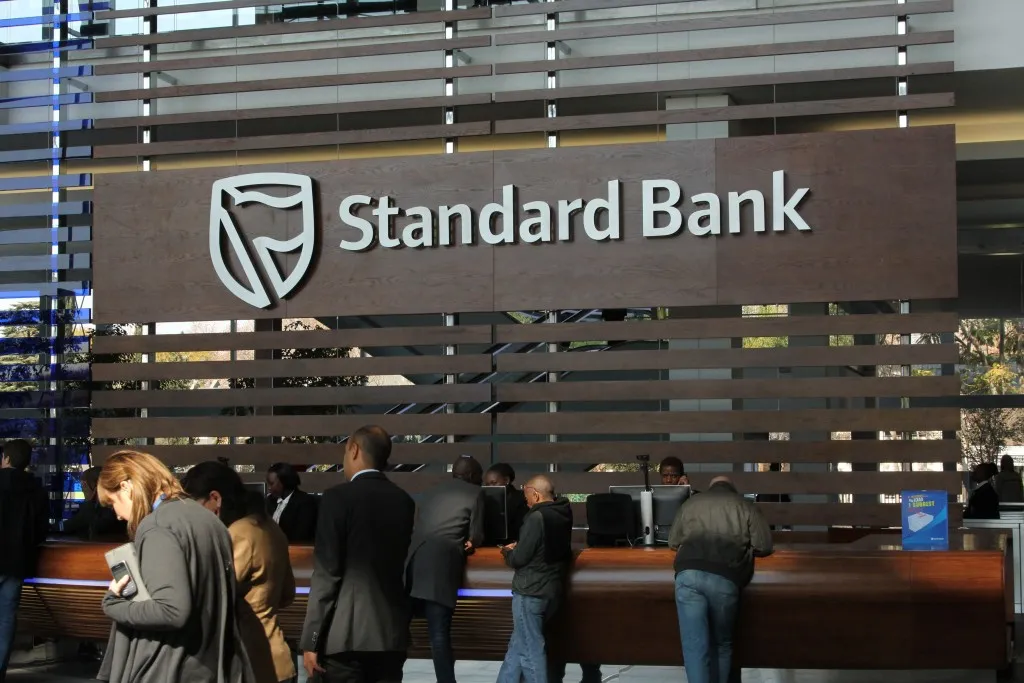
Standard Bank Group, Africa’s biggest lender by assets, has delivered a landmark full-year performance for 2025, posting record headline earnings underpinned by a rapidly expanding client base, robust fee and commission income, and a surge in trading revenue driven by currency and market volatility across the continent. The results not only surpassed analyst expectations but confirmed the successful completion of a multi-year transformation strategy the bank first outlined in 2021.
Markets move fast; don’t get left behind. We’ve paired the Serrari Group Market Index with a curated Marketplace and a comprehensive Financial Literacy Course to ensure you have the data—and the skills—to act on it.
Record Earnings Beat Market Estimates
Headline earnings for the year climbed 10.5% to R49.2 billion ($2.9 billion), the Johannesburg-based lender announced. The result comfortably outpaced the R48.2 billion median estimate compiled by Bloomberg. Attributable profit was 12% higher at R49.1 billion, while total net income reached R194.76 billion for the year.
The lender declared a final dividend of R8.78 per share, bringing the total payout for the year to a record R16.95 — a 12% year-on-year increase — rewarding shareholders after years of disciplined execution.
The bank’s return on equity improved to 19.3% from 18.5% in 2024, landing at the top end of its 2025 target range of 17% to 20%. Standard Bank also reported a strong common equity tier 1 ratio of 13.8%, up from 13.5% in the prior year, underscoring the robustness of the group’s capital position.
Standard Bank’s shares rose as much as 2.8% in early trade on the Johannesburg Stock Exchange before paring gains to 0.5%, while the benchmark FTSE/JSE All Share Index fell 0.8% on the same day.
The SBG 2025 Strategy: Targets Set in 2021, Delivered in Full
Perhaps the most significant narrative in this results announcement is the successful conclusion of the SBG 2025 strategy. According to Daily Investor, the targets were laid out in August 2021 as a post-pandemic reset plan designed to transform Standard Bank from a traditional financial institution into a digital platform business. At the time, the bank was grappling with flat revenue growth, a cost-to-income ratio of 59.1% and a return on equity of just 8.9%.
Four years on, the bank has exceeded every benchmark it set. Headline earnings grew at a compound annual rate of 25% over the past five years, while the dividend per share surged at an annual rate of 48%. The bank’s cost-to-income ratio has improved to 50.2%, compared with the earlier 59.1%, and the return on equity has more than doubled.
“2025 marked a significant milestone as we achieved or surpassed the ambitious financial targets we set in 2021, validating our strategy and confirming our capacity for disciplined execution,” CEO Sim Tshabalala said. “Put simply, we keep our promises, and we meet our targets.”
Client Growth and Fee Income Drive the Engine
At the heart of the record results is a structurally growing revenue base. The lender, backed by Industrial & Commercial Bank of China, added 3.3% more clients during the year to reach a total of 19.6 million. This client growth had a direct multiplier effect on non-interest income, which grew 10% to R63.75 billion.
Net fee and commission revenue rose 11% as the growing customer base drove increased transactional activity across digital platforms and physical channels alike. The increase in the customer base also drove deposits up 11% to R2.4 trillion, while gross loans and advances jumped 6%. Net interest income climbed 4% as a result of the larger average balance sheet. The bank now holds R3.62 trillion in total assets, firmly anchoring its position as the continent’s largest bank by assets.
Credit quality also improved. Credit impairment charges declined by 5%, with the retail and business portfolios benefiting from an improved macroeconomic environment, enhanced collection strategies, and earlier intervention on struggling clients. The credit loss ratio fell to 73 basis points from 83 basis points in 2024. However, impairment charges in the corporate portfolio rose, with increases in financial investments driven by deteriorating sovereign credit risk, primarily in Mozambique.
Trading Revenue Surges on African Market Volatility
Beyond fee income, a notable contributor to the 2025 performance was the bank’s trading division. Trading revenue grew 10% on the back of heightened market volatility, which boosted client activity and market-making opportunities across African debt and currency markets.
The South African rand was particularly active. The one-year historical volatility of the rand stood at 10% at the end of 2025, the highest among major currencies on the continent. This elevated volatility, which creates wider bid-ask spreads and higher volumes for banks like Standard Bank, was a direct contributor to trading revenue growth.
The volatility is unlikely to dissipate soon. Coordinated U.S. and Israeli strikes on Iran have amplified global uncertainty and pushed oil prices sharply higher. Iran’s retaliatory actions and the risk of disruption to the Strait of Hormuz — through which roughly one-fifth of global oil supply passes daily — have sharply altered market expectations. The rand, described as one of the most risk-sensitive emerging market currencies, has come under renewed pressure, reversing some of the gains it made in early 2026 when it briefly strengthened below the R15.70 per dollar mark.
Standard Bank directly acknowledged the geopolitical risk in its results statement. “Geopolitical developments in the Middle East, particularly the conflict involving Iran, continue to introduce uncertainty,” the bank said. “While our guidance includes current information, an enduring or escalated conflict could affect macroeconomic assumptions, including on trade, inflation, and growth.”
For the bank, this geopolitical turbulence is a double-edged sword. Sustained volatility in African currencies and debt markets can enhance short-term trading revenues, but prolonged instability poses risks to loan portfolios, particularly in markets with heavy commodity export dependence and sovereign credit vulnerability.
Context is everything. While you follow today’s updates, use the Serrari Market Index and Marketplace to spot emerging shifts. Need to sharpen your edge? Our Financial Literacy Course turns these insights into a professional-grade strategy.
Insurance and Asset Management: A Standout Unit
Standard Bank’s insurance and asset management division delivered some of the most impressive growth in the group. Headline earnings in that unit grew 26% to R4.1 billion, reflecting both strong product uptake and improved investment returns. The division has increasingly been cited by management as a key pillar of the group’s diversified earnings model, which reduces over-reliance on traditional net interest income.
The insurance and asset management contribution has grown markedly as South African consumers increasingly seek savings and protection products amid a complex macroeconomic backdrop, and as the bank deepens its reach into middle-income and mass-market segments.
Africa Regions: 40% of Group Earnings
Standard Bank’s pan-African strategy continued to bear fruit. Headline earnings at rest-of-Africa operations climbed 9%, with the Africa Regions unit now making up 40% of the group’s total headline earnings, delivering R19.7 billion. South Africa’s own banking operations, where income surged 16%, accounted for 51% of headline earnings at R24.9 billion. Offshore businesses contributed R3.1 billion (6%), while the group’s 40% stake in ICBC Standard Bank Plc added a further R1.5 billion (3%).
The key contributors to Africa Regions’ earnings were Angola, Ghana, Kenya, Mauritius, Nigeria, Tanzania, Uganda, and Zambia. The diversification of earnings across these markets reflects the group’s deliberate strategy to leverage Africa’s structural growth story, including a young and rapidly urbanising population, rising financial inclusion, and growing intra-African trade.
This geographical diversification also provides a natural hedge: while South Africa-specific risks such as load-shedding, fiscal concerns, and political uncertainty can weigh on domestic operations, growth markets in East and West Africa can offset some of these pressures. The International Monetary Fund expects sub-Saharan Africa to grow 4.4% in 2025 and accelerate to 4.6% in subsequent years, providing a favorable macro backdrop for the bank’s Africa-wide operations.
Looking Ahead: ROE Target Raised for 2028
Standard Bank’s management is looking ahead with ambition. The bank expects return on equity to remain within its target range of 17-20% in the near term, while targeting an improved range of 18% to 22% by 2028, compared with a 16% average return on equity over the decade to 2024. For 2026 to 2028, it expects headline earnings per share growth of 8% to 12% annually.
Management also reaffirmed its medium-term guidance: mid- to high single-digit banking revenue growth, a cost-to-income ratio that is flat to marginally declining year-on-year, and continued credit loss ratio improvement. These targets are framed against a backdrop of ongoing global trade disruptions and geopolitical uncertainty, risks the bank acknowledges but believes are manageable given its diversified earnings base.
Sustainable Finance: R100 Billion Mobilised in 2025 Alone
One of the more striking figures in Standard Bank’s 2025 results was the scale of its sustainable finance activity. The group has cumulatively mobilised more than R277 billion in sustainable finance since 2022, with R100 billion added in 2025 alone — the largest single-year mobilisation in the bank’s history.
The bank has also raised its overall sustainable finance ambition significantly. Earlier in 2025, Standard Bank increased its sustainable finance mobilisation target from R250 billion by 2026 to R450 billion by 2028, an 80% increase in ambition reflecting both the growing pipeline of eligible assets and the bank’s deepening integration of sustainability across its operations. The updated target encompasses renewable energy financing, climate transition initiatives, social impact lending, and infrastructure development across the continent.
Standard Bank’s energy supply ratio — the share of finance directed to renewable power generation relative to non-renewable — stood at nearly six times by the end of 2024, up sharply from prior years. Projects supported include large-scale solar and wind installations, battery energy storage systems, and decentralised energy solutions for small businesses and households across sub-Saharan Africa.
“Our approach to sustainability is deeply rooted in our purpose: Africa is our home; we drive her growth,” said Boitumelo Sethlatswe, Standard Bank Group Head of Sustainability. “Our commitments reflect our ambition to be a leading green energy player on the continent.”
600 million people across Africa still lack access to electricity, making the bank’s commitment to energy financing not just a commercial strategy, but a critical development imperative. The bank has committed to achieving net-zero financed emissions by 2050, with upstream oil and gas capped at under 30% of its energy portfolio and less than 3% of total loans and advances.
Conclusion
Standard Bank’s 2025 results represent the culmination of a carefully constructed, multi-year strategy that has transformed the bank’s financial profile, client base, and geographic footprint. Record headline earnings, a record dividend, an improving return on equity, and the completion of the SBG 2025 targets all tell a story of disciplined execution in a volatile operating environment.
The challenges ahead are real — the conflict involving Iran, trade disruptions, sovereign credit stress in select African markets, and the ever-present risk of rand depreciation — but the bank enters its next strategic phase from a position of structural strength, a growing client franchise, and a sustainability agenda that aligns its commercial interests with Africa’s long-term development imperatives.
As CEO Sim Tshabalala has emphasised, the bank’s ambition for 2028 is not a retreat from boldness, but an acceleration of it.
Don’t just read the news—navigate it. Track trends with the Serrari Group Market Index, discover your next move in the Serrari Marketplace, and master the “how” with our Financial Literacy Course.
Photo Source: Google
By: Montel Kamau
Serrari Financial Analyst
12th March, 2026
Article, Financial and News Disclaimer
The Value of a Financial Advisor
While this article offers valuable insights, it is essential to recognize that personal finance can be highly complex and unique to each individual. A financial advisor provides professional expertise and personalized guidance to help you make well-informed decisions tailored to your specific circumstances and goals.
Beyond offering knowledge, a financial advisor serves as a trusted partner to help you stay disciplined, avoid common pitfalls, and remain focused on your long-term objectives. Their perspective and experience can complement your own efforts, enhancing your financial well-being and ensuring a more confident approach to managing your finances.
Disclaimer: This article is for informational purposes only and does not constitute financial advice. Readers are encouraged to consult a licensed financial advisor to obtain guidance specific to their financial situation.
Article and News Disclaimer
The information provided on www.serrarigroup.com is for general informational purposes only. While we strive to keep the information up to date and accurate, we make no representations or warranties of any kind, express or implied, about the completeness, accuracy, reliability, suitability, or availability with respect to the website or the information, products, services, or related graphics contained on the website for any purpose. Any reliance you place on such information is therefore strictly at your own risk.
www.serrarigroup.com is not responsible for any errors or omissions, or for the results obtained from the use of this information. All information on the website is provided on an as-is basis, with no guarantee of completeness, accuracy, timeliness, or of the results obtained from the use of this information, and without warranty of any kind, express or implied, including but not limited to warranties of performance, merchantability, and fitness for a particular purpose.
In no event will www.serrarigroup.com be liable to you or anyone else for any decision made or action taken in reliance on the information provided on the website or for any consequential, special, or similar damages, even if advised of the possibility of such damages.
The articles, news, and information presented on www.serrarigroup.com reflect the opinions of the respective authors and contributors and do not necessarily represent the views of the website or its management. Any views or opinions expressed are solely those of the individual authors and do not represent the website's views or opinions as a whole.
The content on www.serrarigroup.com may include links to external websites, which are provided for convenience and informational purposes only. We have no control over the nature, content, and availability of those sites. The inclusion of any links does not necessarily imply a recommendation or endorsement of the views expressed within them.
Every effort is made to keep the website up and running smoothly. However, www.serrarigroup.com takes no responsibility for, and will not be liable for, the website being temporarily unavailable due to technical issues beyond our control.
Please note that laws, regulations, and information can change rapidly, and we advise you to conduct further research and seek professional advice when necessary.
By using www.serrarigroup.com, you agree to this disclaimer and its terms. If you do not agree with this disclaimer, please do not use the website.
www.serrarigroup.com, reserves the right to update, modify, or remove any part of this disclaimer without prior notice. It is your responsibility to review this disclaimer periodically for changes.
Serrari Group 2025