South Africa’s economy maintained its upward trajectory in the third quarter of 2025, expanding by 0.5% quarter-on-quarter, according to data released by Statistics South Africa on Tuesday, December 2. While the growth figure met market expectations, it represented a notable deceleration from the revised 0.9% expansion recorded in the second quarter, marking the first slowdown in economic momentum after 12 consecutive months of acceleration.
The latest figures paint a complex picture of Africa’s most industrialized economy as it navigates structural challenges including persistent infrastructure constraints, global trade tensions, and the lingering effects of years of underinvestment. Despite the moderation in growth, the third quarter performance marks the fourth consecutive period of economic expansion, the longest sustained streak since 2021 when the country was emerging from the devastating economic impact of the COVID-19 pandemic.
Build the future you deserve. Get started with our top-tier Online courses: ACCA, HESI A2, ATI TEAS 7, HESI EXIT, NCLEX-RN, NCLEX-PN, and Financial Literacy. Let Serrari Ed guide your path to success. Enroll today.
On an annual basis, the economy delivered a stronger-than-expected performance, with GDP increasing by 2.1% year-on-year, surpassing economists’ forecast of 1.8%. This better-than-anticipated annual growth reflects the cumulative strength of key productive sectors over the past year, despite quarterly volatility.
Joe de Beer, Deputy Director-General of economic statistics at Statistics South Africa, emphasized the significance of the sustained growth trajectory. “This is now the fourth consecutive quarter of economic expansion,” de Beer said during the announcement of the GDP figures. “We value real GDP at R1.187 trillion in constant 2015 prices, which is comparable to the levels we had pre-Covid.”
Mining Sector Emerges as Growth Champion
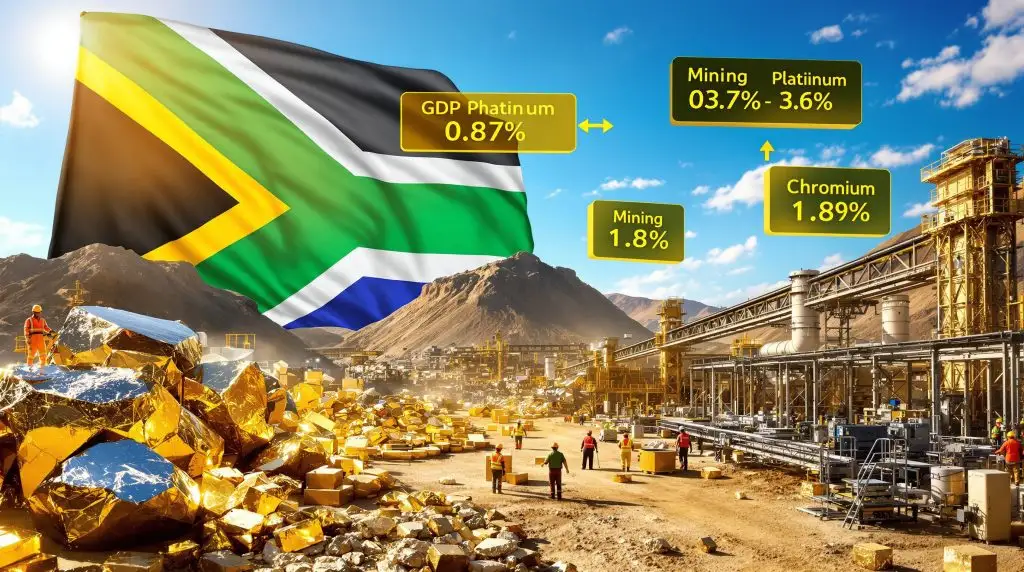
The mining and quarrying sector stood out as the primary driver of third-quarter growth, expanding by 2.3% and providing crucial momentum to the overall economy. This robust performance was underpinned by increased production across several key commodities, with platinum group metals, manganese ore, coal, chromium ore, and copper leading the charge.
South Africa’s mining sector, which has faced decades of declining output and profitability challenges, appears to be experiencing a modest renaissance. The country holds approximately 80% of global platinum group metals reserves, 40% of gold reserves, and is the world’s largest producer of chromium, positioning it as a critical supplier of minerals essential for global industrial and technological applications.
The third quarter’s mining performance was particularly notable given the sector’s recent volatility. Gold production increased by 5.9%, benefiting from record-high prices exceeding $2,400 per ounce during the period, while improved operational efficiency at major mines operated by companies like Anglo American Platinum and Sibanye-Stillwater contributed to the positive momentum.
Platinum group metals production rose by 6.7%, contributing 1.7 percentage points to overall mining growth. These metals remain critical components for hydrogen fuel cells and catalytic converters, positioning South Africa favorably as global demand for clean energy technologies accelerates.
Manganese ore production followed with a 6.8% increase, while coal output grew by 1.0%, each making meaningful contributions to the sector’s overall performance. The positive showing across multiple commodity categories demonstrates the diversified nature of South Africa’s mineral wealth and its potential to drive economic recovery.
However, not all mining subsectors shared in the gains. Iron ore production declined by 2.2%, largely due to plant maintenance at major producers, while output in diamonds, nickel, and gold fell slightly. Despite these pockets of weakness, they did not materially affect the sector’s overall positive contribution to GDP.
The mining sector’s improved performance coincided with a critical operational advantage: the sustained absence of load shedding. South Africa has now gone over 200 days without load shedding, with Eskom’s energy availability improving to approximately 70% from 55% the previous year. This enhanced power reliability has been instrumental in allowing mining operations to run at fuller capacity and improve productivity.
Hugo Pienaar, chief economist at the Minerals Council South Africa, acknowledged the sector’s resilience while noting ongoing concerns. “Despite the exclusions, we remain concerned about the adverse impact on sentiment and global growth,” Pienaar said, referring to global trade tensions. “Even PGMs are not immune. Tariffs on vehicles mean fewer sales, which hits demand for autocatalysts.”
Agriculture Continues Recovery Trajectory
Agriculture, forestry, and fishing maintained its upward momentum in the third quarter, recording a 1.1% expansion. The sector’s performance was driven by stronger production across field crops, horticulture, and animal products, reflecting favorable weather conditions and improved farming practices.
The 2025 agricultural year has been characterized as a recovery period following the challenging drought conditions that plagued the sector in 2024. Widespread rainfall rejuvenated grain, oilseed, and citrus production, with projections indicating an 18 million tonne spring crop, marking a 16% year-on-year increase.
Wandile Sihlobo, Chief Economist at the Agricultural Business Chamber of South Africa, noted the uneven nature of the recovery. “As the field crops and horticulture subsectors thrived this year, the livestock subsector underperformed,” Sihlobo explained in his analysis of the sector’s performance. “Foot-and-mouth disease has been a significant challenge for the cattle industry, leading to the loss of some export markets.”
The agricultural sector’s contribution to GDP growth, while modest in percentage terms, carries significant weight for rural employment and food security. The sector employed approximately 920,000 people in the third quarter, with a 2% increase in agricultural employment reflecting optimism generated by abundant harvests in field crops, horticulture, and forestry subsectors.
South Africa’s agricultural exports reached a record $13.7 billion in 2024, representing a 3% increase led by fruit and livestock recovery. This export performance underscores the sector’s importance to the country’s foreign exchange earnings and its potential to contribute to economic growth.
Broad-Based Economic Activity with Mixed Signals
Beyond mining and agriculture, the third quarter witnessed positive contributions from multiple sectors, with nine of the ten major industries recording growth. The trade, catering, and accommodation sector posted its fourth consecutive quarter of expansion, driven by stronger performance across wholesale trade, retail trade, motor trade, accommodation, and food & beverages.
The transport, storage, and communication industry contributed positively to growth, buoyed by increased activity in air transport and related services. A 0.5% increase in the sector reflected improved operational capacity and growing demand for logistics services as economic activity expanded.
One of the quarter’s more encouraging developments was the construction sector’s return to positive territory after three consecutive quarters of decline. The industry recorded a marginal 0.1% increase, with growth in non-residential buildings and construction works providing the foundation for the turnaround. Construction also emerged as a standout performer in employment, adding 130,000 jobs in the third quarter, a 10.3% quarterly increase that signals renewed investment in infrastructure and building projects.
However, not all sectors shared in the positive momentum. The electricity, gas, and water industry contracted by 2.5%, reflecting lower electricity production and consumption alongside weak water demand. This contraction occurred despite the absence of load shedding, suggesting structural challenges in the energy sector that extend beyond power availability to include aging infrastructure and maintenance requirements.
General government services activity rose during the quarter, supported by increased employment across national and provincial institutions, though the sustainability of government-driven growth remains contingent on fiscal constraints and budgetary pressures.
Consumer Spending Resilience Supports Domestic Demand
On the expenditure side of the economy, household consumption rose for a sixth consecutive quarter, increasing by 0.7%. This sustained growth in consumer spending reflects improving confidence and disposable income among South African households, though it remains vulnerable to interest rate levels and inflation pressures.
Transport spending emerged as the largest positive contributor to household consumption growth, driven primarily by a rise in new vehicle sales. This spending pattern suggests that consumers, particularly in middle and upper-income brackets, maintained an appetite for durable goods despite economic uncertainties and elevated interest rates.
The automotive sector’s contribution to consumer spending comes against the backdrop of challenging market conditions. However, the resilience in vehicle sales reflects pent-up demand and the necessity of personal transport in a country with limited public transportation alternatives. Categories of clothing, footwear, and miscellaneous goods and services recorded declines, indicating that consumers are being selective in their spending choices.
Gross fixed capital formation, a critical indicator of long-term investment confidence, recovered by 1.6% after three consecutive quarters of contraction. The rebound was driven primarily by increased investment in transport equipment and ICT assets, with the miscellaneous category ‘other assets’ also contributing positively through investments in information and communication technology equipment and software.
This recovery in capital formation is particularly significant as it signals renewed business confidence and willingness to invest in productive capacity. However, investment levels remain approximately 10% below 2019 levels, indicating that structural impediments continue to constrain long-term capital deployment.
One decision can change your entire career. Take that step with our Online courses in ACCA, HESI A2, ATI TEAS 7, HESI EXIT, NCLEX-RN, NCLEX-PN, and Financial Literacy. Join Serrari Ed and start building your brighter future today.
External Trade Maintains Positive Contribution
South Africa’s external sector made a modest positive contribution to growth in the third quarter. Exports rose by 0.7%, primarily led by increased trade in vegetable products and mineral products. The export performance reflects the country’s ability to maintain market access despite global economic headwinds and trade policy uncertainties.
The export growth occurred despite the implementation of 30% US tariffs on South African goods that took effect on August 7, 2025. The tariff, announced by US President Donald Trump as part of a broader restructuring of America’s trade relationships, targeted a range of South African exports including automotive parts, agricultural products, and manufactured goods.
President Cyril Ramaphosa characterized the tariff as a “miscalculation,” arguing that South Africa’s average tariff on US imports stands at 7.6% rather than the 30% reciprocal rate imposed by Washington. The South African government maintained that the tariff was not an accurate representation of available trade data and contested the methodology used to arrive at the 30% figure.
Trade expert Donald MacKay noted that the tariffs effectively ended the African Growth and Opportunity Act (AGOA) benefits for South Africa. “Agoa has essentially ended tonight,” MacKay said following the tariff announcement. The AGOA program had provided duty-free access to the US market for more than 6,000 South African products across automotive, agriculture, and textile industries.
The tariff threatens approximately 30,000 jobs in South Africa, particularly in the automotive and agriculture sectors, according to government estimates. The South African Reserve Bank had warned that the levy could result in job losses of up to 100,000 if the response was mismanaged and economic conditions deteriorated significantly.
Despite these concerns, the third quarter GDP figures suggest that the immediate impact of the tariffs was less severe than initially feared. Several key mineral exports, including platinum, titanium, copper, and other critical minerals, were exempted from the tariffs, accounting for approximately a third of South African exports to the United States. These exemptions helped cushion the blow to the country’s overall export performance.
Imports increased by 2.2% in the third quarter, reflecting rising trade in machinery and electrical equipment, mineral products, textiles and textile articles, and animal and vegetable fats and oils. The faster growth in imports relative to exports suggests some pressure on the trade balance, though mineral exports continue to provide substantial foreign exchange earnings.
In response to the US tariffs, South Africa has accelerated efforts to diversify its export markets. President Ramaphosa emphasized the need for the country to adapt quickly to turbulent trade conditions, stating that “reducing over-dependence on certain markets is a strategic imperative to build the resilience of our economy.”
The government has been exploring alternative markets in Africa, Asia, and the Middle East, with Agriculture Minister John Steenhuisen announcing that South Africa expects to conclude a deal to export stone fruit to China, including apricots, peaches, nectarines, plums, and prunes. These diversification efforts reflect a pragmatic response to shifting global trade dynamics.
Labour Market Shows Encouraging Improvement
The economic growth in the third quarter coincided with significant improvement in South Africa’s labour market, with the unemployment rate falling for the first time in a year. The official unemployment rate eased to 31.9% in Q3 2025 from 33.2% in the second quarter, marking the lowest level since the fourth quarter of 2024.
The number of employed persons increased by 248,000 to 17.1 million, while the number of unemployed persons decreased by 360,000 to 8 million. This reduction in unemployment defied concerns that the US tariffs would trigger widespread job losses across key export-oriented sectors.
Risenga Maluleke, South Africa’s Statistician-General, highlighted the breadth of the employment gains. “The number of employed persons increased in eight provinces between Q2 and Q3 of 2025,” Maluleke noted in the Quarterly Labour Force Survey release. “The largest employment gains were in the Western Cape (70,000), KwaZulu-Natal (54,000), Gauteng (51,000), North West (42,000), and Limpopo (40,000).”
Six of the ten economic sectors tracked by Statistics South Africa recorded employment gains in the third quarter. Construction led job creation with 130,000 new positions, followed by community and social services with 116,000 additions, and trade with 108,000 new jobs. These sectors accounted for the bulk of employment growth during the period.
However, not all industries shared in the positive employment momentum. Manufacturing shed 62,000 jobs, while the finance sector lost 54,000 positions, reflecting ongoing structural challenges and technological disruption in these industries. The manufacturing sector’s employment losses are particularly concerning given its historical role as a major employer and contributor to skills development.
The unemployment improvement extended to youth employment, with the jobless rate for those aged 15-24 years falling to 58.5% in Q3, a two-year low. However, this figure remains alarmingly high, underscoring the persistent challenges young South Africans face in accessing economic opportunities.
The expanded unemployment rate, which includes discouraged workers who have given up looking for jobs, fell to 42.4% from 43% in the second quarter. This broader measure provides a more complete picture of labour underutilization in the economy, capturing individuals who remain available for work but have become discouraged by repeated failures to find employment.
Employment and Labour Minister Nomakhosazana Meth welcomed the unemployment decline while acknowledging ongoing challenges. “It is encouraging to further note that the official unemployment rate decreased in seven provinces between Q2 and Q3 of 2025,” Meth said. “However, of concern is that the Eastern Cape recorded an increase of 1.7%, from 39.5% to 41.2%.”
The labour market improvement reflects several factors, including better power supply that has reduced business disruptions, increased activity in construction and infrastructure projects, and seasonal hiring in retail and tourism sectors. However, economists caution that sustained employment growth will require addressing deeper structural issues including skills mismatches, regulatory constraints, and the high cost of doing business.
Nedbank economist Busisiwe Nkonki offered a cautious assessment of the employment outlook. “The outlook for the labour market remains fragile, but there are signs of cautious optimism,” Nkonki said in comments on the data. “Job creation will continue to be constrained by embedded structural inefficiencies, which undermine confidence and employment in the private sector. Meanwhile, higher tariffs imposed by the US will add further strain on export-oriented industries.”
Economic Outlook and Structural Challenges
Looking ahead, South Africa’s economic trajectory faces both opportunities and significant headwinds. The National Treasury expects a modest pickup in growth, forecasting GDP expansion of 1.2% for 2025 and 1.5% for 2026. These projections remain well below the levels required to make meaningful progress in reducing unemployment and poverty.
Hugh Hackman, Executive Head of Structured Investment and Annuities at Momentum Corporate, highlighted several positive developments that could support future growth. “Improved electricity reliability could be a catalyst for renewed business confidence and economic activity,” Hackman noted in analysis of the GDP figures. “Additionally, the removal of South Africa from the financial grey list is expected to bolster economic prospects going forward.”
The stabilization of electricity supply represents one of the economy’s most significant recent achievements. South Africa’s ability to sustain operations without load shedding for over 200 consecutive days has provided businesses with the operational certainty necessary to plan investments and expand production. However, the underlying structural problems in the energy sector, including aging power plants and insufficient generation capacity, remain unresolved.
Infrastructure constraints beyond electricity continue to hamper economic performance. The country’s rail network, critical for moving bulk commodities from mines to export terminals, suffers from chronic underinvestment and operational inefficiencies. Transnet, the state-owned logistics company, has struggled to maintain adequate service levels, forcing mining companies to rely on more expensive road transport alternatives or accept export constraints.
The mining sector, despite its strong third-quarter performance, faces longer-term challenges including declining ore grades, increasing mining depths, rising operational costs, and regulatory uncertainty. The recently released Mineral Resources Development Bill has drawn industry criticism for ambiguous provisions regarding community ownership and participation requirements.
Water scarcity represents another critical constraint, particularly for agriculture and mining operations. Climate change is intensifying rainfall variability, with some regions experiencing prolonged droughts while others face flooding. The agricultural sector’s vulnerability to weather shocks was evident in the 2024 drought that significantly reduced crop production.
The fiscal outlook remains constrained, with government debt-to-GDP ratio expected to peak at 77.4% in 2025/26. Limited fiscal space restricts the government’s ability to increase infrastructure investment or provide substantial support for economic development initiatives. Tax revenue projections have been reduced by more than R60 billion between 2025 and 2027, reflecting weaker economic performance and concerns about global trade tensions.
South Africa’s global competitiveness continues to be undermined by various factors including crime, corruption, skills shortages, and regulatory complexity. The country ranks poorly on various business environment indices, deterring both foreign direct investment and domestic capital formation. Without addressing these structural impediments, the economy is likely to remain trapped in a low-growth trajectory.
The trade policy environment has become increasingly uncertain, with the US tariffs representing just one manifestation of broader protectionist trends in global trade. South Africa’s response strategy emphasizes market diversification, with increased focus on intra-African trade through the African Continental Free Trade Area (AfCFTA), as well as strengthening ties with China, India, and other emerging markets.
The implementation of AfCFTA presents both opportunities and challenges for South African businesses. While the agreement promises access to a continental market of over 1.3 billion people, realizing this potential requires overcoming significant infrastructure gaps, non-tariff barriers, and varying regulatory standards across African countries.
Despite these challenges, certain sectors show promise for future growth. The transition to renewable energy creates opportunities for South Africa’s mining sector, particularly in platinum group metals used in hydrogen fuel cells, manganese for battery storage, and other critical minerals essential for clean energy technologies. The country’s substantial mineral endowments position it as a potential key supplier in the global energy transition.
The digital economy offers another avenue for growth, with increasing adoption of financial technology, e-commerce, and digital services. However, realizing this potential requires addressing connectivity gaps, improving digital literacy, and creating an enabling regulatory environment for innovation.
Tourism, which has been recovering from COVID-19 disruptions, presents opportunities for job creation and foreign exchange earnings. South Africa’s diverse natural attractions, wildlife, and cultural heritage provide a strong foundation for tourism development, though safety concerns and infrastructure quality remain impediments to maximizing the sector’s potential.
Policy Implications and Reform Imperatives
The third quarter GDP figures underscore the importance of sustained policy focus on structural reforms. While the economy has demonstrated resilience through four consecutive quarters of growth, the pace of expansion remains insufficient to address the country’s deep-seated challenges of unemployment, poverty, and inequality.
The Government of National Unity, formed after the May 2024 elections in which the African National Congress lost its outright majority for the first time since 1994, has emphasized economic growth and job creation as priority areas. However, translating these commitments into concrete policy action and implementation remains an ongoing challenge.
Key reform priorities identified by economists and business organizations include expediting infrastructure investment, particularly in transport and logistics; accelerating the transition to renewable energy while ensuring grid stability; streamlining business regulations and reducing red tape; addressing crime and corruption more effectively; and improving the quality of education and skills development programs.
The mining sector’s performance highlights the economic benefits that can be realized when critical constraints, such as reliable electricity supply, are addressed. Extending this success to other sectors requires coordinated action across multiple policy domains and sustained political commitment to reform implementation.
Labour market reforms represent another critical area requiring attention. South Africa’s labour regulations, while intended to protect workers, have been criticized for reducing flexibility and increasing hiring costs, particularly for small and medium enterprises. Finding the right balance between worker protection and employment creation remains a contentious policy challenge.
The education system’s failure to produce graduates with skills aligned to labour market needs perpetuates the unemployment crisis. Strengthening technical and vocational education, improving basic education quality, and creating pathways between education and employment represent urgent priorities for breaking the cycle of youth unemployment.
Conclusion
South Africa’s third quarter GDP growth of 0.5%, while representing a deceleration from the previous quarter’s stronger performance, demonstrates the economy’s continued resilience in the face of multiple challenges. The mining sector’s robust contribution, agricultural recovery, and improvement in employment conditions provide reasons for cautious optimism about the country’s economic trajectory.
However, the modest growth rate underscores the enormous distance South Africa must travel to achieve the economic transformation necessary to address its pressing social challenges. With unemployment remaining above 30%, poverty widespread, and inequality among the highest in the world, incremental economic gains, while welcome, are insufficient to fundamentally alter the lives of millions of citizens.
The impact of US trade tariffs, while less severe than initially feared in the third quarter, will continue to reverberate through the economy in coming months as affected industries adjust to new market realities. The imperative to diversify export markets and reduce dependence on any single trading partner has been reinforced by this experience.
As South Africa prepares to host the G20 Summit later in December, the country’s economic performance and policy direction will come under increased international scrutiny. The summit presents an opportunity to showcase progress while also highlighting the support needed from the international community to accelerate the country’s development trajectory.
The path forward requires sustained commitment to structural reforms, decisive action to address infrastructure constraints, and coordinated efforts across government, business, and civil society to unlock the economy’s potential. The fourth quarter of 2025 and beyond will reveal whether South Africa can maintain its growth momentum and begin the difficult work of translating economic expansion into meaningful improvements in employment, living standards, and opportunity for all its citizens.
For now, the third quarter figures offer a mixed message: progress is being made, but at a pace that falls short of what is needed to fundamentally transform one of the world’s most unequal societies. The challenge for policymakers, business leaders, and society at large is to accelerate the tempo of reform and growth, turning modest economic gains into transformative change that benefits all South Africans.
Catch Up With Our Other Headlines
3rd December, 2025
America Takes Command: U.S. Charts New Economic Path as G20 President Amid Diplomatic Tensions
New MoU Between Kenya and Somalia Exchanges Targets Stronger Regional Market Link
Ready to take your career to the next level? Join our Online courses: ACCA, HESI A2, ATI TEAS 7 , HESI EXIT , NCLEX – RN and NCLEX – PN, Financial Literacy!🌟 Dive into a world of opportunities and empower yourself for success. Explore more at Serrari Ed and start your exciting journey today! ✨
Track GDP, Inflation and Central Bank rates for top African markets with Serrari’s comparator tool.
See today’s Treasury bonds and Money market funds movement across financial service providers in Kenya, using Serrari’s comparator tools.
photo source: Google
By: Montel Kamau
Serrari Financial Analyst
3rd December, 2025