










Saudi Arabia has entered a new phase in its ambitious digital transformation journey with the launch of the Hexagon Data Center in Riyadh, marking a strategic assertion of technological sovereignty and positioning the Kingdom as a formidable player in the global race for advanced digital infrastructure. Described as the world’s largest government data center and classified as Tier IV—the highest global rating for data center operations—the facility represents both a technical achievement and a geopolitical statement about Saudi Arabia’s determination to control its own digital destiny.
The foundation stone for the facility was laid on January 1, 2026, with President of the Saudi Data and Artificial Intelligence Authority (SDAIA) Dr. Abdullah bin Sharaf Alghamdi and senior officials from various government entities in attendance. The project embodies the vision of Crown Prince and Prime Minister Mohammed bin Salman, Chairman of SDAIA’s Board of Directors, to position Saudi Arabia as a global center for advanced technologies and data-driven economies.
With a capacity of 480 megawatts and covering more than 30 million square feet in Riyadh, Hexagon is expected to establish Saudi Arabia as a global hub for cutting-edge digital infrastructure. The initiative aligns with the strategic objectives of SDAIA and the Vision 2030 reform agenda, which seeks to diversify the Kingdom’s economy beyond its historical reliance on hydrocarbon revenues.
Build the future you deserve. Get started with our top-tier Online courses: ACCA, HESI A2, ATI TEAS 7, HESI EXIT, NCLEX-RN, NCLEX-PN, and Financial Literacy. Let Serrari Ed guide your path to success. Enroll today.
The Strategic Imperative: Data as Economic Engine
The Hexagon Data Center launch occurs at a crucial moment in the evolution of global digital infrastructure, when data has emerged as what some describe as “the oil of the 21st century”—a phrase that SDAIA itself adopted as its founding slogan when it was established in 2019. This metaphor carries particular resonance for Saudi Arabia, whose economic power in the 20th century derived from its vast petroleum reserves but which now seeks to build comparable advantage in the data economy.
Building robust national digital infrastructure has become a strategic necessity to ensure data sovereignty, strengthen non-oil economic diversification, and secure long-term competitiveness, according to Saudi officials. The Kingdom’s approach reflects a growing global recognition that control over data infrastructure constitutes a form of technological sovereignty comparable to control over energy resources or strategic minerals.
Data centers have evolved dramatically since their origins in the 1950s, when they were large, climate-controlled rooms housing early supercomputers. Their strategic importance accelerated with the rise of the internet in the late 1990s and expanded further with the introduction of cloud computing services in 2006. By 2020, data centers had become an economic priority for governments worldwide, a trend further amplified by the rise of generative artificial intelligence, which requires vast processing capacity.
Saudi Arabia’s massive investment in the Hexagon facility reflects this recognition that advanced digital infrastructure is no longer optional but essential for economic competitiveness, national security, and technological independence in an increasingly data-driven global economy.
SDAIA: Architect of Saudi Arabia’s Digital Transformation
At the center of Saudi Arabia’s data and AI strategy is the Saudi Data and Artificial Intelligence Authority, established in August 2019 by Royal Decree to facilitate the Kingdom’s transition to a data-driven economy and help achieve Vision 2030’s goals. SDAIA serves as the official authority for data—including big data—and artificial intelligence, functioning as the national reference for their regulation, development, and use.
In just six years, SDAIA’s efforts have positioned the Kingdom as a key player in the global digital economy and a leading destination in the Middle East for major international technology firms. The authority has moved with remarkable speed to establish frameworks, infrastructure, and capabilities that would typically require decades to develop.
SDAIA announced in October 2020 the National Strategy for Data and AI (NSDAI) with an ambitious vision: “Where the best of Data and AI is made reality.” The strategy aims to achieve this through a multi-phased approach, focusing on addressing national urgencies by 2025, building foundations for competitive advantage in key niche areas by 2030, and becoming one of the leading economies utilizing and exporting data and AI after 2030.
The three core entities within SDAIA—the National Data Management Office (NDMO), the National Information Center (NIC), and the National Center for Artificial Intelligence (NCAI)—help deliver the promise of a data-driven and AI-supported government and economy. These institutions work in concert to build what SDAIA describes as an integrated digital ecosystem capable of supporting the Kingdom’s ambitious technological and economic goals.
SDAIA’s role has extended beyond technical development to building a comprehensive regulatory environment for data and AI. The authority has enacted a comprehensive legislative and regulatory framework, including the Personal Data Protection Law and its executive regulations, as well as national principles and standards for generative AI, AI adoption frameworks, and the management of the National Data Controllers Registry. These measures are designed to safeguard privacy, enhance trust in digital systems, and ensure that advanced technologies contribute to sustainable development.
Technical Specifications: World-Class Infrastructure
The Hexagon Data Center’s technical specifications position it at the pinnacle of global data center capabilities. Classified as Tier IV and holding the highest data center rating by the global Uptime Institute, the facility ensures 99.995 percent operational availability—a level of reliability that translates to less than 26 minutes of downtime per year.
The Tier IV classification represents the most stringent standard in the industry, requiring fully redundant infrastructure with multiple independent distribution paths serving the IT equipment, along with compartmentalized security zones and comprehensive fault tolerance. This classification is essential for hosting critical government services that cannot tolerate disruption.
Beyond the Uptime Institute certification, the facility has also been awarded ISO IEC 22237 certification, which addresses infrastructure resilience and protection against technical and environmental risks. The facility has received international accreditations under the TIA 942 standard, the telecommunications infrastructure standard for data centers.
The 480-megawatt capacity makes Hexagon one of the largest data centers globally by power capacity. To put this in perspective, a typical enterprise data center might consume 1-5 megawatts, while major hyperscale facilities operated by technology giants typically range from 50-150 megawatts. Hexagon’s 480-megawatt capacity places it in an elite category of mega-scale facilities designed to support national-level digital infrastructure.
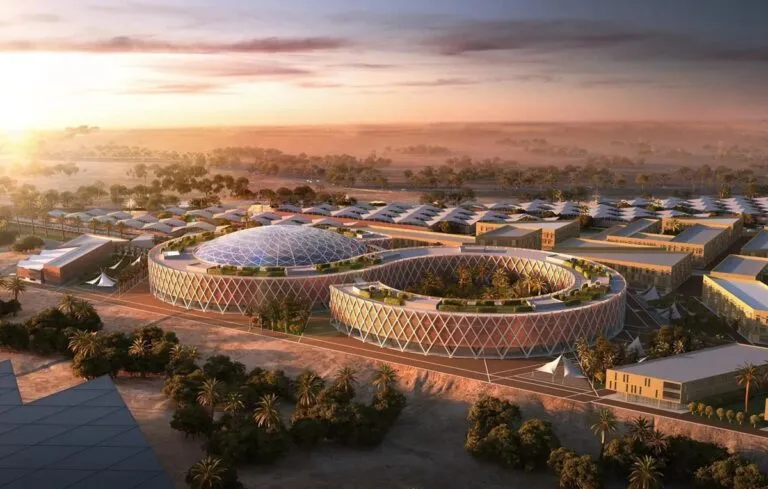
The facility’s 30 million square foot footprint provides space for massive computing resources, storage systems, networking equipment, and supporting infrastructure. Based on images of the upcoming facility, it is aptly named after its design—two concentric hexagons with a courtyard in the middle, creating both structural efficiency and symbolic resonance with geometric precision and interconnection.
Sustainability and Green Technology Integration
Recognizing the environmental implications of large-scale data infrastructure, Saudi Arabia has incorporated advanced sustainability features into the Hexagon design. The facility meets US Green Building Council LEED Gold standards and incorporates advanced energy efficiency and smart cooling technologies.
The center implements advanced solutions that leverage cutting-edge technologies in energy efficiency and smart cooling, such as direct liquid cooling and hybrid cooling systems, to attain the lowest possible power usage effectiveness (PUE). PUE is the standard metric for data center energy efficiency, measuring the ratio of total facility energy to IT equipment energy. A PUE closer to 1.0 indicates greater efficiency, and modern liquid cooling systems can achieve PUE values significantly better than traditional air cooling approaches.
The facility incorporates renewable energy as a sustainable power source, reinforcing its status as one of the world’s largest green data centers. This renewable energy integration aligns with Saudi Arabia’s broader commitments to sustainability and environmental responsibility within Vision 2030.
According to SDAIA President Dr. Alghamdi, the data center strategy contributes to reducing carbon emissions by approximately 30,000 tons annually. This carbon reduction represents a significant environmental benefit, equivalent to removing thousands of gasoline-powered vehicles from the road each year.
Economic Impact and Job Creation
The economic dimensions of the Hexagon Data Center extend far beyond its construction costs. SDAIA estimates that the Kingdom’s data center strategy will generate a cumulative local economic impact exceeding SAR10 billion ($2.67 billion), alongside annual savings of more than SAR1.8 billion ($480 million), while supporting non-oil economic growth and improving digital government services for citizens and residents.
These economic projections reflect both direct impacts—construction jobs, operational employment, procurement of equipment and services—and indirect multiplier effects as enhanced digital infrastructure enables new business models, attracts technology investment, and improves productivity across the economy.
The facility is expected to strengthen the national economy through non-oil resources and greatly enhance the quality of life by improving the digital capabilities of government applications serving Saudi citizens and residents. This dual focus on economic diversification and public service improvement reflects Vision 2030’s integrated approach to development.
The data center will also play a role in building domestic technical capabilities. Saudi Arabia has invested heavily in training programs, with SDAIA collaborating with leading international academic institutions to establish training programs and scholarships that have trained more than 45,000 professionals to elevate their data and AI skills. Plans exist to train over 25,000 women over the next five years.
SDAIA has set ambitious national targets, aiming to train 20,000 AI and data specialists by 2030 and to equip 40% of the entire workforce with foundational data and AI literacy skills. The Hexagon Data Center will serve as both a training ground and employment destination for this emerging technical workforce.
One decision can change your entire career. Take that step with our Online courses in ACCA, HESI A2, ATI TEAS 7, HESI EXIT, NCLEX-RN, NCLEX-PN, and Financial Literacy. Join Serrari Ed and start building your brighter future today.
Foundation for a Nationwide Network
The Hexagon Data Center is explicitly conceived not as a standalone facility but as the cornerstone for a future network of centers to be established across the Kingdom. SDAIA President Dr. Alghamdi stated during the foundation ceremony: “The Hexagon data center will be followed by the establishment of other centers. This center is a qualitative strategic boost toward making the Kingdom a global center for data, ensuring data sovereignty and security, and enabling innovation and a digital economy.”
This network approach reflects best practices in resilience, redundancy, and geographic distribution of critical digital infrastructure. By establishing multiple interconnected facilities across different regions, Saudi Arabia can ensure continuity of operations even in the event of localized disruptions, while also providing lower-latency access to government and commercial services for citizens and businesses throughout the Kingdom.
The Hexagon Data Center will provide the foundation for a nationwide network of interconnected facilities, part of SDAIA’s strategic expansion to meet growing demand for national digital infrastructure services while ensuring systems remain operational with maximum availability.
The network strategy also positions Saudi Arabia to serve as a regional data hub for the Middle East, potentially hosting services and infrastructure for neighboring countries and international organizations seeking stable, well-governed data center facilities in a strategic geographic location between Europe, Africa, and Asia.
Global Context and Competition
Saudi Arabia’s Hexagon project enters a highly competitive global landscape where nations and technology companies are racing to build data center capacity to support AI development, cloud computing, and digital services. The Kingdom faces competition from established players with decades of infrastructure development, but also brings unique advantages including substantial financial resources, strategic geographic location, and strong government commitment.
Saudi Arabia is home to several large data center projects. Throughout 2025, companies like xAI and Humain agreed to build a 500MW data center in the country, STC is developing 1GW of capacity also with Humain, while Khazna has detailed expansion plans. These private sector investments complement the government’s Hexagon facility, creating a comprehensive ecosystem of data center capabilities.
The competitive dynamics reflect a broader global trend where data infrastructure has become a strategic asset comparable to traditional infrastructure like ports, telecommunications networks, and energy systems. Nations that control advanced data infrastructure gain advantages in economic development, technological innovation, and increasingly in national security and geopolitical influence.
China has invested tens of billions in domestic data centers and AI infrastructure. The European Union has launched initiatives to build “data sovereignty” through regional cloud infrastructure. The United States maintains the world’s largest concentration of hyperscale data centers, though increasingly distributed across multiple states and regions.
Saudi Arabia’s approach differs from these models in its integration of government-owned infrastructure with private sector development, its explicit focus on data sovereignty and Arabic language AI capabilities, and its acceleration timeline attempting to achieve in years what other nations accomplished over decades.
Vision 2030: The Driving Framework
The Hexagon Data Center cannot be understood outside the context of Vision 2030, the comprehensive national transformation program announced by Crown Prince Mohammed bin Salman in April 2016. Vision 2030 identifies the long-term goals and expectations for Saudi Arabia, encompassing economic diversification, social development, improved government services, and enhanced quality of life for citizens.
Data and artificial intelligence contribute to achieving Saudi Vision 2030; official assessments indicate that out of 96 direct and indirect goals of the vision, 66 are related to data. This pervasive dependence on digital capabilities means that infrastructure like the Hexagon Data Center is not peripheral to Vision 2030 but central to its success.
The vision’s emphasis on economic diversification beyond oil requires building new sources of competitive advantage, and Saudi leadership has identified data, AI, and digital services as key sectors where the Kingdom can achieve global leadership. The substantial investments in SDAIA, the Hexagon Data Center, and related initiatives reflect strategic decisions about where to allocate national resources to achieve transformational change.
In conjunction with Accenture, SDAIA established the national cloud infrastructure as well as the National Data Bank, which enables secure, efficient data sharing among government entities. This digital infrastructure has practical implications for government services, enabling more efficient administration, better policy-making through data analytics, and improved service delivery to citizens and residents.
The National Data Bank is connected to more than 200 key government systems and has catalyzed the establishment of Estishraf, a national insights and analytics platform that supports data-driven decision-making and planning across government entities.
Data Sovereignty in Practice
A central theme in Saudi Arabia’s digital strategy is data sovereignty—the principle that nations should control their own data, algorithms, and computing infrastructure. For Saudi Arabia, this goes to the heart of Vision 2030 and the Kingdom’s ambition to lead the world in data, compute, and digital services, according to analysis from technology experts.
In practical terms, AI sovereignty means ensuring that Saudi Arabia’s technological destiny is not dependent on foreign code, proprietary platforms, or opaque systems. This approach reflects concerns shared by many governments about excessive reliance on technology infrastructure controlled by foreign entities, where data flows, algorithmic decisions, and system architecture may not align with national interests or values.
The Hexagon Data Center will play a central role in reinforcing national data sovereignty by hosting and developing digital solutions domestically, supporting the Kingdom’s digital transformation objectives. By maintaining control over the physical infrastructure, software systems, and data flows, Saudi Arabia can ensure compliance with its own legal and regulatory frameworks, protect sensitive information, and maintain operational independence.
Data sovereignty extends beyond security concerns to encompass cultural and linguistic dimensions. HUMAIN, a full-stack AI company formed under the Public Investment Fund, is charged with creating one of the world’s most powerful multimodal Arabic Large Language Models (LLMs). This model, known as ALLAM, is being designed to be culturally fluent and capable of understanding the nuances of regional dialects and values, representing a direct move to assert technological sovereignty by reducing dependence on Western-developed models.
Challenges and Implementation Realities
Despite the ambitious vision and substantial financial resources, the Hexagon Data Center and broader Saudi digital strategy face significant implementation challenges. Building advanced technical infrastructure requires not just capital but specialized expertise, established supply chains, proven operational practices, and time for systems to mature and prove reliability.
Technical talent represents a particular challenge. While Saudi Arabia has made substantial investments in training programs, building a workforce with deep expertise in data center operations, AI development, cybersecurity, and related technical domains typically requires years or decades. The Kingdom is addressing this through a combination of domestic training, recruitment of international experts, and partnerships with established technology companies.
The facility’s 480-megawatt power requirement, while manageable for Saudi Arabia with its substantial energy production capacity, still requires sophisticated power distribution infrastructure, backup systems, and integration with renewable energy sources to meet sustainability commitments. The advanced cooling systems necessary to maintain optimal operating temperatures in Saudi Arabia’s climate present ongoing operational challenges and costs.
Competitive pressures from established technology hubs—the United States, China, Singapore, Ireland, and others—mean Saudi Arabia must offer compelling value propositions to attract and retain the international technology companies and talent needed to build a thriving digital ecosystem. Government ownership and operation of critical infrastructure, while ensuring sovereignty, can also introduce bureaucratic complexities that may slow innovation compared to more nimble private sector operations.
The regulatory framework, while comprehensive, must evolve continuously to address emerging technologies, changing threat landscapes, and international standards. Balancing data protection with data utility, security with accessibility, and national interests with international cooperation requires ongoing policy development and adjustment.
Regional and Global Implications
The Hexagon Data Center has implications extending beyond Saudi Arabia’s borders. As the facility becomes operational and the planned network of data centers expands, the Kingdom will increasingly function as a regional digital hub, potentially hosting services and data for neighboring Gulf Cooperation Council countries, Middle Eastern nations, and international organizations operating in the region.
Saudi Arabia’s strategic geographic location—positioned between Europe, Africa, and Asia—provides natural advantages for serving as a data transit point and hosting location for organizations seeking middle-ground infrastructure between these major markets. The Kingdom’s political stability relative to some regional neighbors, substantial financial resources, and modern infrastructure investments make it an attractive location for mission-critical digital operations.
The focus on Arabic language AI capabilities addresses a significant gap in global technology development, where models and services have been predominantly designed for English and other major Western languages. 86% of public sector organizations lack cloud data governance, underscoring the need for comprehensive frameworks. By building AI systems optimized for Arabic and culturally appropriate for Middle Eastern contexts, Saudi Arabia could export technology services across the Arab world and to global organizations seeking to engage with Arabic-speaking populations.
The Path Forward
The foundation laying for the Hexagon Data Center represents a milestone but not a destination in Saudi Arabia’s digital transformation journey. The facility must now be completed, commissioned, and brought into operational service—a process that typically takes several years for projects of this scale and complexity.
SDAIA President Dr. Alghamdi has emphasized that the Kingdom will continue to strengthen its presence in advanced technologies with the ongoing support of Crown Prince Mohammed bin Salman. SDAIA will pursue pioneering projects that reflect its ambitious path toward building an integrated digital ecosystem, strengthening national enablers in data and artificial intelligence, and developing world-class technical infrastructure that enhances the competitiveness of the national economy and attracts investment.
The success of the Hexagon facility and the broader data center network strategy will ultimately be measured not by technical specifications or construction achievements, but by practical outcomes: whether the infrastructure enables improved government services, supports economic diversification, attracts technology investment, creates high-value employment, and positions Saudi Arabia as a genuine leader in the global digital economy.
Early indicators suggest progress. Saudi Arabia currently holds the top position globally in various metrics, including the government strategy category of the Global AI Index. This ranking reflects the comprehensive approach SDAIA has taken to policy development, strategy formulation, and implementation planning.
The coming years will test whether Saudi Arabia can translate substantial financial investments and strategic vision into operational reality. The Hexagon Data Center stands as both a technical achievement and a statement of national ambition—a physical manifestation of Saudi Arabia’s determination to control its digital destiny and secure a leading position in the data-driven economy of the 21st century.
For a nation whose 20th-century prosperity derived from geological resources beneath its desert sands, the 21st-century bet on data centers, AI infrastructure, and digital services represents a fundamental reimagining of competitive advantage and national power. Whether this vision succeeds will have implications not just for Saudi Arabia but for the broader question of how nations transition from resource-based economies to knowledge-based ones in an era of rapid technological change.
Ready to take your career to the next level? Join our Online courses: ACCA, HESI A2, ATI TEAS 7 , HESI EXIT , NCLEX – RN and NCLEX – PN, Financial Literacy!🌟 Dive into a world of opportunities and empower yourself for success. Explore more at Serrari Ed and start your exciting journey today! ✨
Track GDP, Inflation and Central Bank rates for top African markets with Serrari’s comparator tool.
See today’s Treasury bonds and Money market funds movement across financial service providers in Kenya, using Serrari’s comparator tools.
photo source: Google
By: Montel Kamau
Serrari Financial Analyst
5th January, 2026
Article, Financial and News Disclaimer
The Value of a Financial Advisor
While this article offers valuable insights, it is essential to recognize that personal finance can be highly complex and unique to each individual. A financial advisor provides professional expertise and personalized guidance to help you make well-informed decisions tailored to your specific circumstances and goals.
Beyond offering knowledge, a financial advisor serves as a trusted partner to help you stay disciplined, avoid common pitfalls, and remain focused on your long-term objectives. Their perspective and experience can complement your own efforts, enhancing your financial well-being and ensuring a more confident approach to managing your finances.
Disclaimer: This article is for informational purposes only and does not constitute financial advice. Readers are encouraged to consult a licensed financial advisor to obtain guidance specific to their financial situation.
Article and News Disclaimer
The information provided on www.serrarigroup.com is for general informational purposes only. While we strive to keep the information up to date and accurate, we make no representations or warranties of any kind, express or implied, about the completeness, accuracy, reliability, suitability, or availability with respect to the website or the information, products, services, or related graphics contained on the website for any purpose. Any reliance you place on such information is therefore strictly at your own risk.
www.serrarigroup.com is not responsible for any errors or omissions, or for the results obtained from the use of this information. All information on the website is provided on an as-is basis, with no guarantee of completeness, accuracy, timeliness, or of the results obtained from the use of this information, and without warranty of any kind, express or implied, including but not limited to warranties of performance, merchantability, and fitness for a particular purpose.
In no event will www.serrarigroup.com be liable to you or anyone else for any decision made or action taken in reliance on the information provided on the website or for any consequential, special, or similar damages, even if advised of the possibility of such damages.
The articles, news, and information presented on www.serrarigroup.com reflect the opinions of the respective authors and contributors and do not necessarily represent the views of the website or its management. Any views or opinions expressed are solely those of the individual authors and do not represent the website's views or opinions as a whole.
The content on www.serrarigroup.com may include links to external websites, which are provided for convenience and informational purposes only. We have no control over the nature, content, and availability of those sites. The inclusion of any links does not necessarily imply a recommendation or endorsement of the views expressed within them.
Every effort is made to keep the website up and running smoothly. However, www.serrarigroup.com takes no responsibility for, and will not be liable for, the website being temporarily unavailable due to technical issues beyond our control.
Please note that laws, regulations, and information can change rapidly, and we advise you to conduct further research and seek professional advice when necessary.
By using www.serrarigroup.com, you agree to this disclaimer and its terms. If you do not agree with this disclaimer, please do not use the website.
www.serrarigroup.com, reserves the right to update, modify, or remove any part of this disclaimer without prior notice. It is your responsibility to review this disclaimer periodically for changes.
Serrari Group 2025