











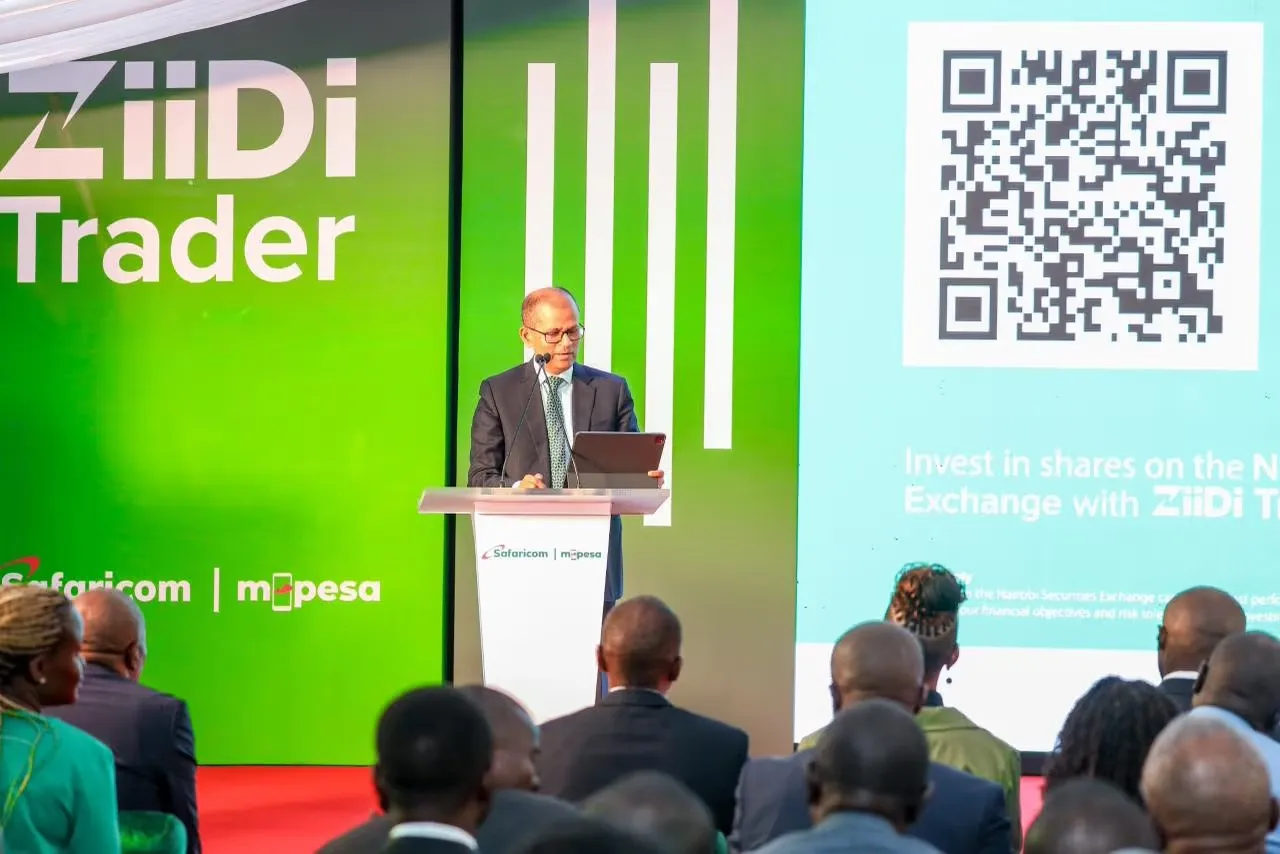
Safaricom, in partnership with the Nairobi Securities Exchange, has officially launched Ziidi Trader, a groundbreaking platform integrated directly into the M-PESA mobile application that enables Kenyans to buy and sell listed shares on the NSE from their mobile phones. The launch, which was officiated by President William Ruto at the NSE trading floor in Nairobi on Monday, represents a significant step in democratizing access to Kenya’s capital markets by leveraging M-PESA’s massive user base to bring investing closer to millions of Kenyans through a secure and easy-to-use mobile experience.
The platform operates under the oversight of the Capital Markets Authority, ensuring investor protection, transparency, and market integrity while supporting informed long-term investing through clear disclosures and comprehensive investor education. The launch builds on Safaricom’s sustained commitment to champion financial access and wellness, marking the latest milestone in the evolution of the Ziidi Investment Platform that began with the Ziidi Money Market Fund and Ziidi Shariah offerings.
Build the future you deserve. Get started with our top-tier Online courses: ACCA, HESI A2, ATI TEAS 7, HESI EXIT, NCLEX-RN, NCLEX-PN, and Financial Literacy. Let Serrari Ed guide your path to success. Enroll today.
Presidential Endorsement and National Significance
President Ruto hailed the initiative as transformative during the launch ceremony, declaring that it will democratize capital markets and allow those at the bottom of the economic pyramid to grow wealth through participation in Kenya’s securities exchange. “This platform represents a decisive turning point in how citizens engage with the stock exchange,” the President stated, emphasizing the platform’s potential to empower millions of Kenyans, especially youth and women, with simple, affordable, and convenient access to investments in shares, bonds, and other NSE-listed products.
The President’s remarks underscored the alignment between private sector innovation and national development objectives. “I challenged the capital markets to democratise access through innovation and technology. Today, I am pleased to note that this challenge has been answered. The Safaricom Ziidi Trader clearly demonstrates what becomes possible when private sector innovation aligns with public purpose and national vision,” Ruto declared.
President Ruto actively encouraged informal sector participants—including vegetable sellers (mama mbogas) and motorcycle taxi riders (boda-boda operators)—to take up investing through the new platform, highlighting its potential in boosting financial inclusion and enabling participation in wealth creation for segments of society that have historically been excluded from capital markets participation.
Removing Traditional Barriers to Investment
For years, retail participation in Kenya’s stock market has been severely constrained by complex processes and prohibitive entry requirements. According to verified data, while there are approximately 1.4 million registered investors on the NSE, only about 61,000—representing just 4.3%—are actively trading. The market has been characterized as “boring, slow, and elitist,” with participation largely confined to institutions and high-net-worth individuals.
Until the launch of Ziidi Trader, someone wanting to buy shares on the NSE had to navigate a labyrinth of paperwork and intermediaries. The process required opening a Central Depository System account, engaging a licensed stockbroker, completing Know-Your-Customer checks, linking bank accounts, and only then could they purchase listed equities. This complex onboarding process created formidable barriers, particularly in a country where digital payments have achieved near-universal penetration.
Cabinet Secretary for the National Treasury and Economic Planning, John Mbadi, acknowledged these historical barriers during the launch event. He noted that with previous limits set at KES 50,000, combined with the requirement to know a stockbroker and maintain a CDS account, opportunities for a large part of the public to interact with the stock market were severely limited.
Ziidi Trader eliminates these obstacles by integrating stock trading directly into the M-PESA ecosystem. Users can access the platform through the M-PESA App’s Financial Services tab, accept the terms and conditions, and begin investing from as little as one share. The seamless integration means no separate login credentials, no CDS account opening, and no traditional broker onboarding is required at the entry level.
Building on Ziidi Money Market Fund Success
The launch of Ziidi Trader represents the third pillar in Safaricom’s “Ziidi” wealth management ecosystem, following the successful deployment of the Ziidi Money Market Fund and Ziidi Shariah-compliant investment options. The MMF, which launched in December 2024, attracted over 450,000 opt-ins and KES 2.85 billion in assets under management within its first month of public availability.
By September 2025, Ziidi MMF had grown dramatically, capturing nearly half of Kenya’s unit trust investors with 1.15 million customers representing an estimated 47.9% of the 2.4 million individual investors in unit trust schemes. The fund’s assets under management reached KES 15.1 billion, demonstrating the massive pent-up demand for accessible investment products when offered through familiar mobile channels.
The rapid success of Ziidi MMF validated several critical assumptions that underpin the Ziidi Trader strategy. First, it demonstrated that M-PESA users are eager for investment products when offered in accessible, low-friction formats. Second, it showed that users trust Safaricom with their investment capital, not just their payment transactions. Third, it proved that the regulatory framework could accommodate innovative delivery mechanisms without compromising investor protection.
“Ziidi Trader is a powerful step in democratizing wealth for our customers. For eighteen years, M-PESA has transformed how Kenyans live, work and do business,” said Peter Ndegwa, CEO of Safaricom PLC, in remarks read by Chief Financial Officer Dilip Pal at the launch event. “Today, in partnership with the NSE, we are extending that impact to how our customers build and grow their wealth. Our ambition is to be a trusted partner in powering digital lifestyles, making investing simple, convenient, and accessible to everyone, everywhere.”
Platform Features and Functionality
Ziidi Trader enables users to buy and sell NSE-listed shares, monitor their portfolios, create personalized watchlists, set price alerts, and access real-time market insights seamlessly within the M-PESA App. The platform allows investors to track gains and losses instantly, view live prices, and execute buy or sell orders using funds directly from their M-PESA wallets.
When a user makes a purchase, the M-PESA wallet is debited immediately, and when they sell shares, the cash is returned to the same wallet instantly. There is no minimum bank balance required to unlock access, unlike with traditional stockbrokers. The entire transaction flow is designed to feel as familiar as sending money to a friend or paying a utility bill—actions that millions of Kenyans perform daily.
To get started, users are asked to verify basic information such as their source of funds and occupation, and to acknowledge that investing carries risk. Safaricom embeds standard disclaimers about stock prices rising and falling, recognizing that Ziidi Trader is a gateway to fundamental financial markets, not a guaranteed income stream.
The cost structure appears designed to make micro-investing mathematically viable. According to a detailed cost breakdown, a purchase of 100 shares valued at KES 4,500 attracts a total transaction charge of KES 68.50, representing approximately 1.52% in fees. This all-inclusive fee covers brokerage commissions and statutory charges such as stamp duty and levies—significantly lower than the minimum commissions charged by traditional stockbrokers that often punish small investors.
Additionally, Ziidi Trader lets customers invest in corporate bonds, providing an easy and secure way to expand their portfolios and explore new opportunities in Kenya’s fixed-income markets. This multi-asset capability positions the platform as a comprehensive investment solution rather than a narrowly focused equity trading app.
Leveraging M-PESA’s Massive Scale
The potential impact of Ziidi Trader becomes clear when considering the scale and centrality of M-PESA in Kenyan economic life. Launched in March 2007, M-PESA recently celebrated its 18th anniversary as arguably the world’s most successful mobile money platform. As of December 2024, M-PESA had 37.9 million customers in Kenya alone, with 319,300 M-PESA agents and 2.4 million merchants across the country.
The platform’s reach extends far beyond simple payments. Each day, 18 million people use the M-PESA service for their everyday transactions, and more than 5 million people use the M-PESA app monthly. In Safaricom’s November 2025 half-year results, M-PESA demonstrated continued robust growth, adding 2.1 million new active users in just six months, representing 13.3% year-over-year growth.
This massive user base provides Ziidi Trader with an unparalleled distribution advantage. Unlike standalone investment apps that must acquire users one by one through costly marketing campaigns, Ziidi Trader can reach tens of millions of potential investors instantly through notifications, app promotions, and agent networks. The platform places the “Buy” button next to the money Kenyans already have in their pockets, fundamentally changing the incentive structure for retail market participation.
Safaricom CFO Dilip Pal highlighted the technological foundation enabling this expansion. “We have made significant investments in transforming M-PESA into a cloud-native, AI-enabled platform built for scale, resilience, and trust,” Pal stated. “This foundation strengthens fraud detection, improves reliability, and gives us the confidence to introduce innovative services like Ziidi Trader securely and at scale.”
NSE Partnership and Market Transformation
Frank Mwiti, CEO of the Nairobi Securities Exchange, emphasized the partnership’s significance for expanding market access. “Partnering with Safaricom is helping us bring the stock market closer to everyday Kenyans,” Mwiti said. “By making NSE trading available through M-PESA, we are making it easier for more people, both locally and abroad to invest and play an active role in Kenya’s economic growth.”
The partnership represents a strategic evolution for the NSE, which has been actively working to expand retail investor participation through various initiatives. In August 2025, the NSE implemented a transformative change to its trading rules, allowing investors to buy and sell shares one at a time rather than requiring minimum purchases of 100 shares (known as board lots).
Previously, the cost to enter certain stocks could exceed KES 30,000 due to the board lot requirement—a threshold that was simply too high for many potential investors. The change to single-share trading, combined with the elimination of the separate Odd Lot Board that suffered from low liquidity and wide price spreads, aligned the NSE with global practices in markets like the United States, United Kingdom, and South Africa.
These regulatory reforms complement Ziidi Trader’s technological accessibility, creating a powerful combination that addresses both the procedural and financial barriers that have constrained retail participation. The NSE has set an ambitious goal of growing active investor accounts from 2 million to 9 million by 2029, and Ziidi Trader provides the infrastructure to reach that target.
One decision can change your entire career. Take that step with our Online courses in ACCA, HESI A2, ATI TEAS 7, HESI EXIT, NCLEX-RN, NCLEX-PN, and Financial Literacy. Join Serrari Ed and start building your brighter future today.
Technical Implementation and Custody Structure
Ziidi Trader operates through an innovative custody structure that balances accessibility with regulatory compliance. Unlike traditional brokerage platforms where each investor maintains a personal CDS account with their name on the exchange’s registry, Ziidi Trader uses an omnibus account structure where holdings are administered on behalf of users.
Trades from many customers are pooled into accounts operated by Safaricom in partnership with licensed brokers like Kestrel Capital. The broker holds the actual share certificates, while Ziidi Trader maintains an internal ledger showing how much of each stock M-PESA users own. This structure is similar to how many modern fintech trading apps manage large volumes of small trades across global markets.
The omnibus structure enables the seamless user experience that makes Ziidi Trader accessible to mass-market users, but it represents a different ownership model from traditional CDS registration. Holdings are tracked internally within Ziidi’s system, while execution and custody are handled by regulated intermediaries operating under Capital Markets Authority supervision.
For most users, this distinction will be invisible in day-to-day usage. However, it may have implications in specific scenarios—for example, direct voting rights at company annual general meetings may not be available, and protections in the event of broker insolvency could differ from standard CDS ownership. These are theoretical risks that the regulatory oversight from the CMA is designed to mitigate, but they represent trade-offs inherent in the simplicity that makes the platform accessible.
Competitive Dynamics and Market Impact
The launch of Ziidi Trader has significant implications for Kenya’s fintech ecosystem and capital markets landscape. Independent trading apps like Hisa, which pioneered democratized access to the NSE and US stocks, now face competition from a platform integrated into the financial infrastructure that tens of millions of Kenyans use daily.
Analysis suggests that Safaricom does not need to be more innovative than standalone apps; it simply needs to be more reliable and accessible. With Ziidi Trader, Safaricom has effectively commoditized the core value proposition of independent trading platforms, potentially triggering a wave of consolidation or defensive innovation from banks and fintech competitors.
The competitive pressure extends beyond fintech startups to traditional stockbrokers and investment banks that have been slow to fully embrace digital transformation. These institutions now face a platform that can reach more potential customers in a week than they have collectively onboarded in years of traditional operations.
However, the platform also faces risks and challenges. The ease of access that makes Ziidi Trader revolutionary could also encourage impulsive trading behavior, with unsophisticated investors potentially treating the NSE like a casino, buying volatile stocks without adequate research. The “Use Best Price” feature, while convenient, could execute market orders at unfavorable prices in Kenya’s sometimes illiquid market if sudden spread gaps occur.
Education will be critical to ensuring that accessibility does not translate into reckless speculation. Safaricom and the NSE must invest heavily in investor education, helping users understand fundamental concepts like price volatility, company analysis, diversification, and long-term investing principles.
Regulatory Framework and Investor Protection
The Capital Markets Authority’s oversight ensures that Ziidi Trader operates within Kenya’s established regulatory framework for investor protection. The platform’s integration into the M-PESA ecosystem required extensive regulatory approvals and compliance mechanisms to ensure that trading activities meet the same standards as traditional brokerage services.
The CMA approved the Ziidi Money Market Fund in November 2024, signaling the regulator’s willingness to accommodate innovative delivery mechanisms that expand financial inclusion while maintaining appropriate safeguards. The approval of Ziidi Trader follows similar principles, balancing innovation with prudential oversight.
The regulatory framework requires clear disclosure of risks, transparent pricing, proper custody arrangements, and mechanisms for dispute resolution. Users must acknowledge that stock prices can fall as well as rise, and that past performance does not guarantee future returns. These disclosures appear prominently during onboarding and throughout the user journey.
The partnership between Safaricom, the NSE, and licensed intermediaries like Kestrel Capital creates multiple layers of accountability, with each party having specific responsibilities for different aspects of the transaction chain. This distributed accountability model, overseen by the CMA, aims to provide robust investor protection even as the user experience becomes dramatically simpler.
Alignment with Digital Financial Inclusion Strategy
Ziidi Trader aligns with Safaricom’s broader smartphone and digitization agenda while complementing the NSE’s efforts to modernize market access and promote investment education. By simplifying access and integrating with the existing financial ecosystem, the platform contributes to a shared mission of growing financial literacy and investment confidence nationwide.
The collaborative approach allows the platform to evolve further, potentially accommodating additional players from across the investment community as part of the institutions’ commitment to driving inclusive financial participation. Treasury Cabinet Secretary Mbadi emphasized this inclusive vision, noting that previous structural barriers had prevented broad public engagement with capital markets.
The platform’s potential extends beyond individual wealth creation to systemic market development. By increasing retail participation, Ziidi Trader could provide more stable, long-term capital to Kenyan companies, reducing the market’s historical dependence on volatile foreign portfolio flows. Deeper retail participation typically correlates with more stable valuations and reduced market volatility, benefiting all participants.
The initiative also supports Kenya’s broader economic transformation agenda. President Ruto detailed the government’s plans for the next decade, including infrastructure development, road expansion, and industrial growth—all requiring substantial private sector capital mobilization. An active, liquid capital market with broad retail participation provides a critical funding mechanism for these ambitious development objectives.
Global Context and Mobile Money Evolution
Ziidi Trader represents a significant evolution in mobile money services globally. While M-PESA pioneered mobile money transfers and payments beginning in 2007, the expansion into securities trading marks a new frontier in mobile-first financial services. Few mobile money platforms globally have successfully made the leap from payments and basic savings products to full capital markets integration.
The success or failure of Ziidi Trader will be closely watched by regulators, telecommunications companies, and fintech innovators across emerging markets. If Safaricom successfully mobilizes millions of small-scale retail investors into active capital markets participation, it could provide a blueprint for similar initiatives in other mobile money-dominated economies across Africa and Asia.
The platform demonstrates how telecommunications infrastructure—mobile networks, agent distribution, and trusted brands—can be leveraged to address fundamental development challenges around financial inclusion and wealth creation. It shows that barriers to capital markets participation are often more about access and user experience than regulatory constraints or investor sophistication.
Implementation Timeline and User Adoption
Ziidi Trader is now live on the M-PESA app, offering millions of Kenyans a modern, reliable, and fully digital way to participate in the country’s economic growth. The platform underwent a successful pilot phase announced in November 2025, allowing Safaricom to refine the user experience, test system capacity, and address technical challenges before the mass market rollout.
Safaricom has begun notifying customers via SMS with messages designed to cut through traditional market barriers: “Stock trading is now easier with Ziidi Trader. No account, No paperwork. Buy & sell shares on NSE from your MPESA App.” This direct marketing leverages Safaricom’s unmatched ability to reach users where they already are, dramatically lowering customer acquisition costs compared to standalone investment platforms.
Early adoption metrics will be critical indicators of the platform’s potential impact. If even 1% of M-PESA’s 37 million users become active stock market participants through Ziidi Trader, that would represent 370,000 new retail investors—more than sixfold the current active trading population of approximately 61,000. Achieving 5% penetration would transform the NSE into a genuinely mass-market exchange with over 1.8 million active traders.
Looking Ahead: Challenges and Opportunities
As Safaricom continues to deepen its commitment to financial wellness, Ziidi Trader represents a major step toward empowering customers with the tools, knowledge, and confidence to build long-term wealth. However, significant challenges remain in translating access into sustainable, informed investment behavior.
A knowledge gap persists between awareness and understanding. When Safaricom conducted street surveys in Nairobi asking Kenyans about the NSE, most responses were “nimewahi skia”—”I’ve heard of it.” That phrase captures everything: awareness without understanding, interest without education, desire without direction.
Analysts point to two main reasons why most Kenyans have historically avoided stocks: lack of knowledge about how markets work and lingering trauma from years of bearish performance. The NSE experienced a prolonged period of underperformance that created widespread skepticism about equity investing. Overcoming this psychological barrier will require more than just accessible technology—it demands sustained investor education and market performance that validates the investment thesis.
Safaricom and the NSE must invest heavily in financial literacy programs, explaining concepts like company fundamentals, valuation metrics, diversification principles, and long-term wealth building. The platform’s success will ultimately depend not just on how many people sign up, but on how many develop sustainable, informed investment habits that generate positive outcomes.
Infrastructure concerns also loom. Can the NSE’s technical systems handle a sudden influx of thousands of retail trades per second if millions of M-PESA users begin actively trading? Past incidents at other emerging market exchanges suggest that trading system capacity must be carefully managed to prevent outages or execution failures that could undermine confidence.
Liquidity in less-traded counters could also pose challenges. While large-cap stocks like Safaricom, Equity Group, and KCB have reasonable liquidity, many smaller NSE-listed companies trade infrequently. If millions of retail investors begin placing market orders in illiquid stocks, price volatility could increase, potentially creating unfavorable execution prices and user frustration.
Conclusion: A Watershed Moment for Kenyan Capital Markets
The launch of Ziidi Trader on February 10, 2026, marks a watershed moment in the democratization of Kenya’s capital markets. By integrating stock trading directly into the M-PESA ecosystem used by tens of millions daily, Safaricom and the NSE have removed the most significant barriers that have historically confined equity investing to a small elite.
The platform’s impact will ultimately be measured not in downloads or registered users, but in whether it succeeds in creating a generation of informed, confident long-term investors who use capital markets as a tool for wealth building and economic participation. If successful, Ziidi Trader could fundamentally alter Kenya’s investment culture, transforming capital markets from an exclusive domain into a genuinely inclusive platform for economic empowerment.
The initiative demonstrates that financial inclusion is not primarily a regulatory or capital constraint—it is fundamentally about access, user experience, and trust. When investment products are delivered through platforms that people already use and trust, with interfaces they understand and pricing they can afford, participation becomes possible for millions who were previously excluded.
As Kenya pursues its economic development ambitions and companies seek capital for expansion, having millions of engaged retail investors participating in capital allocation decisions could provide more stable, patient capital than the historically volatile foreign portfolio flows. The broader societal impact of widespread capital markets participation—creating stakeholders in corporate performance, deepening understanding of business economics, and building long-term savings habits—could be transformative.
President Ruto’s statement that “this platform represents a decisive turning point in how citizens engage with the stock exchange” may prove prescient. Ziidi Trader has the potential to be remembered as the innovation that finally delivered on the promise of democratized access to wealth creation—a promise made possible by the unique convergence of mobile money ubiquity, regulatory willingness to innovate, and technological capability to deliver complex financial services through simple mobile interfaces.
The journey from launch to impact will require sustained commitment from all stakeholders—investor education from Safaricom and the NSE, regulatory vigilance from the CMA, responsible marketing that balances opportunity with risk disclosure, and ultimately, market performance that validates the decision to invest. But for the first time in Kenya’s history, the tools of wealth creation through equity ownership are truly accessible to everyone, everywhere. The democratization of capital markets is no longer an aspiration—it is a reality unfolding in real time through the simple act of millions of Kenyans opening their M-PESA apps and choosing to invest.
Ready to take your career to the next level? Join our Online courses: ACCA, HESI A2, ATI TEAS 7 , HESI EXIT , NCLEX – RN and NCLEX – PN, Financial Literacy!🌟 Dive into a world of opportunities and empower yourself for success. Explore more at Serrari Ed and start your exciting journey today! ✨
Track GDP, Inflation and Central Bank rates for top African markets with Serrari’s comparator tool.
See today’s Treasury bonds and Money market funds movement across financial service providers in Kenya, using Serrari’s comparator tools.
photo source: Google
By: Montel Kamau
Serrari Financial Analyst
11th February, 2026
Article, Financial and News Disclaimer
The Value of a Financial Advisor
While this article offers valuable insights, it is essential to recognize that personal finance can be highly complex and unique to each individual. A financial advisor provides professional expertise and personalized guidance to help you make well-informed decisions tailored to your specific circumstances and goals.
Beyond offering knowledge, a financial advisor serves as a trusted partner to help you stay disciplined, avoid common pitfalls, and remain focused on your long-term objectives. Their perspective and experience can complement your own efforts, enhancing your financial well-being and ensuring a more confident approach to managing your finances.
Disclaimer: This article is for informational purposes only and does not constitute financial advice. Readers are encouraged to consult a licensed financial advisor to obtain guidance specific to their financial situation.
Article and News Disclaimer
The information provided on www.serrarigroup.com is for general informational purposes only. While we strive to keep the information up to date and accurate, we make no representations or warranties of any kind, express or implied, about the completeness, accuracy, reliability, suitability, or availability with respect to the website or the information, products, services, or related graphics contained on the website for any purpose. Any reliance you place on such information is therefore strictly at your own risk.
www.serrarigroup.com is not responsible for any errors or omissions, or for the results obtained from the use of this information. All information on the website is provided on an as-is basis, with no guarantee of completeness, accuracy, timeliness, or of the results obtained from the use of this information, and without warranty of any kind, express or implied, including but not limited to warranties of performance, merchantability, and fitness for a particular purpose.
In no event will www.serrarigroup.com be liable to you or anyone else for any decision made or action taken in reliance on the information provided on the website or for any consequential, special, or similar damages, even if advised of the possibility of such damages.
The articles, news, and information presented on www.serrarigroup.com reflect the opinions of the respective authors and contributors and do not necessarily represent the views of the website or its management. Any views or opinions expressed are solely those of the individual authors and do not represent the website's views or opinions as a whole.
The content on www.serrarigroup.com may include links to external websites, which are provided for convenience and informational purposes only. We have no control over the nature, content, and availability of those sites. The inclusion of any links does not necessarily imply a recommendation or endorsement of the views expressed within them.
Every effort is made to keep the website up and running smoothly. However, www.serrarigroup.com takes no responsibility for, and will not be liable for, the website being temporarily unavailable due to technical issues beyond our control.
Please note that laws, regulations, and information can change rapidly, and we advise you to conduct further research and seek professional advice when necessary.
By using www.serrarigroup.com, you agree to this disclaimer and its terms. If you do not agree with this disclaimer, please do not use the website.
www.serrarigroup.com, reserves the right to update, modify, or remove any part of this disclaimer without prior notice. It is your responsibility to review this disclaimer periodically for changes.
Serrari Group 2025