











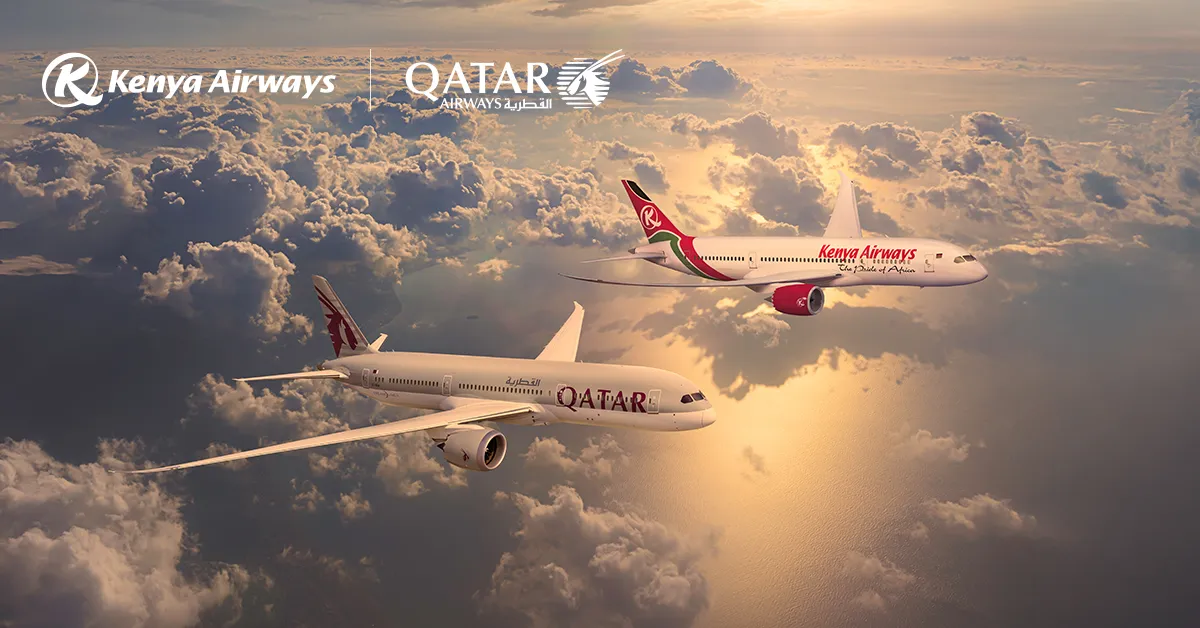
Qatar Airways is exploring a deeper strategic partnership with Kenya Airways (KQ), including the possibility of acquiring an equity stake in the financially constrained national carrier. The potential transaction signals more than bilateral cooperation. It reflects a broader strategic realignment in African aviation — one that could reshape connectivity, capital flows, and hub competition across the continent.
The Doha-based airline’s engagement with Kenya Airways follows the October 2025 code-sharing agreement between the two carriers, which allowed both airlines to sell seats on 19 shared destinations and coordinate schedules across their respective networks. Kenya Airways passengers gained access to 11 destinations via Qatar Airways’ Doha hub, strengthening intercontinental connectivity.
Since then, Qatar Airways has launched a third daily widebody service between Doha and Nairobi — an operational escalation that indicates strategic seriousness rather than symbolic cooperation.
The equity stake under consideration would represent a significant shift: from tactical commercial alignment to structural capital integration.
To understand why this matters, one must analyze the intersection of aviation economics, African market growth, Kenya Airways’ financial trajectory, Gulf carrier competition, and the geopolitics of global air corridors.
Build the future you deserve. Get started with our top-tier Online courses: ACCA, HESI A2, ATI TEAS 7, HESI EXIT, NCLEX-RN, NCLEX-PN, and Financial Literacy. Let Serrari Ed guide your path to success. Enroll today.
Nairobi as an Aggregation Hub: Geography as Strategy
At the heart of Qatar Airways’ interest lies Nairobi’s structural position.
Jomo Kenyatta International Airport (JKIA) occupies a unique geographic sweet spot. It sits at the intersection of East, Central, and Southern Africa. Unlike smaller East African markets, Nairobi aggregates demand from:
- Uganda
- Tanzania
- Rwanda
- Burundi
- South Sudan
- Democratic Republic of Congo
- Parts of Southern Africa
This “behind-and-beyond” traffic — passengers traveling from secondary and tertiary cities into a regional hub before connecting internationally — is difficult to serve directly from Doha.
Operating narrow-body aircraft across fragmented African routes is capital-intensive and logistically complex. By partnering with Kenya Airways, Qatar Airways can:
- Leverage KQ’s regional feeder network
- Consolidate African traffic into Nairobi
- Funnel passengers onto long-haul routes via Doha
In aviation economics, aggregation is power.
Nairobi functions as a consolidation node, reducing route fragmentation while maximizing load factors on intercontinental widebody services.
Code Share as Precursor to Equity
The October 2025 code-share agreement was the first operational layer.
Code-sharing allows:
- Coordinated scheduling
- Shared booking systems
- Revenue-sharing arrangements
- Network optimization
However, code-share agreements do not provide capital control or strategic influence.
Equity ownership changes incentives.
An equity stake allows Qatar Airways to:
- Align fleet strategy
- Influence capital structure decisions
- Optimize route allocation
- Coordinate pricing and capacity
Historically, Gulf carriers have used minority stakes to expand influence without triggering regulatory pushback.
Qatar Airways’ African Strategy: A Pattern Emerges
The Kenya Airways engagement fits into a broader expansion strategy.
Recent investments include:
- 25% minority stake in South Africa’s Airlink (2024)
- 60% stake agreement in Rwanda’s Bugesera International Airport project (2019)
- Ongoing negotiations for up to 49% stake in RwandAir
Africa is one of the last high-growth aviation regions globally.
Passenger demand growth across Africa is projected to exceed the global average over the next two decades, driven by:
- Urbanization
- Rising middle class
- AfCFTA trade flows
- Tourism expansion
Qatar Airways appears to be building a hub-and-spoke extension strategy across key African nodes.
Kenya offers a scale that Rwanda cannot match.
Competitive Dynamics: Qatar vs Emirates
Africa has become a competitive theatre between Gulf carriers.
Dubai handled approximately 95 million passengers in 2025, compared with Doha’s 54.3 million. Emirates remains the larger player globally.
However, Emirates’ fleet is heavily composed of large widebody aircraft such as the A380 and Boeing 777. While efficient on high-density routes, these aircraft are less flexible in smaller, fragmented African markets.
Qatar Airways operates a more diversified fleet, including mid-size widebodies that allow more adaptable deployment.
By embedding within regional carriers, Qatar can enhance network density without relying solely on point-to-point long-haul operations.
Equity stakes reduce competitive friction while expanding regional reach.
Kenya Airways’ Financial Trajectory: Opportunity or Risk?
Kenya Airways presents both opportunity and complexity.
The airline secured an $841.6 million U.S. Export-Import Bank loan in 2017 to finance fleet expansion, much of it government-guaranteed. By 2018, mounting debt pressures pushed the airline into insolvency proceedings.
The COVID-19 pandemic severely weakened global aviation, and KQ was no exception.
Recent financial data shows volatility:
- Net profit of KSh 5.43 billion ($41.9 million) for year ending December 2024
- Net loss of KSh 12.15 billion in first half of 2025
Currency depreciation and global rate hikes increased dollar-denominated debt servicing costs.
An equity infusion from Qatar Airways could:
- Strengthen balance sheet
- Improve credit profile
- Reduce financing costs
- Enhance operational discipline
However, integration risk remains.
One decision can change your entire career. Take that step with our Online courses in ACCA, HESI A2, ATI TEAS 7, HESI EXIT, NCLEX-RN, NCLEX-PN, and Financial Literacy. Join Serrari Ed and start building your brighter future today.
Capital Structure Implications
If Qatar Airways acquires an equity stake, potential outcomes include:
- Debt restructuring acceleration
- Operational cost optimization
- Fleet rationalization
- Network reconfiguration
Equity ownership may also influence:
- Board composition
- Management strategy
- Government ownership dilution
Kenya’s government has historically played a central role in KQ’s capital structure.
Any transaction would likely involve sovereign-level negotiation.
JKIA’s Role in the AfCFTA Era
The African Continental Free Trade Agreement (AfCFTA) increases the importance of efficient regional air connectivity.
Trade liberalization requires:
- Business travel flows
- Cargo capacity expansion
- Financial services mobility
Nairobi is positioned to serve as an AfCFTA corridor hub.
Qatar Airways’ interest aligns with this macro trend.
Equity participation could accelerate:
- Cargo optimization
- Route rationalization
- Transit traffic growth
Risks to Monitor
While strategically compelling, the transaction carries risks.
1. Political Risk
Kenya’s aviation sector is politically sensitive.
2. Regulatory Hurdles
Competition authorities may scrutinize consolidation.
3. Debt Legacy Issues
Historical debt burdens remain material.
4. Currency Volatility
KQ’s exposure to dollar liabilities persists.
5. Integration Complexity
Operational alignment across different corporate cultures can be difficult.
Long-Term Outlook: Structural Repositioning
If executed effectively, Qatar Airways’ involvement could:
- Stabilize Kenya Airways financially
- Elevate Nairobi’s hub status
- Intensify Gulf-Africa competition
- Accelerate continental connectivity
Africa remains one of the last underpenetrated aviation growth markets globally.
Equity partnerships allow capital-efficient expansion.
For Qatar Airways, embedding in East Africa enhances structural advantage against Emirates.
For Kenya Airways, external capital may provide breathing room and strategic direction.
Why This Matters
The potential transaction reflects:
- The globalization of African aviation
- Capital integration between Gulf and African carriers
- The strategic importance of Nairobi
- The evolving role of equity stakes in airline competition
Air connectivity underpins trade, tourism, finance, and investment.
In many emerging markets, aviation infrastructure shapes economic integration more profoundly than highways or rail.
This is not just an airline story.
It is a regional capital allocation story.
Conclusion
Qatar Airways’ exploration of an equity stake in Kenya Airways marks a pivotal moment in African aviation strategy.
By deepening ties beyond code-sharing into capital alignment, Qatar signals long-term commitment to East Africa as a growth theatre.
For Kenya Airways, the move could represent stabilization, restructuring, and renewed competitiveness.
For the continent, it signals intensifying hub competition and strategic investment in Africa’s air corridors.
Whether the transaction materializes will depend on regulatory, financial, and political negotiations.
But one thing is clear: Africa’s aviation map is being redrawn — and Nairobi sits at its center.
Ready to take your career to the next level? Join our Online courses: ACCA, HESI A2, ATI TEAS 7 , HESI EXIT , NCLEX – RN and NCLEX – PN, Financial Literacy!🌟 Dive into a world of opportunities and empower yourself for success. Explore more at Serrari Ed and start your exciting journey today! ✨
Track GDP, Inflation and Central Bank rates for top African markets with Serrari’s comparator tool.
See today’s Treasury bonds and Money market funds movement across financial service providers in Kenya, using Serrari’s comparator tools.
Photo source: Google
By: Elsie Njenga
26th February,2026
Article, Financial and News Disclaimer
The Value of a Financial Advisor
While this article offers valuable insights, it is essential to recognize that personal finance can be highly complex and unique to each individual. A financial advisor provides professional expertise and personalized guidance to help you make well-informed decisions tailored to your specific circumstances and goals.
Beyond offering knowledge, a financial advisor serves as a trusted partner to help you stay disciplined, avoid common pitfalls, and remain focused on your long-term objectives. Their perspective and experience can complement your own efforts, enhancing your financial well-being and ensuring a more confident approach to managing your finances.
Disclaimer: This article is for informational purposes only and does not constitute financial advice. Readers are encouraged to consult a licensed financial advisor to obtain guidance specific to their financial situation.
Article and News Disclaimer
The information provided on www.serrarigroup.com is for general informational purposes only. While we strive to keep the information up to date and accurate, we make no representations or warranties of any kind, express or implied, about the completeness, accuracy, reliability, suitability, or availability with respect to the website or the information, products, services, or related graphics contained on the website for any purpose. Any reliance you place on such information is therefore strictly at your own risk.
www.serrarigroup.com is not responsible for any errors or omissions, or for the results obtained from the use of this information. All information on the website is provided on an as-is basis, with no guarantee of completeness, accuracy, timeliness, or of the results obtained from the use of this information, and without warranty of any kind, express or implied, including but not limited to warranties of performance, merchantability, and fitness for a particular purpose.
In no event will www.serrarigroup.com be liable to you or anyone else for any decision made or action taken in reliance on the information provided on the website or for any consequential, special, or similar damages, even if advised of the possibility of such damages.
The articles, news, and information presented on www.serrarigroup.com reflect the opinions of the respective authors and contributors and do not necessarily represent the views of the website or its management. Any views or opinions expressed are solely those of the individual authors and do not represent the website's views or opinions as a whole.
The content on www.serrarigroup.com may include links to external websites, which are provided for convenience and informational purposes only. We have no control over the nature, content, and availability of those sites. The inclusion of any links does not necessarily imply a recommendation or endorsement of the views expressed within them.
Every effort is made to keep the website up and running smoothly. However, www.serrarigroup.com takes no responsibility for, and will not be liable for, the website being temporarily unavailable due to technical issues beyond our control.
Please note that laws, regulations, and information can change rapidly, and we advise you to conduct further research and seek professional advice when necessary.
By using www.serrarigroup.com, you agree to this disclaimer and its terms. If you do not agree with this disclaimer, please do not use the website.
www.serrarigroup.com, reserves the right to update, modify, or remove any part of this disclaimer without prior notice. It is your responsibility to review this disclaimer periodically for changes.
Serrari Group 2025