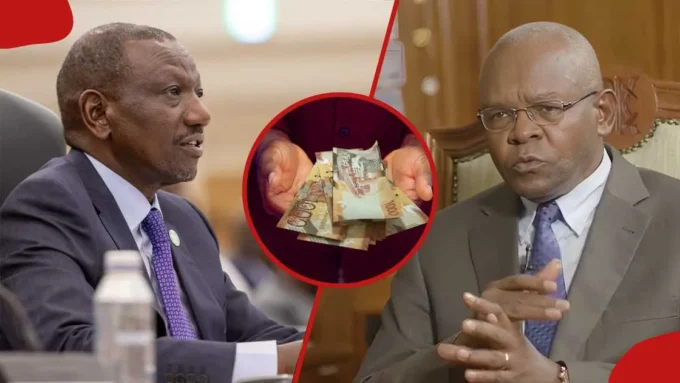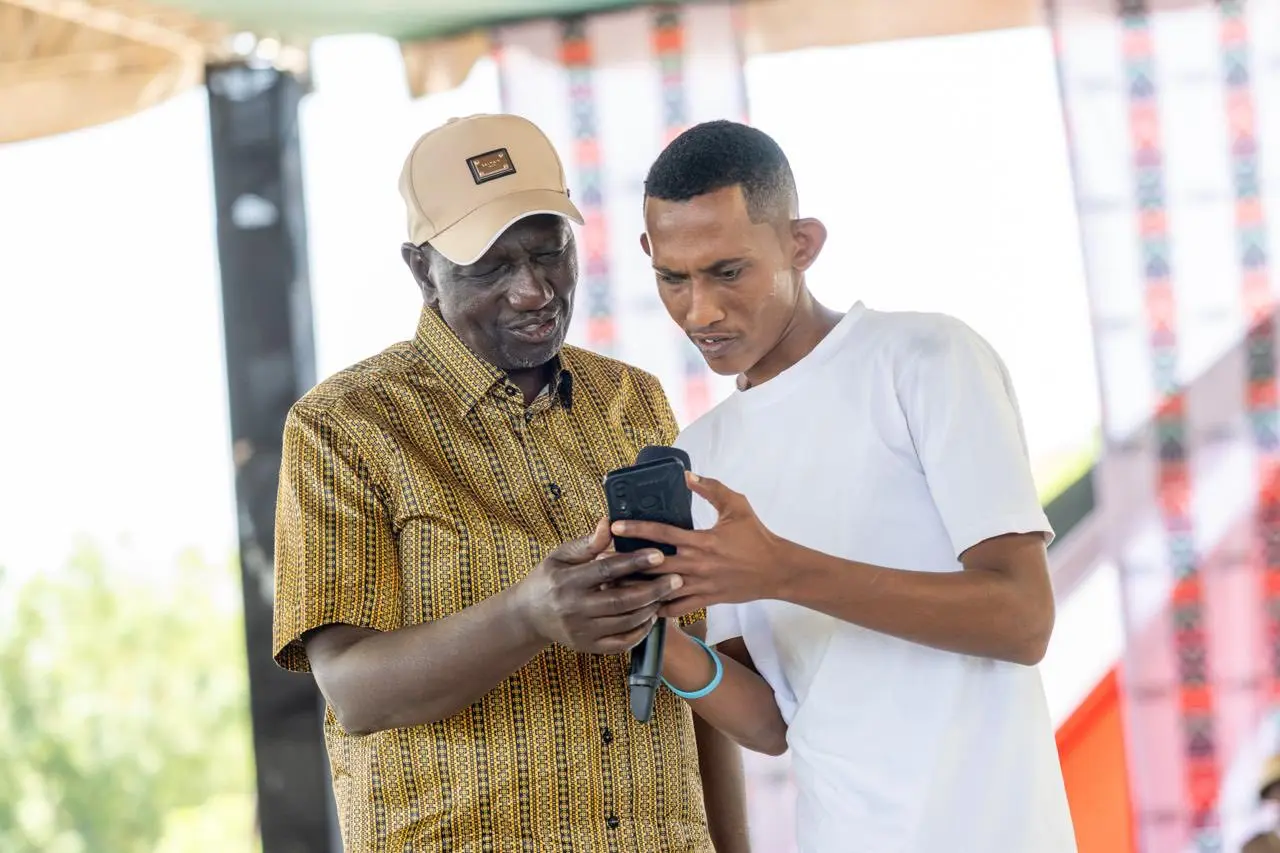
President William Ruto presided over the distribution of KSh63 million in business start-up capital to 2,520 young entrepreneurs from Garissa County’s 30 wards today, marking the final phase of a nationwide youth empowerment initiative that has reached over 100,000 young Kenyans across all 47 counties.
The disbursement ceremony, held at Garissa High School grounds, represents a significant milestone in the government’s Bottom-Up Economic Transformation Agenda (BETA), reaffirming the administration’s commitment to empower young people by providing equitable access to economic opportunities through the National Youth Opportunities Towards Advancement (NYOTA) programme.
Each beneficiary will receive KSh25,000 in the first phase of the programme, with KSh22,000 credited directly to their Pochi la Biashara account – a mobile money business wallet that allows entrepreneurs to separate their business and personal funds. The remaining KSh3,000 will be deposited in their Haba na Haba Savings Account managed by the National Social Security Fund (NSSF), encouraging a culture of savings among young business owners.
In the second phase of the NYOTA programme, each beneficiary will receive an additional KSh25,000, bringing the total start-up capital to KSh50,000 per entrepreneur. This two-phase disbursement model is designed to ensure that recipients demonstrate commitment and business viability before receiving the full allocation.
Build the future you deserve. Get started with our top-tier Online courses: ACCA, HESI A2, ATI TEAS 7, HESI EXIT, NCLEX-RN, NCLEX-PN, and Financial Literacy. Let Serrari Ed guide your path to success. Enroll today.
World Bank-Backed National Initiative
The NYOTA programme is a World Bank-financed initiative with a total commitment of approximately KSh29.5 billion spread over five years. The project targets unemployed and underemployed youth aged 18 to 29 years, and up to 35 years for persons with disabilities, focusing on those with secondary-level education or below who face systemic barriers to economic opportunity.
Speaking during the launch of the NYOTA programme in Malindi, Kilifi County, World Bank Country Director for Kenya Qimiao Fan emphasized that the initiative addresses what he described as Kenya’s biggest development challenge: jobs. “NYOTA is important because it addresses what I believe is the biggest development challenge Kenya faces today – jobs. This is why we, as the World Bank, decided to support it,” Fan stated.
The World Bank director explained that improving employability sits at the center of the institution’s engagement with Kenya, with a strong focus on job creation. He noted that success would not be judged by how many young people sign up, but by how many gain work experience, build sustainable businesses, and generate jobs within their communities.
The Garissa County disbursement represents the conclusion of Phase Two of the NYOTA Business Support Component, which covered eight counties in the Coast and North Eastern regions. According to the Principal Secretary of the State Department for Micro, Small and Medium Enterprises Development, Susan Mang’eni, the final phase rollout took place between Thursday, February 5, and Thursday, February 12, 2026.
Beneficiaries from Kilifi, Lamu, and Tana River counties received their funds on Thursday, February 5, in Kilifi, while those from Mombasa, Kwale, and Taita Taveta received disbursements on Friday, February 6, in Mombasa. Wajir County beneficiaries received their allocations on Wednesday, February 11, with Garissa concluding the nationwide distribution on Thursday, February 12.
Comprehensive Youth Empowerment Framework
The NYOTA programme is structured around four main pillars designed to create a holistic approach to youth economic empowerment. The first pillar focuses on paid on-the-job training, providing structured apprenticeships for over 90,000 youth to gain hands-on technical and workplace skills, culminating in professional certification through the On-the-Job Experience (OJE) component.
The second pillar addresses entrepreneurship support through the Business Support Component, which has now disbursed funds to over 100,000 vulnerable youth across all 1,450 wards in Kenya, with at least 70 beneficiaries per ward. This component includes not just the capital disbursement but also comprehensive business development services, mentorship programmes, and networking opportunities designed to ensure the sustainability of youth-led enterprises.
The third pillar recognizes prior learning through the Recognition of Prior Learning (RPL) certification programme, which targets uncertified vulnerable youth who already have job skills acquired through formal, non-formal, and informal learning. This component provides formal recognition and certification for existing skills, enhancing employability and market competitiveness for young workers who have learned trades through apprenticeships or on-the-job training.
The fourth pillar emphasizes youth savings through partnerships with the National Social Security Fund, leveraging the Haba na Haba product that gives members in the informal sector a chance to save a minimum of KSh25 a day, with the option of withdrawing 50 percent of their contribution after consistently contributing for a minimum of five years.
Digital-First, Transparent Distribution
Cabinet Secretary for Micro, Small and Medium Enterprises, Hon. Wycliffe Ambetsa Oparanya, emphasized that the NYOTA programme was deliberately designed to be transparent, digital, and accessible, eliminating intermediaries and ensuring funds reach intended beneficiaries directly. The application process uses the USSD code *254#, which is free to use on both feature phones and smartphones, ensuring accessibility even for youth in remote areas with limited internet connectivity.
Applicants dial the code and choose their preferred option: training, entrepreneurship, or skill recognition, and await confirmation for further processing. This digital-first approach has been crucial in reaching beneficiaries across Kenya’s diverse geography, from urban centers to rural and remote communities.
The use of Pochi la Biashara – Safaricom’s mobile money business account – for fund disbursement represents a significant innovation in government-to-person payment systems. The platform allows business owners to receive and separate business funds from personal funds on their M-PESA line, with a simple sign-up process that involves no paperwork. Business owners can withdraw funds at an agent directly from their Pochi la Biashara account without moving funds to their M-PESA account, streamlining cash flow management for small enterprises.
The integration of the NSSF Haba na Haba savings component addresses a critical gap in social security coverage for informal sector workers. Unlike other NSSF benefits that require members to retire or attain age 50 to access their savings, Haba na Haba allows members to withdraw 50 percent of their contribution after consistently contributing for a minimum of five years, providing a safety net while maintaining long-term savings discipline.
Nationwide Impact and Regional Distribution
The NYOTA programme has achieved remarkable scale across Kenya since its launch. The first cohort of the Business Support Component was launched on December 7, 2025, at Mumias Sports Complex in Kakamega County, covering the Western region counties of Kakamega, Busia, Bungoma, and Vihiga, where over 12,155 beneficiaries received KSh303.9 million.
The North Rift region followed on January 8, 2026, with 9,423 beneficiaries from Uasin Gishu, Nandi, West Pokot, Turkana, and Elgeyo Marakwet counties receiving KSh200 million in Eldoret. The South Rift region saw 9,847 beneficiaries from Nakuru, Baringo, Narok, Bomet, and Kericho counties receive KSh245.6 million on January 9.
The Central region disbursement on January 12 provided 6,982 beneficiaries from Nyeri, Nyandarua, Kirinyaga, and Murang’a counties with KSh173.2 million. The North Eastern region, which includes Samburu, Isiolo, Laikipia, and Marsabit counties, received KSh103.9 million for 4,159 beneficiaries on January 13.
The Nairobi, Kiambu, and Kajiado cluster saw one of the largest single disbursements on January 26, 2026, when 10,337 youth beneficiaries received KSh258.4 million at the Moi International Sports Centre, Kasarani, during an event presided over by President Ruto. The event was attended by the Deputy President, Governors, Cabinet Secretaries, Members of Parliament, and National Government Administrative Officers.
During the Kasarani event, Nairobi Governor Johnson Sakaja announced a two-year waiver on business license fees for NYOTA beneficiaries operating in the capital, while Kajiado Governor Joseph Ole Lenku pledged allocation of market stalls to support youth enterprises. These complementary interventions by county governments demonstrate the multi-level governmental support for youth entrepreneurship under the NYOTA framework.
One decision can change your entire career. Take that step with our Online courses in ACCA, HESI A2, ATI TEAS 7, HESI EXIT, NCLEX-RN, NCLEX-PN, and Financial Literacy. Join Serrari Ed and start building your brighter future today.
Bottom-Up Economic Transformation in Action
President Ruto has consistently positioned NYOTA as a central pillar of his administration’s Bottom-Up Economic Transformation Agenda, which aims to shift Kenya’s economic development strategy from trickle-down approaches to interventions that directly impact ordinary citizens, particularly those at the bottom of the economic pyramid.
Speaking at various NYOTA disbursement events, President Ruto has emphasized that the programme is about giving young people the capital, skills, and opportunities they need to build sustainable livelihoods and create jobs for others. “This programme is about giving young people the capital, skills and opportunities they need to build sustainable livelihoods and create jobs,” the President stated during the Kasarani disbursement.
The President has defended BETA against critics who characterize it as mere political rhetoric, pointing to page 10 of the BETA Plan which he says explicitly articulates a comprehensive vision for elevating Kenya’s economy to first-world standards. He argues that the Bottom-Up Economic Agenda, which served as his powerful rallying point during the 2022 elections, remains fully synchronized with his vision of transforming Kenya into a globally competitive economy.
The NYOTA programme aligns with Kenya’s broader development framework under Vision 2030 and is implemented through the Fourth Medium Term Plan (MTP IV) 2023-2027. The BETA framework targets sectors with high impact potential to drive economic recovery through a value chain approach, with particular emphasis on supporting Micro, Small and Medium Enterprises (MSMEs) to provide employment and income opportunities for economically excluded segments of society.
Kenya’s economy has shown signs of stabilization under BETA policies, with inflation declining from 9.6 percent in 2022 to 3.5 percent, alongside increased production of maize, tea and sugarcane, and improved prices for coffee and milk. President Ruto has attributed these improvements to the comprehensive implementation of bottom-up economic policies that prioritize direct interventions in productive sectors.
Structured Support Beyond Capital
A critical feature of the NYOTA programme that distinguishes it from previous youth empowerment initiatives is its emphasis on structured support beyond mere capital disbursement. All beneficiaries must complete a compulsory four-day Business Development Services training before receiving the first tranche of funding, ensuring that recipients have basic business management skills and understanding of financial planning, record-keeping, and market analysis.
Following the initial disbursement, beneficiaries enter a two-month structured mentorship programme where they receive ongoing guidance from experienced business advisors and successful entrepreneurs. During this period, their businesses are monitored and evaluated to assess viability, challenges faced, and support needs. This mentorship phase is crucial in helping young entrepreneurs navigate the critical early months of business establishment when failure rates are typically highest.
After completing the mentorship programme, beneficiaries undergo additional Business Development Support (BDS) training in preparation for the second tranche of business grants. This staged approach ensures that only entrepreneurs who demonstrate commitment, basic business acumen, and potential for sustainability receive the full KSh50,000 allocation, maximizing the programme’s impact and return on investment.
The Principal Secretary for Youth Affairs and the Creative Economy, Mr. Fikirini Jacobs, has emphasized that the project specifically targets young people who did not progress beyond Form Four, noting that formal university or college qualifications are not a requirement. “Today, over 10,000 young people are receiving capital to start businesses and transform their lives. This money is for business,” he emphasized during the Nairobi disbursement event.
Inclusive Reach and Special Populations
One of the distinctive features of the NYOTA programme is its deliberately inclusive design, which extends opportunities not only to vulnerable and unemployed Kenyan youth but also to refugee youth in Kakuma (Turkana County) and Dadaab (Garissa County), reinforcing Kenya’s commitment to inclusive economic growth and equal opportunity for all youth within its borders.
The programme targets 50 percent participation from women, recognizing the particular barriers that young women face in accessing economic opportunities and capital. Special provisions have also been made for persons with disabilities, who are eligible for the programme up to age 35 (compared to 29 for other youth), acknowledging the additional challenges this population faces in economic participation.
President Ruto has emphasized the inclusive nature of NYOTA in his public statements, noting that the programme’s design ensures participation from marginalized groups, young mothers, and refugees, aligning with constitutional principles of non-discrimination and equal opportunity. “In the next ten days, we want to have completed this project. Every young person who has qualified should receive the first tranche so that we can elevate the business environment of our young people,” the President stated during the Western region launch.
The programme’s multi-agency implementation approach involves coordination by the State Department for Youth Affairs and Creative Economy, working with the State Department for Labour and Skills Development, State Department for Micro, Small and Medium Enterprise Development, National Industrial Training Authority, National Employment Authority, Micro and Small Enterprises Authority, and National Social Security Fund. This collaborative framework ensures comprehensive support addressing multiple dimensions of youth economic empowerment.
Economic Impact and Public Perception
Public confidence in the NYOTA initiative appears strong according to available survey data. A recent Infotrak survey shows that most Kenyans believe the KSh50,000 start-up grant is adequate to help young entrepreneurs take their first steps into business, reinforcing support for the programme’s design and funding levels.
The economic multiplier effects of distributing over KSh7 billion (approximately $50 million) to more than 100,000 young entrepreneurs across Kenya are expected to be substantial. These funds flow directly into local economies, stimulating demand for goods and services, creating employment in supply chains, and generating tax revenue through increased economic activity. The focus on labor-intensive sectors such as retail, food services, agriculture, and artisanal production maximizes the job creation potential per shilling invested.
Beyond direct economic impacts, the programme contributes to financial inclusion by bringing thousands of young Kenyans into the formal financial system through mobile money platforms and NSSF savings accounts. This financial integration creates credit histories, enables access to additional financial services, and builds assets that can serve as collateral for future borrowing, creating pathways for business expansion beyond the initial grant support.
The emphasis on savings through the Haba na Haba component addresses long-term economic security, helping to build a culture of financial planning among young entrepreneurs who typically operate in the informal sector with limited access to social protection. The ability to withdraw 50 percent of contributions after five years provides liquidity for emergencies or investment opportunities while maintaining a retirement savings component.
Challenges and Implementation Considerations
While the NYOTA programme has achieved impressive scale and coverage, implementation of any initiative of this magnitude inevitably faces challenges. Ensuring that business training translates into viable enterprises requires ongoing monitoring and support beyond the two-month mentorship period. Many young entrepreneurs will face market competition, cash flow challenges, and business management difficulties that require sustained technical assistance and potentially additional forms of support.
The programme’s success will ultimately be measured not by the number of disbursements but by the survival and growth rates of supported enterprises, job creation beyond the primary beneficiary, and income improvements for participating youth. Rigorous monitoring and evaluation frameworks are essential to assess impact and make necessary adjustments to programme design based on evidence of what works in different contexts and sectors.
Access to markets remains a critical constraint for many small enterprises, particularly in rural areas where NYOTA beneficiaries may face limited local demand and high costs of reaching larger urban markets. Complementary interventions to improve infrastructure, reduce transaction costs, and facilitate market linkages will be important to maximize the programme’s impact.
The integration with county government support, as demonstrated by the Nairobi and Kajiado initiatives to waive business license fees and allocate market stalls, suggests a promising model of multi-level government coordination that could be replicated across other counties. Such complementary support addresses some of the non-financial barriers to business success and demonstrates commitment to youth enterprise development beyond capital provision.
Looking Ahead
As the NYOTA programme completes its second phase of Business Support Component disbursements with the Garissa allocation, attention turns to sustaining the momentum and ensuring that the initial investment translates into lasting economic transformation for Kenya’s youth. The programme’s comprehensive design – combining capital, skills training, mentorship, and savings – provides a more holistic approach than previous youth empowerment initiatives that often focused solely on one dimension of support.
President Ruto announced at the Samburu disbursement event that “there are another 90,000 young people in the next phase who will also benefit from this project,” indicating the government’s commitment to expanding the programme’s reach beyond the initial 100,000 beneficiaries. This expansion will bring NYOTA closer to its target of uplifting 820,000 unemployed young people through apprenticeships, certification, entrepreneurship grants, digital skills, and savings support.
The World Bank’s commitment of KSh29.5 billion over five years provides a stable funding foundation for sustained implementation, allowing the programme to move beyond the pilot phase toward institutionalization as a core element of Kenya’s youth employment strategy. The emphasis on building systems and digital infrastructure for programme delivery creates foundations that can support ongoing youth economic empowerment interventions beyond the current programme cycle.
For the 2,520 young entrepreneurs in Garissa County who received their disbursements today, the NYOTA grant represents not just financial capital but an opportunity to demonstrate that with appropriate support, Kenya’s youth can become engines of economic growth and job creation in their communities. Their success – or challenges – will provide valuable lessons for refining youth empowerment approaches and ensuring that economic transformation truly reaches Kenya’s most vulnerable and marginalized young people.
As President Ruto emphasized during the launch events, the ultimate goal extends beyond individual business success to systemic economic transformation that creates opportunity, reduces inequality, and builds prosperity from the bottom up. Whether NYOTA achieves this ambitious vision will depend on sustained implementation, rigorous monitoring, adaptive management based on evidence, and complementary reforms that address broader constraints to youth economic participation in Kenya’s economy.
For now, the completion of the nationwide disbursement across all 47 counties marks a significant milestone in Kenya’s youth development policy, demonstrating the government’s capacity to implement large-scale, digitally-enabled social programmes that reach beneficiaries across diverse geographic and social contexts. The coming months and years will reveal whether this investment translates into the transformative economic impact that both the government and the World Bank envision for Kenya’s youth and the nation’s broader development trajectory.
Ready to take your career to the next level? Join our Online courses: ACCA, HESI A2, ATI TEAS 7 , HESI EXIT , NCLEX – RN and NCLEX – PN, Financial Literacy!🌟 Dive into a world of opportunities and empower yourself for success. Explore more at Serrari Ed and start your exciting journey today! ✨
Track GDP, Inflation and Central Bank rates for top African markets with Serrari’s comparator tool.
See today’s Treasury bonds and Money market funds movement across financial service providers in Kenya, using Serrari’s comparator tools.
photo source: Google
By: Montel Kamau
Serrari Financial Analyst
12th February, 2026