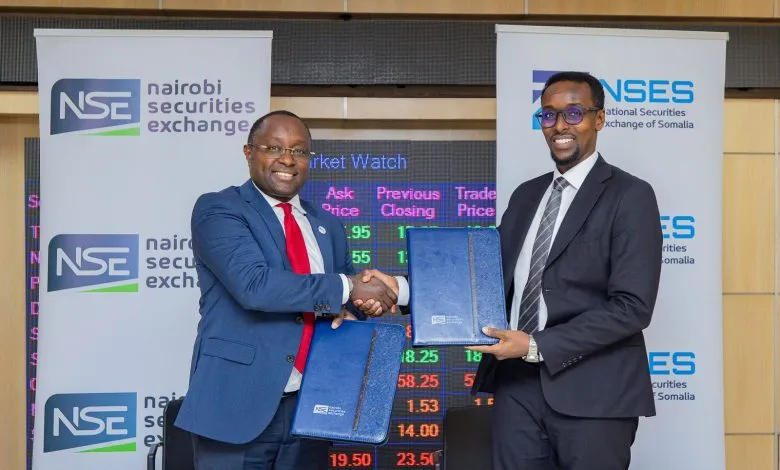
The Nairobi Securities Exchange of Kenya and the National Securities Exchange of Somalia have forged a transformative partnership that promises to reshape East Africa’s financial landscape, marking an unprecedented collaboration between one of the continent’s most established stock markets and its newest bourse. The Memorandum of Understanding signed between the two institutions establishes a comprehensive framework for cooperation that extends far beyond traditional bilateral agreements, encompassing technology transfer, dual-listing mechanisms, investor education initiatives, and the development of Islamic financial instruments.
This landmark agreement comes at a pivotal moment for both nations and the broader East African region. Somalia, having launched its National Securities Exchange on June 19, 2025, is preparing to commence trading in early 2026, targeting critical sectors including telecommunications, banking, energy, real estate, and agriculture. Meanwhile, Kenya’s Nairobi Securities Exchange, established in 1954 and serving as one of Africa’s premier financial hubs, brings six decades of expertise in capital markets development, regulatory frameworks, and investor protection mechanisms.
Build the future you deserve. Get started with our top-tier Online courses: ACCA, HESI A2, ATI TEAS 7, HESI EXIT, NCLEX-RN, NCLEX-PN, and Financial Literacy. Let Serrari Ed guide your path to success. Enroll today.
The Strategic Context: Somalia’s Journey to Capital Markets
Somalia’s path to establishing a functional securities exchange represents a remarkable transformation for a nation that has spent decades rebuilding its institutions and economic infrastructure. The National Securities Exchange of Somalia was officially launched in June 2025 with Yasin M. Ibar appointed as its first Chief Executive Officer. The exchange will initially operate as a private and self-regulatory organization, working closely with the Central Bank of Somalia and other public institutions to ensure market integrity and transparency.
The establishment of the NSES comes against the backdrop of Somalia’s broader economic recovery efforts. The country’s economy has historically been sustained by remittances from the Somali diaspora, which contribute an estimated $2 billion annually, equivalent to approximately 25 percent of Somalia’s GDP. These remittance flows have been instrumental in keeping households afloat during periods of conflict and natural disasters, but the country’s leadership recognizes that sustainable economic development requires diversifying funding sources and creating formal channels for capital formation.
“For decades, Somali entrepreneurs have relied on informal trust networks and family capital to grow their businesses,” said Yasin M. Ibar, Chief Executive Officer of the National Securities Exchange of Somalia. “This partnership is how we change that story, creating a transparent, regulated marketplace where opportunity is open to everyone.” His comments underscore the transformative potential of formal capital markets in shifting Somalia from an economy dependent on informal financing mechanisms to one that can attract institutional investment and facilitate large-scale business development.
The World Bank estimates that remittances account for 25 percent of Somalia’s GDP, with approximately $2 billion flowing into the country annually from Somalis living in North America, Europe, the Middle East, and other diaspora communities. While these flows have been critical for survival, particularly during humanitarian crises, they represent private household income rather than investment capital. The establishment of the NSES aims to channel some of this diaspora wealth into productive investments through equity and bond markets, transforming remittances from consumption-focused transfers into development-oriented capital.
Nairobi’s Role as Regional Financial Gateway
The Nairobi Securities Exchange brings formidable credentials to this partnership. Founded in 1954, the NSE has evolved into a leading African Exchange, offering world-class trading facilities for both local and international investors seeking exposure to Kenya’s dynamic economy. The exchange is a founding member of the African Securities Exchanges Association and the East African Securities Exchanges Association, and maintains full membership in the World Federation of Exchanges and the Association of Futures Markets.
Kenya’s capital markets infrastructure has undergone significant modernization in recent years. In 2025, the NSE removed the mandatory 100-share board lot requirement, allowing single-share trading to increase retail participation and democratize access to equity investments. The exchange has also been developing tokenization and digital asset infrastructure through the Kenya Digital Exchange initiative, positioning itself at the forefront of financial technology innovation in Africa.
Frank Mwiti, Chief Executive Officer of the Nairobi Securities Exchange, articulated the strategic vision underlying this partnership: “The future of African capital markets lies in connectivity. Through this MoU, we are proud to stand with NSES in advancing a more inclusive, efficient, and sustainable regional market that will benefit investors and issuers across East Africa. Somalia’s progress in setting up the NSES represents bold leadership and vision. As exchanges, our collaboration will help unlock liquidity, support private sector growth, and create opportunities for both local and diaspora investors to participate in Africa’s growth story.”
The NSE has positioned itself as the gateway to regional capital flows, and this partnership with Somalia represents a natural extension of that strategy. Despite facing challenges in recent years, including a decade-long drought in initial public offerings, the exchange remains optimistic about facilitating cross-border listings and helping newer markets develop the institutional capacity necessary to attract quality issuers.
Technology Transfer and Capacity Building
A central pillar of the NSE-NSES partnership involves comprehensive technology transfer and capacity building initiatives. The agreement commits both exchanges to cooperation on technology transfer, market surveillance systems, post-trade infrastructure, and the development of Shariah-compliant financial products. For Somalia’s nascent exchange, access to the NSE’s proven technological platforms and operational expertise represents a critical accelerant for its development trajectory.
The newly formed National Securities Exchange of Somalia is courting Kenyan companies to cross-list in Mogadishu through this partnership with the Nairobi bourse, in a move aimed at accelerating the exchange’s early growth and credibility. Under the fresh agreement, Kenyan firms with business interests in Somalia will be encouraged to consider listing on the NSES, while the NSE opens its platform to Somali firms seeking regional visibility and access to a broader investor base.
This mutual access arrangement addresses critical needs for both markets. The NSE, which has not recorded a new initial public offering in more than a decade, stands to benefit from Somali companies seeking cross-listing opportunities in Nairobi. Meanwhile, the NSES gains credibility and liquidity through the participation of established Kenyan firms that have already demonstrated their ability to meet international listing standards and corporate governance requirements.
Technology transfer extends beyond trading systems to encompass critical market infrastructure including clearing and settlement mechanisms, regulatory reporting frameworks, and investor protection systems. The NSE has developed sophisticated surveillance capabilities to detect market manipulation, insider trading, and other forms of abuse that undermine investor confidence. Transferring these capabilities to Somalia will be essential for establishing the NSES as a trustworthy marketplace that can attract both domestic and international capital.
Islamic Finance and Shariah-Compliant Instruments
A particularly significant aspect of the partnership involves the development and promotion of Shariah-compliant financial instruments, particularly Sukuk bonds. Somalia’s population is predominantly Muslim, and ensuring that capital market products align with Islamic finance principles will be critical for maximizing participation and channeling savings into productive investments.
Sukuk, or Islamic bonds, represent certificates of ownership in tangible assets or services rather than debt obligations bearing interest. The structure of Sukuk makes them compliant with Islamic law, which prohibits the payment or receipt of interest. The NSES plans to provide a platform for issuing government-backed, Sharia-compliant Sukuk to finance priority infrastructure and development projects across Somalia, addressing the nation’s substantial infrastructure gap while adhering to Islamic financial principles.
The NSE brings experience in listing and trading Sukuk instruments, having admitted several Islamic finance products to its platforms in recent years. This expertise will prove invaluable as Somalia develops its regulatory framework for Islamic securities and establishes market-making mechanisms to ensure liquidity for Sukuk investors. The partnership also envisions joint investor education programs specifically focused on Islamic finance, helping both institutional and retail investors understand the structure, risks, and potential returns associated with these instruments.
Regional Integration and the East African Securities Exchanges Association
The NSE-NSES partnership operates within the broader framework of regional financial market integration championed by the East African Securities Exchanges Association. EASEA brings together the exchanges of Kenya, Rwanda, Somalia, Tanzania, Uganda and Ethiopia, serving as the umbrella body representing securities exchanges and depositories across the East African Community.
Somalia’s membership in EASEA, alongside the National Securities Exchange of Somalia and the pre-existing Somali Stock Exchange, reflects the country’s integration into regional capital market structures. The association has been instrumental in promoting cross-border cooperation, with initiatives including the launch in April 2025 of the East Africa Exchanges 20-Share Index, which tracks price movements and changes in market capitalization of constituent firms across the region, offering a transparent benchmark for investors, analysts, and policymakers.
The commitment by both the NSE and NSES to align their activities with EASEA protocols represents more than regulatory harmonization—it signals a shared vision for creating an integrated East African capital market where securities can flow freely across borders, investors can access opportunities throughout the region, and companies can raise capital from a much larger pool of potential shareholders. This vision aligns with broader East African Community integration efforts, which have progressively eliminated trade barriers and promoted the free movement of people, goods, services, and capital.
Somalia became the eighth Partner State of the East African Community on November 24, 2023, with the accession process finalized on March 4, 2024 after ratification by Somalia’s Parliament. This membership provides Somalia with access to a market of over 300 million people and positions the country to benefit from reduced trade barriers, coordinated economic policies, and enhanced infrastructure connectivity across the region.
Cross-Border Listings and Dual-Listing Frameworks
The partnership’s emphasis on developing dual-listing frameworks addresses one of the most significant barriers to regional capital market integration: the difficulty companies face in accessing investors across multiple markets. Cross-listing allows a company’s shares to trade on multiple exchanges simultaneously, dramatically expanding the potential investor base while maintaining a primary listing on the company’s home market.
Kenyan firms currently lead in cross-listing within the East African region. Eight Kenyan companies are cross-listed, including Nation Media Group, East African Breweries, Kenya Airways, and Jubilee Holdings, primarily on the Uganda Securities Exchange and the Dar es Salaam Stock Exchange. However, the NSE has seen only limited reciprocal cross-listings from other EAC countries, with Rwanda’s Bank of Kigali and Ugandan utility Umeme representing the primary examples.
The NSE has committed to encourage Kenyan firms operating in Somalia to explore listing opportunities in Mogadishu while helping the Somali bourse design cross-listing mechanisms that could also enable Somali companies to list in Nairobi. This bilateral approach recognizes that cross-listing must be mutually beneficial, providing Kenyan companies with access to Somalia’s diaspora investors while giving Somali firms access to Kenya’s more liquid and sophisticated capital markets.
For Somalia, attracting cross-listings from established Kenyan companies would provide immediate credibility and demonstrate that the NSES operates according to international standards. For Kenya, facilitating the growth of Somalia’s exchange creates opportunities for Kenyan financial services firms, brokerages, and institutional investors to expand their regional footprint and capture the first-mover advantages associated with entering frontier markets.
One decision can change your entire career. Take that step with our Online courses in ACCA, HESI A2, ATI TEAS 7, HESI EXIT, NCLEX-RN, NCLEX-PN, and Financial Literacy. Join Serrari Ed and start building your brighter future today.
The African Continental Free Trade Area Context
The NSE-NSES partnership derives additional strategic significance from its alignment with the African Continental Free Trade Area, which aims to create a single continental market for goods and services, facilitated by the movement of persons and the contribution of capital and natural resources. The AfCFTA, which became operational in 2021, represents the largest free trade area in the world by number of participating countries, connecting 1.3 billion people across 55 countries with a combined GDP valued at approximately $3.4 trillion.
One of the AfCFTA’s core objectives involves facilitating the movement of capital across African borders, recognizing that robust capital markets are essential for financing the continent’s development needs. The agreement seeks to reduce barriers to capital flows, harmonize financial regulations, and promote regional investment by fostering deeper and more liquid capital markets. The NSE-NSES partnership serves as a concrete example of how African countries can advance these objectives through bilateral cooperation that eventually contributes to broader continental integration.
By promoting stability and enhancing trade within the Horn of Africa and East Africa, this partnership supports a stronger, more interconnected regional economy. As a model for cross-border collaboration under the AfCFTA framework, this MoU positions Kenya and Somalia as leaders in advancing regional economic integration and setting precedents for how established exchanges can support nascent markets in developing the institutional capacity necessary for sustainable capital market development.
The World Bank estimates that full implementation of the AfCFTA could increase Africa-wide real income by 7 percent and lift 30 million people out of extreme poverty by 2035. Achieving these outcomes requires not only the elimination of tariff barriers but also the development of enabling infrastructure, including financial market infrastructure that can facilitate cross-border investment and capital formation.
Kenya-Somalia Economic and Cultural Linkages
The partnership builds on deep-rooted economic and cultural ties between Kenya and Somalia that have long facilitated trade and investment flows. Communities of Somali heritage are an essential part of Kenya’s social and economic landscape, contributing significantly to commerce in cities such as Nairobi, Mombasa, and Garissa. The Eastleigh neighborhood of Nairobi, often referred to as “Little Mogadishu,” has emerged as a vibrant commercial center where Somali entrepreneurs have established thriving businesses in retail, wholesale trade, real estate, and telecommunications.
Conversely, Kenyan businesses have been expanding their presence in Somalia’s finance and consumer sectors, creating opportunities for growth on both sides of the border. Kenyan banks, telecommunications companies, and consumer goods manufacturers have identified Somalia as a promising frontier market, with its large diaspora population, youthful demographics, and ongoing economic recovery creating substantial demand for modern financial services and consumer products.
This MoU builds on these organic economic connections to foster shared prosperity, enabling investors and diaspora communities from both nations to participate confidently in each other’s markets and drive inclusive development across the region. By formalizing and institutionalizing cross-border capital flows through regulated securities markets, the partnership aims to transform what has historically been informal trade and family-based investment into transparent, scalable capital formation that can support larger enterprises and infrastructure projects.
Yasin Ibar emphasized this point: “Somalis move between these two markets every day. The ties are already deep because our people and our diaspora connect them. This partnership simply formalizes what has long existed and ensures that everyone can finally benefit from it.” His observation highlights how the formal financial infrastructure being created through this partnership will serve to channel and amplify existing economic relationships rather than creating artificial linkages.
Diaspora Engagement and Investment Mobilization
Engaging Somalia’s substantial diaspora community represents a critical component of the NSES development strategy, and the partnership with the NSE provides valuable channels for reaching these potential investors. The Somali diaspora is estimated to number between 1.5 and 2 million people globally, with significant concentrations in the United States, United Kingdom, Canada, Scandinavia, the Gulf countries, and Kenya itself.
The remittances from this diaspora community represent more than three times the size of foreign direct investment flowing into Somalia and roughly equal the total amount of grants and official aid the country receives. These flows demonstrate both the diaspora’s financial capacity and their continued emotional and economic connection to Somalia. Converting even a small percentage of these remittances into equity or bond investments could dramatically increase the capital available for business expansion and infrastructure development.
The NSES has indicated plans to conduct investor education campaigns and international roadshows targeting Somali diaspora communities in Turkey, Kenya, Britain, Norway and the United States. These outreach efforts will emphasize the opportunity for diaspora members to participate in Somalia’s economic recovery not merely as donors or providers of consumption support to family members, but as investors who can earn returns while contributing to the country’s development.
The NSE’s experience in diaspora engagement will prove valuable in designing these outreach programs. Kenya has successfully attracted investment from its own diaspora, and the NSE has developed materials and educational programs specifically tailored to overseas investors who may be unfamiliar with formal capital markets procedures. Adapting these materials for the Somali context, while ensuring they address concerns specific to investing in a post-conflict economy, will be a joint undertaking between the two exchanges.
Regulatory Harmonization and Investor Protection
Establishing robust regulatory frameworks and credible investor protection mechanisms represents perhaps the most critical challenge facing the NSES as it prepares to commence trading. Investors, particularly institutional investors and diaspora members with access to investment opportunities in more developed markets, will only commit capital to Somalia if they have confidence that the market operates fairly, that their property rights will be respected, and that they have recourse in the event of disputes.
The partnership commits both exchanges to aligning with East African Securities Exchanges Association protocols to promote seamless trade and transparent governance across borders. This alignment extends beyond technical standards to encompass principles of corporate governance, disclosure requirements, and enforcement mechanisms that protect minority shareholders and prevent market manipulation.
The NSE’s regulatory framework, developed over six decades and refined through numerous market cycles, provides a valuable template for Somalia. Kenya’s Capital Markets Authority has established comprehensive rules governing everything from initial public offering procedures to continuous disclosure obligations for listed companies to sanctions for market abuse. While Somalia will need to adapt these frameworks to its own legal system and institutional capacity, having proven models to draw upon will substantially accelerate the development process.
A joint working committee established under the MoU will operationalize the partnership, focusing on areas such as regulatory cooperation, market surveillance, and joint investor education initiatives. This committee will serve as the primary mechanism for transferring knowledge from the NSE to the NSES, identifying challenges as they arise, and developing practical solutions that account for Somalia’s unique circumstances.
Economic Impact and Market Potential
The economic potential of a functional securities exchange in Somalia extends far beyond simply providing businesses with an alternative to bank financing. Capital markets facilitate price discovery, allocate capital efficiently, enable risk sharing, provide liquidity, and create benchmarks for valuing businesses. These functions are essential for a modern economy and have been largely absent from Somalia during decades of conflict and institutional weakness.
Somalia’s GDP, while difficult to measure precisely due to the substantial informal economy, is estimated at approximately $8 billion. The remittance flows of $2 billion annually represent 25 percent of GDP, suggesting that the formal economy has substantial room to grow as security improves and institutions strengthen. Key sectors targeted by the NSES—telecommunications, banking, energy, real estate, and agriculture—are all experiencing robust growth and would benefit from access to long-term capital through equity and bond markets.
The telecommunications sector has been a particular success story in Somalia despite the absence of traditional governance structures. Companies like Hormuud Telecom have built extensive networks and pioneered mobile money services that now serve millions of Somalis. Listing these companies on the NSES would provide liquidity for early investors, enable the companies to raise capital for network expansion, and allow ordinary Somalis to participate in the sector’s continued growth.
Similarly, Somalia’s banking sector is experiencing rapid evolution as formal institutions gradually displace or incorporate the hawala networks that have historically moved money in and out of the country. Banks need capital to expand their branch networks, invest in technology, and increase lending capacity. Equity markets provide an efficient mechanism for raising this capital while distributing the benefits of banking sector growth across a broader shareholder base.
Challenges and Risk Factors
Despite the promise of this partnership and the broader NSES initiative, substantial challenges remain. Somalia continues to grapple with security concerns, particularly in regions affected by Al-Shabaab insurgency. While the security situation has improved dramatically in Mogadishu and other major cities, periodic attacks and the ongoing presence of armed groups in some areas create uncertainty that deters investment and complicates business operations.
Institutional capacity represents another significant challenge. Somalia’s government institutions, while improving, lack the depth of experience and resources necessary to effectively regulate a securities market. The Central Bank of Somalia, which has pledged technical support for the NSES, is itself in the process of rebuilding its capacity to conduct monetary policy, supervise financial institutions, and maintain financial stability. Developing securities market regulation as an additional responsibility will strain already-limited resources.
The legal and judicial system’s capacity to enforce contracts and resolve disputes represents a third major challenge. Investors need confidence that courts can fairly adjudicate disputes over share ownership, interpret listing agreements, and impose meaningful sanctions on companies that violate disclosure requirements. Building this judicial capacity while the broader rule of law remains a work in progress will require sustained effort and international support.
Currency volatility and the lack of integration with international financial systems also pose challenges. Somalia uses the Somali shilling alongside the US dollar, with exchange rates determined largely by supply and demand in informal forex markets. The absence of correspondent banking relationships for most Somali financial institutions constrains trade finance and investment flows, making it difficult for international investors to move money in and out of the country efficiently.
Implementation Timeline and Next Steps
The signing of the Memorandum of Understanding represents the beginning rather than the culmination of this partnership. Translating the broad commitments outlined in the MoU into operational systems and procedures will require sustained effort from both exchanges, their respective regulatory authorities, and supporting institutions.
The immediate priority involves establishing the joint working committee that will operationalize the partnership. This committee will need to develop detailed work plans covering technology transfer timelines, investor education program content and delivery mechanisms, regulatory cooperation protocols, and dual-listing procedures. Each of these work streams involves complex technical issues that will require input from multiple stakeholders including listed companies, brokerages, institutional investors, and regulatory authorities.
As Somalia prepares to commence trading on NSES in early 2026, the working committee will need to ensure that essential systems are in place before the market opens. This includes trading platforms, clearing and settlement systems, regulatory reporting mechanisms, and investor protection frameworks. The NSE’s experience in managing these systems will be invaluable, but adapting them to Somalia’s context while ensuring they meet international standards will require careful attention.
Investor education initiatives represent another immediate priority. Both retail and institutional investors in Somalia and the diaspora need to understand how securities markets work, what rights they have as shareholders, how to evaluate investment opportunities, and what risks they face. The joint investor education programs envisioned in the MoU will need to reach audiences with varying levels of financial literacy, using culturally appropriate materials and delivery channels.
Broader Implications for African Capital Markets
The NSE-NSES partnership carries implications that extend well beyond Kenya and Somalia. If successful, it could serve as a template for how established African exchanges can support emerging markets in developing their capital market infrastructure, demonstrating that South-South cooperation and technology transfer can accelerate financial sector development.
Many African countries lack well-developed securities markets, limiting their ability to mobilize domestic savings for productive investment and forcing them to rely heavily on foreign portfolio investment or bank lending. The experience gained through the NSE-NSES partnership could inform similar initiatives elsewhere on the continent, from West Africa to Southern Africa, where smaller economies could benefit from partnering with regional financial hubs.
The partnership also demonstrates the viability of Islamic finance in African capital markets beyond the traditional centers of Islamic finance in the Gulf region and Southeast Asia. If the NSES successfully develops a vibrant market in Sukuk and other Shariah-compliant instruments, it could inspire similar developments in other African countries with significant Muslim populations, from Senegal to Nigeria to Tanzania.
Moreover, the emphasis on diaspora engagement represents an important evolution in thinking about how African countries can tap into the resources of their overseas populations. Rather than viewing diaspora members primarily as sources of remittances to support consumption, the partnership recognizes them as potential investors who can provide patient capital for long-term development while earning financial returns.
Conclusion
The Memorandum of Understanding between the Nairobi Securities Exchange and the National Securities Exchange of Somalia represents far more than a bilateral agreement between two financial institutions. It embodies a vision for regional economic integration, demonstrates the potential for South-South cooperation in financial sector development, and provides a concrete mechanism for channeling diaspora resources into productive investment.
For Somalia, the partnership with Kenya’s established exchange offers a fast track to building credible capital market infrastructure, avoiding costly mistakes, and establishing international credibility that will be essential for attracting both domestic and foreign investment. For Kenya, supporting Somalia’s capital market development reinforces Nairobi’s role as East Africa’s financial hub while creating opportunities for Kenyan companies and financial institutions to expand into a promising frontier market.
The road ahead presents substantial challenges, from building regulatory capacity to ensuring security to developing the investor base necessary for liquid markets. However, both exchanges have demonstrated commitment to seeing this partnership succeed, recognizing that their fates are intertwined in an increasingly integrated regional economy.
As Frank Mwiti emphasized, “The future of African capital markets lies in connectivity.” The NSE-NSES partnership brings that future one step closer, creating pathways for capital to flow across borders, enabling investors and issuers to access broader markets, and demonstrating that African institutions can drive their own development through strategic cooperation. If Somalia’s experience demonstrates that even post-conflict economies can build functional capital markets with the right partnerships and support, it could inspire similar transformations across Africa’s remaining frontier markets, ultimately contributing to the continent’s broader vision of economic integration and shared prosperity.
Catch Up With Our Other Headlines
2nd December, 2025
Mastercard and AXIAN Launch Integrated Financial Ecosystem Across Five African Nations
India’s GDP Growth Hits 8.2% as Private Sector Takes the Wheel
ASX Downturn: Technology Outage and $5 Billion Takeover Collapse Fuel Market Uncertainty
Africa’s Top Economists Convene to Forge a New Path for Sustainable and Inclusive Growth
Superior Homes Launches ‘The Orchards’ as Northlands City’s Premier Residential Anchor
Kenya Ranked Africa’s Most Competitive Economy in IMD 2025 Index
Ready to take your career to the next level? Join our Online courses: ACCA, HESI A2, ATI TEAS 7 , HESI EXIT , NCLEX – RN and NCLEX – PN, Financial Literacy!🌟 Dive into a world of opportunities and empower yourself for success. Explore more at Serrari Ed and start your exciting journey today! ✨
Track GDP, Inflation and Central Bank rates for top African markets with Serrari’s comparator tool.
See today’s Treasury bonds and Money market funds movement across financial service providers in Kenya, using Serrari’s comparator tools.
photo source: Google
By: Montel Kamau
Serrari Financial Analyst
2nd December, 2025