










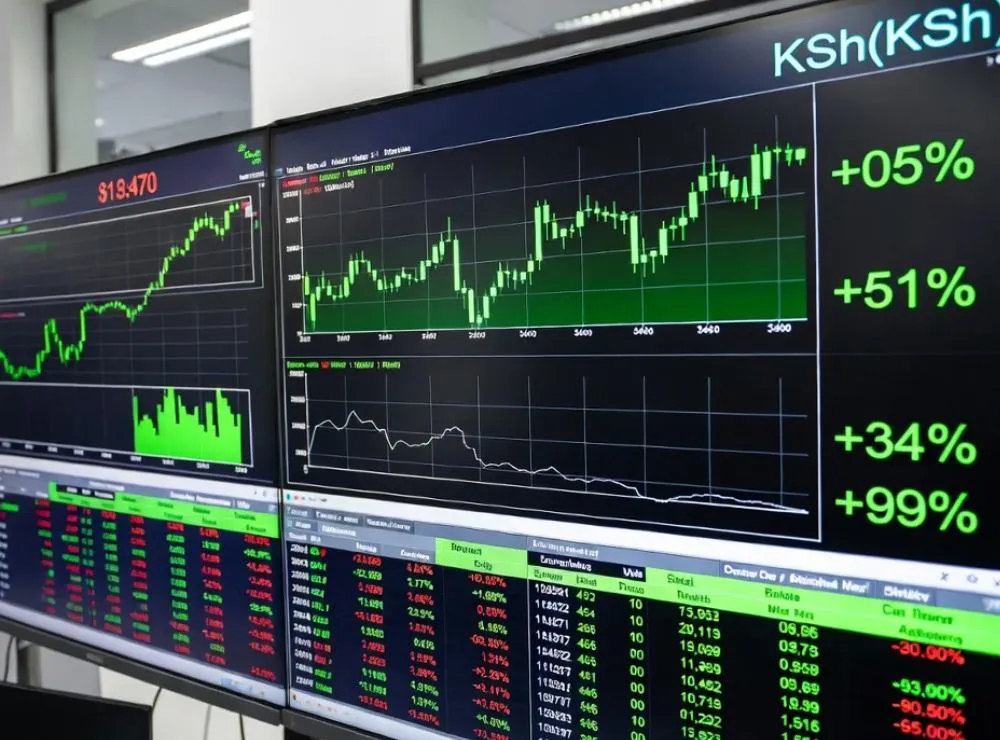
The Nairobi Securities Exchange (NSE) opened 2026 with a steady and broad-based advance, defying a cautious global backdrop marked by geopolitical tensions, volatile energy markets, and mixed signals from major economies. Equity indices closed January at their strongest levels this year, underpinned by gains in large-cap stocks, improving valuations, and renewed confidence among domestic investors.
While foreign participation remained volatile and liquidity softened on a month-on-month basis, the overall picture suggests a market gradually rebuilding momentum after several years of subdued performance. January’s gains were not driven by speculative excess, but by selective positioning across banking, industrial, and consumer counters, supported by attractive valuations and stabilising macroeconomic conditions.
Build the future you deserve. Get started with our top-tier Online courses: ACCA, HESI A2, ATI TEAS 7, HESI EXIT, NCLEX-RN, NCLEX-PN, and Financial Literacy. Let Serrari Ed guide your path to success. Enroll today.
Equity Indices Push Higher Across the Board
Market performance in the final week of January reinforced the positive tone that has characterised the opening month of 2026.
- The NSE 20 Share Index rose 0.98% to close at 3,299.28 points
- The All Share Index (NASI) gained 0.39% to 195.36 points, marking its highest weekly close this year
- The NSE 25 Index advanced 0.38% to 5,321.96 points
- The NSE 10 Index climbed 0.89% to 2,046.82 points
The only laggard among major benchmarks was the Banking Index, which slipped 0.35% amid mild profit-taking in large-cap lenders, even as trading volumes in the sector remained elevated.
January Performance Shows Broad Momentum
Zooming out to the full month, the strength of the rally becomes more apparent.
- The NASI closed January up 4.7% month-on-month, reflecting steady accumulation in blue-chip stocks
- The NSE 20 Index recorded the strongest gain, rising 5.1% from 3,139.19 to 3,299.28
- The NSE 25 Index gained 4.4%, while the NSE 10 advanced 4.2%
Market capitalisation expanded by 4.7% to KES 3.08 trillion, up from KES 2.94 trillion at the end of December. The increase was driven largely by gains in heavyweight banking stocks, including Co-operative Bank of Kenya, Absa Bank Kenya, and NCBA Group, which together accounted for 36.6% of the total market capitalisation added in January.
Market Breadth Improves as Cyclicals and Defensives Advance
Market breadth during January remained constructive, with thirteen stocks posting double-digit gains over the month. Performance was not confined to a single sector, signalling a healthier rally than those seen in past years.
Leading the gainers was Kenya Airways, which surged 36.8% to close at KES 4.83. The rally followed announcements that Temasek Holdings and Qatar Airways were considering acquiring control of the airline—news that reignited optimism around the carrier’s long-term prospects.
Other notable gainers included:
- Uchumi Supermarket (+23.3%)
- Absa NewGold ETF (+15.6%)
- Car and General (+15.2%)
- East African Portland Cement (+14%)
The diversity of gainers highlights renewed appetite for both cyclical recovery plays and defensive hedges, particularly in an environment of global uncertainty.
One decision can change your entire career. Take that step with our Online courses in ACCA, HESI A2, ATI TEAS 7, HESI EXIT, NCLEX-RN, NCLEX-PN, and Financial Literacy. Join Serrari Ed and start building your brighter future today.
Losers Reflect Selective Risk Appetite
On the downside, losses were largely concentrated in smaller-cap and structurally challenged counters.
Olympia Capital Holdings emerged as the top loser, shedding 9.5% to close at KES 8.22. It was followed by:
- WPP ScanGroup (-8.6%)
- Home Afrika (-6.7%)
- Nairobi Business Ventures (-6.1%)
- Liberty Kenya (-5.2%)
The pattern suggests investors are increasingly discriminating, favouring balance-sheet strength and earnings visibility.
Liquidity Softens Despite Rising Prices
Despite the strong performance in prices, trading activity cooled during the month.
- Equity turnover declined 23.6% month-on-month to KES 13 billion, down from KES 17 billion in December
- Trading volumes fell 19.5% to 410 million shares, compared with 509.6 million shares in the prior month
This divergence between rising prices and falling volumes suggests that price discovery was driven by targeted buying rather than broad speculative participation.
Foreign investors also shifted positions. After a marginal inflow in December, they recorded net selling of KES 1.09 billion in January, indicating continued caution toward frontier and emerging markets.
Domestic Investors Take the Lead
The pullback in foreign participation was offset by strong domestic investor engagement, which helped carry the market higher. This dynamic is increasingly characteristic of the NSE, where local institutional investors—pension funds, insurance companies, and fund managers—have become the dominant force.
This shift has made the market more resilient to global capital flow volatility, but it also means that domestic liquidity conditions and interest rate expectations play an outsized role in market direction.
Weekly Trading: Activity Concentrates in Large Caps
In the final week of January, equity turnover rebounded sharply, rising 39.1% week-on-week to KES 4.45 billion, while volumes increased to 114.7 million shares from 79.8 million previously.
Trading remained highly concentrated:
- The top five counters accounted for 67.26% of total market value
Leading the turnover table was KCB Group, which traded KES 954.6 million, closing slightly lower at KES 66.50. It was followed by:
- Safaricom (KES 684.5 million)
- Equity Group Holdings (KES 553.3 million)
- Absa NewGold ETF (KES 460.8 million, +5.41%)
- East African Breweries (KES 341.5 million, +7.37%)
Sector Breakdown Highlights Banking Dominance
Sector activity during the week underscored the central role of financial stocks:
- Banking sector: 53.84% of turnover (KES 2.3 billion)
- Telecommunications: 15.37%
- Exchange-traded funds: 10.37%
- Manufacturing: 9.79%
This composition reflects both the size of banking stocks and their sensitivity to interest rate and macroeconomic expectations.
Valuations Remain Supportive
Despite January’s gains, valuations suggest the market is far from overheated. According to data from Cytonn Investments:
- The market trades at a price-to-earnings ratio of 7.8x, representing a 31% discount to the historical average
- Dividend yield stands at 5.1%, attractive relative to inflation
- The NASI PEG ratio of 1.0x indicates prices are broadly aligned with expected earnings growth
These metrics suggest that the rally is being driven by valuation re-rating rather than speculative excess.
Fixed Income Activity Picks Up
Activity in the fixed-income market remained robust, reflecting sustained demand for yield and duration.
- Secondary bond turnover rose 20.7% to KES 278.2 billion
- Year-on-year, bond turnover surged 76.9%
- The bond index advanced 0.92% to 1,174.14
Commercial banks remained the dominant players, positioning amid stable policy rates and declining Treasury bill yields.
CBK Confirms Market Strength
According to the Central Bank of Kenya (CBK) weekly update:
“At the Nairobi Securities Exchange, the NASI, NSE 25 and NSE 20 share price indices increased by 0.29 percent, 0.16 percent and 0.73 percent respectively during the week ending January 29, 2026.”
The CBK also reported increases in market capitalisation, equity turnover, and total shares traded, signalling active repositioning by investors across counters.
Global Backdrop: Supportive but Uncertain
Globally, the environment remains mixed. The U.S. economy grew 4.4% in Q3 2025, but labour market conditions remained weak despite declining jobless claims. The U.S. Dollar Index weakened by 2.11%, providing some relief to emerging markets.
Meanwhile, oil prices rose sharply, with Murban crude climbing to USD 68.46 per barrel amid concerns over rising U.S.–Iran geopolitical tensions, a factor that could feed into inflation and current account pressures.
Against this backdrop, the NSE’s positive performance stands out as a sign of improving domestic confidence.
Why This Matters: Reading the Signals
1. Market Confidence Is Returning
January’s rally suggests investors are beginning to price in stabilising macro conditions and earnings recovery.
2. Domestic Capital Is Now the Anchor
Local investors are increasingly shaping market direction, reducing vulnerability to sudden foreign outflows.
3. Valuations Offer a Margin of Safety
At current multiples, equities still look attractive relative to fixed income and inflation.
4. Risks Remain
Geopolitical tensions, oil price volatility, and foreign selling could still test sentiment.
Historical Perspective: A Different Kind of Rally
Unlike previous short-lived rallies driven by foreign inflows, the current advance is grounded in domestic liquidity, valuation support, and selective earnings growth. This makes it potentially more durable—but also more sensitive to local policy and fiscal developments.
Conclusion: A Measured but Encouraging Start to 2026
The Nairobi Securities Exchange has begun 2026 on a firm footing, supported by rising indices, improving breadth, and supportive valuations. While liquidity remains uneven and foreign participation cautious, domestic investors are increasingly willing to step in.
The result is a market that is not euphoric—but quietly constructive. If earnings continue to improve and macro stability holds, January’s gains could mark the foundation for a more sustained recovery rather than a fleeting rebound.
Ready to take your career to the next level? Join our Online courses: ACCA, HESI A2, ATI TEAS 7 , HESI EXIT , NCLEX – RN and NCLEX – PN, Financial Literacy!🌟 Dive into a world of opportunities and empower yourself for success. Explore more at Serrari Ed and start your exciting journey today! ✨
photo source: Google
By : Elsie Njenga
3rd February, 2026
Article, Financial and News Disclaimer
The Value of a Financial Advisor
While this article offers valuable insights, it is essential to recognize that personal finance can be highly complex and unique to each individual. A financial advisor provides professional expertise and personalized guidance to help you make well-informed decisions tailored to your specific circumstances and goals.
Beyond offering knowledge, a financial advisor serves as a trusted partner to help you stay disciplined, avoid common pitfalls, and remain focused on your long-term objectives. Their perspective and experience can complement your own efforts, enhancing your financial well-being and ensuring a more confident approach to managing your finances.
Disclaimer: This article is for informational purposes only and does not constitute financial advice. Readers are encouraged to consult a licensed financial advisor to obtain guidance specific to their financial situation.
Article and News Disclaimer
The information provided on www.serrarigroup.com is for general informational purposes only. While we strive to keep the information up to date and accurate, we make no representations or warranties of any kind, express or implied, about the completeness, accuracy, reliability, suitability, or availability with respect to the website or the information, products, services, or related graphics contained on the website for any purpose. Any reliance you place on such information is therefore strictly at your own risk.
www.serrarigroup.com is not responsible for any errors or omissions, or for the results obtained from the use of this information. All information on the website is provided on an as-is basis, with no guarantee of completeness, accuracy, timeliness, or of the results obtained from the use of this information, and without warranty of any kind, express or implied, including but not limited to warranties of performance, merchantability, and fitness for a particular purpose.
In no event will www.serrarigroup.com be liable to you or anyone else for any decision made or action taken in reliance on the information provided on the website or for any consequential, special, or similar damages, even if advised of the possibility of such damages.
The articles, news, and information presented on www.serrarigroup.com reflect the opinions of the respective authors and contributors and do not necessarily represent the views of the website or its management. Any views or opinions expressed are solely those of the individual authors and do not represent the website's views or opinions as a whole.
The content on www.serrarigroup.com may include links to external websites, which are provided for convenience and informational purposes only. We have no control over the nature, content, and availability of those sites. The inclusion of any links does not necessarily imply a recommendation or endorsement of the views expressed within them.
Every effort is made to keep the website up and running smoothly. However, www.serrarigroup.com takes no responsibility for, and will not be liable for, the website being temporarily unavailable due to technical issues beyond our control.
Please note that laws, regulations, and information can change rapidly, and we advise you to conduct further research and seek professional advice when necessary.
By using www.serrarigroup.com, you agree to this disclaimer and its terms. If you do not agree with this disclaimer, please do not use the website.
www.serrarigroup.com, reserves the right to update, modify, or remove any part of this disclaimer without prior notice. It is your responsibility to review this disclaimer periodically for changes.
Serrari Group 2025