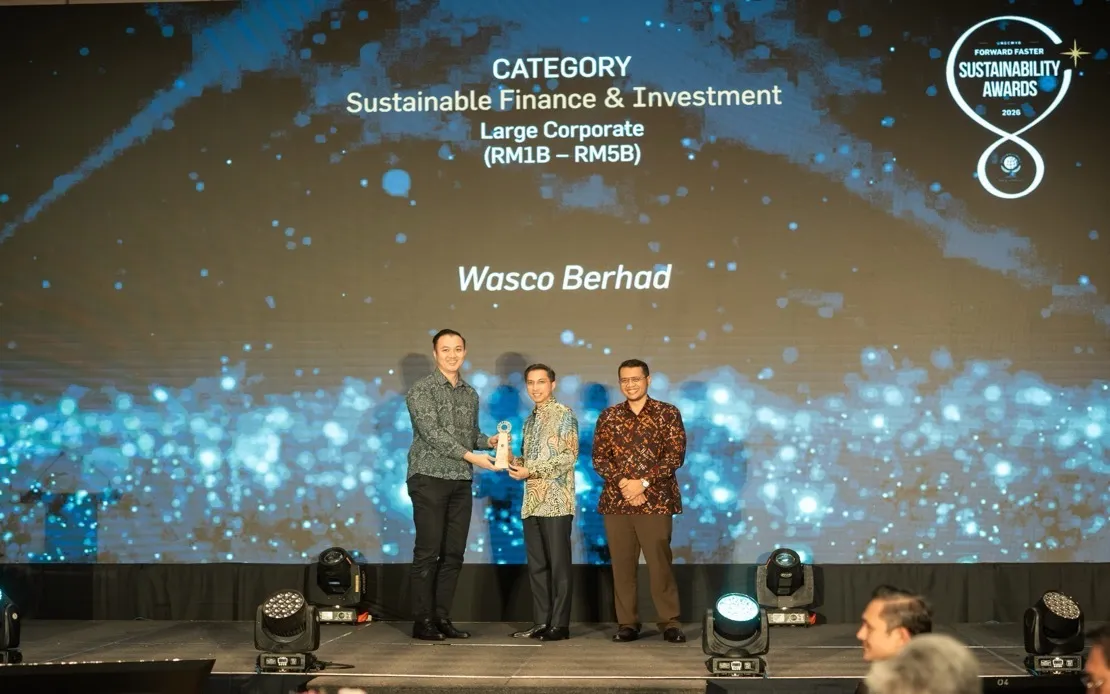
Wasco Bhd, a prominent Malaysian energy solutions provider, has secured the Sustainable Finance and Investment category at the Forward Faster Sustainability Awards 2026, marking a significant milestone in the company’s journey to integrate environmental, social, and governance principles into its core financial strategy. The award,organized by the United Nations Global Compact Network Malaysia and Brunei, recognizes organizations that demonstrate leadership in embedding sustainability commitments directly into capital structure and management processes.
The recognition was conferred for Wasco’s groundbreaking Sustainable Transition Finance Framework (STFF), which stands among the first corporate financing structures in the Association of Southeast Asian Nations region to operationalize the ASEAN Taxonomy for Sustainable Finance within a practical business context. This achievement represents not merely compliance with emerging standards but genuine innovation in translating regional sustainability policy frameworks into actionable financial instruments.
Build the future you deserve. Get started with our top-tier Online courses: ACCA, HESI A2, ATI TEAS 7, HESI EXIT, NCLEX-RN, NCLEX-PN, and Financial Literacy. Let Serrari Ed guide your path to success. Enroll today.
The Significance of ASEAN Taxonomy Integration
The ASEAN Taxonomy, released progressively since 2021 with the latest Version 4 published in November 2025, provides a science-based, inclusive framework for classifying sustainable economic activities across Southeast Asia’s diverse economies. Developed collaboratively by the region’s central banks, capital market regulators, insurance regulators, and financial agencies, the taxonomy serves as a common language for identifying and financing sustainable projects across member states.
The framework was designed specifically to address the challenge that different jurisdictions define sustainable economic activities and associated criteria differently, which complicates cross-border sustainable finance flows. By providing standardized classification approaches, the ASEAN Taxonomy aims to unlock capital for projects advancing net-zero transitions, biodiversity goals, and other environmental objectives throughout the region.
Wasco’s STFF demonstrates practical application of these principles by embedding taxonomy-aligned criteria directly into the company’s financing agreements. This approach ensures that capital allocation decisions systematically support environmental transition objectives while providing lenders and investors with transparent, standardized metrics for assessing sustainability performance.
The multi-tiered structure of the ASEAN Taxonomy—comprising a Foundation Framework for organizations beginning sustainability journeys and a more rigorous Plus Standard for those demonstrating capacity to meet stricter environmental requirements—enables companies at different stages of development to participate in sustainable finance markets. Wasco’s successful implementation of this framework validates its effectiveness as both a business tool and a regional standard.
Leadership Perspective on Sustainable Finance Integration
Giancarlo Maccagno, Managing Director and Group Chief Executive Officer of Wasco, emphasized that the recognition affirms the company’s fundamental belief that sustainability must be embedded in how organizations finance their growth rather than treated as a separate compliance exercise. He explained that through the STFF, Wasco has created a comprehensive framework that connects capital allocation directly with measurable environmental outcomes.
This integration strengthens investor confidence by providing clear line-of-sight between financial decisions and sustainability impact, while simultaneously supporting the broader energy transition that Southeast Asia must undertake to meet climate commitments. Maccagno’s comments reflect growing understanding among corporate leaders that sustainable finance is not peripheral to business strategy but central to long-term value creation and resilience.
The approach represents a departure from traditional sustainability reporting, which often operates independently from financial decision-making processes. By structuring financing agreements to include sustainability performance targets and transparent eligibility criteria, Wasco has aligned economic incentives with environmental objectives, ensuring that sustainability considerations influence actual capital allocation rather than merely shaping external communications.
Concrete Financial Achievements Through the Framework
The Sustainable Transition Finance Framework has already delivered tangible results for Wasco, demonstrating that taxonomy-aligned approaches can mobilize significant capital for sustainable business transformation. Through the framework, the company has secured a US$25 million sustainability-linked loan, converted existing conventional and Islamic banking facilities into sustainability-linked financing instruments, and established rigorous sustainability performance targets aligned with its commitment to achieve net zero Scope 1 and Scope 2 carbon emissions by 2026.
Sustainability-linked loans differ from traditional green loans by tying financial terms to achievement of predetermined sustainability performance targets rather than restricting proceeds to specific environmental projects. This structure provides borrowers with flexibility to use capital for general corporate purposes while creating economic incentives—typically through interest rate adjustments—linked to sustainability outcome achievement.
The conversion of existing facilities into sustainability-linked instruments demonstrates Wasco’s commitment to transitioning its entire capital structure toward sustainability alignment rather than merely adding green financing alongside conventional arrangements. This comprehensive approach ensures that sustainability considerations influence all financing relationships and capital allocation decisions across the organization.
The net zero commitment for Scope 1 and Scope 2 emissions by 2026—covering direct emissions from owned or controlled sources and indirect emissions from purchased energy—represents an ambitious target that requires substantive operational changes rather than merely purchasing carbon offsets. By embedding this commitment within financing agreements, Wasco has created external accountability mechanisms that complement internal sustainability goals.
The Growing Importance of Transition Finance in ASEAN
Wasco’s recognition arrives at a critical moment for Southeast Asian sustainable finance markets, as regional economies increasingly adopt taxonomy-aligned standards and work toward harmonization across national frameworks. Five ASEAN Member States—Indonesia, Malaysia, Philippines, Singapore, and Thailand—have developed or implemented national sustainable finance taxonomies over recent years, with increasing alignment to the regional ASEAN Taxonomy framework.
This trend toward regional harmonization creates significant opportunities for companies that can navigate taxonomy requirements effectively. Financial institutions are increasingly scrutinizing whether borrowers demonstrate credible sustainability strategies, robust governance structures, meaningful interim targets, and clear alignment between capital expenditure plans and transition objectives before agreeing to sustainability-linked financing terms.
The award reflects growing regional emphasis on credible and measurable transition practices, where sustainability commitments must be integrated directly into how organizations raise, structure, and manage capital rather than existing as aspirational statements disconnected from financial reality. This evolution responds to legitimate concerns about greenwashing and the need for standardized, verifiable approaches to sustainable finance.
Southeast Asia faces particular sustainability challenges given its role as a significant contributor to global emissions through rapid industrialization, dependence on fossil fuel exports in some economies, and diverse stages of economic development across member states. The concept of just transition—ensuring that economic transformation toward sustainability does not leave the poorest and most vulnerable populations behind—is therefore central to regional sustainability frameworks.
Enhanced ESG Performance and External Recognition
The Forward Faster Sustainability Award follows Wasco’s recent improvement in its FTSE Russell ESG Rating to 4.4 out of 5.0, placing the company in the 98th percentile among Oil Equipment and Services peers globally. This exceptional positioning demonstrates that Wasco’s sustainability performance stands out even when benchmarked against international industry standards rather than merely regional comparators.
The rating improvement was led by a sector-leading Social Theme score of 5.0, providing independent verification that reinforces the credibility of Wasco’s sustainability practices across governance structures, operational execution, and disclosure quality. FTSE Russell’s methodology evaluates companies on exposure to and management of environmental, social, and governance risks, with ratings updated regularly based on publicly available information and company disclosures.
Achieving the 98th percentile positioning indicates that Wasco manages ESG risks more effectively than 98% of global peers in the Oil Equipment and Services sector—a remarkable achievement given the sector’s inherent sustainability challenges and stakeholder scrutiny. The Social Theme score, which assesses factors including labor standards, health and safety, human rights, community relations, and product responsibility, highlights particular strength in managing social dimensions of sustainability.
This external validation complements Wasco’s internal sustainability initiatives and provides stakeholders with independent assurance that the company’s ESG commitments translate into measurable performance improvements. For investors and lenders evaluating sustainable finance opportunities, third-party ESG ratings offer crucial benchmarks for assessing whether corporate sustainability claims reflect genuine performance or merely aspirational communications.
One decision can change your entire career. Take that step with our Online courses in ACCA, HESI A2, ATI TEAS 7, HESI EXIT, NCLEX-RN, NCLEX-PN, and Financial Literacy. Join Serrari Ed and start building your brighter future today.
Broader Recognition of Wasco’s Sustainability Journey
Beyond the Forward Faster Award and FTSE Russell rating improvement, Wasco has secured multiple sustainability recognitions that validate its comprehensive approach. The company maintained inclusion in both the FTSE4Good Bursa Malaysia and FTSE4Good Bursa Malaysia Syariah indices, affirming progress in transparency and sustainability standards aligned with Malaysian market requirements.
At The Edge ESG Awards 2024, Wasco was honored with two silver accolades—for Best Performer in the Energy Sector and Most Improved ESG Performance Over the Past Three Years in the RM800 Million to RM5 Billion Market Capitalization category. These awards recognize both current performance excellence and trajectory of improvement, indicating sustained commitment rather than one-time initiatives.
The company’s inclusion in the 2024 Fortune 500 Southeast Asia list further validated its strategic focus and growing investor confidence globally, demonstrating that sustainability leadership contributes to overall business recognition rather than existing as a separate domain of achievement. This integration reflects the increasing importance of ESG factors in comprehensive business evaluation and investment decision-making.
Wasco’s sustainability vision commits to delivering reliable energy solutions while achieving net zero carbon emissions for Scope 1 and 2 by 2026, with the mission to accelerate the global energy transition while enhancing value for all stakeholders. This framing positions sustainability not as constraint on business operations but as central to the company’s strategic purpose and value proposition.
The Mechanics of Sustainable Transition Finance Frameworks
The Sustainable Transition Finance Framework developed by Wasco through close collaboration between sustainability and finance functions provides structured approaches to aligning capital allocation with environmental and transition objectives. The framework establishes transparent eligibility criteria specifying which activities and expenditures qualify for sustainability-linked financing, measurable performance targets defining specific environmental outcomes to be achieved, and reporting mechanisms ensuring ongoing transparency about progress toward stated objectives.
This structured approach addresses key challenges in sustainable finance: establishing clear definitions of what constitutes sustainable or transition activities, creating accountability through measurable targets rather than aspirational statements, and providing stakeholders with regular, verified information about actual progress. The framework enables lenders and investors to understand precisely how sustainability commitments translate into financial performance and governance processes.
The development process required significant cross-functional collaboration, bringing together teams with expertise in sustainability strategy, financial management, treasury operations, risk assessment, and stakeholder communications. This integrated approach ensures that the framework reflects both genuine operational capabilities and credible financial structures rather than being developed in isolation by either sustainability or finance functions alone.
Transparent eligibility criteria are particularly important for preventing greenwashing and ensuring that sustainability-linked financing actually supports environmental transition rather than simply rebranding conventional activities. By clearly defining which expenditures and initiatives qualify for sustainable finance designation, frameworks create boundaries that maintain credibility and enable meaningful assessment by external parties.
Financial Performance and Strategic Positioning
Wasco’s sustainability leadership exists alongside strong financial performance, demonstrating that environmental commitments and commercial success can be mutually reinforcing. The company reported revenue of RM3.18 billion in 2024, representing 21.8% year-on-year growth driven by strong demand for energy infrastructure projects. Net profit rose 11% to RM166.32 million, while return on capital employed remained robust at 21%.
Importantly, the company has substantially improved its financial discipline, reducing its gearing ratio to 0.21x from 0.48x in the previous year. This deleveraging creates financial flexibility for strategic investments while reducing balance sheet risk—a combination that positions Wasco advantageously for pursuing growth opportunities in sustainable energy infrastructure.
The company is executing several strategic initiatives to future-proof its business model, including expansion into high-margin segments like renewable energy infrastructure through bioenergy subsidiary Wasco Greenergy, geographic diversification with new facilities in the United Kingdom, Indonesia, and Dubai, and development of sustainability-linked financing capabilities that may unlock more favorable capital costs as ESG targets are achieved.
These initiatives reflect understanding that the global energy transition creates both challenges and opportunities for traditional energy services companies. By proactively repositioning toward renewable infrastructure, sustainable financing, and international markets, Wasco is adapting its business model to capitalize on structural shifts in energy markets rather than merely managing decline in conventional operations.
The Regional Context: ASEAN’s Sustainable Finance Evolution
The ASEAN Taxonomy’s multi-tiered structure reflects pragmatic recognition that member states operate at different stages of economic development and have varying capacities to meet stringent environmental standards immediately. The Foundation Framework provides entry-level guidance for organizations beginning sustainability journeys, while the Plus Standard offers science-based technical screening criteria for companies demonstrating capacity to meet rigorous environmental thresholds.
This stacked approach enables inclusive participation across diverse economies while maintaining credibility through science-based standards at higher performance tiers. Companies can commence classification of economic activities based on their current readiness level, then progress toward more demanding criteria as capabilities develop—creating pathways for continuous improvement rather than binary pass-fail assessments.
The taxonomy addresses six focus sectors identified as particularly important for ASEAN’s sustainability journey: Energy, Transportation and Storage, Construction and Real Estate, Manufacturing, Agriculture, Forestry and Fishing, and Water Supply, Sewerage, Waste Management and Remediation. These sectors collectively account for major shares of regional emissions and resource consumption, making their transformation central to achieving climate and environmental objectives.
Three enabling sectors—Information and Communication, Professional, Scientific and Technical Activities, and Financial and Insurance Activities—support sustainability transitions across the economy by providing essential infrastructure, expertise, and capital. The inclusion of enabling sectors recognizes that achieving sustainable development requires comprehensive ecosystem transformation rather than isolated sectoral improvements.
Stakeholder Value and Transparency Enhancement
The Sustainable Transition Finance Framework provides multiple stakeholder groups with enhanced clarity and confidence regarding Wasco’s sustainability performance and commitments. For lenders, the framework offers standardized criteria for assessing credit risk related to environmental transition, transparent performance metrics enabling ongoing monitoring, and clear accountability mechanisms tied to financing terms and conditions.
For investors, taxonomy alignment provides assurance that capital allocation follows internationally recognized sustainability principles, comparable metrics enabling assessment across potential investments, and reduced greenwashing risk through standardized eligibility criteria and verification processes. This transparency is particularly valuable as asset managers and institutional investors face increasing pressure to demonstrate that ESG-focused investment strategies deliver genuine sustainability impact rather than merely applying superficial screening.
For customers and business partners, the framework demonstrates credible commitment to environmental responsibility, provides visibility into specific transition plans and timelines, and creates accountability through external verification and reporting requirements. As supply chain sustainability becomes increasingly important across industries, customers need assurance that their suppliers and partners are genuinely advancing environmental objectives.
For employees and communities, transparent sustainability commitments connected to financial performance create confidence that environmental priorities will receive sustained attention and resources rather than being abandoned when business conditions become challenging. This long-term perspective is essential for attracting and retaining talent while maintaining constructive relationships with communities where the company operates.
Looking Forward: Scaling Sustainable Finance in Southeast Asia
Wasco’s success in implementing ASEAN Taxonomy-aligned financing provides a practical template for other regional companies seeking to develop credible sustainable finance frameworks. The experience demonstrates that taxonomy operationalization, while complex, is achievable for organizations willing to invest in cross-functional collaboration, stakeholder engagement, and transparent reporting systems.
Several factors will influence the scaling of taxonomy-aligned sustainable finance across Southeast Asia in coming years. Regulatory developments, including potential mandatory disclosure requirements or preferential treatment for taxonomy-aligned activities, will create additional incentives for companies to adopt standardized frameworks. Investor demand for verified sustainable investment opportunities will continue growing as asset owners face pressure to demonstrate ESG integration and impact.
Financial institution capabilities in assessing taxonomy alignment and structuring appropriate financing terms will evolve, potentially reducing transaction costs and expanding access beyond large corporations to medium-sized enterprises. Standardization and harmonization efforts across national taxonomies within ASEAN will reduce complexity for regional businesses operating across multiple jurisdictions.
The development of technical screening criteria for additional sectors and activities will expand the scope of economic activities eligible for taxonomy-aligned classification, creating sustainable finance opportunities across broader swaths of regional economies. Enhanced data availability and digital tools for measuring, monitoring, and reporting sustainability performance will reduce administrative burdens while improving verification quality.
Conclusion: Leadership Through Implementation
Wasco’s recognition at the Forward Faster Sustainability Awards 2026 validates the company’s strategic decision to embed sustainability directly into financial strategy through operationalization of the ASEAN Taxonomy for Sustainable Finance. By developing a comprehensive Sustainable Transition Finance Framework, securing US$25 million in sustainability-linked financing, and converting existing facilities to incorporate sustainability performance criteria, Wasco has demonstrated practical leadership in regional sustainable finance evolution.
The company’s improved FTSE Russell ESG Rating to 4.4, positioning it in the 98th percentile among global Oil Equipment and Services peers with a perfect 5.0 Social Theme score, provides independent validation of sustainability performance across governance, operations, and disclosure dimensions. This external recognition complements internal initiatives and strengthens stakeholder confidence in the credibility of Wasco’s environmental commitments.
As Giancarlo Maccagno emphasized, the framework creates clear connections between capital allocation and measurable environmental outcomes, strengthening investor confidence while supporting the energy transition that Southeast Asia must undertake to meet climate objectives. This integration of sustainability and finance represents evolution from treating environmental considerations as external constraints to recognizing them as central to long-term value creation and business resilience.
For the broader ASEAN region, Wasco’s experience offers practical insights into taxonomy implementation challenges and opportunities, demonstrating that regional frameworks can translate into actionable corporate financing structures. As more companies develop similar capabilities and financial institutions enhance their capacity to assess taxonomy alignment, Southeast Asia’s sustainable finance ecosystem will continue maturing toward the scale and sophistication required to mobilize capital for meaningful climate and environmental action.
The Forward Faster Sustainability Award recognizes not merely Wasco’s current achievements but the company’s role in advancing regional sustainable finance capabilities through practical implementation of emerging standards. This leadership through execution—rather than merely through aspirational commitments—provides a valuable model for organizations throughout Southeast Asia working to align business strategy, financial management, and sustainability objectives in mutually reinforcing ways.
Ready to take your career to the next level? Join our Online courses: ACCA, HESI A2, ATI TEAS 7 , HESI EXIT , NCLEX – RN and NCLEX – PN, Financial Literacy!🌟 Dive into a world of opportunities and empower yourself for success. Explore more at Serrari Ed and start your exciting journey today! ✨
Track GDP, Inflation and Central Bank rates for top African markets with Serrari’s comparator tool.
See today’s Treasury bonds and Money market funds movement across financial service providers in Kenya, using Serrari’s comparator tools.
Photo source: Google
By: Montel Kamau
Serrari Financial Analyst
4th February, 2026