Malaysia is poised to introduce its first comprehensive National Climate Change Bill to Parliament during the current legislative session, marking a critical advancement in the country’s legal framework to address climate change and fulfill its international emissions reduction commitments. Deputy Minister of Natural Resources and Environmental Sustainability (NRES) Syed Ibrahim Syed Noh confirmed during a parliamentary question-and-answer session on January 21, 2026, that the Bill is expected for at least its first reading during the current parliamentary meeting, representing a significant milestone after years of development and consultation.
The legislation arrives alongside the finalization of Malaysia’s National Carbon Market Policy, which together will provide the government with comprehensive legal authority to regulate greenhouse gas (GHG) emissions from domestic facilities and strengthen market instruments and governance mechanisms. This dual-track approach reflects Malaysia’s strategic commitment to implementing Article 6 of the Paris Agreement, which establishes frameworks for international carbon cooperation and trading.
Build the future you deserve. Get started with our top-tier Online courses: ACCA, HESI A2, ATI TEAS 7, HESI EXIT, NCLEX-RN, NCLEX-PN, and Financial Literacy. Let Serrari Ed guide your path to success. Enroll today.
Legislative Authority for Carbon Market Regulation
The National Climate Change Bill and accompanying carbon market policy will grant the government explicit legislative authority to regulate carbon trading activities, including Internationally Transferred Mitigation Outcomes (ITMO), which will contribute towards Malaysia’s climate change mitigation targets. ITMOs represent emission reductions and removals that can be transferred between countries under bilateral or multilateral agreements, allowing nations to cooperate in achieving their Nationally Determined Contribution (NDC) targets under the Paris Agreement.
Deputy Minister Syed Ibrahim explained that this legislative framework will enhance transparency and accountability through carbon emission measurement and reporting mechanisms, directly supporting Malaysia’s NDC targets. The country has committed to reducing economy-wide carbon intensity by 45% by 2030 compared to 2005 levels—a target that represents a 10% increase from its earlier submission and is now unconditionally pledged regardless of international support.
The Bill’s provisions align with Article 6.2 and Article 6.4 of the Paris Agreement, which establish two distinct mechanisms for international carbon market cooperation. Article 6.2 allows countries to trade emission reductions and removals through bilateral or multilateral agreements, while Article 6.4 creates a global carbon market overseen by a United Nations entity known as the Article 6.4 Supervisory Body.
Evolution of Malaysia’s Climate Legislative Framework
The path to Malaysia’s National Climate Change Bill has been long and circuitous, reflecting both the technical complexity of climate legislation and shifting political priorities. Announcements about an impending climate change act began as early as 2019 under the Pakatan Harapan administration and continued through the Perikatan Nasional government, yet legislation failed to materialize through successive administrations.
The current Bill represents the culmination of extensive stakeholder engagement and policy development initiated under the new NRES ministry structure. Minister of Natural Resources and Environmental Sustainability Nik Nazmi Nik Ahmad confirmed in January 2026 that the ministry plans to table both the National Climate Change Bill (RUUPIN) and the National Climate Change Authority Bill (RUUIKLIM) for their first reading in Parliament by March 2026, with RUUPIN serving as the primary legal instrument to address climate change through mitigation and adaptation strategies.
The legislative timetable has evolved significantly over the past year. In August 2025, officials indicated the Bill would be tabled after the presentation of Budget 2026, following review by the Attorney General’s Chambers. By October 2025, authorities suggested the Bill would be introduced “in the coming months,” and now January 2026 statements confirm introduction during the current parliamentary session, indicating accelerated progress in finalizing the legislation.
Comprehensive Stakeholder Consultation Process
To ensure comprehensive implementation and broad stakeholder buy-in, NRES has conducted at least 13 engagement sessions with state governments, recognizing the federal nature of Malaysia’s governance structure where both federal and state governments exercise specific legislative and executive authority. This extensive consultation process reflects the complex interplay between federal climate policy and state-level implementation, particularly in sectors such as forestry, land use, and water resources where states retain significant constitutional authority.
The ministry also invited public feedback through a consultation paper on the Bill, which was available on the ministry’s website from October to December 2025. This public consultation period allowed civil society organizations, industry associations, academic institutions, and individual citizens to provide input on the proposed legislative framework, contributing to a more robust and implementable final product.
Deputy Minister Syed Ibrahim emphasized that further engagement sessions with industry players and non-governmental organizations (NGOs) will be held to gather feedback on the implementation of both the carbon market and the Bill. “The carbon market is a new field and remains under close study,” he explained, adding that “efforts to inform the industry and the public will be intensified to ensure the benefits to the country and its people are clearly understood.”
This commitment to ongoing consultation reflects awareness that carbon markets remain relatively novel instruments in Malaysia’s policy toolkit, and that successful implementation will require sustained education, capacity building, and stakeholder engagement across government, industry, and civil society sectors.
National Carbon Market Policy Framework
Parallel to the Climate Change Bill’s development, NRES is finalizing the National Carbon Market Policy to establish an inclusive framework for carbon trading. The policy outlines implementation pathways for both Article 6.2 bilateral cooperation and Article 6.4 centralized mechanisms, positioning Malaysia to participate actively in international carbon markets while developing domestic trading infrastructure.
Malaysia expects the compliance carbon market mechanism under Article 6 to become operational as early as 2026, according to statements by Deputy Natural Resources and Environmental Sustainability Minister Datuk Seri Huang Tiong Sii in October 2025. The implementation of these mechanisms will enable carbon projects in Malaysia to contribute to reducing GHG emissions, strengthen local technological capabilities, and create green job opportunities—objectives that align with broader national development goals outlined in the 12th Malaysia Plan and National Energy Policy 2022-2040.
Malaysia has already begun establishing bilateral cooperation under Article 6.2, having signed two memoranda of understanding for bilateral cooperation—with South Korea on November 25, 2024, and Singapore on January 7, 2025. Through these MOUs, both countries will be able to invest in the implementation of carbon projects in Malaysia, potentially providing crucial climate finance for emissions reduction initiatives that might otherwise face funding constraints.
However, technical elements such as specific methodologies, a complete registry system, and corresponding adjustment procedures have yet to be finalized, resulting in carbon credits not being officially issued under Malaysia’s national framework despite the bilateral agreements being in place. Deputy Minister Huang acknowledged that participation of local companies in the carbon market is expected to become more active once the proposed National Climate Change Bill is implemented, as it will outline clear procedures for participation in carbon markets under Article 6.
Malaysia Forest Fund and Sectoral Carbon Development
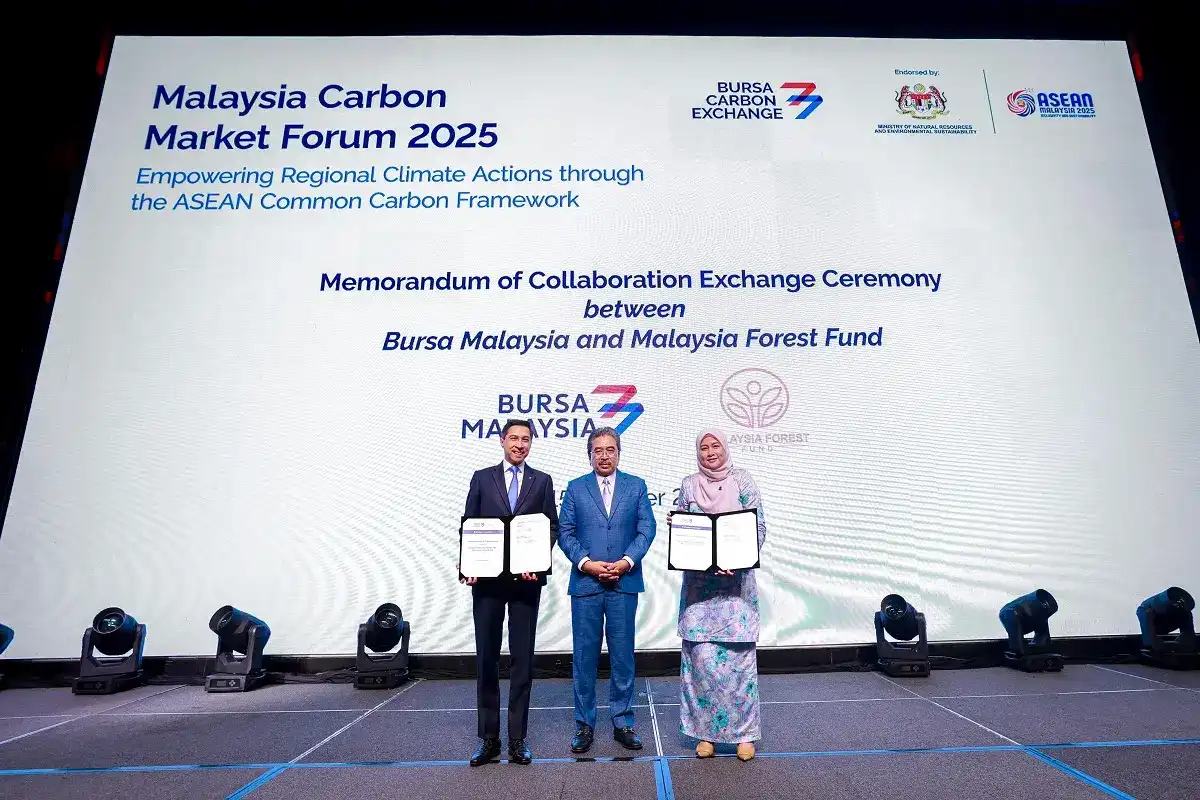
To promote development of forest-based carbon projects and facilitate their implementation by local companies, Malaysia has established the Malaysia Forest Fund. This initiative recognizes forests’ critical role in both climate mitigation through carbon sequestration and adaptation through ecosystem services including water regulation, biodiversity conservation, and disaster risk reduction.
The government is also considering applications from projects under the Clean Development Mechanism—the carbon offset mechanism established under the Kyoto Protocol—to be aligned with the Article 6.4 compliance market mechanism. This approach seeks to bridge legacy carbon market mechanisms with the new Paris Agreement framework, potentially allowing existing projects to transition to the new system and maintain continuity in carbon finance flows.
Forest-based carbon projects hold particular significance for Malaysia given the country’s commitment to maintaining at least 50% forest cover nationwide—a pledge first made at the Rio Earth Summit in 1992 and consistently reaffirmed. Current forest cover stands at approximately 54%, providing Malaysia with some buffer above the minimum threshold while also creating potential for forest carbon projects to generate emission reduction credits.
National Adaptation Plan and Climate Resilience
Complementing the mitigation focus of the Climate Change Bill and carbon market policy, Malaysia announced it would launch its first comprehensive National Adaptation Plan (MyNAP) in January 2026. Developed with over 100 stakeholders across government, industry, and civil society, MyNAP outlines strategies to address climate risks across health, infrastructure, agriculture, water, and biodiversity sectors.
Plantation and Commodities Minister Datuk Seri Johari Abdul Ghani, who has been performing the duties and functions of the natural resources and environmental sustainability minister during administrative transitions, emphasized that “MyNAP will complement the Climate Change Act, serving as a blueprint to help Malaysia withstand the growing impacts of climate change.”
The urgency of adaptation planning is underscored by Malaysia’s recent climate-related disasters and emerging trends. The December 2021 floods displaced thousands of people and caused RM6.1 billion in losses, equivalent to 0.4% of gross domestic product. Malaysia recorded 45 heatwave warnings in 2024, up dramatically from just two in 2023. Should current trends persist, the country could face up to 200 heatwave days annually by 2050, while floods are expected to grow more frequent and severe.
These climate impacts create compelling economic and humanitarian rationales for comprehensive adaptation planning integrated with mitigation efforts. The National Adaptation Plan addresses priority sectors including water resource management and security, coastal resource protection and sea level rise adaptation, agricultural sustainability and food security, infrastructure and urban resilience, public health resilience, and sustainable forest and biodiversity conservation.
One decision can change your entire career. Take that step with our Online courses in ACCA, HESI A2, ATI TEAS 7, HESI EXIT, NCLEX-RN, NCLEX-PN, and Financial Literacy. Join Serrari Ed and start building your brighter future today.
Nationally Determined Contributions and International Commitments
Malaysia’s climate legislative framework is designed to support achievement of its Nationally Determined Contributions under the Paris Agreement. The country intends to unconditionally reduce economy-wide carbon intensity against gross domestic product by 45% by 2030 compared to 2005 levels. This updated NDC, submitted in July 2021, represents a significant increase from the previous target of 35% unconditional reduction plus 10% conditional upon receipt of climate finance, technology transfer, and capacity building from developed countries.
The updated NDC also expanded greenhouse gas coverage to seven gases: carbon dioxide (CO₂), methane (CH₄), nitrous oxide (N₂O), hydrofluorocarbons (HFCs), perfluorocarbon (PFCs), sulphur hexafluoride (SF₆), and nitrogen trifluoride (NF₃). This comprehensive scope ensures that Malaysia’s emissions accounting captures the full range of climate-relevant pollutants across all economic sectors.
In October 2025, Malaysia submitted its third iteration of the NDC, which strengthens ambition further by adopting an economy-wide absolute emissions target covering all seven greenhouse gases and key sectors. The third NDC aims to peak emissions by 2030 and reduce 15-30 million metric tons of CO₂ equivalent by 2035 from peak levels, representing a transition from intensity-based targets to absolute emissions limits—a shift that climate advocates have long recommended.
Malaysia has also committed to join the Global Methane Pledge, pledging to cut methane emissions by 30% by 2030 compared to 2020 levels. This commitment recognizes methane’s status as a highly potent greenhouse gas with warming potential many times greater than carbon dioxide over shorter time horizons, making methane reduction a critical near-term climate strategy.
Carbon Taxation and Market-Based Mechanisms
In addition to the regulatory frameworks established by the Climate Change Bill and carbon market policy, Malaysia announced plans to introduce a carbon tax by 2026, initially targeting the iron and steel industry and the energy sector. Prime Minister Datuk Seri Anwar Ibrahim confirmed this commitment in the national Budget 2025 announcement, positioning carbon pricing as a mechanism to encourage heavy emitters to adopt low-carbon technologies.
Revenue from the carbon tax will be earmarked to fund green technology and research and development programs, creating a feedback loop to support further emissions cuts. For steel mills and power plant operators, the carbon tax means that by 2026 they could face charges on each tonne of CO₂ emitted, with specific ringgit-per-tonne rates still being determined through the policy development process.
The integration of carbon taxation with carbon trading mechanisms reflects international best practices suggesting that hybrid approaches combining price floors (through taxation) with flexibility mechanisms (through trading) can achieve emissions reductions more cost-effectively than either instrument alone. This dual-instrument strategy aligns Malaysia’s approach with jurisdictions including the European Union, California, and Quebec, which have successfully combined carbon pricing mechanisms.
Regional Carbon Market Context and ASEAN Cooperation
Malaysia’s carbon market development occurs within a broader regional context where several ASEAN countries are establishing carbon pricing schemes and trading infrastructure. Thailand, Vietnam, and the Philippines have legislation in various stages establishing carbon pricing mechanisms, while Indonesia conducted its first auctioning of ITMOs from six energy sector projects on January 20, 2025, with 2.48 million tons of carbon ready for international trade.
Singapore has emerged as a regional leader in carbon pricing, having set a carbon tax of S$25 per metric ton of CO₂ equivalent effective from 2024, with planned increases to S$45 per metric ton in 2026 and 2027. Singapore’s phased approach—starting with a lower tax rate of S$5 per metric ton from 2019 to 2023 to provide a transitional period for emitters to adjust—offers lessons for Malaysia’s own carbon pricing design, suggesting the value of gradual implementation to allow industries time for technological adaptation.
However, regional carbon market development faces challenges including potential supply-demand imbalances, with voluntary carbon credit supply substantially outpacing domestic demand in several countries. Thailand’s Greenhouse Gas Organization, for example, has issued approximately 22 million T-VERs from 379 projects between 2015 and 2025, but retirements for the Thai carbon offsetting program have averaged only around 200,000 annually—meaning supply outweighs demand by more than 100-fold.
This supply-demand mismatch underscores the importance of establishing robust domestic compliance mechanisms through regulations like Malaysia’s Climate Change Bill and carbon market policy. Without mandatory compliance obligations creating baseline demand, voluntary markets alone may prove insufficient to drive the carbon finance flows necessary for large-scale emissions reductions.
Implementation Challenges and Capacity Building Needs
While Malaysia’s legislative and policy frameworks represent significant progress, successful implementation will require substantial capacity building across government agencies, industry sectors, and civil society. Carbon accounting, monitoring, reporting, and verification systems demand technical expertise that must be developed through training programs, institutional development, and potentially technical assistance from international partners.
The government must establish clear institutional arrangements for authorizing ITMOs, processing applications for carbon projects, maintaining registries to track carbon credit transactions, and ensuring corresponding adjustments are properly accounted for to prevent double-counting of emissions reductions. These administrative systems require sophisticated database infrastructure, trained personnel, and robust governance structures to maintain environmental integrity and market confidence.
Industry stakeholders, particularly in sectors targeted for carbon taxation and emissions regulation, will need support in understanding their obligations, implementing emissions monitoring systems, and identifying mitigation opportunities. Small and medium enterprises may face particular challenges in accessing capital for low-carbon technology investments and in navigating complex regulatory requirements.
Deputy Minister Syed Ibrahim’s acknowledgment that “the carbon market is a new field and remains under close study” reflects realistic assessment of the learning curve ahead. International experience demonstrates that carbon markets require several years of operation before functioning efficiently, as stakeholders gain familiarity with mechanisms, methodologies are refined based on implementation experience, and institutional capacity is built through practice.
Political and Economic Context for Climate Legislation
Malaysia’s advancing climate legislation occurs against a backdrop of significant economic and political considerations. Prime Minister Anwar Ibrahim has emphasized that Malaysia is “determined to be well-positioned to play its part in reducing emissions while ensuring that it is ready for the growth of the low-carbon economy,” framing climate action as an economic opportunity rather than merely an environmental obligation.
The government’s Madani Economy framework, National Energy Transition Roadmap (NETR), and National Industrial Master Plan (NIMP) all integrate climate considerations, reflecting a whole-of-government approach to sustainability. These integrated planning documents recognize that climate policy cannot be siloed within the environmental ministry but must be coordinated across economic planning, energy policy, industrial development, and financial regulation.
Malaysia’s positioning as a developing Southeast Asian economy with relatively modest greenhouse gas emissions—contributing only 0.8% of global GHG emissions according to government statements—creates both opportunities and constraints. On one hand, Malaysia can argue for differentiated responsibilities recognizing its development status and limited historical contribution to atmospheric greenhouse gas concentrations. On the other hand, as a relatively wealthy emerging economy with significant fossil fuel resources and export-oriented manufacturing, Malaysia faces expectations from the international community to demonstrate climate leadership within its region.
The integration of climate policy with Malaysia’s aspirations to become a regional hub for green finance, sustainable technology, and carbon trading could generate economic benefits including foreign investment flows, technology transfer, and positioning in growing global markets for climate solutions. Conversely, failure to implement credible climate policies could expose Malaysian exports to trade measures such as the European Union’s Carbon Border Adjustment Mechanism, which imposes charges on carbon-intensive imports.
Environmental Quality Act Amendment and Complementary Legislation
Alongside the National Climate Change Bill, the ministry plans to table amendments to the Environmental Quality Act 1974 in Parliament by March 2026. These amendments will update Malaysia’s foundational environmental legislation to address contemporary environmental challenges and harmonize with new climate policy frameworks.
The concurrent advancement of multiple pieces of environmental legislation reflects a comprehensive approach to environmental governance reform. Rather than addressing climate change in isolation, the government is updating its entire environmental legal architecture to create coherent and mutually reinforcing policy instruments.
Additionally, the ministry announced plans to disburse the Ecological Fiscal Transfer (EFT) totalling RM250 million to state governments to support expansion of new protected areas under the National Biodiversity Policy 2022-2030. This fiscal transfer mechanism creates financial incentives for states to conserve ecosystems, recognizing that many climate mitigation and adaptation functions—including carbon sequestration, water regulation, and disaster risk reduction—depend on maintaining healthy natural ecosystems.
Path Forward and Expected Outcomes
The introduction of Malaysia’s National Climate Change Bill to Parliament represents a watershed moment in the country’s climate governance. If enacted, the legislation will provide the legal foundation for comprehensive climate action spanning mitigation, adaptation, carbon market participation, and emissions regulation.
The Bill’s passage through Parliament will require navigating political dynamics including potential concerns from industrial sectors facing new regulatory obligations, questions about implementation costs and capacity, and debates about the appropriate balance between environmental protection and economic development. However, broad political consensus around Malaysia’s net-zero 2050 aspiration and international climate commitments suggests reasonable prospects for legislative approval.
Following enactment, attention will shift to implementation—developing implementing regulations, establishing institutional structures, building technical capacity, and engaging stakeholders in operationalizing new frameworks. The National Carbon Market Policy must be translated into specific rules governing project approval, credit issuance, registry operations, and corresponding adjustments. Government agencies must develop emissions monitoring and reporting systems while industry adapts business practices to new regulatory requirements.
Success will ultimately be measured not by legislative passage alone but by demonstrable progress toward Malaysia’s climate targets—reducing emissions intensity, peaking total emissions by 2030, building resilience to climate impacts, and positioning the country for a prosperous low-carbon future. The National Climate Change Bill provides essential legal infrastructure, but achieving Malaysia’s climate ambitions will require sustained political will, adequate resources, effective implementation, and genuine partnership between government, industry, and civil society.
As Deputy Minister Syed Ibrahim emphasized to Parliament, ensuring “the benefits to the country and its people are clearly understood” remains paramount. Malaysia’s climate legislative framework must deliver not only environmental integrity but also economic opportunities, social equity, and improved quality of life for Malaysians—demonstrating that climate action and sustainable development are mutually reinforcing rather than competing priorities. The months ahead will reveal whether Malaysia’s comprehensive climate legislative agenda can fulfill this promise.
Ready to take your career to the next level? Join our Online courses: ACCA, HESI A2, ATI TEAS 7 , HESI EXIT , NCLEX – RN and NCLEX – PN, Financial Literacy!🌟 Dive into a world of opportunities and empower yourself for success. Explore more at Serrari Ed and start your exciting journey today! ✨
Track GDP, Inflation and Central Bank rates for top African markets with Serrari’s comparator tool.
See today’s Treasury bonds and Money market funds movement across financial service providers in Kenya, using Serrari’s comparator tools.
photo source: Google
By: Montel Kamau
Serrari Financial Analyst
27th January, 2026