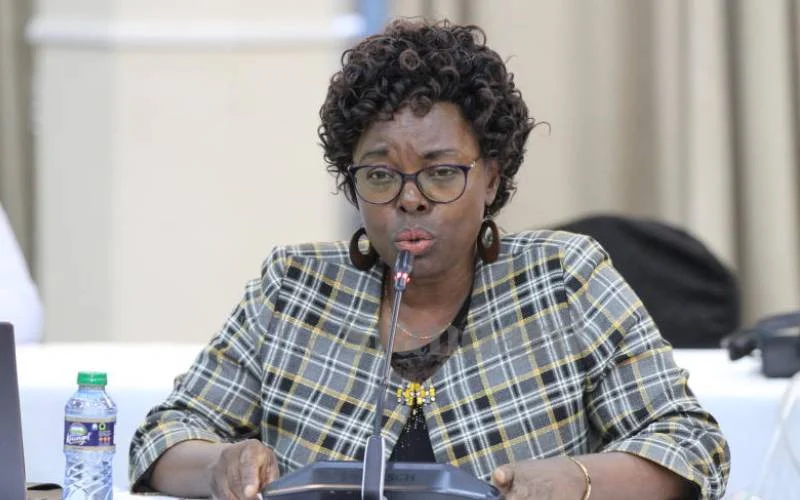
Kenya’s Controller of Budget Margaret Nyakang’o has issued a stark warning against the country’s heavy reliance on International Monetary Fund financing, arguing that such dependence risks surrendering economic sovereignty to external lenders while undermining domestic accountability and reform initiatives. The caution comes as Kenya pursues a fresh funding arrangement with the IMF following the expiration of its previous $3.6 billion facility in early 2025.
Speaking before a parliamentary committee on February 11, 2026, Nyakang’o called on the government to diversify its sources of budget support, warning that heavy dependence on the IMF could leave the country exposed once programmes expire. “So, we should not just be puppets; we need to look at this realistically,” the Controller of Budget stated, emphasizing the need for Kenya to maintain control over its economic destiny rather than ceding policy direction to international financial institutions.
Build the future you deserve. Get started with our top-tier Online courses: ACCA, HESI A2, ATI TEAS 7, HESI EXIT, NCLEX-RN, NCLEX-PN, and Financial Literacy. Let Serrari Ed guide your path to success. Enroll today.
Transparency Concerns Over Government-Owned Enterprises Act
Central to Nyakang’o’s critique is her questioning of the push to operationalize the National Infrastructure Fund through the Government Owned Enterprises Act, which was signed into law by President William Ruto on November 21, 2025. The Controller of Budget argues that the law raises serious concerns about transparency and oversight, particularly in how it restructures accountability mechanisms for state-owned entities.
The Government-Owned Enterprises Act requires State entities to operate as commercial ventures that generate profit and sustain themselves financially. The law formed part of reform measures agreed upon under IMF-backed arrangements for State corporations. However, Nyakang’o cautioned that such programmes come with strict terms that can reshape fiscal policy in ways that strain the country.
According to the Controller of Budget, the structure created under the GOE Act weakens independent checks on public resources. “GOE Act, as we noted, bypasses Parliamentary scrutiny as well as that of my office and therefore, weakens public oversight,” Nyakang’o emphasized during her appearance before the Senate Standing Committee on Energy and the National Assembly Departmental Committee on Energy.
Under the new framework, affected enterprises are registered as limited liability companies under the Companies Act rather than being formed under specific legislation. This allows them to operate outside the usual government systems and annual budget approvals, enabling them to mobilize funds for long-term investments. Public accountability for these entities is channeled through the National Treasury, a shift that Nyakang’o argues diminishes the role of independent oversight bodies.
IMF’s Push for State Corporation Reform
The IMF has consistently encouraged reforms aimed at reducing the financial strain caused by struggling State corporations. Passing the GOE Act was viewed as a key signal as Kenya opened talks on a successor programme after the expiry of its Sh464.47 billion, or $3.6 billion, facility in early 2025.
The previous IMF programme, approved in April 2021, was extended by 10 months in July 2023 to April 2025 to address emerging challenges. However, Kenya exited the programme before completing the final review, which would have unlocked a remaining tranche of $850 million. The programme fell short of meeting 11 of 16 performance conditions, including revenue targets, budget consolidation, limits on the fuel stabilisation fund, and structural reforms such as restructuring state-backed Kenya Airways.
Nyakang’o pointed out that IMF support often demands quick fiscal adjustments, including tighter spending controls. These demands, while aimed at fiscal sustainability, can create tensions with domestic priorities and social programmes that serve vulnerable populations.
Legal Challenges to the GOE Act
Implementation of the Government Owned Enterprises Act began on February 2, 2026, but was halted until February 23, 2026, after the High Court issued conservatory orders in response to a petition filed by the Consumers Federation of Kenya. The case challenged elements of the Act, temporarily stalling its rollout.
The judicial intervention maintained the status quo to allow for a full hearing on the petition’s merits, with a final ruling on the application expected by late February 2026. The conservatory order effectively paused the transition of State Corporations into limited liability companies and the appointment of new governance boards under the Act’s framework.
In addition to business operations, Government Owned Enterprises may also undertake public service roles. Previously, establishing, merging or dissolving a State corporation required parliamentary approval through legislation. The new law grants the Cabinet authority to make such decisions with minimal direct involvement of lawmakers—a shift that has raised concerns about democratic accountability.
Kenya’s Debt Burden and IMF Relations
Nyakang’o’s warnings come against a backdrop of mounting debt concerns. The Controller of Budget has previously raised alarms about Kenya’s debt portfolio, revealing that it exceeds the required limit of 55 percent of GDP as prescribed in the Public Finance Management Act. As of September 2024, the debt limit had grown to 67 percent of GDP, attributed to growth in both domestic and foreign borrowing.
Kenya’s external debt in January 2025 stood at $39.4 billion while domestic debt was Sh5.93 trillion ($45.8 billion), according to budget policy statements presented by the Treasury to Parliament. Multilateral lenders such as the IMF and World Bank accounted for 55.6% of external debt, while bilateral lenders led by China held 21.4% of external debt. Commercial loans, the bulk of which include Eurobonds, surpassed bilateral loans, with a 23% share of external debt.
The fiscal deficit has also widened, coming in at 5.02% of GDP according to the Treasury’s latest projections. There was reportedly an agreement with the IMF that this figure should not exceed 4.3% in the current fiscal year—a benchmark Kenya failed to meet, contributing to the early exit from the previous programme.
The Quest for a Successor IMF Programme
Kenya has formally requested a new IMF-supported program, and preliminary discussions are underway. The IMF is currently working with Kenyan authorities to review recent developments and update the macroeconomic assessment while awaiting details on the authorities’ priorities for the program.
According to the Kenyan Treasury, IMF staff were expected to return to Nairobi in February 2026 to continue discussions on a successor arrangement to support the country’s economic reform agenda. Raphael Owino, director general of the Public Debt Management Office, indicated that discussions with the IMF have remained “open and candid,” with frank exchanges on ground realities.
However, economists remain skeptical about the immediate prospects of securing a new deal. Churchill Ogutu, an economist at IC Asset Managers, expressed doubts in an interview with CNBC Africa: “I’m still skeptical that even amidst the discussion, that they will be able to reach a middle ground. My best case scenario is that we may get an IMF program probably after 2027, after the elections, but not in the near term.”
The skepticism stems from Kenya’s failure to meet key benchmarks in the previous programme. Authorities have struggled to boost tax collection, sell off struggling state-owned enterprises, and rein in borrowing from expensive commercial sources—all conditions that the IMF typically emphasizes in its lending arrangements.
One decision can change your entire career. Take that step with our Online courses in ACCA, HESI A2, ATI TEAS 7, HESI EXIT, NCLEX-RN, NCLEX-PN, and Financial Literacy. Join Serrari Ed and start building your brighter future today.
Diversification of Funding Sources
Nyakang’o’s call for diversification reflects growing recognition that Kenya cannot continue to rely primarily on a single source of external financing. The country has already begun exploring alternative funding mechanisms, including Eurobond issuances, conversion of Chinese debt to renminbi, and potential Samurai bonds in the Japanese market.
In February 2025, Kenya floated an 11-year $1.5 billion eurobond to finance the early retirement of a $900 million note maturing in 2027. A total of $593.3 million from the proceeds of this issuance was used to partially buy back the $900 million note, while the balance was earmarked for the repayment of syndicated commercial debts due in March.
Compared to the Eurobond 2031 that was issued in 2024 with a coupon rate of 9.75%, Eurobond 2036 with a slightly longer tenor has a comparatively lower coupon rate of 9.5%, implying a more favorable risk sentiment compared to a year earlier. This improvement in investor confidence suggests that Kenya has options beyond IMF financing, though commercial debt carries its own risks of high borrowing costs and short maturities.
Budget Credibility and Execution Gaps
Nyakang’o maintained that as Kenya moves toward a new IMF agreement, it must confront credibility and execution gaps that continue to affect public finance management. The Controller of Budget has been a persistent critic of budgetary indiscipline, warning that these weaknesses squeeze funds meant for social programmes, slow development efforts and fuel public frustration when economic hardship deepens.
In previous statements, Nyakang’o has exposed instances of budgeted corruption and wastage of resources within the government. She has also spoken of being pressured to take certain actions, including the controversial release of Sh15 billion days before the 2022 General Elections—Sh6 billion for the purchase of telecommunications assets and Sh9.5 billion from the annuity fund.
The Controller of Budget’s independence is constitutionally protected. Appointed in December 2019, Nyakang’o holds security of tenure for an eight-year non-renewable term. Article 251 of the Constitution provides strict grounds for removal from office, including serious violation of the Constitution, gross misconduct, physical or mental incapacity, incompetence, or bankruptcy—protections designed to shield independent officers from political pressure.
IMF Conditionality and National Sovereignty
At the heart of Nyakang’o’s critique is the tension between IMF conditionality and national sovereignty. IMF programmes typically come with structural adjustment requirements that can include privatization of state assets, reduction of subsidies, increases in taxation, and reforms to public sector management.
A February 2025 report from Transparency International highlighted concerns about Kenya’s debt crisis, noting that “misaligned financing and corruption are barriers to breaking the debt trap.” The report emphasized that high levels of public debt have accumulated with limited transparency and contrary to constitutional principles of public finance management, with oversight reports pointing to massive irregularities in state-funded projects.
The report also noted that Kenya is currently undergoing multiple separate IMF financing programs, bringing the total number of IMF arrangements over the years to 22—suggesting, in the view of critics, more of a “debt trap” than a pathway to a sustainable economy.
The GOE Act and Infrastructure Financing
The Controller of Budget’s specific concern about the National Infrastructure Fund reflects broader anxieties about how infrastructure projects will be financed under the new framework. The Government-Owned Enterprises Act identifies 65 key state-owned enterprises for potential privatization, including the Kenya Literature Bureau, National Oil Corporation of Kenya, Kenya Seed Company Limited, Rivatex East Africa Ltd, Kenyatta International Convention Centre, and New Kenya Cooperative Creameries.
President Ruto has argued that Kenya’s development ambitions—including improvements in roads, energy, water systems, logistics, education, and digital networks—require sustained and innovative financing models. “We cannot continue funding essential infrastructure through unsustainable borrowing or burdening taxpayers with additional taxes. But neither can we afford to postpone these imperatives without risking our future,” President Ruto stated during his State of the Nation Address in November 2025.
The government plans to raise funds through privatization, with the Kenya Pipeline Company IPO expected to generate close to Sh100 billion. The government plans to sell 65 percent of its shareholding in KPC, with the state retaining a 35 percent stake after the IPO. The privatization is targeted for completion by March 2026.
However, Nyakang’o’s concerns suggest that the rush to operationalize these commercial frameworks may be driven more by IMF conditionality requirements than by a carefully considered national strategy that balances commercial efficiency with public accountability.
Fiscal Reforms and Social Impact
The Controller of Budget pointed out that IMF-mandated fiscal adjustments, while aimed at macroeconomic stability, can have severe social consequences. Kenya has already experienced significant public pushback against austerity measures, most notably the mass protests in June 2024 that forced the government to withdraw the 2024 Finance Bill.
The protests, largely driven by young Kenyans who organized through social media under the banner “Gen Z,” reflected deep frustration with the government’s economic management and the perceived burden of IMF-mandated tax increases. The movement operated as a leaderless conduit of public demands, forcing the Ruto administration to shelve planned tax hikes that would have further strained households already struggling with inflation and unemployment.
Youth unemployment in Kenya has reached 67 percent according to recent estimates, while poverty rates hover close to 40 percent. In this context, fiscal consolidation measures demanded by the IMF—such as subsidy removals, public sector wage freezes, and reduced social spending—risk exacerbating inequality and social tensions.
The Path Forward
Nyakang’o’s warnings highlight a fundamental dilemma facing Kenya and many developing countries: how to access necessary external financing without surrendering policy autonomy or compromising domestic accountability structures. The Controller of Budget advocates for a middle path that involves diversifying funding sources, strengthening domestic revenue mobilization, and ensuring that any external financing arrangements respect constitutional principles of public finance management.
The call for diversification extends beyond simply seeking different lenders. It includes building domestic capacity for revenue generation, improving the efficiency of tax collection, reducing wastage and corruption in public spending, and creating sustainable financing mechanisms that don’t rely on continuous external borrowing.
As Kenya continues negotiations with the IMF for a successor programme, the tensions Nyakang’o articulates will likely remain central to the debate. The government faces pressure from international creditors and rating agencies to demonstrate fiscal discipline and implement structural reforms. At the same time, it must respond to domestic constituencies demanding improved services, job creation, and relief from the cost of living crisis.
The Controller of Budget’s insistence on maintaining robust oversight mechanisms, even as the government seeks to make state enterprises more commercially viable, reflects an understanding that economic efficiency and public accountability are not mutually exclusive goals. Whether Kenya can chart a path that satisfies both IMF conditions and constitutional governance requirements remains to be seen, but Nyakang’o has clearly signaled that independent oversight bodies will not be silent partners in any arrangement that compromises their constitutional mandate.
Conclusion
The Controller of Budget’s cautionary message arrives at a critical juncture for Kenya’s economic policy. With the country seeking a fresh IMF arrangement worth approximately $3.6 billion, the terms of that engagement will shape fiscal policy and development priorities for years to come. Nyakang’o’s warnings about surrendering to external dictates, bypassing parliamentary oversight, and weakening independent checks serve as important reminders that short-term financing solutions must not come at the cost of long-term institutional integrity.
As the High Court prepares to rule on the legality of the Government-Owned Enterprises Act and IMF staff return to Nairobi for continued negotiations, Kenya stands at a crossroads. The decisions made in the coming months will determine not only the country’s immediate fiscal trajectory but also the balance of power between external lenders and domestic democratic institutions—a balance that the Controller of Budget insists must be preserved if Kenya is to chart a sustainable and sovereign path to development.
Ready to take your career to the next level? Join our Online courses: ACCA, HESI A2, ATI TEAS 7 , HESI EXIT , NCLEX – RN and NCLEX – PN, Financial Literacy!🌟 Dive into a world of opportunities and empower yourself for success. Explore more at Serrari Ed and start your exciting journey today! ✨
Track GDP, Inflation and Central Bank rates for top African markets with Serrari’s comparator tool.
See today’s Treasury bonds and Money market funds movement across financial service providers in Kenya, using Serrari’s comparator tools.
photo source: Google
By: Montel Kamau
Serrari Financial Analyst
16th February, 2026