










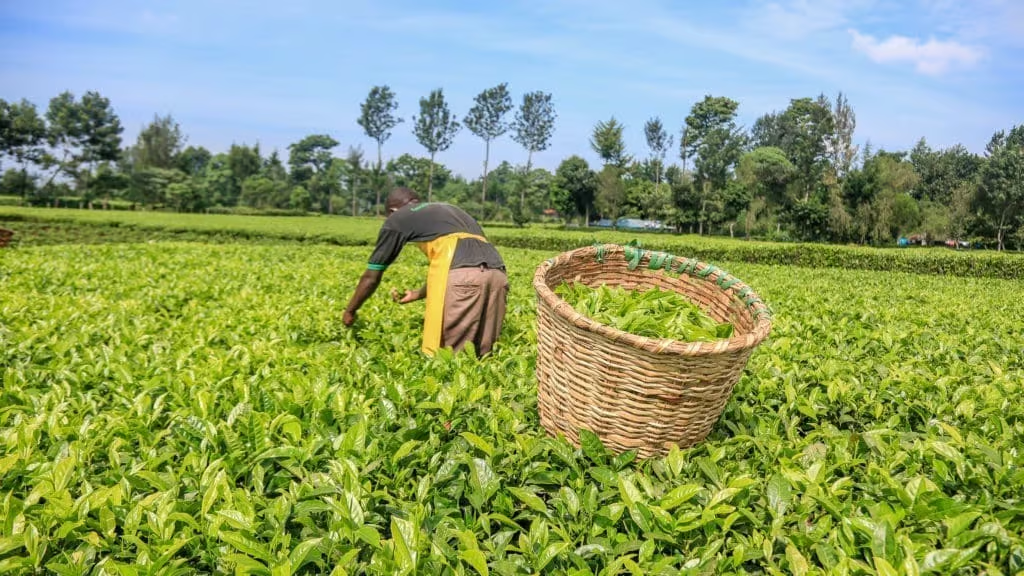
Kenya’s tea sector, long plagued by regional price disparities and allegations of anti-competitive practices, is set for a comprehensive overhaul as the government unveils ambitious reforms designed to raise smallholder farmer earnings to Sh100 per kilogramme of green leaf by 2027. Agriculture Cabinet Secretary Mutahi Kagwe announced the wide-ranging intervention, which addresses complaints from farmers in Kisii, Nyamira, and the East Rift Valley who have protested what they describe as systemic discrimination in bonus payments.
The government has introduced at least seven guidelines aimed at increasing the earnings of smallholder tea farmers from Sh50.18 per kilogramme of green leaf to at least Sh100 by 2027, according to Kagwe’s report to the National Assembly. All farmers across the country are projected to benefit from the improved earnings, irrespective of where they grow their tea, marking a significant departure from the current system where regional disparities have created deep frustration and occasional violence among farming communities.
Build the future you deserve. Get started with our top-tier Online courses: ACCA, HESI A2, ATI TEAS 7, HESI EXIT, NCLEX-RN, NCLEX-PN, and Financial Literacy. Let Serrari Ed guide your path to success. Enroll today.
The Crisis: Regional Disparities Fuel Farmer Anger
The reforms come against a backdrop of mounting anger over bonus payment disparities that have exposed deep fault lines in Kenya’s tea industry. Recent statistics for the 2024/2025 financial year reveal glaring disparity in the annual bonus rates paid to tea farmers across Kenya’s key tea-growing regions. While farmers in the East of Rift Valley and Mt Kenya regions receive relatively higher bonuses ranging from Sh26 to Sh57 per kilogramme of green leaf supplied, those in the Gusii region comprising Kisii and Nyamira counties earn significantly less, with rates as low as Sh10 to Sh32 per kilogramme.
The stark contrast in earnings sparked protests, with farmers in Kisii and Nyamira counties destroying tea collection centers in protest and disillusionment, believing their labor was not being fairly rewarded despite producing tea sold in the same international markets.
Specific examples illustrate the depth of inequality. Mununga Tea Factory in Murang’a (Central Kenya) announced a bonus rate of Sh57.00 per kilo, and Embu’s Rukuriri Tea Factory offered an even higher Sh57.50 per kilo. Meanwhile, rates at Gusii tea factories were far lower: Nyansiongo Tea Factory (Nyamira) at Sh12.00, Kiamokama Tea Factory (Kisii) at Sh10.00, Itumbe Tea Factory (Kisii) at Sh11.00, and Kebirigo Tea Factory (Nyamira) at Sh13.00.
The crisis deepened when Members of Parliament demanded a parliamentary probe into the Kenya Tea Development Agency (KTDA) over allegations of corruption, mismanagement and unfair bonus distribution from Bomet, Kericho, Kisii, Nandi and Nyamira Counties, saying more than 700,000 farmers have been short-changed despite their hard work in producing world-class tea.
The Parliamentary Intervention
In November 2025, leaders from Kisii, Nyamira and East Rift Valley petitioned National Assembly Speaker Moses Wetang’ula over what they described as unfair tea bonuses. They called for an investigation into regional price differences in Kenya’s tea sector, arguing that the disparities could not be justified when all Kenyan tea is sold through the same auction systems and international markets.
The National Assembly Agriculture Committee’s subsequent inquiry identified cartels and anti-competitive practices within the tea industry as factors suppressing prices and leading to low farmer earnings. The findings validated farmers’ complaints and provided the evidence base for comprehensive sector reforms.
Senators amplified the pressure, with Nominated Senator Esther Okenyuri telling the Senate that the KTDA recently released bonus rates for the 2024–2025 financial year, with farmers in the Mount Kenya region receiving substantial bonuses while those in Kisii and Nyamira counties reeled from significantly lower rates.
Kisii Senator Richard Onyonka lamented that despite raising questions on tea bonuses more than two years ago, the Senate Agriculture Committee was yet to act. He criticized Kenya’s reliance on traditional tasting methods, saying “Kenya still uses the tongue to taste tea, yet scientists have proposed advanced parameters like measuring iron and potassium content to assess quality more accurately.”
Seven Guidelines: The Reform Framework
In a report to the National Assembly, Cabinet Secretary Mutahi Kagwe pointed out that most guidelines are expected to be fully operational by June this year. The guidelines were developed by a multi-agency committee comprising the Ministry of Agriculture and Livestock Development, the Tea Board of Kenya (TBK), the Tea Research Foundation (TRF), tea factories and traders, ensuring broad stakeholder input in the reform design.
The cornerstone of the reforms is the introduction of minimum quality standards for green leaf processed by all tea factories. These guidelines prescribe minimum quality standards for green leaves to be processed by all tea factories, and once implemented, will bridge the quality and price differentials between the western and eastern regions. This standardization represents a fundamental shift from the current system where quality assessment has been criticized as subjective and potentially biased.
A critical component of quality enforcement is the establishment of a laboratory in Mombasa to analyze and validate tea quality and safety. Kagwe informed the House that the government is establishing a laboratory in Mombasa to analyze and validate the quality and safety of teas, requesting the National Assembly to support the allocation of funds necessary to fully operationalize the facility.
The facility is expected to address tea quality and safety through analytical testing based on three sets of parameters: the physical quality parameter, microbiological parameters, heavy metal contaminants and pesticide residues, and emerging contaminants. Civil works at the facility are complete and equipping is ongoing, with operationalization expected by June 2026.
The laboratory will facilitate scientific verification of teas offered for sale at auction by ascertaining levels of nitrogen, polyphenols and ash content, which have scientifically been proven to correlate with sensory attributes. Additionally, through the laboratory, the Tea Board of Kenya will carry out sensory evaluation to complement scientific testing, with results then used in price determination.
Strategic Quality Improvement Programme
Under the third guideline, the government will implement strategic quality improvement programmes to help Western tea factories meet market requirements, running for two years and aiming to transition most factories producing plainer or medium-quality teas to above-average or premium quality within five years.
“Those teas are, in turn, expected to fetch better prices as has been the case with the performance of some tea factories in the West tea block,” Kagwe told MPs, acknowledging that some Western region factories have demonstrated the potential for quality improvement and premium pricing when proper standards are maintained.
The programme entails conducting blind tasting of teas from all licensed tea factories for evaluation and ranking, with the government selecting the 15 lowest ranked tea factories for inclusion in the quality improvement programme. The government will undertake on-site capacity building training with tea makers for black Crush, Tear, Curl (CTC) and orthodox teas, transferring technical expertise directly to factory personnel.
Financial Support: Sh3.7 Billion Modernization Facility
Recognizing that quality improvements require capital investment in modern equipment, the government is providing a Sh3.7 billion loan from the Kenya Development Corporation, at a concessionary rate of 5 percent, to all smallholder tea factories that wish to modernize their equipment and machinery.
Factories are expected to use this funding to expand production of orthodox teas, which fetch higher prices in niche markets compared to the standard CTC teas that dominate Kenyan production. Orthodox tea, which refers to loose-leaf tea produced using traditional methods involving plucking, withering, rolling, oxidation, and drying, preserves natural flavors and develops complex flavor profiles, allowing premium pricing for specialty markets.
The modernization push addresses a longstanding inefficiency problem. As Kagwe noted, “Some factories are not operating optimally, and this affects farmers’ returns.” Upgrading equipment can reduce production costs, improve energy efficiency, enhance quality control, and enable diversification into value-added products.
One decision can change your entire career. Take that step with our Online courses in ACCA, HESI A2, ATI TEAS 7, HESI EXIT, NCLEX-RN, NCLEX-PN, and Financial Literacy. Join Serrari Ed and start building your brighter future today.
Broader Reform Measures
Beyond the seven core guidelines, the government unveiled additional measures including abolishing the reserve price in September 2024 to address the quality-price mismatch and reduce unsold stock, stimulating market demand by allowing prices to find natural levels based on quality and market conditions.
The government is reviewing the second payment model, with plans to move from annual to quarterly payments to ease farmer liquidity challenges. This shift addresses a persistent complaint from farmers who currently receive monthly initial payments of Sh23-25 per kilogramme but must wait an entire year for bonus payments, creating cash flow difficulties for households dependent on tea income.
Additional initiatives include governance and financial audits for underperforming factories, expansion into digital tea-marketing platforms, strengthened international market engagement under the African Continental Free Trade Area (AfCFTA) framework, and the introduction of Tea Levy Regulations 2024 to support sustainable sector financing.
The government is also intensifying efforts to curb greenleaf hawking and theft, which compromises quality by introducing substandard leaves into the supply chain and deprives registered farmers of income.
Direct Sales and Value Addition Initiatives
In a parallel reform stream announced earlier in 2025, the government revealed that all 142 factories will receive licenses allowing them to directly sell and export to international markets, bypassing the traditional auction system that has dominated Kenyan tea trade for decades.
This direct sales model eliminates intermediaries, potentially improving farmers’ profit margins by allowing factories to negotiate directly with international buyers, set their own prices instead of relying on volatile auction prices, and sell value-added or specialty teas at premium rates while developing their own brands for retail or niche markets abroad.
Agriculture Cabinet Secretary Mutahi Kagwe said government support for direct sales will allow producers to negotiate directly with international buyers, ensuring that farmers earn what they deserve as price transparency is no longer optional but a necessity.
The government is establishing common-user packaging and processing facilities accessible to all producers, providing affordable access to modern packaging technology, branding services, and compliance with export standards—a major boost for smallholder-led value addition.
Kagwe announced that the government has factored in key tax incentives in the 2025/2026 Finance Bill, including removal of excise duty on tea packaging materials and elimination of VAT on value-added tea exports, making it more affordable for farmers to add value to their products before export.
The External Challenges: Market Conditions and Currency
The reform push comes amid challenging market conditions that have depressed farmer earnings in recent years. In the 2024/25 financial year, average auction prices declined to USD 2.41 per kilogramme of made tea from USD 2.54, a drop attributed to forex shortages in Pakistan and Egypt, instability in Sudan, and trade-access challenges in Iran—markets that collectively absorb about 70 percent of Kenya’s tea exports.
Currency fluctuations have compounded pricing pressures. The Kenya Tea Development Agency explained that in 2024, the Kenya Shilling traded at an average of Sh144 to the US dollar, while in 2025 the average was Sh129, meaning that even where international prices were stable, the amount realized in Kenya Shillings was significantly lower.
Agriculture PS Paul Kipronoh Ronoh attributed the fall in payments for the 2024/25 financial year to external factors, noting that while there was an urgent need to address governance, accountability, and transparency challenges within KTDA, the sector also faced genuine market headwinds beyond local control.
KTDA’s Response and Defense
Faced with farmer anger and political pressure, KTDA admitted to poor performance in the financial year ending June 30, 2025, after bonus payments tumbled compared to the previous year. The sharp drop in earnings invited widespread anger from farmers across 21 tea-growing counties.
“While understandably disappointing to many, this year’s final payment (bonus) is a direct reflection of global trading conditions beyond KTDA’s control,” the agency stated, attributing the decline to international market dynamics and unfavourable currency exchange rates.
KTDA dismissed claims of bias against factories in the west of the Rift Valley in favor of those in the east, saying the discrepancies reflected market realities and quality differences. However, the agency struggled to explain why high-altitude Rift Valley teas, which should theoretically command premium prices, underperformed compared to Mount Kenya teas.
The agency outlined measures to stabilize farmer incomes, including expanding production of orthodox teas which fetch higher prices in niche markets, working with government to promote value addition and open new markets including China, and investing in factory modernization and energy solutions to cut costs and improve competitiveness.
KTDA Holdings Chairman Chege Kirundi echoed the government’s commitment on tea reforms and emphasized the agency’s focus on farmer empowerment through grassroots-level value addition, specialty tea production, farmer-owned branding, and creation of new tea-based products. “We are turning farmers into entrepreneurs, giving them ownership not just of their farms but of their brands and markets,” he said.
The Path to Sh100 Per Kilogramme
The target of Sh100 per kilogramme by 2027 represents nearly a doubling of current average payments. Farmers currently receive between Sh23 and Sh25 per kilogramme as initial payment, with average payments dropping to Sh56 per kilogramme of green leaf in the 2024/25 financial year, a 12.5 percent decline from the previous year.
Achieving the Sh100 target requires multiple interventions working in concert: improved tea quality commanding higher auction prices, reduced production costs through modernization, better international market access and diversification, enhanced value addition capturing premium pricing, elimination of cartels and anti-competitive practices, improved factory governance and cost control, and favorable exchange rate management.
President William Ruto referenced the target in earlier speeches, saying tea sector earnings rose from Sh138 billion in 2022 to Sh215 billion, with potential to reach Sh280 billion by 2027 as prices climbed from Sh51 to Sh64 per kilogram through continued value addition, modernization, and branding.
CS Kagwe emphasized that “Our goal is to ensure every tea farmer earns a dignified, predictable income. These reforms are not cosmetic; they are structural,” signaling government recognition that incremental adjustments are insufficient and fundamental sector restructuring is required.
Stakeholder Perspectives and Challenges
The reform agenda faces implementation challenges and competing interests. Some senators questioned whether uniform pricing is achievable or even desirable. Narok Senator Ledama Olekina argued that bonuses should not necessarily be uniform, saying “We must be realistic. Soil conditions, climate, management and demand determine the bonuses paid. Saying it should be universal is missing the point.”
Senate Deputy Speaker Kathuri Murungi defended KTDA, saying differences were due to management and quality issues at individual factories, not bias. However, this position was rejected by Western Kenya representatives who argue that management and quality issues themselves reflect systemic problems requiring correction.
Farmers have voiced strong concerns about price disparities between East and West Tea Blocks, questionable expenditures, excessive sitting allowances by directors running into tens of millions, and weak internal controls that continue to erode farmer confidence.
PS Ronoh urged that while there is urgent need to address governance, accountability, and transparency challenges within KTDA, disbanding it is not the solution, but rather comprehensive restructuring of its governance and operational framework with stricter oversight of directors’ expenditures, firm limits on allowances and meetings, stronger internal controls, and full financial accountability to restore farmer trust.
Conclusion: High Stakes for Kenya’s Tea Future
Kenya’s tea sector sustains more than 680,000 smallholder farmers and millions of dependents, making it a critical economic and social institution. The sector generated Sh215 billion in export earnings in recent years, maintaining tea’s position as a major foreign exchange earner second only to diaspora remittances.
The comprehensive reform package targeting Sh100 per kilogramme by 2027 represents an ambitious attempt to address deep-seated structural problems that have festered for decades. Success requires not just technical interventions like quality testing laboratories and factory modernization, but fundamental changes in governance, market structures, and power relationships within the tea value chain.
The regional disparities that sparked the reform push reflect broader questions about equity, transparency, and fairness in agricultural value chains where smallholder farmers often lack bargaining power and information. Whether the reforms deliver on their promise will depend on sustained political will, adequate financing, effective implementation, cooperation from powerful industry stakeholders, and continued farmer mobilization to ensure accountability.
The timeline is tight—June 2026 for most guidelines to become operational, with the Sh100 target by 2027. The stakes could not be higher for the millions of Kenyans whose livelihoods depend on tea, and for a government staking political capital on delivering economic transformation to rural communities long frustrated by promises unfulfilled.
Ready to take your career to the next level? Join our Online courses: ACCA, HESI A2, ATI TEAS 7 , HESI EXIT , NCLEX – RN and NCLEX – PN, Financial Literacy!🌟 Dive into a world of opportunities and empower yourself for success. Explore more at Serrari Ed and start your exciting journey today! ✨
Track GDP, Inflation and Central Bank rates for top African markets with Serrari’s comparator tool.
See today’s Treasury bonds and Money market funds movement across financial service providers in Kenya, using Serrari’s comparator tools.
photo source: Google
By: Montel Kamau
Serrari Financial Analyst
5th January, 2026
Article, Financial and News Disclaimer
The Value of a Financial Advisor
While this article offers valuable insights, it is essential to recognize that personal finance can be highly complex and unique to each individual. A financial advisor provides professional expertise and personalized guidance to help you make well-informed decisions tailored to your specific circumstances and goals.
Beyond offering knowledge, a financial advisor serves as a trusted partner to help you stay disciplined, avoid common pitfalls, and remain focused on your long-term objectives. Their perspective and experience can complement your own efforts, enhancing your financial well-being and ensuring a more confident approach to managing your finances.
Disclaimer: This article is for informational purposes only and does not constitute financial advice. Readers are encouraged to consult a licensed financial advisor to obtain guidance specific to their financial situation.
Article and News Disclaimer
The information provided on www.serrarigroup.com is for general informational purposes only. While we strive to keep the information up to date and accurate, we make no representations or warranties of any kind, express or implied, about the completeness, accuracy, reliability, suitability, or availability with respect to the website or the information, products, services, or related graphics contained on the website for any purpose. Any reliance you place on such information is therefore strictly at your own risk.
www.serrarigroup.com is not responsible for any errors or omissions, or for the results obtained from the use of this information. All information on the website is provided on an as-is basis, with no guarantee of completeness, accuracy, timeliness, or of the results obtained from the use of this information, and without warranty of any kind, express or implied, including but not limited to warranties of performance, merchantability, and fitness for a particular purpose.
In no event will www.serrarigroup.com be liable to you or anyone else for any decision made or action taken in reliance on the information provided on the website or for any consequential, special, or similar damages, even if advised of the possibility of such damages.
The articles, news, and information presented on www.serrarigroup.com reflect the opinions of the respective authors and contributors and do not necessarily represent the views of the website or its management. Any views or opinions expressed are solely those of the individual authors and do not represent the website's views or opinions as a whole.
The content on www.serrarigroup.com may include links to external websites, which are provided for convenience and informational purposes only. We have no control over the nature, content, and availability of those sites. The inclusion of any links does not necessarily imply a recommendation or endorsement of the views expressed within them.
Every effort is made to keep the website up and running smoothly. However, www.serrarigroup.com takes no responsibility for, and will not be liable for, the website being temporarily unavailable due to technical issues beyond our control.
Please note that laws, regulations, and information can change rapidly, and we advise you to conduct further research and seek professional advice when necessary.
By using www.serrarigroup.com, you agree to this disclaimer and its terms. If you do not agree with this disclaimer, please do not use the website.
www.serrarigroup.com, reserves the right to update, modify, or remove any part of this disclaimer without prior notice. It is your responsibility to review this disclaimer periodically for changes.
Serrari Group 2025