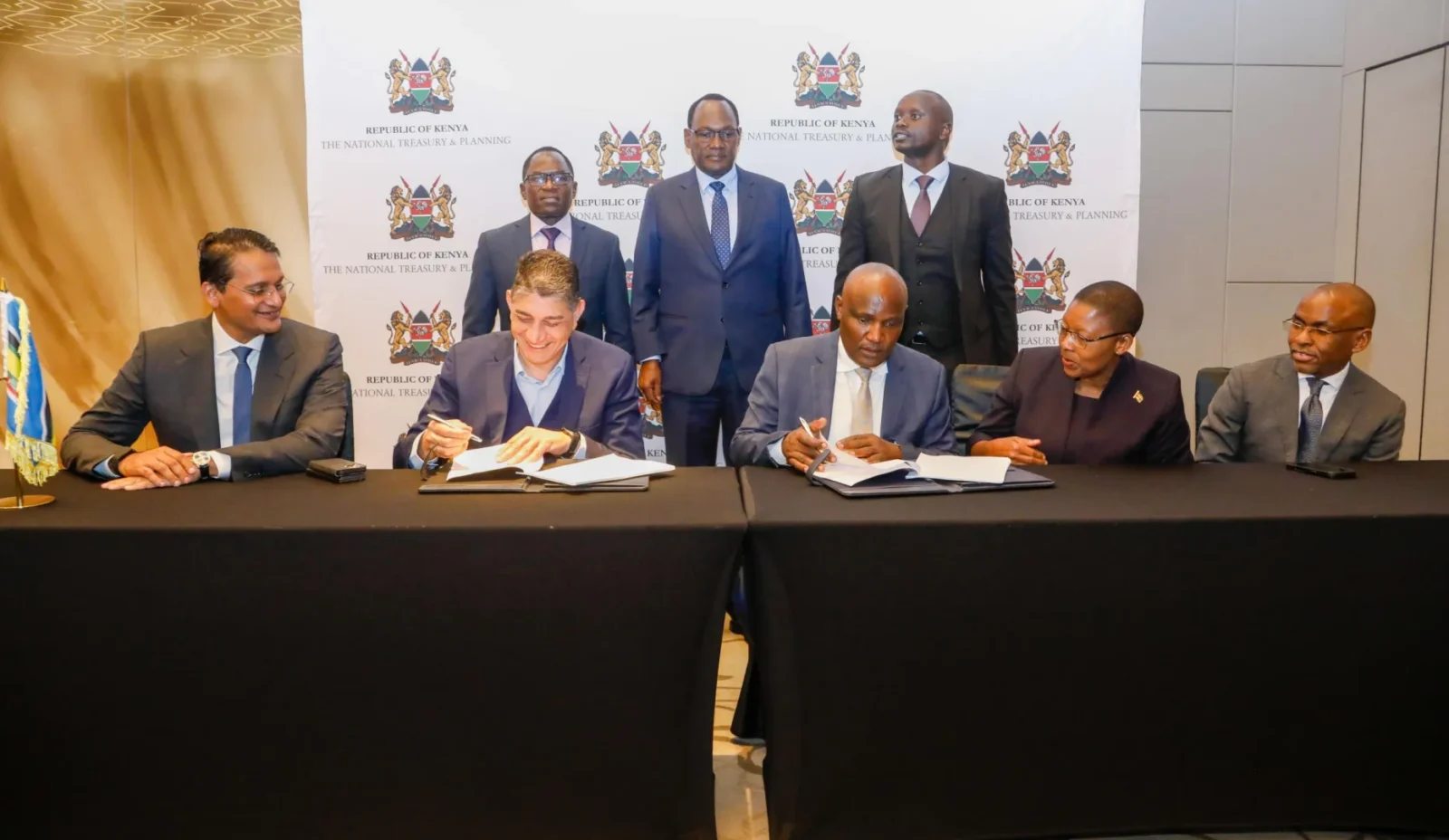
The Kenyan government has finalized a landmark sale of its 15 percent stake in Safaricom PLC to Vodafone Kenya Limited for Sh244.5 billion, marking one of the largest divestiture transactions in the country’s corporate history. National Treasury Cabinet Secretary John Mbadi announced the deal on Thursday, December 4, 2025, positioning the proceeds as critical seed capital for Kenya’s newly conceived National Infrastructure Fund and Sovereign Wealth Fund.
The divestment reduces the government’s ownership in East Africa’s most profitable telecommunications company from 35 percent to 20 percent. Vodacom Group will acquire an additional 5 percent from Vodafone International Holdings and the government’s 15 percent stake, bringing its total shareholding to 55 percent and giving it effective majority control of Kenya’s telecommunications giant.
The transaction structure includes two key components: Sh204.3 billion from the direct sale of shares, plus Sh40.2 billion from an upfront payment by Vodafone Kenya in exchange for future dividend rights on the government’s remaining 20 percent stake. CS Mbadi emphasized the sale achieved a 23.6 percent premium on the six-month volume-weighted average price, with shares priced at Sh34 each for 6,009,814,200 ordinary shares.
Build the future you deserve. Get started with our top-tier Online courses: ACCA, HESI A2, ATI TEAS 7, HESI EXIT, NCLEX-RN, NCLEX-PN, and Financial Literacy. Let Serrari Ed guide your path to success. Enroll today.
Transaction Structure and Premium Valuation
The total value comprises two distinct components. The primary Sh204.3 billion represents the direct sale of the 15 percent shareholding, while an additional Sh40.2 billion comes from an innovative dividend advance arrangement. Under this structure, Vodafone Kenya has agreed to make an upfront payment to the government in exchange for the right to receive future dividends tied to the state’s remaining 20 percent stake.
This dividend monetization mechanism allows the Treasury to realize income streams immediately rather than waiting for quarterly dividend declarations, providing crucial liquidity for infrastructure projects that require upfront capital deployment. The transaction’s pricing at Sh34 per share represents a notable premium over Safaricom’s closing price of Sh28.20 on the Nairobi Securities Exchange at the time of announcement, though it has sparked debate about whether the valuation adequately captures Safaricom’s strategic worth.
Parliamentary Criticism and Valuation Concerns
The divestment has not proceeded without controversy. Kiharu Member of Parliament Ndindi Nyoro emerged as a vocal critic, arguing that the government had significantly undervalued Safaricom, insisting the company should be worth at least Sh2.5 trillion rather than the implied valuation of approximately Sh1.36 trillion based on the transaction pricing.
“The problem is that we are selling this asset for a song. There is no way the government can purport to sell Safaricom at a valuation of less than Sh2.5 trillion,” Nyoro stated during a Thursday press conference. He attributed the pricing to either “self-interest or incompetence on the side of the government,” raising concerns about the transparency of the valuation process.
Nyoro further warned that the administration might be tempted to sell additional stakes before the 2027 general election, potentially offloading remaining shares to entities like the National Social Security Fund. The lawmaker proposed alternative restructuring approaches, arguing the government could have created three separate entities from Safaricom’s operations—potentially splitting off M-Pesa and infrastructure assets—to unlock greater value while maintaining strategic control over critical national telecommunications infrastructure.
Safaricom’s Strategic Value and Market Position
The controversy over valuation reflects Safaricom’s commanding position in Kenya’s telecommunications and financial services landscape. The company controls approximately 65.9 percent of Kenya’s mobile market as of December 2023, with a subscriber base that has grown to over 49 million customers and one-month active users exceeding 37.7 million.
Safaricom’s M-Pesa mobile money platform represents perhaps its most strategically valuable asset. The platform reached 34 million customers in Kenya by December 2024, cementing its position as the country’s dominant financial services infrastructure. M-Pesa’s market share stood at 93.4 percent as of June 2024, according to Communications Authority data, though this represents a slight decline from 97.1 percent the previous year as competitors like Airtel Money gained ground.
The financial performance underscores M-Pesa’s centrality to Safaricom’s business model. During the year ended March 2024, Safaricom’s revenue from M-Pesa jumped 19.4 percent to Sh139.9 billion, contributing 42.4 percent to the telecommunications company’s overall service revenue—essentially meaning M-Pesa alone generates nearly half of Safaricom’s total income. The platform’s importance extends beyond Safaricom’s corporate balance sheet to Kenya’s broader economy, supporting over 1.5 million enterprises through merchant payment options and maintaining a network of more than 300,000 agents nationwide.
National Safeguards and Conditions
Recognizing Safaricom’s strategic importance to national security and economic infrastructure, the government secured extensive undertakings from Vodacom Kenya Limited as conditions of the transaction. Treasury CS Mbadi outlined ten specific conditions designed to protect Kenya’s national interests.
These safeguards include requirements that both the Chairman and Chief Executive Officer of Safaricom must always be Kenyan citizens, preserving local leadership of the telecommunications giant. No changes to the Executive Committee composition as of the signature date can occur without the CEO’s consent, maintaining stability in senior management during the transition.
The conditions also stipulate that Safaricom’s data centers and all subscriber data must remain physically located within Kenya, ensuring data sovereignty and preventing sensitive information from being transferred to foreign jurisdictions. All cyber and national security requirements must be strictly adhered to, with Vodacom Kenya required to cooperate fully with Kenyan security agencies on matters affecting national security.
Additional provisions require Vodacom Kenya to comply with directives from Kenya’s telecommunications regulator and maintain local operations. These conditions collectively establish a framework designed to prevent foreign control from compromising Kenya’s telecommunications sovereignty or strategic interests, even as operational control shifts to Vodacom.
Infrastructure Fund Strategy
Treasury Cabinet Secretary Mbadi articulated an ambitious vision for deploying the Sh244.5 billion proceeds. The government plans to use these funds as seed capital for both a National Infrastructure Fund and a Sovereign Wealth Fund, with the infrastructure fund designed to attract private sector co-investment that could multiply the available capital significantly.
According to PS Kiptoo, the infrastructure fund model aims to leverage the government seed capital at a ratio of approximately 1:10, potentially mobilizing up to Sh2.4 trillion for infrastructure development. “This approach shifts Kenya from debt-dependent infrastructure financing to a sustainable asset-backed investment model,” Kiptoo explained, positioning the strategy as fundamentally different from traditional government borrowing.
The infrastructure priorities include transportation networks, energy generation and transmission, water and sanitation systems, and digital infrastructure expansion. Kenya faces a massive infrastructure financing gap, with President William Ruto previously estimating the country requires approximately Sh5 trillion in infrastructure investment to support economic transformation goals outlined in the government’s Bottom-Up Economic Transformation Agenda.
Kenya’s public debt currently stands at approximately 70 percent of GDP, with debt service consuming a substantial portion of government revenue and limiting fiscal space for development spending. This debt burden has driven the Ruto administration to explore alternative financing mechanisms including privatization proceeds, pension fund mobilization, and public-private partnerships rather than additional borrowing.
Vodacom’s Strategic Expansion
For Vodacom Group, the transaction represents a significant strategic milestone in consolidating its East African telecommunications footprint. The South African telecommunications giant has operated as Safaricom’s largest shareholder since the company’s founding, but effective control has been shared with the Kenyan government and the minority Vodafone International Holdings stake.
Acquiring majority control allows Vodacom to fully integrate Safaricom into its corporate strategy and potentially extract operational synergies across its African portfolio. The company operates in South Africa, Tanzania, Mozambique, Lesotho, and the Democratic Republic of Congo, making Kenya—one of Africa’s largest and most sophisticated telecommunications markets—a strategic anchor for regional operations.
Vodacom CEO Shameel Joosub has previously emphasized the company’s commitment to expanding financial services capabilities across Africa, viewing mobile money platforms as complementary to traditional telecommunications services. Safaricom’s highly successful M-Pesa platform provides Vodacom with a proven fintech model that could potentially be replicated or adapted for other markets.
The transaction also simplifies governance structures by allowing Vodacom to acquire Vodafone International Holdings’ 5 percent stake alongside the government shares. This consolidation reduces coordination complexity and eliminates potential conflicts between different shareholder groups within the Vodafone corporate family.
One decision can change your entire career. Take that step with our Online courses in ACCA, HESI A2, ATI TEAS 7, HESI EXIT, NCLEX-RN, NCLEX-PN, and Financial Literacy. Join Serrari Ed and start building your brighter future today.
Regulatory Approval Process
The transaction requires regulatory approvals from multiple Kenyan authorities before completing. The Competition Authority of Kenya must review the deal to ensure it doesn’t create anti-competitive market conditions or consumer harm. Given Vodacom’s existing significant stake in Safaricom, regulators will examine whether increased control concentrates market power excessively.
The Capital Markets Authority must also approve the transaction since it involves a substantial change in ownership of a listed company. The CMA’s review will focus on whether minority shareholders receive adequate protection and whether the transaction complies with securities regulations governing major transactions by publicly listed entities.
Parliamentary approval, while not strictly a regulatory requirement, represents a significant political hurdle. The National Assembly’s Budget and Appropriations Committee and relevant departmental committees will likely scrutinize the transaction, with MP Nyoro’s opposition indicating potential political resistance.
Legal experts suggest the combination of the premium pricing, protective conditions, and clear strategic rationale should facilitate regulatory approval, though the timeline remains uncertain. Government officials expressed confidence that all necessary approvals would be secured, allowing the transaction to close within the coming months.
Market Reaction and Shareholder Impact
Safaricom’s share price performance following the announcement provides insight into market sentiment. The stock traded at Sh30.30 shortly after the transaction disclosure, representing a modest premium to the recent trading range but below the Sh34 transaction price, suggesting some market skepticism about valuation or concerns about governance changes under increased Vodacom control.
For the approximately 25 percent of Safaricom shares held by public investors trading on the Nairobi Securities Exchange, the transaction creates both opportunities and uncertainties. On one hand, Vodacom’s increased commitment to Safaricom and the 23.6 percent premium paid by Vodafone Kenya validates the company’s strategic value and growth prospects.
On the other hand, majority control by a single shareholder could theoretically reduce board independence and shift corporate governance dynamics. However, Kenya’s regulatory framework and the specific protective conditions negotiated by the government provide meaningful safeguards for minority shareholders’ interests.
Safaricom has historically delivered strong shareholder returns through both dividends and capital appreciation. The company maintained dividend payments even during challenging periods, making it a favorite among income-focused investors on the NSE. Analysts expect dividend policies to remain shareholder-friendly under Vodacom majority control, given the parent company’s own emphasis on dividend distributions.
Current Operations and Performance
Safaricom reported service revenue growth of 13.1 percent to Sh179.9 billion for the first half of fiscal 2025, with overall customer numbers rising 7.8 percent to 52.01 million. M-Pesa revenue grew 16.6 percent to Sh77.2 billion, while mobile data revenue surged 20.2 percent to Sh35.6 billion, reflecting ongoing strong demand for Safaricom’s core services.
The requirement that the Chairman and CEO remain Kenyan citizens ensures local perspectives continue shaping corporate strategy. Current CEO Peter Ndegwa, who joined from Diageo in 2020, has emphasized Safaricom’s transformation “from a Telco to a TechCo,” expanding beyond traditional telecommunications into fintech, e-commerce, and digital services. Under Ndegwa’s leadership, Safaricom has launched initiatives including cloud services, Internet of Things solutions, and e-commerce platforms while strengthening its core telecommunications and mobile money businesses.
Broader Privatization Agenda
The Safaricom divestiture forms part of Kenya’s larger privatization program authorized under the Privatization Act and accelerated through recent legislative reforms. President Ruto signed the Privatisation Bill 2023 into law, establishing frameworks for strategic asset sales that generate revenue while potentially improving efficiency through private sector management.
Treasury PS Kiptoo’s reference to “Project Marble” as the transaction’s internal codename suggests government officials view this as a template for future divestitures. The National Assembly’s Budget and Appropriations Committee has recommended exploring asset sales as revenue sources, potentially extending to other state-owned enterprises in sectors including energy, ports, and aviation.
However, MP Nyoro’s warnings about potential future sales reflect political sensitivities. “The government is now selling 15 percent. You can be sure that before elections, they will have sold the other stake,” Nyoro predicted, suggesting concern that fiscal pressures could drive additional divestitures of the remaining 20 percent government stake in Safaricom or stakes in other strategic assets.
The balance between asset monetization and strategic state ownership remains politically contentious. While privatization advocates argue private sector management often improves efficiency and service delivery while freeing government capital for public goods, critics contend that selling strategic assets amounts to “selling the family silver” and sacrificing long-term revenue streams for short-term cash.
Economic and Market Implications
The transaction’s Sh244.5 billion value represents approximately 0.4 percent of Kenya’s estimated GDP, making it economically significant but not transformative on its own. The strategic importance lies more in demonstrating that Kenya can execute large-scale privatizations attracting international capital, potentially opening pathways for additional transactions.
For Vodacom, the acquisition consolidates its position in one of Africa’s most attractive telecommunications markets. Kenya’s relatively high GDP per capita by regional standards, growing middle class, and advanced digital infrastructure make it a strategic anchor for Vodacom’s African operations. The company gains full operational control of Vodafone Kenya while strengthening its Safaricom stake, simplifying governance structures.
For minority shareholders holding shares traded on the Nairobi Securities Exchange, the transaction creates some uncertainty about future governance and dividend policies. While Vodacom’s increased control theoretically allows it to direct more corporate decisions, the ten government conditions and Kenya’s regulatory framework provide meaningful protections.
Future Outlook and Challenges
The success of Kenya’s infrastructure funding strategy ultimately depends on whether the National Infrastructure Fund can achieve its ambitious leverage targets. Attracting Sh10 of private capital for every Sh1 of government seed funding requires creating investment vehicles that meet institutional investors’ risk-return requirements while directing capital toward productive infrastructure.
International experience with sovereign wealth funds and infrastructure funds shows mixed results. Successful examples like Singapore’s GIC and Temasek demonstrate that professionally managed state investment vehicles can generate strong returns while funding strategic priorities. However, numerous examples of poorly governed sovereign funds exist where political interference, corruption, or mismanagement destroyed value.
Kenya’s relatively weak credit ratings—’B’ from S&P, ‘B-‘ from Fitch, and ‘Caa1′ from Moody’s—reflect ongoing fiscal challenges including high debt service costs that consume substantial government revenue. These ratings affect the country’s borrowing costs and may influence institutional investors’ willingness to commit capital to government-sponsored investment funds.
The regulatory approvals process presents near-term execution risk. While analysts expect the Competition Authority and Capital Markets Authority to approve the transaction, political opposition in Parliament could delay or complicate approval. Any extended timeline would create uncertainty for both Vodacom’s strategic planning and the government’s infrastructure funding schedule.
For Safaricom, maintaining operational momentum amid ownership transitions and expanding successfully in Ethiopia while defending market position against intensifying competition in Kenya represent key challenges. Airtel Kenya has gained market share in mobile money, while new entrants in various service segments create pricing pressure.
The Sh244.5 billion from Safaricom divestiture, while substantial, represents less than half of the government’s Sh600 billion near-term infrastructure funding target and only approximately 5 percent of the Sh5 trillion long-term requirement articulated by President Ruto. Additional privatizations, pension fund mobilization, public-private partnerships, and potentially new revenue sources will be necessary to meet infrastructure ambitions.
As Kenya navigates the complex tradeoffs between asset monetization and strategic state ownership, the Safaricom transaction will serve as an important test case. Whether the National Infrastructure Fund successfully channels proceeds into productivity-enhancing infrastructure that generates economic returns—or whether the funds dissipate through governance failures and misallocation—will significantly influence public and investor confidence in Kenya’s evolving development finance model.
For now, the completion of East Africa’s largest telecommunications privatization marks a definitive shift in Kenya’s approach to infrastructure financing, with implications that will reverberate through the country’s economic development trajectory for years to come.
Ready to take your career to the next level? Join our Online courses: ACCA, HESI A2, ATI TEAS 7 , HESI EXIT , NCLEX – RN and NCLEX – PN, Financial Literacy!🌟 Dive into a world of opportunities and empower yourself for success. Explore more at Serrari Ed and start your exciting journey today! ✨
Track GDP, Inflation and Central Bank rates for top African markets with Serrari’s comparator tool.
See today’s Treasury bonds and Money market funds movement across financial service providers in Kenya, using Serrari’s comparator tools.
photo source: Google
By: Montel Kamau
Serrari Financial Analyst
5th December, 2025