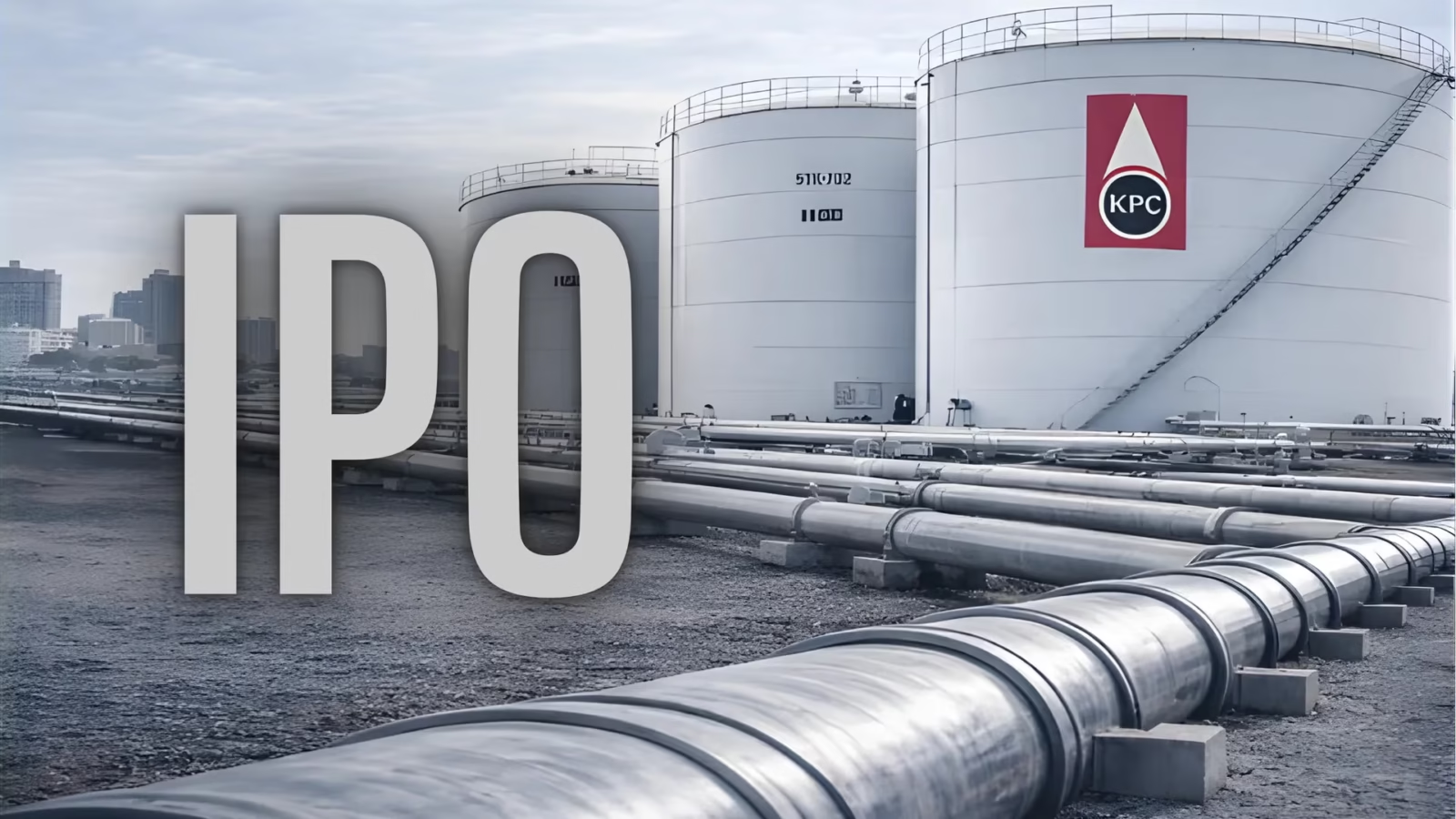
Kenya’s government has raised Ksh.112.374 billion from the Initial Public Offering (IPO) of Kenya Pipeline Company (KPC), after the share sale drew strong demand from investors across the East African region and was oversubscribed by 105.7 percent. The milestone, announced by Treasury Cabinet Secretary John Mbadi on Wednesday, March 4, 2026, marks the most significant capital markets event in Kenya in nearly two decades — and a pivotal test of the government’s wider privatisation ambitions.
Investors applied for 12.49 billion shares against the 11.81 billion shares on offer at a price of Ksh.9 per share, pushing the total subscription rate to 105.7 percent. While the oversubscription margin was relatively narrow by historical standards, the headline figure of Ksh.112.374 billion exceeded the government’s original target of Ksh.106.3 billion — a result that Treasury CS Mbadi described as a clear reflection of growing confidence in Kenya’s economic trajectory and the maturity of its capital markets.
Build the future you deserve. Get started with our top-tier Online courses: ACCA, HESI A2, ATI TEAS 7, HESI EXIT, NCLEX-RN, NCLEX-PN, and Financial Literacy. Let Serrari Ed guide your path to success. Enroll today.
A Landmark in Kenya’s Privatisation History
The KPC share sale is significant not just for its size, but for what it represents institutionally. According to the Treasury, it marks the first public offering of a state-owned enterprise by the government of Kenya since the iconic Safaricom IPO in 2008 — a gap of nearly 17 years. That 2008 offering attracted more than 800,000 retail investors and was oversubscribed by over 500 percent, setting a benchmark that still defines Kenya’s capital market memory.
The KPC offering also becomes the first executed under the Privatization Act 2025, signed into law by President William Ruto on October 15, 2025. That legislation replaced the Privatisation Act of 2005, establishing a new Privatization Authority to replace the old Privatisation Commission and mandating Cabinet and Parliamentary oversight, extensive public participation, and full compliance with capital markets, sector, and competition regulations before any state enterprise can be divested. The framework was designed to address longstanding concerns about the opacity that had surrounded earlier — and ultimately failed — privatisation attempts.
President Ruto hailed the result as a show of investor confidence. “Pleased by the successful outcome of the Kenya Pipeline Company (KPC) IPO, the first initial public offering in Kenya in 17 years, whose overall subscription reached 105%, reflecting strong confidence by investors and the market in our privatisation agenda,” the President said.
Who Actually Bought the Shares
The headline subscription figure, however, obscures a more complex picture of investor participation. An analysis of the allocation data reveals that the IPO was effectively rescued by a small group of large institutional buyers — while retail investors, foreign investors, and oil marketing companies participated far below their allocated limits.
Kenyan retail and institutional investors together were allocated 7.95 billion shares, representing 67.32 percent of the total shares on offer. Within that group, local institutional investors alone — led by the National Social Security Fund (NSSF) and the Public Service Superannuation Fund (PSSF) — accounted for a commanding 40.99 percent of total shares. A total of 465 local institutional investors snapped up the shares that other categories had left on the table.
Retail investors, on the other hand, bought shares worth only Ksh.4.1 billion against a Ksh.21.2 billion allocation. Foreign investors spent a mere Ksh.34.8 million compared to a target of Ksh.21.2 billion. Oil marketing companies — widely expected to be strategic buyers given their deep reliance on the pipeline — took up just Ksh.23.1 million worth of shares, or 0.14 percent of the Ksh.15.9 billion allocated to them.
The picture is clear: without strong institutional demand and Uganda’s sovereign participation, the IPO would have fallen short of its minimum threshold of Ksh.53.1 billion needed from more than 250 investors for it to proceed.
Uganda’s Strategic Stake: Fuel Security as Investment Logic
Perhaps the most geopolitically significant element of the KPC IPO was the formal participation of the Ugandan government, through the Uganda National Oil Company (UNOC). Investors from across the East African Community were allocated 3.86 billion shares, representing 32.65 percent of the offer — and Uganda led that regional bloc.
Uganda’s rationale for the investment is straightforward and existential. The country imports approximately 95 percent of its petroleum products — nearly 2.96 billion litres annually — through Kenya via the Port of Mombasa and the KPC pipeline system. With a monthly fuel demand of approximately 240 million litres and an annual growth rate of around 7 percent, KPC’s infrastructure is not merely convenient for Uganda; it is the backbone of the country’s energy supply chain, price stability, and economic resilience.
Uganda’s Energy Minister Ruth Nankabirwa signed the agreement in Nairobi on behalf of the Ugandan government on February 23, 2026, formalising a 20.15 percent strategic shareholding for UNOC. The investment grants Uganda voting rights and governance protections over specific company decisions — critical safeguards now that KPC transitions to a profit-driven, private-sector-influenced governance model. “During the period when KPC was 100% Government of Kenya-owned, Uganda relied on strong bilateral relationships to ensure a reliable and secure supply of petroleum products,” Minister Nankabirwa explained. The privatisation changed that calculus, making formal equity ownership the logical next step.
CS Mbadi acknowledged the regional significance of Uganda’s participation, describing it as making KPC “a truly regional corporate.” Following the privatisation, the Government of Kenya will retain a 35 percent stake in the company, while EAC investors will hold 21.22 percent ownership.
Understanding the Asset: What KPC Actually Does
For investors and observers unfamiliar with the company’s operations, it is worth understanding why KPC is considered one of Kenya’s most strategically vital state enterprises. Established in 1973 and operational since February 1978, the company operates a pipeline network spanning approximately 1,342 kilometres from the port of Mombasa to Nairobi, Nakuru, Eldoret, and Kisumu, with onward distribution by road to Uganda, Rwanda, Burundi, and the Democratic Republic of Congo. The network handles approximately 14 billion litres of petroleum products annually — a figure that makes it the artery of East Africa’s fuel supply chain.
KPC controls approximately 91 percent of Kenya’s refined petroleum transportation market, making it a natural monopoly with regulated tariffs and highly predictable cash flows. It operates five storage and distribution depots for conventional petroleum products in Eldoret, Kisumu, Mombasa, Nairobi, and Nakuru, and runs two aviation fuel depots at Jomo Kenyatta International Airport and Moi International Airport in Mombasa.
Beyond pipelines, KPC operates a 96-core fibre optic cable (FOC) network running the full length of its pipeline corridor, licensed by the Communications Authority of Kenya in 2018 to offer telecommunications services — a revenue diversification move that gives the company exposure to Kenya’s fast-growing digital infrastructure market. The company also wholly owns the Morendat Institute of Oil and Gas, a regional training institution for oil and gas sector professionals. In a further strategic development, KPC recently acquired Kenya Petroleum Refineries Limited (KPRL) as a fully owned subsidiary, increasing storage capacity and moving toward greater vertical integration in energy logistics.
For the financial year ended June 30, 2025, KPC reported revenue of Ksh.38.6 billion and profit after tax of Ksh.7.49 billion, with net cash from operating activities of Ksh.14.3 billion — a financial profile that reflects the stability typically associated with regulated infrastructure monopolies.
One decision can change your entire career. Take that step with our Online courses in ACCA, HESI A2, ATI TEAS 7, HESI EXIT, NCLEX-RN, NCLEX-PN, and Financial Literacy. Join Serrari Ed and start building your brighter future today.
Kenya’s First Electronic IPO
Beyond the financial and strategic dimensions, the KPC IPO introduced a technological milestone for Kenya’s capital markets. CS Mbadi confirmed the offering was executed as Kenya’s first electronic IPO (e-IPO), meaning all investor applications were submitted online in a fully paperless process. The move eliminates the manual, paper-based application processes that have historically created bottlenecks, errors, and exclusions in public share sales — particularly for retail investors in remote counties.
The IPO attracted more than 70,000 Kenyan investors, helping advance the government’s stated objective of broadening public participation in state-owned assets and “democratizing” ownership. The IPO opened on January 19, 2026, with an initial closing date of February 19, though the deadline was extended to accommodate late applications.
The e-IPO format is expected to set the standard for future state privatisations. With the government targeting several more state-owned enterprises for listing under the Privatization Act 2025 — including Kenya Literature Bureau, Kenyatta International Convention Centre, National Oil Corporation of Kenya, and Kenya Seed Company — a digital-first application infrastructure will be critical to achieving the retail participation numbers the government is counting on.
Capital Markets Context: Reviving the NSE
The KPC IPO arrives at a critical moment for the Nairobi Securities Exchange, which has struggled with declining trading volumes, thin liquidity, and dwindling investor confidence in recent years. The NSE experienced a difficult period in 2023 during a sharp bear market, with major counters including Safaricom recording steep price declines amid broader macroeconomic stress.
The last major state IPO before this one was Safaricom in 2008 — a listing that raised Ksh.51.75 billion, drew more than 800,000 retail applicants, and was oversubscribed by over 500 percent. The gap between that offering and the KPC IPO spans an entire generation of investors. In the intervening years, the NSE recorded no significant new state listings, and even the private sector listings that did occur were largely uninspiring.
The KPC result — even if driven by institutional and sovereign rather than retail buyers — demonstrates that the Nairobi market retains the capacity to absorb large infrastructure transactions when the asset is priced appropriately and key anchor investors are secured. For NSE leadership and the Capital Markets Authority, the successful close of East Africa’s largest local-currency IPO provides a platform to build on.
Analysts at Standard Investment Bank (SIB) issued a buy recommendation for investors with a long investment horizon, noting that KPC’s petroleum movement and storage monopoly — combined with dollar-denominated revenues that buffer against currency volatility — provides a compelling long-term value proposition, even as near-term dividend yields may disappoint investors expecting payouts similar to the company’s pre-IPO history.
Fiscal Rationale: Funding Infrastructure Without New Taxes
The IPO is structured as an Offer for Sale, meaning proceeds flow directly to the National Treasury rather than into KPC’s own coffers. This structure reflects Kenya’s pressing fiscal reality. The government’s debt servicing burden was consuming nearly 70 percent of government revenues at the time of the IPO launch, leaving limited space for new capital investment. Annual loan repayments consume 40 percent of government revenues, and the 2025/26 budget deliberately avoided introducing new taxes following the deadly Gen Z protests of June 2024.
CS Mbadi framed the IPO within this context. “The successful IPO further sustains our economic reforms and enables us to sustain the economic achievements realized thus far both from a macro and fiscal perspective — such as inflation, interest rates, currency stabilization, and economic growth — as we turn to innovative financing mechanisms to fund infrastructure and public service projects,” he said.
The proceeds are earmarked for a national infrastructure fund to support highways, railways, ports, and energy projects — a deployment strategy that ties the privatisation proceeds directly to tangible public goods.
The Road to NSE Listing on March 9
With the results now announced, the process moves into its final phase. Authorities will proceed with share allocation and completion of regulatory approvals ahead of KPC’s anticipated listing on the Nairobi Securities Exchange, where shares are expected to begin trading on March 9, 2026.
Under the new ownership structure, the Government of Kenya retains 35 percent, institutional investors hold 40.99 percent, EAC investors — led by Uganda — take 21.22 percent, with retail investors at 2.56 percent, KPC employees at 0.06 percent, and oil marketers holding 0.014 percent.
The listing will cement KPC’s transformation from a wholly government-owned utility into a publicly traded regional company. CS Mbadi articulated the long-term vision: “KPC’s transition is not just that of being a listed corporate but will now be properly positioned as a regional company allowing it to play a significant geopolitical role in East Africa’s petroleum sector, primarily through its pipeline infrastructure and strategic location.”
For Kenya, this IPO represents more than a single capital markets transaction. It is a proof-of-concept for the government’s wider privatisation programme, a test of the Nairobi Securities Exchange’s capacity to host large anchor listings, and a signal to regional and international investors that Kenya’s reform agenda — despite its slow pace and institutional resistance — is beginning to deliver results.
Ready to take your career to the next level? Join our Online courses: ACCA, HESI A2, ATI TEAS 7 , HESI EXIT , NCLEX – RN and NCLEX – PN, Financial Literacy!🌟 Dive into a world of opportunities and empower yourself for success. Explore more at Serrari Ed and start your exciting journey today! ✨
Track GDP, Inflation and Central Bank rates for top African markets with Serrari’s comparator tool.
See today’s Treasury bonds and Money market funds movement across financial service providers in Kenya, using Serrari’s comparator tools.
photo source: Google
By: Montel Kamau
Serrari Financial Analyst
5th March, 2026