The Kenyan government has issued an urgent call for applications under the World Bank-funded Kenya Jobs and Economic Transformation (KJET) Project, offering micro, small, and medium enterprise (MSME) clusters unprecedented access to co-investment funding of up to Ksh20 million per cluster for value-addition machinery. The State Department for Youth Affairs and the Creative Economy announced on Thursday, December 18, that eligible clusters have just 15 days remaining to submit applications for this transformative funding opportunity that could reshape Kenya’s MSME landscape.
The initiative represents a significant component of Kenya’s ambitious five-year economic transformation strategy running from 2024 to 2029, designed to increase private sector investment, improve access to markets and sustainable finance, and create and enhance jobs across all 47 counties. With stakeholders urged to widely circulate the opportunity among cooperatives, associations, self-help groups, community-based organizations, cluster-based entities, and limited companies involved in value addition activities, the clock is ticking for thousands of Kenyan entrepreneurs who stand to benefit from this unprecedented government support.
Build the future you deserve. Get started with our top-tier Online courses: ACCA, HESI A2, ATI TEAS 7, HESI EXIT, NCLEX-RN, NCLEX-PN, and Financial Literacy. Let Serrari Ed guide your path to success. Enroll today.
Understanding the KJET Project: A Comprehensive Economic Transformation Initiative
The Kenya Jobs and Economic Transformation (KJET) Project represents a landmark collaboration between the Government of Kenya and the World Bank, approved in December 2023 with $150 million in financing. The project’s development objective is straightforward yet ambitious: to increase private sector investments, access to markets, and sustainable finance to create and improve jobs across Kenya’s diverse economic sectors.
The KJET Project aims to benefit at least 45,000 Kenyans, including at least 6,800 women, through new or improved job opportunities. The initiative specifically targets select MSME clusters based on priority value chains envisioned under the Bottom-Up Economic Transformation Agenda (BETA), positioning small businesses at the heart of Kenya’s economic development strategy.
According to the World Bank’s project documentation, KJET is designed to provide business development services aimed at strengthening viable value chains and connecting MSMEs to markets, in addition to investments in firms for the improvement of productive capacity and capabilities. These activities are expected to enhance firms’ capacity and efficiency, translating to increased hiring and improved worker productivity—critical objectives for a nation where the share of employment in low-productivity sectors remains stubbornly high.
Keith Hansen, World Bank Country Director for Kenya, Rwanda, Somalia and Uganda, emphasized the project’s significance: “The project supports the achievement of the World Bank’s mission of ending extreme poverty on a livable planet. It will focus on empowering the private sector, driving job creation, and catalyzing green investments by private investors in member countries.”
The Co-Investment Model: Government Covers 70% of Machinery Costs
Under the KJET Project’s co-investment component, eligible MSME clusters can access substantial financial support for acquiring value-addition machinery that will enhance their processing capabilities, boost productivity, and drive economic growth. The funding mechanism is structured as a partnership model where the government covers up to 70% of the machinery cost, with clusters contributing the remaining 30%, and with the total value of supported machinery capped at Ksh20 million per cluster.
This co-financing approach represents a carefully calibrated balance between providing significant government support while ensuring that clusters maintain meaningful financial commitment and ownership of the investments. The model specifically targets 600 MSME clusters that will receive co-investment support for acquiring machinery, representing a substantial infusion of capital into Kenya’s MSME sector.
The co-investment assistance is complemented by Business Development Services (BDS), creating a comprehensive support package that addresses both the capital constraints and capability gaps that typically limit MSME competitiveness. This integrated approach recognizes that machinery alone is insufficient without the technical knowledge, business management skills, and market linkages necessary to translate capital investments into sustainable economic returns.
For many MSME clusters operating in Kenya’s informal or semi-formal economy, access to capital for machinery purchases has traditionally represented an insurmountable barrier to growth and formalization. Commercial lending rates remain prohibitively high for most small businesses, while collateral requirements exclude enterprises lacking formal property titles or established credit histories. The KJET co-investment model directly addresses this market failure, providing catalytic capital that enables clusters to make productivity-enhancing investments that would otherwise remain out of reach.
Priority Value Chains: Aligning with Bottom-Up Economic Transformation Agenda
Priority for KJET funding will be given to clusters operating within key value chains identified under Kenya’s Bottom-Up Economic Transformation Agenda. These strategic sectors include building and construction, edible oils, cotton, tea, coffee, the blue economy (encompassing fisheries, aquaculture, and marine resources), leather, dairy, rice, and textiles, as well as other relevant agricultural and industrial value chains that demonstrate high potential for employment generation and market demand.
The Bottom-Up Economic Transformation Agenda (BETA) represents the Government of Kenya’s comprehensive plan for economic turnaround and inclusive growth through a value chain approach. BETA identifies policy priorities expected to result in the greatest impact on the economy and welfare of households, specifically addressing objectives such as bringing down the cost of living, eradicating hunger, creating jobs, expanding the tax base, improving foreign exchange balances, and driving inclusive growth that uplifts those at the bottom of the economic pyramid.
The Bottom-Up agenda focuses on five key pillars expected to yield the highest impact at the grassroots level: Agricultural Transformation and Inclusive Growth; Transforming the MSME Economy; Housing and Settlement; Healthcare; and the Digital Superhighway and Creative Economy. These pillars are supported by strategic interventions in infrastructure, manufacturing, the blue economy, environmental sustainability, education and training, youth and women empowerment, social protection, and good governance.
The selection of priority value chains for KJET support reflects careful analysis of sectors where interventions can generate maximum economic multiplier effects. The edible oils value chain, for example, addresses a critical import dependency—Kenya imports edible oils worth billions of shillings annually despite having the agricultural potential to produce these commodities domestically. Similarly, the textile and apparel value chain taps into existing but underutilized manufacturing capacity while addressing substantial import bills for clothing and fabrics.
The leather value chain presents particular opportunities, with Kenya producing substantial raw hides and skins that are often exported in unprocessed form rather than being converted into higher-value leather products domestically. BETA envisions establishing leather clusters in Wajir, Narok, and Isiolo to tap into raw materials for tanning and processing into leather and leather products, with Leather Parks providing comprehensive support infrastructure for value addition.
The blue economy—encompassing fisheries, aquaculture, and marine resources—represents an underexploited frontier for Kenya’s economic development. With substantial coastline, inland water bodies, and maritime exclusive economic zones, Kenya possesses natural advantages in aquaculture and marine resource exploitation that remain underdeveloped relative to their potential contribution to employment, nutrition security, and export earnings.
KJET’s Four-Component Structure: A Whole-of-Government Approach
KJET is structured around four interrelated components that together address multiple constraints limiting job creation and economic transformation. This comprehensive architecture reflects recognition that MSME competitiveness requires not just capital and training but also supportive regulatory environments, access to green financing, and robust monitoring systems.
Component 1: Strengthening Business and Investment-Enabling Reforms is implemented by the State Department for Investment Promotion in collaboration with the Kenya Investment Authority. This component offers a comprehensive set of interventions expected to support business and investment-enabling reforms that will result in streamlined licensing processes, improved investment-related laws, regulations, and strategies, and enhanced government capacity for investor outreach and government-to-business service delivery. It finances technical assistance and Performance-Based Conditions (PBCs) supporting the design and implementation of well-defined regulatory reforms affecting business entry and operations.
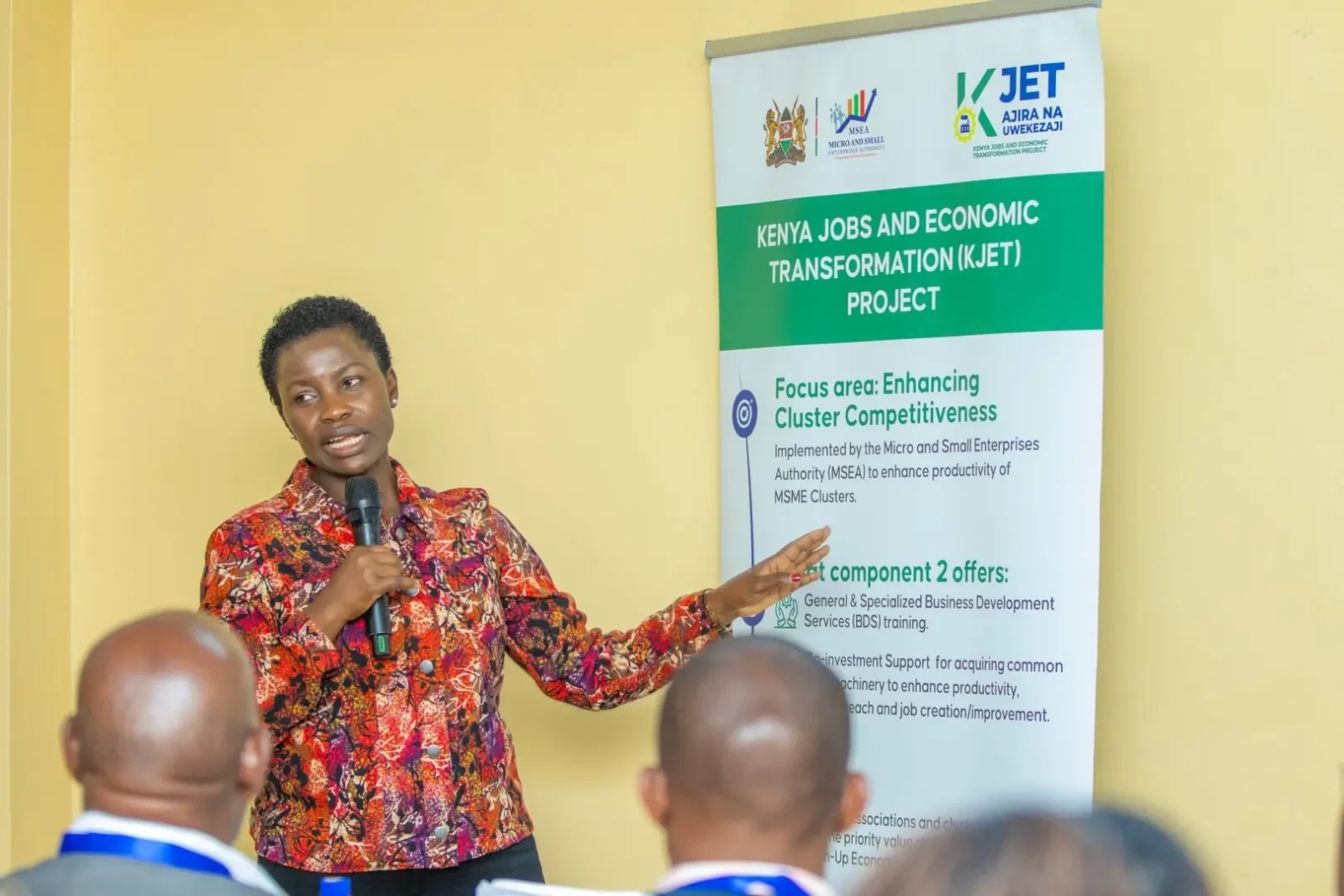
Component 2: Enhancing MSME Cluster Competitiveness is implemented by the Micro and Small Enterprises Authority (MSEA) and represents the component under which the current Ksh20 million co-investment call falls. This component aims to strengthen competitiveness and market access of MSMEs through provision of both generalized and value chain-specific Business Development Services as well as co-investment in viable MSME clusters. Under this component, 1,200 MSME clusters will receive free general and specialized training through BDS, while 600 clusters will receive co-investment support to acquire machinery.
Component 3: Scaling Up Green Financing and Strengthening Climatic Resilience for SMEs is implemented by the Kenya Development Corporation (KDC). This component is designed to mobilize green private capital to support SME adoption of green, clean, and eco-friendly technologies through setting up an agile, patient financing structure capable of crowding in private capital, especially for medium businesses. It will also pilot innovative instruments to support SMEs in managing compound shocks including climatic risks. KDC will establish a Green Investment Fund (GIF) and focus on equity and debt financing to eligible MSMEs through environmentally sustainable lending practices.
Component 4: Project Management, Monitoring and Evaluation is overseen by the State Department for Micro, Small and Medium Enterprises Development. This component strengthens the Monitoring and Evaluation (M&E) systems and capacity of national implementing agencies, financing project management activities with the aim of building sustainable systems that last beyond the project’s lifetime.
The multi-component structure reflects a whole-of-government approach to economic transformation, with activities anchored within the State Department for MSME Development of the Ministry of Cooperatives and MSME Development and the State Department for Investment Promotion of the Ministry of Investments, Trade, and Industry. Two dedicated Project Implementation Units (PIU)—one in each Ministry—are responsible for day-to-day management of the project, ensuring coordinated implementation across government agencies.
One decision can change your entire career. Take that step with our Online courses in ACCA, HESI A2, ATI TEAS 7, HESI EXIT, NCLEX-RN, NCLEX-PN, and Financial Literacy. Join Serrari Ed and start building your brighter future today.
Business Development Services: Building Capabilities Beyond Capital
While the co-investment component garners significant attention due to its substantial financial value, the Business Development Services (BDS) component of KJET Component 2 represents an equally critical intervention addressing the capability constraints that limit MSME competitiveness. A total of 1,200 clusters will benefit from free general and specialized training through BDS, providing comprehensive capacity building to improve operational efficiency, market access, and business sustainability.
The BDS offerings under KJET encompass both generalized training applicable across all MSME clusters and value chain-specific technical assistance tailored to the unique requirements of different sectors. Generalized training typically covers fundamental business management topics including financial management, record-keeping, marketing, customer service, quality management, and business planning—core competencies that many informal and semi-formal MSMEs lack despite possessing strong technical or production capabilities.
Value chain-specific BDS goes deeper into sector-specific technical requirements, quality standards, market dynamics, and best practices. For clusters in the dairy value chain, for example, specialized training might cover proper milk handling and storage, adherence to food safety standards, cooperative management, and linkages to formal milk collection and processing systems. For textile clusters, training might focus on fabric quality control, modern manufacturing techniques, fashion design trends, and export market requirements.
MSEA CEO Henry Rithaa has emphasized the Authority’s commitment to field-driven economic transformation, noting that county teams serve as the engines of implementation. Their ability to engage MSEs, identify viable clusters, and nurture innovation will ultimately determine the impact of the KJET Project. Rithaa has called on county teams to ensure that no cluster is left behind, highlighting the importance of strengthening collaboration with private sector stakeholders and development partners to expand the project’s reach and effectiveness.
The BDS component also addresses market coordination failures that constrain linkages between MSMEs and downstream buyers. By providing training on aggregation, standardization, and market linkage arrangements, KJET helps clusters meet the volume, quality, and consistency requirements of formal buyers who might otherwise source from larger, more established suppliers or imports. This market-making function can transform scattered individual producers into coordinated supply chains capable of serving institutional buyers, export markets, or value-added processing facilities.
The Application Process: Navigating Requirements and Deadlines
Interested MSME clusters are advised to carefully review application requirements, eligibility criteria, and submission guidelines through the official KJET portal at https://kjet.msea.go.ke. The application process has been designed to ensure transparent, merit-based selection while remaining accessible to clusters that may have limited experience with formal application procedures.
Clusters applying for support must first confirm that they meet the eligibility criteria set out in the call for applications. Eligible entities include cooperatives, associations, self-help groups (SHGs), community-based organizations (CBOs), cluster-based entities, and limited companies involved in value addition activities. The emphasis on “clusters” rather than individual enterprises reflects KJET’s strategic focus on coordinated groups of businesses operating within similar value chains, enabling economies of scale in both training delivery and machinery utilization.
All sections of the application form must be completed accurately and comprehensively, with applicants required to upload clear, accurate supporting documents. Incomplete applications will not be considered, and only one application per cluster is permitted. This strict approach to application completeness aims to ensure fair evaluation while preventing gaming of the selection process through multiple submissions.
The cluster selection process follows a structured and transparent methodology. Applications are first screened for completeness and eligibility, ensuring that only qualifying clusters proceed to subsequent evaluation stages. This is followed by on-site data validation and eligibility checks, with implementing agencies verifying information provided in applications through physical visits and stakeholder interviews.
Clusters are then evaluated through a technical scoring process using predefined criteria, likely including factors such as cluster size and membership, value chain alignment with BETA priorities, demonstrated market demand for products, financial contribution capacity, business plan viability, gender and youth inclusion, and potential for job creation. Independent quality assurance is conducted before final approval by a selection committee, providing multiple checkpoints to ensure fair, transparent decision-making.
For the first cohort of BDS training support, two clusters per county were selected, resulting in 94 clusters identified nationwide. This geographic distribution ensures that opportunities under KJET reach all corners of Kenya, rather than concentrating in traditionally economically advantaged regions. The county-based approach also facilitates coordination with county governments and local stakeholders who possess intimate knowledge of local value chains and MSME ecosystems.
Mobilizing Private Capital: Beyond Government Funding
An innovative aspect of the KJET Project is its emphasis on mobilizing private capital to complement public investments. Beyond being recipients of business development services and technical support, the private sector is expected to invest capital into the blended finance Green Investment Fund as well as through the co-investment model financing MSMEs’ productive capacity. In all, the project is expected to mobilize at least $27 million in private capital to complement the World Bank and Government of Kenya’s investment.
The co-investment model itself represents a form of private capital mobilization, with clusters contributing 30% of machinery costs. For a cluster accessing the maximum Ksh20 million in machinery support, this translates to a Ksh6 million contribution from the cluster itself—a substantial sum that demonstrates serious commitment and creates strong incentives for productive utilization of acquired assets.
Ahmed Rostom, World Bank Senior Financial Sector Specialist and KJET Task Team Leader, explained: “KJET offers a comprehensive set of interventions that are expected to support business and investment-enabling reforms in Kenya that will result in streamlined licensing processes; improved investment-related laws, regulations, and strategies; enhanced government capacity for investor outreach and government to business service delivery. KJET will also focus on enhancing MSME cluster competitiveness through increased capabilities and productive capacity by extension sales, profits, and jobs at supported firms.”
The Green Investment Fund under Component 3 represents another mechanism for crowding in private capital, particularly institutional investors and impact investors attracted to environmentally sustainable investments with developmental impact. By establishing a dedicated facility with technical assistance for due diligence, risk management, and monitoring, KJET aims to demonstrate the commercial viability of green MSME lending while building track records that can attract follow-on private investment.
Gender and Inclusion Considerations
The KJET Project places explicit emphasis on inclusive growth that benefits women and other underserved groups. Of the 45,000 Kenyans targeted to benefit through new or improved job opportunities, at least 6,800 are specifically targeted to be women, reflecting recognition that women remain underrepresented in formal employment and often face additional barriers to accessing finance, training, and economic opportunities.
Gender considerations are integrated throughout KJET’s design and implementation. Selection criteria for both BDS and co-investment support likely include assessment of gender representation within cluster membership and leadership, creating incentives for clusters to actively include women entrepreneurs. The focus on certain value chains such as dairy, rice, and some agricultural processing aligns with sectors where women are already heavily involved, albeit often in informal or low-value roles.
Beyond gender, KJET’s focus on MSMEs inherently targets economically excluded segments of Kenya’s population. The cluster approach facilitates inclusion of entrepreneurs who might lack individual capacity to access support programs but can participate effectively through collective action. By requiring only 30% co-investment rather than full commercial financing, the program opens doors for enterprises that would be deemed unbankable under conventional credit assessment criteria.
Youth represent another priority demographic for KJET, aligning with Kenya’s broader policy emphasis on youth employment and entrepreneurship. With youth unemployment representing a persistent challenge and potential source of social instability, creating economic pathways for young Kenyans through MSME development carries both economic and social policy significance.
Implementation Challenges and Risk Factors
While KJET’s design appears comprehensive and well-structured, successful implementation faces numerous challenges common to development projects in Kenya and similar contexts. Coordination across multiple implementing agencies—MSEA, KenInvest, KDC, and various State Departments—requires sustained communication, aligned incentives, and clear delineation of responsibilities. Experience with previous multi-agency initiatives suggests that coordination challenges can lead to delays, duplication of efforts, or gaps in implementation.
Reaching truly grassroots MSMEs with meaningful support represents another persistent challenge. Despite stated intentions of inclusion, development programs often experience “elite capture” where benefits flow disproportionately to better-connected, more sophisticated enterprises rather than reaching the most marginalized beneficiaries. The cluster approach mitigates this risk somewhat by requiring collective organization, but clusters themselves can be dominated by more powerful members.
The sustainability of KJET interventions beyond the project period represents a critical consideration. While Component 4 explicitly aims to build sustainable systems lasting beyond the project lifetime, transitioning from donor-funded support to self-sustaining mechanisms has proven difficult for many past initiatives. The question of whether BDS and market linkages will continue functioning after KJET funding ends, or whether they will collapse once external support is withdrawn, looms over long-term impact.
Absorptive capacity constraints may limit the pace and effectiveness of fund disbursement and implementation. Processing 1,200 clusters for BDS and 600 for co-investment support across 47 counties within a five-year period requires substantial administrative capacity at national and county levels. Staff recruitment, training, and retention challenges could slow implementation, particularly given competition for skilled personnel from other government agencies and private sector.
Macroeconomic conditions including exchange rate fluctuations, inflation, and fiscal pressures on the Government of Kenya’s budget could affect project implementation and co-financing commitments. Global commodity price shocks, trade disruptions, or financial market volatility affecting access to capital for MSME contributions could undermine project assumptions and limit participation.
Conclusion: A Transformative Opportunity Requiring Urgent Action
The Kenya Jobs and Economic Transformation Project represents one of the most significant interventions in Kenya’s MSME sector in recent years, combining substantial financial resources, comprehensive technical assistance, and a whole-of-government implementation approach. The current call for applications under the co-investment component offers eligible MSME clusters a genuine opportunity to access capital and capabilities that could transform their productivity, market access, and economic contributions.
With only 15 days remaining until the application deadline, eligible clusters must act urgently to review requirements, prepare documentation, and submit complete applications through the KJET portal. The “time-sensitive opportunity,” as described by the State Department for Youth Affairs, will not remain open indefinitely, and clusters that miss this deadline may find themselves waiting years for similar support opportunities.
For stakeholders including MSME support organizations, county governments, business associations, and development partners, the call to widely circulate information about this funding opportunity carries special urgency. Many eligible clusters may be unaware of KJET or uncertain about their eligibility, requiring proactive outreach and application support to ensure that opportunities reach enterprises most in need of support.
The broader success of KJET will be measured not just by the number of clusters supported or machinery procured, but by sustainable improvements in productivity, competitiveness, and job quality across Kenya’s MSME sector. If implemented effectively, KJET could contribute meaningfully to the Bottom-Up Economic Transformation Agenda’s ambitious goals of bringing down the cost of living, creating jobs, expanding the tax base, and driving inclusive growth.
As Kenya navigates the complex challenges of economic transformation, poverty reduction, and youth employment generation, initiatives like KJET represent critical tools for channeling resources and expertise to the enterprises and entrepreneurs who will ultimately drive inclusive prosperity. The coming weeks will determine which clusters seize this transformative opportunity, and the coming years will reveal whether KJET delivers on its promise of jobs, transformation, and broadly shared economic progress.
Ready to take your career to the next level? Join our Online courses: ACCA, HESI A2, ATI TEAS 7 , HESI EXIT , NCLEX – RN and NCLEX – PN, Financial Literacy!🌟 Dive into a world of opportunities and empower yourself for success. Explore more at Serrari Ed and start your exciting journey today! ✨
Track GDP, Inflation and Central Bank rates for top African markets with Serrari’s comparator tool.
See today’s Treasury bonds and Money market funds movement across financial service providers in Kenya, using Serrari’s comparator tools.
Photo source: Google
By: Montel Kamau
Serrari Financial Analyst
19th December, 2025