










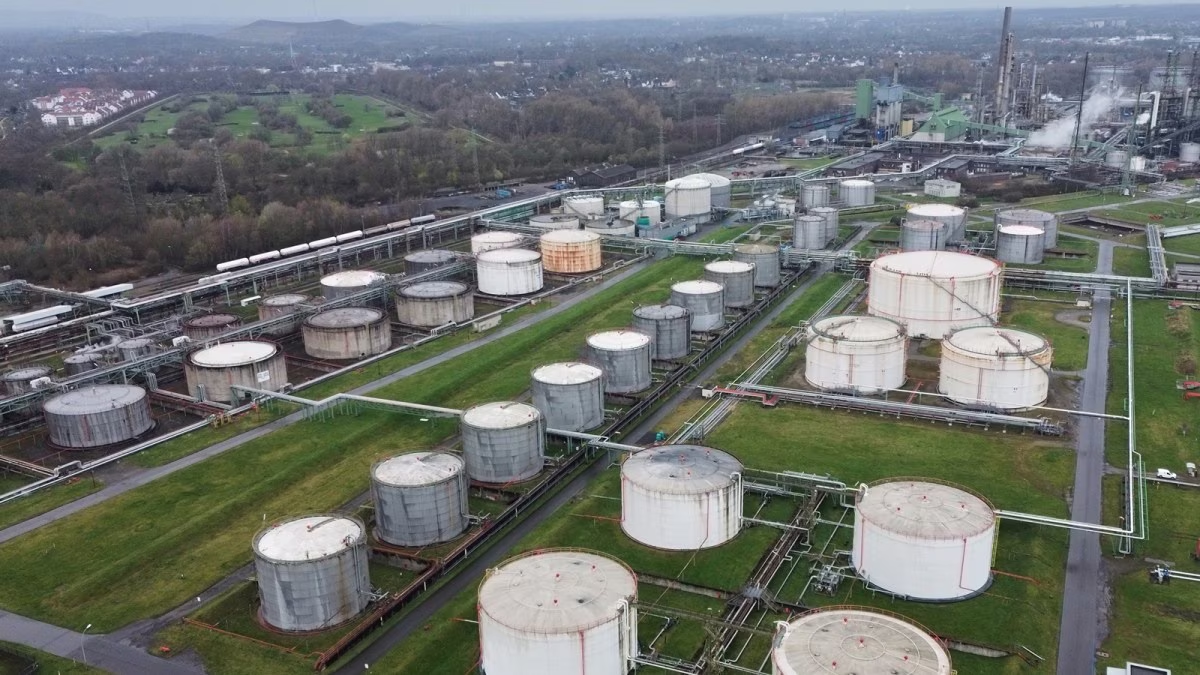
Global energy markets have been thrown into turmoil after escalating tensions in the Middle East triggered fears of severe supply disruptions. In response to the mounting crisis, the International Energy Agency (IEA) has approved the largest coordinated release of strategic oil reserves in its history, agreeing to make 400 million barrels of oil available to global markets.
The unprecedented intervention comes as geopolitical tensions between the United States, Israel and Iran continue to disrupt oil flows through the Strait of Hormuz, one of the most critical energy transit routes in the world. The narrow waterway handles roughly 20 million barrels of oil per day, representing nearly a fifth of global petroleum shipments.
With attacks on oil tankers increasing and shipping risks rising in the region, governments around the world have grown concerned that supply disruptions could trigger another energy crisis similar to the one experienced in 2022 following Russia’s invasion of Ukraine.
To prevent further instability in global markets, the IEA convened an extraordinary meeting of its 32 member countries, which unanimously agreed to release emergency oil stocks in order to stabilize prices and reassure energy markets.
IEA Executive Director Fatih Birol described the move as an extraordinary but necessary response to an increasingly volatile global situation.
“The oil market challenges we are facing are unprecedented in scale,” Birol said in a statement. “Oil markets are global, so the response to major disruptions needs to be global too.”
Build the future you deserve. Get started with our top-tier Online courses: ACCA, HESI A2, ATI TEAS 7, HESI EXIT, NCLEX-RN, NCLEX-PN, and Financial Literacy. Let Serrari Ed guide your path to success. Enroll today.
Largest Strategic Oil Release in History
The coordinated release of 400 million barrels represents the largest emergency intervention ever undertaken by the IEA.
The scale of the action far exceeds previous emergency measures. In 2022, IEA member countries released 182 million barrels of oil following Russia’s invasion of Ukraine in an effort to offset supply disruptions and calm global markets.
This latest release is more than double that amount, highlighting the severity of the current crisis and the potential scale of supply disruptions facing global energy markets.
The volume agreed upon by IEA members represents roughly one-third of the agency’s total strategic petroleum reserves, demonstrating the willingness of governments to deploy significant resources to maintain stability in energy markets.
Officials say the oil will be released gradually over a timeframe determined by each member country’s national circumstances. This approach allows governments to adapt the release according to their domestic policies, logistical capacity, and strategic reserve management strategies.
Despite the flexibility in timing, the coordinated action sends a strong signal to energy markets that governments are prepared to intervene decisively when geopolitical events threaten global energy security.
The Strategic Importance of the Strait of Hormuz
At the center of the current crisis lies the Strait of Hormuz, a narrow maritime corridor located between the Persian Gulf and the Gulf of Oman.
The strait serves as one of the world’s most important energy chokepoints. Oil shipments from major producers such as Saudi Arabia, Iraq, Kuwait, and the United Arab Emirates pass through the waterway before reaching international markets.
On average, approximately 20 million barrels of crude oil and petroleum products move through the strait each day, making it a critical artery for global energy trade.
However, the escalating conflict in the region has dramatically increased risks for shipping companies and oil traders. Reports of attacks on commercial vessels and warnings from military forces in the region have led some shipping operators to delay or reroute deliveries.
Energy analysts warn that even temporary disruptions in the strait can have far-reaching consequences.
If shipping through the waterway were to halt entirely, global oil supply could be reduced by millions of barrels per day almost immediately. Such a scenario would likely trigger sharp price spikes and could have serious economic consequences for energy-importing countries.
The IEA’s decision to release strategic reserves is therefore designed to offset potential supply losses while governments work to restore stability in the region.
G7 Nations Coordinate Political Response
The emergency oil release follows intense discussions among members of the Group of Seven (G7), a political and economic forum consisting of the United States, Canada, the United Kingdom, France, Germany, Italy, and Japan.
G7 leaders held emergency consultations earlier this week as oil prices surged following the escalation of conflict in the Middle East.
Although the G7 did not initially commit to releasing oil reserves directly, the group requested that the IEA assess market conditions and propose options for a coordinated response.
The IEA subsequently convened an emergency meeting of its member governments, where officials unanimously approved the release plan.
The arrangement highlights the complementary roles played by the two organizations.
While the G7 provides political coordination among major advanced economies, the IEA serves as the technical body responsible for managing emergency oil reserves and coordinating supply interventions.
Countries Begin Announcing Contributions
Several countries had already indicated their willingness to release portions of their strategic reserves before the IEA officially announced the coordinated intervention.
Japan, one of the world’s largest energy importers, said it would release approximately 80 million barrels of oil from both government and privately held reserves beginning in mid-March.
The country relies heavily on energy shipments passing through the Strait of Hormuz, with roughly 70 percent of its oil imports transported through the strategic waterway.
Germany has also confirmed that it will contribute roughly 19.5 million barrels to the emergency release.
German officials emphasized that participating in the coordinated intervention reflects the country’s commitment to international energy security cooperation.
Austria has also indicated it will release part of its reserves in response to the IEA’s request.
Together, these contributions illustrate how governments are mobilizing strategic stockpiles to prevent supply shortages and maintain stability in global oil markets.
One decision can change your entire career. Take that step with our Online courses in ACCA, HESI A2, ATI TEAS 7, HESI EXIT, NCLEX-RN, NCLEX-PN, and Financial Literacy. Join Serrari Ed and start building your brighter future today
Oil Prices Remain Volatile
Despite the announcement of the historic oil release, energy markets remain volatile as investors closely monitor developments in the Middle East.
Brent crude, the global oil benchmark, has surged approximately 20 percent since the conflict began, reflecting fears that disruptions to oil shipments could tighten global supply.
However, prices retreated slightly following reports that governments were considering releasing strategic reserves.
Meanwhile, West Texas Intermediate (WTI) crude has fluctuated around $85 per barrel, trading within a relatively narrow range as markets await further developments.
Energy analysts say the situation remains highly sensitive to geopolitical developments.
Even minor disruptions to shipping routes or production facilities in the Middle East could trigger renewed price spikes, particularly if tensions escalate further.
Consumers Already Feeling the Impact
The surge in oil prices is already being felt by consumers around the world.
Higher crude oil prices typically translate into rising fuel costs, increasing transportation expenses for businesses and households alike.
Governments are particularly concerned about the potential impact on inflation, as energy prices play a key role in determining the cost of goods and services throughout the global economy.
If supply disruptions persist, fuel prices could continue rising in the coming weeks.
Some analysts have warned that oil prices could surge dramatically if shipping through the Strait of Hormuz remains blocked for an extended period.
Military analysts say that if naval mines were deployed in the waterway, clearing them could take several weeks even after hostilities end, prolonging disruptions to energy shipments.
Strategic Oil Reserves: A Key Tool for Energy Security
Strategic petroleum reserves were first developed in the 1970s following the global oil crisis triggered by the Arab oil embargo.
The crisis exposed the vulnerability of energy-importing countries to sudden supply disruptions and led governments to establish emergency oil stockpiles that could be released during times of crisis.
The International Energy Agency was created in 1974 partly to coordinate these emergency measures.
Today, IEA member countries collectively maintain over one billion barrels of strategic petroleum reserves, providing a powerful tool for stabilizing global energy markets during times of disruption.
When a coordinated release is approved, member countries can supply oil directly to the market through government sales, loans to refiners, or temporary reductions in reserve requirements.
These interventions are designed to quickly increase supply and calm market fears.
Outlook: Can the Release Stabilize Markets?
Whether the historic oil release will successfully stabilize global energy markets remains uncertain. Much will depend on how long the Middle East conflict continues and whether shipping through the Strait of Hormuz can resume safely and consistently.
If tensions ease and oil shipments recover, the strategic reserve release could help calm markets, ease supply concerns, and gradually bring prices down. The additional supply entering the market may also provide temporary reassurance to traders and energy-importing countries worried about potential shortages.
However, if the conflict intensifies or spreads to additional energy infrastructure in the region, the current intervention may prove insufficient to fully offset supply losses. Extended disruptions to tanker routes or production facilities could quickly absorb the additional barrels being released.
For now, the IEA’s unprecedented action demonstrates the willingness of governments to act collectively to prevent an energy crisis and support market stability. As geopolitical tensions continue to shape global energy markets, coordinated responses such as this may become increasingly important in maintaining stability in the world’s energy system and protecting economies from sudden energy shocks.
Ready to take your career to the next level? Join our Online courses: ACCA, HESI A2, ATI TEAS 7 , HESI EXIT , NCLEX – RN and NCLEX – PN, Financial Literacy!🌟 Dive into a world of opportunities and empower yourself for success. Explore more at Serrari Ed and start your exciting journey today! ✨
Track GDP, Inflation and Central Bank rates for top African markets with Serrari’s comparator tool.
See today’s Treasury bonds and Money market funds movement across financial service providers in Kenya, using Serrari’s comparator tools.
Photo Source: Google
By: Rosemary Wambui
12th March 2026
Article, Financial and News Disclaimer
The Value of a Financial Advisor
While this article offers valuable insights, it is essential to recognize that personal finance can be highly complex and unique to each individual. A financial advisor provides professional expertise and personalized guidance to help you make well-informed decisions tailored to your specific circumstances and goals.
Beyond offering knowledge, a financial advisor serves as a trusted partner to help you stay disciplined, avoid common pitfalls, and remain focused on your long-term objectives. Their perspective and experience can complement your own efforts, enhancing your financial well-being and ensuring a more confident approach to managing your finances.
Disclaimer: This article is for informational purposes only and does not constitute financial advice. Readers are encouraged to consult a licensed financial advisor to obtain guidance specific to their financial situation.
Article and News Disclaimer
The information provided on www.serrarigroup.com is for general informational purposes only. While we strive to keep the information up to date and accurate, we make no representations or warranties of any kind, express or implied, about the completeness, accuracy, reliability, suitability, or availability with respect to the website or the information, products, services, or related graphics contained on the website for any purpose. Any reliance you place on such information is therefore strictly at your own risk.
www.serrarigroup.com is not responsible for any errors or omissions, or for the results obtained from the use of this information. All information on the website is provided on an as-is basis, with no guarantee of completeness, accuracy, timeliness, or of the results obtained from the use of this information, and without warranty of any kind, express or implied, including but not limited to warranties of performance, merchantability, and fitness for a particular purpose.
In no event will www.serrarigroup.com be liable to you or anyone else for any decision made or action taken in reliance on the information provided on the website or for any consequential, special, or similar damages, even if advised of the possibility of such damages.
The articles, news, and information presented on www.serrarigroup.com reflect the opinions of the respective authors and contributors and do not necessarily represent the views of the website or its management. Any views or opinions expressed are solely those of the individual authors and do not represent the website's views or opinions as a whole.
The content on www.serrarigroup.com may include links to external websites, which are provided for convenience and informational purposes only. We have no control over the nature, content, and availability of those sites. The inclusion of any links does not necessarily imply a recommendation or endorsement of the views expressed within them.
Every effort is made to keep the website up and running smoothly. However, www.serrarigroup.com takes no responsibility for, and will not be liable for, the website being temporarily unavailable due to technical issues beyond our control.
Please note that laws, regulations, and information can change rapidly, and we advise you to conduct further research and seek professional advice when necessary.
By using www.serrarigroup.com, you agree to this disclaimer and its terms. If you do not agree with this disclaimer, please do not use the website.
www.serrarigroup.com, reserves the right to update, modify, or remove any part of this disclaimer without prior notice. It is your responsibility to review this disclaimer periodically for changes.
Serrari Group 2025