










Electric mobility startup Zeno has closed a $25 million Series A — the largest raise for any mobility startup in Africa outside of Spiro — to accelerate production of its Emara electric motorcycle and expand a battery-swapping network across East Africa’s booming bodaboda market. The round, announced on March 5, 2026, combines $20.5 million in equity led by climate-tech investor Congruent Ventures with a $4.5 million debt facility, and arrives at a moment when Kenya’s electric motorcycle market is moving from early adoption into something that looks increasingly like a mass-market inflection.
Markets move fast; don’t get left behind. We’ve paired the Serrari Group Market Index with a curated Marketplace and a comprehensive Financial Literacy Course to ensure you have the data—and the skills—to act on it.
The Round: Who’s Backing Zeno and Why
The equity portion of the Series A was led by Congruent Ventures, a California-based climate-focused venture firm, with participation from Active Impact Investments and Lowercarbon Capital. The debt component was structured through Camber Road and Trifecta Capital. Lowercarbon Capital was already a backer, having led Zeno’s $9.5 million seed round in September 2024 alongside Toyota Ventures, 4DX Ventures, Advantedge, MCJ Collective, and RedBlue Ventures.
The new round brings Zeno’s total funding since launch to $34.5 million. For a company that has been operating for less than four years, that figure — and the calibre of investors behind it — reflects the growing conviction among climate-focused institutional investors that East Africa’s motorcycle-taxi sector is one of the most compelling entry points for electrification anywhere in the emerging world.
Gray Robinson, Partner at Congruent Ventures, was direct in explaining the thesis: Zeno’s solution “uniquely satisfies commercial performance requirements in an electric model with 50% lower operating costs than petrol alternatives.” The firm, he added, has both the platform and the team to achieve rapid scale.
The Founder: From Tesla’s Production Lines to Nairobi
The company’s origin is inseparable from its founder. Michael Spencer, Zeno’s CEO and co-founder, is a former executive at Tesla who oversaw Model 3 production ramps — one of the most demanding manufacturing scale-up exercises in automotive history. He founded Zeno in 2022 with a thesis shaped by that experience: that the constraints that made Tesla difficult to build — complex supply chains, precision manufacturing, integrated software — were the same capabilities that could be turned into a durable competitive advantage in Africa’s two-wheeler market.
Zeno is headquartered across Nairobi, Bangalore, and San Francisco — a structure that reflects the blended demands of African market operations, hardware engineering depth, and access to global capital. The company’s deliberately full-stack approach, building its own motorcycle, battery system, charging infrastructure, and cloud-based operating system rather than importing and rebadging hardware from China, has secured a set of competitively important intellectual property and product quality that distinguishes it from most of the field.
The Emara: Engineering for Africa’s Roads
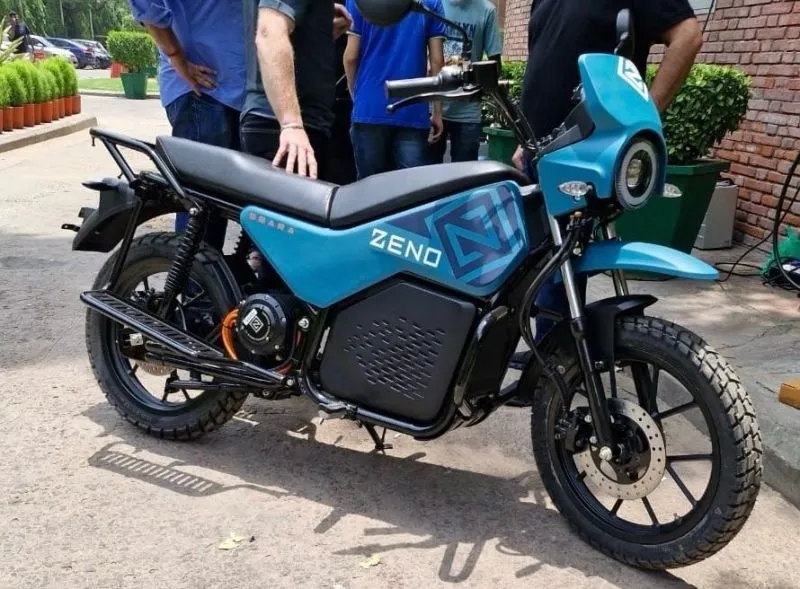
Zeno’s flagship product, the Emara, is engineered specifically for the commercial transport conditions of East Africa. The motorbike travels approximately 100 kilometres on a single charge and is rated to carry loads of up to 250 kilograms — the highest payload capacity among its primary competitors — while delivering peak power of around 8 kilowatts, comparable to a 150cc internal combustion engine. Because electric motors deliver full torque from a standstill, the Emara can climb steep gradients even when fully loaded with passengers and cargo: a fundamental requirement for bodaboda operators navigating Nairobi’s hills and upcountry terrain.
The motorcycle sells for around $1,300 without a battery or approximately $2,000 bundled with one — prices that Spencer described as roughly 50% lower in operating costs than petrol equivalents and more than 25% below other electric motorbike brands operating in the same markets. For riders who do not want to purchase the battery outright, Zeno offers a monthly or pay-per-use battery-swapping subscription, substantially lowering the barrier to ownership.
The economics land with particular force for East Africa’s bodaboda operators, who typically earn around $10 a day but spend nearly half of that on gasoline. Switching to electric can effectively double daily take-home pay — a figure powerful enough to drive adoption even without government subsidies or directed financing.
Context is everything. While you follow today’s updates, use the Serrari Market Index and Marketplace to spot emerging shifts. Need to sharpen your edge? Our Financial Literacy Course turns these insights into a professional-grade strategy.
The Battery-Swap Network: Building the Infrastructure Moat
Beyond the motorcycle itself, Zeno’s competitive position rests on its charging and battery-swap network — and the data and software layer that sits above it. The company has deployed more than 150 charging and battery-swap locations across four cities in Kenya and Uganda, all managed through an app-controlled cloud operating system that gives Zeno real-time visibility into battery state, rider behaviour, and station performance.
The battery-swap model addresses the most significant barrier to commercial electric motorcycle adoption: charging downtime. Rather than waiting for a battery to recharge — a process that can take several hours on a standard home outlet — riders can exchange a depleted battery for a charged one at a Zeno station and be back on the road within minutes. This is not a convenience feature; for commercial riders whose income depends on continuous operation, it is a fundamental enabler.
Zeno’s system is also designed to be interoperable — the first in the region to deploy an interoperable charging system supporting both two- and three-wheelers. This is a strategic long-term asset: if Zeno’s charging standard becomes the baseline for East Africa’s electric two- and three-wheeler market, the network itself becomes a platform, not merely infrastructure.
The company is also prototyping a battery dock that would allow its removable motorcycle batteries to power household lights and small appliances. About a dozen customers are currently piloting the product. If it reaches commercial scale, the system would transform Zeno’s battery network into a distributed energy platform — directly relevant in parts of East Africa where grid reliability remains uneven and demand for modular off-grid power is high. It is a strategy that mirrors, in concept, what Sun King has built in off-grid solar: using a mobile energy asset as the foundation for a broader electricity access business.
The Market Context: Kenya’s Tipping Point
Zeno’s raise arrives at a genuinely significant moment in Kenya’s electric motorcycle market. For years, uptake was a statistical curiosity: just 0.5% of new motorcycle registrations in 2021 were electric. That figure rose to 2.8% in 2022, 3.6% in 2023, and 7.1% in 2024 — itself considered the critical 5% threshold that analysts view as the tipping point for mass adoption.
In 2025, the numbers surged. Electric motorcycles reached 15.3% of all new registrations in Kenya, with 25,277 electric units registered out of a total 168,286 new motorcycles — a 145% jump in overall market volume year-on-year. Kenya now ranks alongside Vietnam and China in terms of growth momentum in the electric two-wheeler sector, a remarkable achievement for a country that registered just 44 electric motorcycles eight years ago.
The policy environment has reinforced these economics. Kenya’s government has zero-rated VAT and removed excise duty on electric motorcycles, electric bicycles, and lithium-ion batteries through the Finance Bill 2025, directly lowering the landed cost of EVs and the batteries that power them. Geothermal energy, which provides a significant share of Kenya’s electricity generation, further reduces the per-kilometre cost of electric operation compared with petrol-dependent alternatives.
The broader African electric two-wheeler market is tracking an equally compelling trajectory. According to Markets and Data research, the segment was valued at $441.69 million in 2023 and is projected to reach $2.61 billion by 2031 — a compound annual growth rate of 24.78%. That projection predates Kenya’s 2025 surge and the capital now flowing into the sector, suggesting the upside case may be materialising ahead of schedule.
The Competitive Landscape: A Race for the Bodaboda Market
Zeno enters its scale-up phase into an intensifying competitive field. The dominant player is Spiro, the continent’s largest electric motorbike operator, which in October 2025 raised $100 million in Africa’s largest-ever electric mobility investment, led by FEDA, the investment arm of Afreximbank. Spiro now operates more than 80,000 electric motorcycles across six countries — Kenya, Uganda, Rwanda, Nigeria, Benin, and Togo — with over 2,500 battery swap stations and 30 million completed swaps. In February 2026, Spiro added a further $50 million debt facility from Afreximbank, Nithio, and Africa Go Green Fund, bringing its total capitalisation to well over $200 million.
Roam, the Swedish-Kenyan company formerly known as Opibus, has raised $24 million in its own Series A and operates the Roam Park manufacturing facility in Nairobi — a 10,000 square metre facility with reported annual capacity of over 50,000 motorcycles. Roam’s flagship Gen-2 model features dual swappable batteries with a total range of up to 180 kilometres, appealing to longer-haul commercial operators.
Ampersand, the Rwanda-Kenya pioneer that has been operating since 2019, is scaling toward 13,000 deployed electric motorcycles in early 2026 with backing from British International Investment, and processes over 20,000 battery swaps per day across its network.
Zeno’s differentiation in this field rests on several specific claims: the highest payload capacity in the category at 250 kilograms; a deliberately full-stack proprietary technology approach rather than Chinese-sourced hardware; an interoperable charging standard; and the nascent home-energy battery dock play that none of its primary competitors have attempted at commercial scale.
As InsightEV noted in its analysis of the round, most e-mobility hardware in Africa deployed by other players remains China-designed and sourced. Zeno’s decision to develop its own motorcycle, battery, and charging infrastructure from the ground up — funded through a $9.5 million seed round alone — is what most observers regard as its most strategically defensible asset.
The Demand Picture: A Waiting List That Says Everything
Perhaps the clearest indicator of Zeno’s near-term commercial opportunity is its own waitlist. More than 25,000 retail and fleet customers are currently waiting to purchase the Emara motorcycle, while the company is producing approximately 70 to 80 bikes per week. At that production rate, Zeno has roughly six years of backlog at current output — a figure that simultaneously validates demand and exposes the manufacturing bottleneck the Series A is designed to close.
The $25 million will be deployed primarily against that constraint: scaling manufacturing capacity, expanding the charging and swap network into additional cities across Kenya and Uganda, and advancing the battery dock product toward commercialisation. Spencer has indicated that the funding will also support geographic expansion, with the East African footprint as the staging ground for a broader continental push.
Fleet customers — ride-hailing operators, delivery companies, and logistics firms — represent a particularly attractive channel alongside individual owner-operators. Fleet deals offer predictable, high-volume demand with lower customer acquisition costs per unit, and they create concentrated battery-swap demand that justifies new station deployment in specific commercial corridors. Zeno’s app-controlled network is designed precisely for this dual retail-and-fleet model, providing the data and remote management capabilities that fleet operators require.
The Bigger Bet: Energy, Not Just Transport
What distinguishes the most ambitious reading of Zeno’s strategy is not the motorbike or even the swap network in isolation — it is the possibility that both are infrastructure for a broader distributed energy business. The battery dock prototype is the most visible expression of this thesis, but the underlying logic runs through the entire model: a fleet of tens of thousands of battery-swappable motorcycles, managed through a proprietary software stack, represents a meaningful distributed energy asset that could be leveraged for grid services, renewable storage integration, or household power access in markets where the grid is unreliable.
This is not an imminent product — it is a strategic horizon. But it is the kind of optionality that explains why climate-focused investors like Congruent Ventures and Lowercarbon Capital are willing to back a hardware-intensive motorbike startup at a moment when global venture capital is otherwise cautious about capital-heavy physical infrastructure businesses.
East Africa’s electric motorcycle market will not be built by one company, and Zeno is not betting that it will be. It is betting that the companies which build the full stack — proprietary hardware, proprietary batteries, proprietary software, and the charging infrastructure that ties them together — will hold a structural advantage over those that assemble imported components. With $34.5 million in total funding, a 25,000-strong waitlist, and the most ambitious technical architecture in the market, Zeno has positioned itself to test that thesis at scale.
Don’t just read the news—navigate it. Track trends with the Serrari Group Market Index, discover your next move in the Serrari Marketplace, and master the “how” with our Financial Literacy Course.
photo source: Google
By: Montel Kamau
Serrari Financial Analyst
16th March, 2026
Article, Financial and News Disclaimer
The Value of a Financial Advisor
While this article offers valuable insights, it is essential to recognize that personal finance can be highly complex and unique to each individual. A financial advisor provides professional expertise and personalized guidance to help you make well-informed decisions tailored to your specific circumstances and goals.
Beyond offering knowledge, a financial advisor serves as a trusted partner to help you stay disciplined, avoid common pitfalls, and remain focused on your long-term objectives. Their perspective and experience can complement your own efforts, enhancing your financial well-being and ensuring a more confident approach to managing your finances.
Disclaimer: This article is for informational purposes only and does not constitute financial advice. Readers are encouraged to consult a licensed financial advisor to obtain guidance specific to their financial situation.
Article and News Disclaimer
The information provided on www.serrarigroup.com is for general informational purposes only. While we strive to keep the information up to date and accurate, we make no representations or warranties of any kind, express or implied, about the completeness, accuracy, reliability, suitability, or availability with respect to the website or the information, products, services, or related graphics contained on the website for any purpose. Any reliance you place on such information is therefore strictly at your own risk.
www.serrarigroup.com is not responsible for any errors or omissions, or for the results obtained from the use of this information. All information on the website is provided on an as-is basis, with no guarantee of completeness, accuracy, timeliness, or of the results obtained from the use of this information, and without warranty of any kind, express or implied, including but not limited to warranties of performance, merchantability, and fitness for a particular purpose.
In no event will www.serrarigroup.com be liable to you or anyone else for any decision made or action taken in reliance on the information provided on the website or for any consequential, special, or similar damages, even if advised of the possibility of such damages.
The articles, news, and information presented on www.serrarigroup.com reflect the opinions of the respective authors and contributors and do not necessarily represent the views of the website or its management. Any views or opinions expressed are solely those of the individual authors and do not represent the website's views or opinions as a whole.
The content on www.serrarigroup.com may include links to external websites, which are provided for convenience and informational purposes only. We have no control over the nature, content, and availability of those sites. The inclusion of any links does not necessarily imply a recommendation or endorsement of the views expressed within them.
Every effort is made to keep the website up and running smoothly. However, www.serrarigroup.com takes no responsibility for, and will not be liable for, the website being temporarily unavailable due to technical issues beyond our control.
Please note that laws, regulations, and information can change rapidly, and we advise you to conduct further research and seek professional advice when necessary.
By using www.serrarigroup.com, you agree to this disclaimer and its terms. If you do not agree with this disclaimer, please do not use the website.
www.serrarigroup.com, reserves the right to update, modify, or remove any part of this disclaimer without prior notice. It is your responsibility to review this disclaimer periodically for changes.
Serrari Group 2025