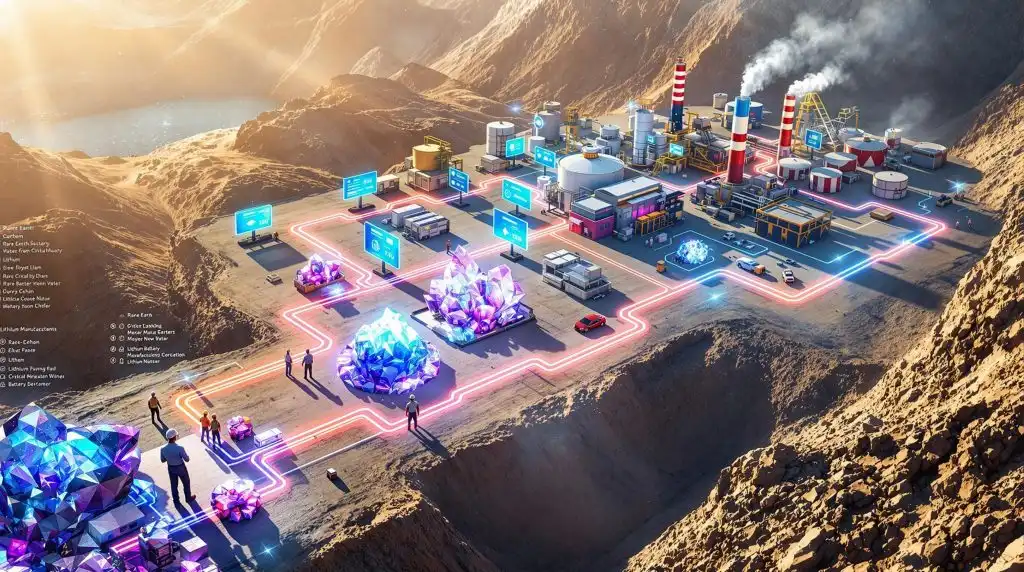
In a landmark move to reshape the global critical minerals landscape, the United States government and Abu Dhabi’s sovereign wealth fund have announced a collaborative $1.8 billion investment partnership with private equity firm Orion Resource Partners. This strategic initiative represents one of the most significant Western investments in critical mineral supply chains in recent years, as nations scramble to secure access to the essential materials that power modern technology, from electric vehicles to renewable energy infrastructure.
The newly established Orion Critical Mineral Consortium brings together three major players: the U.S. International Development Finance Corporation (DFC), Orion Resource Partners, and Abu Dhabi’s ADQ sovereign wealth fund. Each entity has committed $600 million to the fund, which aims to eventually expand to $5 billion by attracting additional investors from allied nations who share concerns about critical mineral security.
Build the future you deserve. Get started with our top-tier Online courses: ACCA, HESI A2, ATI TEAS 7, HESI EXIT, NCLEX-RN, NCLEX-PN, and Financial Literacy. Let Serrari Ed guide your path to success. Enroll today.
The Strategic Imperative Behind Critical Minerals
The investment announcement comes at a pivotal moment in global geopolitics and economics. China currently controls approximately 60% of global rare earth production and an even larger share of rare earth refining capacity, giving Beijing unprecedented leverage over supply chains that are vital to Western economic and national security interests. From lithium batteries in smartphones to rare earth magnets in wind turbines, these materials have become the fundamental building blocks of 21st-century technology.
Recent moves by China to restrict exports of critical minerals have sent shockwaves through Western manufacturing sectors, forcing companies and governments to urgently seek alternative supply sources. The restrictions particularly impact materials like gallium, germanium, and antimony, which are crucial for semiconductor manufacturing and defense applications.
A Production-Focused Investment Strategy
What distinguishes the Orion Critical Mineral Consortium from other investment initiatives is its deliberate focus on near-term production capabilities rather than speculative exploration ventures. Frank Fannon, the consortium’s managing partner who previously served as U.S. assistant secretary of state for energy resources during President Donald Trump’s first term, emphasized this pragmatic approach in the announcement.
“What we’re focused on is projects that are in production or can be put into production in the very near term to get material back to the U.S. and allied nations,” Fannon stated. This strategy reflects growing urgency among Western governments to quickly establish reliable supply chains that can reduce dependence on Chinese mineral exports.
The consortium’s approach stands in contrast to traditional mining investment models that often involve lengthy exploration phases and uncertain timelines. By targeting projects already in or near production, Orion aims to deliver tangible results within years rather than decades, addressing what many security analysts describe as a critical vulnerability in Western supply chains.
Geographic and Mineral Scope
Orion’s investment mandate encompasses a broad geographic reach. “We are going to go where the rocks are,” Fannon explained, indicating the fund will not be constrained by continental boundaries in its search for viable mining and processing projects. This global approach recognizes that critical mineral deposits are distributed unevenly across the planet, with significant reserves located in regions ranging from Australia to Latin America to parts of Africa.
The consortium will focus on minerals designated as critical by the United States, Canada, the European Union, and Australia, which collectively represent the world’s major developed economies. The U.S. Geological Survey’s list of critical minerals includes 50 commodities deemed essential to economic and national security, including lithium, cobalt, rare earth elements, and graphite.
Beyond the officially designated critical minerals, Orion will also invest in copper and uranium projects. Copper demand is surging due to electrification trends across transportation and power infrastructure, while uranium is experiencing renewed interest as nations reconsider nuclear energy in their decarbonization strategies.
Full Supply Chain Integration
Oskar Lewnowski, Orion’s founder and CEO, emphasized that the consortium’s investments will extend beyond mining operations to encompass the entire value chain. “We are absolutely committed to funding the supply chain to the extent necessary to secure end-stage product for customers and consumers,” Lewnowski stated.
This integrated approach addresses a often-overlooked challenge in critical mineral security: even when Western nations can access raw ores, they frequently lack the refining and processing capacity to transform these materials into usable components. China has strategically developed dominant positions not just in mining but throughout the processing chain, creating multiple potential chokepoints for Western manufacturers.
The consortium’s commitment to funding processing facilities alongside mines could help address what experts have identified as a critical gap in Western mineral supply chains. For example, while Australia produces significant quantities of lithium ore, most of it is shipped to China for processing into battery-grade materials before being incorporated into products.
Geopolitical Risk Mitigation
The involvement of the U.S. International Development Finance Corporation provides the consortium with unique capabilities to navigate geopolitical risks that might deter purely private investors. The DFC, which has been increasingly active in the critical minerals sector, will participate directly in investment decisions.
“The government certainly brings a lot to bear, particularly in emerging market contexts, and that makes investments that much more tenable for us,” Lewnowski explained. This public-private partnership model allows the consortium to pursue opportunities in regions where political instability or regulatory uncertainty might otherwise be prohibitive.
The DFC’s involvement also signals official U.S. government backing for the initiative, which can help facilitate diplomatic support, regulatory approvals, and risk mitigation in host countries. The agency previously took a stake in TechMet, a company focused on critical minerals for clean energy and technology applications, demonstrating Washington’s growing willingness to directly invest in the sector.
One decision can change your entire career. Take that step with our Online courses in ACCA, HESI A2, ATI TEAS 7, HESI EXIT, NCLEX-RN, NCLEX-PN, and Financial Literacy. Join Serrari Ed and start building your brighter future today.
Intriguing Interest in Ukraine
When asked about potential investments in Ukraine’s mining sector, Lewnowski offered a carefully worded response that nevertheless suggested serious interest: “Ukraine has some very interesting rocks. And let’s leave it at that.”
Ukraine possesses substantial mineral reserves including titanium, lithium, and rare earth elements, but the ongoing conflict with Russia has made development challenging. Any Western investment in Ukrainian mining would carry significant geopolitical implications, potentially helping Kyiv develop economic resilience while advancing Western mineral security objectives.
Parallel Initiatives in the Critical Minerals Space
The Orion announcement follows closely on the heels of other major investment initiatives in the critical minerals sector. Just two days earlier, private equity firm Appian Capital Advisory and the International Finance Corporation launched their own $1 billion fund specifically targeting minerals projects in Africa and Latin America.
This wave of investment activity reflects growing consensus among Western governments and institutional investors that critical mineral supply chains represent both a vulnerability and an opportunity. The European Union has established its own Critical Raw Materials Act, while Canada has released a critical minerals strategy identifying priority commodities and regions for development.
The Trump Administration’s Direct Intervention
The current investment landscape has been shaped significantly by the Trump administration’s unprecedented willingness to take direct equity stakes in mining companies. Washington has invested in MP Materials, which operates the Mountain Pass rare earth mine in California, as well as Lithium Americas, which is developing a major lithium project in Nevada.
These direct government investments represent a departure from previous U.S. policy, which generally avoided taking ownership positions in private mining operations. The shift reflects growing recognition that market forces alone may not establish critical mineral supply chains quickly enough to meet national security requirements.
The willingness to use public funds has been accompanied by regulatory streamlining efforts aimed at accelerating permitting for domestic mining projects. However, environmental concerns and local opposition continue to complicate development of new mines in the United States and other Western nations.
Industry Lobbying and Future Prospects
Critical mineral companies have dramatically increased their lobbying presence in Washington, recognizing the potential for substantial government support. The Trump administration has pledged ambitious investments in firms deemed essential to national security, creating strong incentives for mining companies to position themselves as strategic partners.
For investors considering joining the Orion consortium, Fannon indicated that alignment on strategic objectives would be paramount. The fund is seeking partners with a “shared value and shared understanding” of the need to bolster Western access to critical minerals, suggesting that purely profit-driven investors without commitment to the broader strategic mission might not be welcome.
Challenges and Uncertainties Ahead
Despite the significant capital being mobilized, substantial challenges remain in reshaping global critical mineral supply chains. Building new mines and processing facilities requires not just funding but also technical expertise, regulatory approvals, community acceptance, and often infrastructure development in remote locations.
Environmental concerns around mining operations remain significant, particularly as Western nations impose stricter standards than those applied in some competing jurisdictions. Balancing the imperative for supply chain security with environmental protection will require careful project selection and robust oversight.
Market dynamics also pose challenges. China’s dominant position allows it to potentially undercut prices and make Western projects uneconomical. The consortium will need to consider whether and how to ensure project viability in the face of potential Chinese competition.
A Long-Term Strategic Commitment
The Orion Critical Mineral Consortium represents a recognition by Western governments and investors that critical mineral security requires sustained, long-term commitment rather than ad hoc interventions. The goal of expanding the fund from $1.8 billion to $5 billion indicates ambitions that extend far beyond a handful of projects.
Success will ultimately be measured not just in dollars invested but in the quantity and reliability of critical mineral supplies flowing to Western manufacturers. As the global economy continues its transition toward electrification and advanced technologies, the nations and regions that secure access to essential materials will hold significant advantages in the geopolitical and economic competition of the coming decades.
The partnership between the United States, Abu Dhabi, and private capital through Orion demonstrates that critical mineral security has become a unifying objective capable of bringing together diverse interests. Whether this initiative and others like it can successfully challenge China’s dominance remains to be seen, but the scale of capital and political commitment now being mobilized suggests the balance of power in critical mineral markets may be entering a period of significant change.
Ready to take your career to the next level? Join our Online courses: ACCA, HESI A2, ATI TEAS 7 , HESI EXIT , NCLEX – RN and NCLEX – PN, Financial Literacy!🌟 Dive into a world of opportunities and empower yourself for success. Explore more at Serrari Ed and start your exciting journey today! ✨
Track GDP, Inflation and Central Bank rates for top African markets with Serrari’s comparator tool.
See today’s Treasury bonds and Money market funds movement across financial service providers in Kenya, using Serrari’s comparator tools.
Photo source: Google
By: Montel Kamau
Serrari Financial Analyst
24th October, 2025