










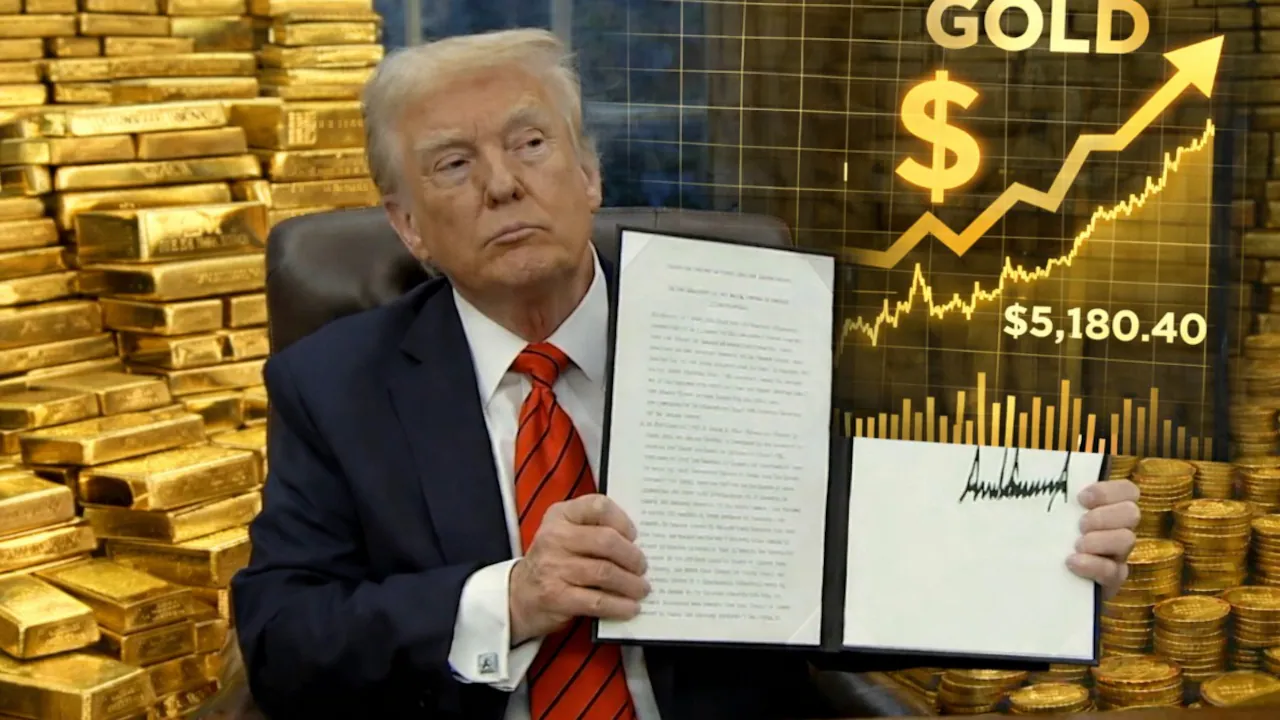
Gold prices stormed to a three-week high on Monday, February 23, 2026, as a historic U.S. Supreme Court ruling invalidating President Donald Trump’s sweeping emergency tariffs sent shockwaves through global markets — weakening the dollar, rattling investor confidence in U.S. trade policy, and reigniting safe-haven demand for bullion.
Build the future you deserve. Get started with our top-tier Online courses: ACCA, HESI A2, ATI TEAS 7, HESI EXIT, NCLEX-RN, NCLEX-PN, and Financial Literacy. Let Serrari Ed guide your path to success. Enroll today.
A Historic Court Ruling Reshapes the Trade Landscape
In a 6-3 decision handed down on Friday, February 20, the Supreme Court ruled that Trump’s tariffs — imposed under the International Emergency Economic Powers Act (IEEPA) of 1977 — exceeded presidential authority. Chief Justice John Roberts, writing for the majority, was unequivocal: “When Congress grants the power to impose tariffs, it does so clearly and with careful constraints. It did neither here.”
The ruling represented one of the most significant judicial checks on executive power in modern U.S. trade history. The IEEPA, a 1977 law designed to give presidents emergency economic powers during national security crises, had never previously been used to impose broad tariffs until Trump’s second term. The court found that while the law allows the president to “regulate” commerce in emergencies, it provides no clear authorization to levy taxes or duties.
The practical fallout was swift and disorienting. The ruling immediately nullified the so-called ‘fentanyl tariffs’ targeting Canada, Mexico, and China, as well as the sweeping ‘reciprocal tariffs’ applied to goods from nearly all of the United States’ trading partners. According to the Council on Foreign Relations, without those IEEPA tariffs, U.S. consumers now face an average effective tariff rate of 9.1 percent — still the highest level since 1946.
Trump Hits Back: The 15% Blanket Tariff Gambit
Rather than accept the ruling as a final word on his trade agenda, Trump moved within hours to reassert his protectionist stance. Invoking Section 122 of the Trade Act of 1974 — a rarely used statute that permits the president to impose a tariff of up to 15% for a maximum of 150 days to address serious U.S. balance-of-payments deficits — he announced a new blanket levy on imports.
Initially set at 10%, the tariff was raised to 15% the following day, taking effect on February 24, 2026. Trump posted on Truth Social that the levies would be “effective immediately” and warned that additional tariffs would follow. He also insisted that previously negotiated trade deals — including those with nearly 20 countries that had secured reductions from higher IEEPA rates — should remain in place, creating further legal ambiguity.
Trump publicly lashed out at the justices, calling the ruling “deeply disappointing” and labelling Justices Neil Gorsuch and Amy Coney Barrett — both his nominees — a “disgrace” and “an embarrassment to their families.” In a rare breach of presidential decorum, he posted a personal rebuke on Truth Social singling out the two conservative justices by name.
Analysts at Chatham House noted the head-spinning rapidity of events: first the Supreme Court decision invalidating IEEPA tariffs, then a 10% Section 122 tariff, and then within 24 hours an escalation to 15%. “It is a fallacy to assume that Trump will play by the rules,” the think tank observed, noting that the Section 122 tariffs expire in 150 days and require a congressional vote to be extended — a body that has so far shown no appetite for blanket tariff legislation.
Gold’s Safe-Haven Surge: Prices, Mechanics, and Market Dynamics
On Monday morning, gold markets responded decisively to the turmoil. Spot gold climbed as much as 1.1% before settling to a gain of 0.9% at $5,146.89 per ounce by 10:10 GMT — marking its highest level since January 30. U.S. gold futures for April delivery rose more sharply, gaining 1.7% to reach $5,167.90 per ounce. By mid-session New York trading, spot gold had climbed as high as $5,198.72, up 1.8% according to updated data from Reuters and Business Standard.
The mechanics behind the rally were well understood by market participants. Gold is priced in U.S. dollars, meaning a weaker greenback makes the metal cheaper — and more attractive — for buyers using other currencies. The dollar fell sharply in the immediate aftermath of the Supreme Court decision, as the ruling raised fundamental questions about the durability of Trump’s trade framework. As FX Street analysts noted, the tariff reshuffle reignited trade uncertainty and contributed to renewed pressure on the U.S. dollar, which typically supports gold by making it more attractive to international buyers.
Independent precious metals analyst Ross Norman summed up the sentiment: “The price recovery in both gold and silver has likely been assisted by concerns or confusion even over the outlook for tariffs,” adding that there were multiple tailwinds including weak economic growth data. Norman further noted: “After surging to unprecedented heights earlier this year, gold is showing signs of reclaiming its long-term bull market but in a more measured way.”
One decision can change your entire career. Take that step with our Online courses in ACCA, HESI A2, ATI TEAS 7, HESI EXIT, NCLEX-RN, NCLEX-PN, and Financial Literacy. Join Serrari Ed and start building your brighter future today.
Inflation, the Federal Reserve, and the Rate Dilemma
Complicating gold’s longer-term outlook is a stubborn inflation backdrop that could tie the Federal Reserve’s hands. Data released on the same day as the Supreme Court ruling showed that core U.S. inflation ran at a 3% annual rate in December 2025 — as measured by the Fed’s preferred PCE gauge — with signals pointing to further acceleration in January 2026.
Gold, as a non-yielding asset, typically benefits from low or falling interest rates because holding it becomes less costly relative to interest-bearing instruments. If inflation remains elevated and the Federal Reserve delays rate cuts, the appeal of bullion as a portfolio hedge diminishes on that specific dimension. However, markets were watching carefully for signals from a slew of Fed speakers scheduled to address audiences through the week, with any dovish signals likely to amplify gold’s upward momentum.
Goldman Sachs, meanwhile, maintained its bullish long-term stance. The bank reiterated its year-end gold target of $5,400 per ounce on February 20, driven by the thesis that central banks are buying roughly 60 tonnes of gold per month in 2026. J.P. Morgan’s Global Research team similarly projected prices pushing toward $5,000 per ounce by the fourth quarter, with $6,000 a possibility over the longer term, as central bank and investor demand averages around 585 tonnes per quarter.
Q4 2025 GDP growth came in at a meager 1.4% annualized rate — largely attributable to the November government shutdown — while inflation held stubbornly at 3.4%. This classic stagflationary combination historically favors precious metals, as investors seek stores of value that are insulated from both currency debasement and economic stagnation.
US-Iran Tensions Add a Geopolitical Dimension
Layered atop the trade policy drama is a simmering geopolitical risk from the Middle East. Iran has indicated it is prepared to make concessions on its nuclear programme in return for the lifting of U.S. sanctions and recognition of its right to enrich uranium. A senior Iranian official told Reuters that Tehran would seriously consider sending half of its most highly enriched uranium abroad, diluting the rest, and participating in a regional enrichment consortium — all in return for economic concessions and a formal U.S. acknowledgment of Iran’s right to peaceful nuclear activities.
Negotiations are ongoing, with a further round of talks expected in Geneva on Thursday. Iranian Foreign Minister Araghchi has made repeated appearances on American news networks to communicate Tehran’s position, telling CBS that a “good chance” remained for a diplomatic solution. The discussions come amid significant military tension: the USS Abraham Lincoln, carrying nearly 80 aircraft, was positioned approximately 700 kilometres from the Iranian coast as of the weekend before the talks, with U.S. F-35 and F-18 fighters within striking range.
The Soufan Center noted that while the second round of talks in Geneva yielded some movement, the discussions remain close to an impasse on key issues, with Iran refusing to commit to zero enrichment or any limitations on its ballistic missile programme. The prospect of a military strike, if talks fail, adds a significant geopolitical risk premium to gold prices — and the metal has historically spiked sharply during periods of Persian Gulf tension.
Silver, Platinum, and Palladium: Precious Metals Rally Broadens
The safe-haven rally was not confined to gold. Silver — sometimes called ‘poor man’s gold’ for its dual role as both an industrial and monetary metal — outperformed dramatically. Spot silver climbed 2.6% to $86.73 per ounce, registering its highest level in more than two weeks. At its intraday peak, silver futures were up as much as 5%, representing one of its most volatile single-session moves this decade, according to financial markets analysts.
Platinum edged 0.3% higher to $2,163.64 per ounce, while palladium — a metal used primarily in catalytic converters — added 1.8% to $1,779.81. Both metals, while not traditional safe havens in the same way as gold, benefit from the broader de-risking rotation that lifts precious metals during periods of macro uncertainty. Silver’s ongoing outperformance, having risen 150% in 2025, has compressed the gold-to-silver ratio to levels not seen in decades, signalling sustained investor appetite for precious metals broadly.
Major gold mining equities also benefited. Newmont Corporation (NYSE: NEM) shares rose approximately 2% on Monday, buoyed by record 2025 earnings and widening margins from elevated gold prices. The SPDR Gold Shares ETF and iShares Silver Trust both saw significant daily inflows as institutional managed money rotated out of the technology sector and into bullion.
The Structural Bull Market: Central Banks and the De-Dollarisation Trend
Beneath the day-to-day tariff drama lies a more structural reason for gold’s enduring strength: central banks around the world are aggressively diversifying away from the U.S. dollar. According to J.P. Morgan Global Research, central bank demand is set to average around 190 tonnes per quarter in 2026, as emerging market central banks in particular reduce their dollar reserve concentration in favour of the yellow metal.
Western ETFs have added approximately 500 tonnes of gold since early 2025, and private investors — including family offices and high-net-worth individuals — are treating gold increasingly as long-term insurance against fiscal and monetary policy risks rather than as a short-term speculative trade. Goldman Sachs analysts describe the structural bid under gold as essentially disconnected from day-to-day tariff headlines: it reflects a deeper, multi-year repositioning in global reserve management.
Gold’s share of total global financial assets has been rising steadily since 2010, reaching approximately 2.8% in Q3 2025. Experts at J.P. Morgan argue that even a modest 0.5% diversification of foreign U.S. asset holdings into gold would be sufficient to push prices to $6,000 per ounce — without requiring any acceleration in central bank buying beyond current trends. With gold mine supply remaining relatively inelastic due to long project development timelines, any sustained demand surge can translate rapidly into significant price appreciation.
What’s Next: Tariff Uncertainty, Fed Signals, and the 150-Day Window
The immediate market focus now shifts to how durable Trump’s 15% Section 122 tariff regime will prove to be. As the Council on Foreign Relations noted, while Trump retains other trade tools — including Section 232 national security tariffs and Section 301 unfair practices levies — none of these instruments is broad enough to replicate the sweeping IEEPA regime in its entirety. Section 232, for instance, can only target specific sectors and requires a formal Commerce Department investigation, while Section 301 is limited to retaliatory action against specific unfair trade practices.
Chris Krueger of TD Cowen Washington Research Group warned that given Trump’s track record, a meaningful tariff escalation response from the White House should not be ruled out in the coming weeks. The question of refunds for companies that paid the now-invalidated IEEPA tariffs — estimated at over $130 billion collected — remains unresolved, with Trump suggesting the matter will require extended litigation.
For gold investors, the structural backdrop remains supportive. The combination of tariff-driven policy chaos, geopolitical tension in the Persian Gulf, a Federal Reserve constrained by sticky inflation, and a secular de-dollarisation trend among global central banks collectively form a powerful multi-factor tailwind for the metal. As FX Leaders analysts concluded, while volatility is likely to persist, the broader backdrop of geopolitical risk and trade uncertainty suggests gold’s longer-term bullish foundation remains firmly intact.
The events of February 23, 2026 have underscored gold’s enduring role as the world’s preferred crisis hedge. In a single trading session, the metal absorbed the aftershocks of a landmark constitutional ruling, a presidential counter-offensive on trade, and an unresolved nuclear standoff in the Middle East — and emerged higher. For markets still navigating the full implications of the Supreme Court’s historic decision, gold’s message was clear: when the rules of the global trading system are up for grabs, the oldest store of value reasserts its relevance.
Sources: SCOTUSblog, NBC News, CNN, CFR, FXStreet, CNBC, Business Standard, Chatham House, Al Jazeera, Reuters/BusinessWorld Online, The Soufan Center, J.P. Morgan Global Research, Goldman Sachs via Investing.com, FX Leaders, Financial Content/Market Minute
Ready to take your career to the next level? Join our Online courses: ACCA, HESI A2, ATI TEAS 7 , HESI EXIT , NCLEX – RN and NCLEX – PN, Financial Literacy!🌟 Dive into a world of opportunities and empower yourself for success. Explore more at Serrari Ed and start your exciting journey today! ✨
Track GDP, Inflation and Central Bank rates for top African markets with Serrari’s comparator tool.
See today’s Treasury bonds and Money market funds movement across financial service providers in Kenya, using Serrari’s comparator tools.
photo source: Google
By: Montel Kamau
Serrari Financial Analyst
24th February, 2026
Article, Financial and News Disclaimer
The Value of a Financial Advisor
While this article offers valuable insights, it is essential to recognize that personal finance can be highly complex and unique to each individual. A financial advisor provides professional expertise and personalized guidance to help you make well-informed decisions tailored to your specific circumstances and goals.
Beyond offering knowledge, a financial advisor serves as a trusted partner to help you stay disciplined, avoid common pitfalls, and remain focused on your long-term objectives. Their perspective and experience can complement your own efforts, enhancing your financial well-being and ensuring a more confident approach to managing your finances.
Disclaimer: This article is for informational purposes only and does not constitute financial advice. Readers are encouraged to consult a licensed financial advisor to obtain guidance specific to their financial situation.
Article and News Disclaimer
The information provided on www.serrarigroup.com is for general informational purposes only. While we strive to keep the information up to date and accurate, we make no representations or warranties of any kind, express or implied, about the completeness, accuracy, reliability, suitability, or availability with respect to the website or the information, products, services, or related graphics contained on the website for any purpose. Any reliance you place on such information is therefore strictly at your own risk.
www.serrarigroup.com is not responsible for any errors or omissions, or for the results obtained from the use of this information. All information on the website is provided on an as-is basis, with no guarantee of completeness, accuracy, timeliness, or of the results obtained from the use of this information, and without warranty of any kind, express or implied, including but not limited to warranties of performance, merchantability, and fitness for a particular purpose.
In no event will www.serrarigroup.com be liable to you or anyone else for any decision made or action taken in reliance on the information provided on the website or for any consequential, special, or similar damages, even if advised of the possibility of such damages.
The articles, news, and information presented on www.serrarigroup.com reflect the opinions of the respective authors and contributors and do not necessarily represent the views of the website or its management. Any views or opinions expressed are solely those of the individual authors and do not represent the website's views or opinions as a whole.
The content on www.serrarigroup.com may include links to external websites, which are provided for convenience and informational purposes only. We have no control over the nature, content, and availability of those sites. The inclusion of any links does not necessarily imply a recommendation or endorsement of the views expressed within them.
Every effort is made to keep the website up and running smoothly. However, www.serrarigroup.com takes no responsibility for, and will not be liable for, the website being temporarily unavailable due to technical issues beyond our control.
Please note that laws, regulations, and information can change rapidly, and we advise you to conduct further research and seek professional advice when necessary.
By using www.serrarigroup.com, you agree to this disclaimer and its terms. If you do not agree with this disclaimer, please do not use the website.
www.serrarigroup.com, reserves the right to update, modify, or remove any part of this disclaimer without prior notice. It is your responsibility to review this disclaimer periodically for changes.
Serrari Group 2025