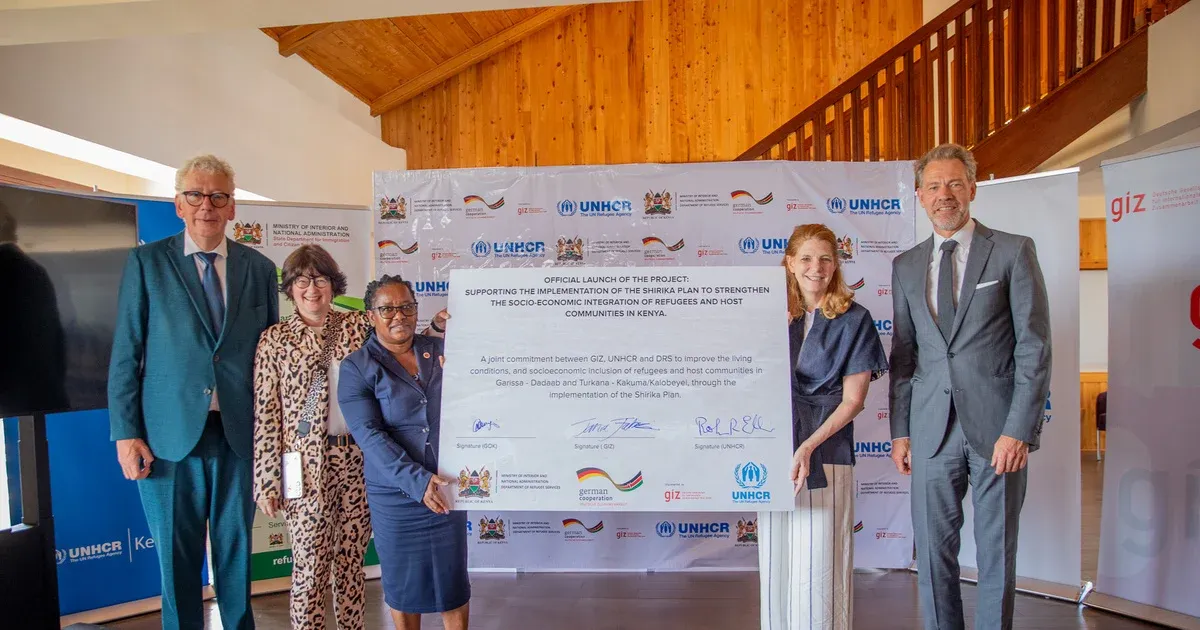
The Government of Germany, in partnership with the Government of Kenya and the United Nations High Commissioner for Refugees (UNHCR), has launched a transformative three-year joint project to support implementation of Kenya’s groundbreaking Shirika Plan. Announced on February 12, 2026, this collaborative initiative marks a significant milestone in advancing socioeconomic inclusion for refugees and host communities through practical, sustainable interventions focused on institutional strengthening, modern energy access, and skills development.
The Shirika Plan, which translates to “cooperation” in Swahili, represents Kenya’s bold framework to shift from humanitarian assistance towards refugee self-reliance and peaceful coexistence with host communities. The new German-supported project aims to translate this visionary policy framework into tangible, on-the-ground results that transform lives and strengthen systems across Kenya’s refugee-hosting areas.
Build the future you deserve. Get started with our top-tier Online courses: ACCA, HESI A2, ATI TEAS 7, HESI EXIT, NCLEX-RN, NCLEX-PN, and Financial Literacy. Let Serrari Ed guide your path to success. Enroll today.
A Strategic Response to Protracted Displacement
Kenya hosts one of the largest refugee populations in Africa, with over 840,000 registered refugees and asylum-seekers, many of whom have lived in the country for decades. The vast majority reside in the country’s two largest refugee camps—Dadaab in Garissa County, hosting over 420,000 people, and Kakuma in Turkana County, home to more than 300,000 refugees primarily from Somalia, South Sudan, Burundi, and the Democratic Republic of the Congo.
This protracted displacement, combined with growing pressure on services and livelihoods in host communities, has underscored the urgent need for sustainable, development-oriented responses. The Shirika Plan provides precisely this comprehensive framework—shifting away from camp-based humanitarian assistance toward integrated development approaches that benefit both refugees and host communities.
Speaking at the project launch event, representatives of the Government of Kenya reaffirmed the country’s commitment to progressive refugee policies that promote dignity and social cohesion while ensuring that host communities benefit alongside refugees. This dual focus reflects growing recognition that sustainable solutions must address the needs of all affected populations, not just displaced persons.
The Three-Year Project: Objectives and Implementation
The jointly implemented project, executed by Deutsche Gesellschaft für Internationale Zusammenarbeit (GIZ) and UNHCR in close collaboration with Kenya’s Department of Refugee Services, focuses on three interconnected pillars designed to support the Shirika Plan’s implementation at national and county levels.
The first pillar targets strengthening institutional capacities and systems. This includes building the capacity of government institutions at both national and county levels to plan, coordinate, and deliver services to both refugees and host communities. The emphasis on systems-building recognizes that sustainable transformation requires strong institutional foundations capable of sustaining gains beyond the project’s lifespan.
The second pillar focuses on expanding access to improved or modern energy services. In refugee-hosting areas like Kakuma and Dadaab, energy poverty represents a critical constraint on economic development and quality of life. GIZ has significant experience in this sector, having previously installed solar mini-grids in Kalobeyei that provide energy to schools, hospitals, UNHCR facilities, and hundreds of small businesses and homes.
The third pillar emphasizes providing needs-based skills training to promote inclusive socioeconomic opportunities. This component recognizes that both refugees and host community members require relevant skills to participate effectively in local economies and access livelihood opportunities. GIZ’s expertise in technical and vocational education and training, developed through decades of work in Kenya, provides a strong foundation for this intervention.
Robin R. Ellis on Translating Policy into Opportunity
Robin R. Ellis, Acting UNHCR Representative in Kenya, emphasized the transformative potential of the partnership during his remarks at the launch. “The Shirika Plan marks a significant shift which benefits both refugees and host communities. Through this partnership, UNHCR is working with the Government of Kenya, the Government of Germany and other partners to translate policy commitments into tangible opportunities—by strengthening systems, expanding access to services and supporting pathways towards self-reliance.”
Ellis’s comments underscore a critical challenge facing many progressive refugee policies: the gap between policy frameworks and practical implementation. The Shirika Plan, officially launched in March 2025 by President William Ruto, provides the strategic vision. This German-supported project provides crucial resources and technical expertise to operationalize that vision.
The shift toward self-reliance approaches represents a fundamental rethinking of refugee assistance. Rather than maintaining indefinite dependency on humanitarian aid, self-reliance models seek to enable refugees to meet their own needs through employment, entrepreneurship, and participation in local economies. This approach not only reduces long-term costs but also restores dignity and agency to displaced populations.
Germany’s Strategic Commitment to Displacement Solutions
Tania Fabricius, Head of Division for Displaced Persons and Host Countries at the German Federal Ministry for Economic Cooperation and Development, articulated Germany’s strategic rationale for supporting the Shirika Plan. She emphasized that Germany’s support aligns with its priorities on displacement and migration, stating: “Germany remains committed to responsibility-sharing and to supporting host countries in developing sustainable solutions that address the drivers of forced displacement, promote stability and foster inclusive economic development.”
This commitment reflects Germany’s recognition that effective responses to global displacement require supporting host countries, particularly in the Global South, which bear a disproportionate share of the responsibility for hosting displaced populations. Germany and Kenya signed a bilateral Climate and Development Partnership in November 2022, which aims to intensify cooperation in climate mitigation and adaptation—including through renewable energy development, a key component of the Shirika Plan implementation.
Germany’s development cooperation with Kenya dates back to 1963, making it one of the longest-standing bilateral partnerships. Over six decades, Germany has committed approximately 2.5 billion euros for bilateral development cooperation with Kenya. The country’s lead implementing agencies, GIZ and KfW, bring extensive operational experience and technical expertise to partnership initiatives.
The Humanitarian-Development-Peace Nexus in Practice
The project explicitly aims to contribute to improved livelihoods, strengthened institutions, and enhanced coordination between humanitarian and development actors, in line with the Humanitarian-Development-Peace Nexus—often referred to as the “triple nexus.” This approach recognizes that sustainable solutions to displacement require integrated interventions that address immediate humanitarian needs while simultaneously building longer-term development capacity and supporting peacebuilding and social cohesion.
The nexus approach represents a departure from traditional siloed interventions where humanitarian agencies focus solely on emergency response while development actors pursue separate, longer-term programs. In the context of protracted displacement, such separation often proves counterproductive, perpetuating aid dependency while failing to address underlying drivers of vulnerability.
Kenya’s context particularly demands nexus approaches. The country faces simultaneous challenges of hosting large refugee populations, addressing development needs in marginalized refugee-hosting counties like Turkana and Garissa, and managing complex peace and security dynamics in border regions. Effective responses must engage all three dimensions concurrently.
The Shirika Plan’s comprehensive framework encompasses sectors including education, health and nutrition, adequate housing, water and sanitation, livelihoods and self-reliance, social protection, sustainable natural resource management, climate change adaptation and disaster risk reduction, energy access, and durable solutions. This breadth reflects the integrated, multi-sectoral approach required to address protracted displacement sustainably.
Building on Progressive Legislative Foundations
The Germany-Kenya-UNHCR partnership builds on significant legislative progress Kenya has made in refugee policy. The Refugees Act of 2021, which came into effect in February 2022, provides new and additional opportunities, rights, protection, and solutions for refugees in Kenya. The Act grants refugees the right to work, freedom of movement in designated areas, the right to own property, and access to documentation facilitating service access and employment opportunities.
These progressive legislative provisions create an enabling environment for the Shirika Plan’s implementation. However, as civil society observers have noted, implementation challenges remain. Administrative hurdles in securing work permits, limited acceptance of refugee identification cards by service providers, and gaps in government coordination across ministries and agencies continue to frustrate the full realization of refugees’ legal rights.
The German-supported project’s focus on strengthening institutional capacities directly addresses these implementation gaps. By building government systems and coordination mechanisms, the project aims to ensure that progressive policies translate into accessible rights and opportunities for refugees on the ground.
One decision can change your entire career. Take that step with our Online courses in ACCA, HESI A2, ATI TEAS 7, HESI EXIT, NCLEX-RN, NCLEX-PN, and Financial Literacy. Join Serrari Ed and start building your brighter future today.
Energy Access: A Foundation for Economic Inclusion
The project’s emphasis on expanding access to modern energy services reflects recognition of energy as a fundamental enabler of economic development and quality of life. In Kakuma and Dadaab, energy poverty severely constrains livelihood opportunities, with only 1% of refugees having access to reliable electricity through the main power grid.
Most refugees and host community members rely on expensive, unstable, and unreliable alternative energy sources. Diesel mini-grid operators charge premium prices for intermittent service, while households spend significant portions of limited income on batteries, kerosene, or firewood for lighting and cooking. This energy poverty limits opportunities for productive activities, constrains children’s ability to study after dark, and creates health risks from indoor air pollution and fire hazards.
GIZ has pioneered innovative renewable energy solutions in refugee contexts. In Kalobeyei Settlement, solar mini-grids provide reliable, affordable electricity to health facilities, schools, businesses, and households. These installations have enabled new economic activities, improved service delivery, and reduced reliance on environmentally damaging and expensive alternatives.
The project’s energy component will expand this proven model, focusing on both higher-tier electricity supply to institutions and communities, and household-level renewable energy solutions. By making clean, affordable energy accessible, the intervention creates conditions for economic inclusion and improved quality of life.
Skills Development for Market-Driven Opportunities
The third pillar of needs-based skills training addresses a critical constraint on refugee and host community livelihoods. Many refugees arrive with professional skills and experience but lack credentials recognized in Kenya or require training in sectors with local demand. Young people in both refugee and host communities often lack access to quality technical and vocational education that prepares them for available employment opportunities.
GIZ brings substantial experience in technical and vocational education and training to the partnership. Previous initiatives have focused on industry-oriented training in close cooperation with the private sector, ensuring that skills development aligns with labor market needs rather than providing generic training with limited employment prospects.
The emphasis on “needs-based” skills training reflects lessons learned from earlier interventions. Effective skills development requires careful assessment of local labor markets, identification of sectors with growth potential, engagement with employers to understand their skill requirements, and provision of practical training that combines theoretical knowledge with hands-on experience.
In refugee contexts, skills training must also address specific barriers refugees face, including language challenges, lack of documentation, restricted freedom of movement that limits access to training opportunities, and discrimination in hiring. Successful programs typically combine technical skill-building with life skills, language training, entrepreneurship support, and linkages to employment or self-employment opportunities.
Addressing Host Community Concerns and Building Social Cohesion
The Shirika Plan’s explicit focus on benefiting both refugees and host communities reflects lessons learned from previous interventions that focused solely on refugee populations. In Kenya’s refugee-hosting areas, host communities face their own significant development challenges, including poverty rates exceeding 90% in parts of Turkana, inadequate access to basic services, environmental degradation, and limited livelihood opportunities.
When humanitarian assistance focuses exclusively on refugees while host communities’ needs remain unaddressed, this creates perceptions of unfairness that can fuel resentment and conflict. Some political leaders in Turkana and Garissa counties have expressed concerns about the Shirika Plan, arguing that host communities must see tangible benefits before integration progresses.
The German-supported project’s dual focus on refugees and host communities aims to ensure shared benefits from interventions. Energy infrastructure, skills training programs, and strengthened public service systems will be designed to serve both populations, creating opportunities for peaceful coexistence and shared prosperity.
However, as researchers have noted, achieving equitable inclusion requires careful attention to power dynamics, resource allocation, and conflict sensitivity. The project’s implementation will need to navigate complex local politics, ensure meaningful consultation with both refugee and host communities, and demonstrate tangible benefits to all stakeholders.
Implementation Timeline and Coordination Architecture
The three-year project timeline provides a structured period for establishing foundations and demonstrating initial results. The Shirika Plan itself spans eleven years (2025-2036) across three phases: Transition, Stabilization, and Resilience. The German-supported project primarily aligns with the Transition phase, helping to establish systems, build capacity, and demonstrate feasibility of the integrated approach.
Implementation is overseen by a National Steering Committee, chaired by the Principal Secretary for Immigration and Citizen Services, which provides overall guidance for Shirika Plan development and operationalization. A multi-stakeholder Technical Committee comprising line ministry focal points and representatives from various stakeholder groups provides technical inputs and supports coordination.
A Joint Department of Refugee Services-UNHCR Shirika Plan Secretariat leads day-to-day implementation, organizing stakeholder consultations and coordinating among implementing partners. This governance architecture aims to ensure strong government ownership while enabling effective collaboration among diverse actors.
The partnership among the Government of Germany, Government of Kenya, and UNHCR exemplifies the type of international cooperation required to operationalize ambitious refugee inclusion agendas. Each partner brings distinct capacities: Kenya provides political leadership, policy frameworks, and operational presence; UNHCR contributes technical expertise in refugee protection and assistance; and Germany provides financial resources, development cooperation experience, and technical support through GIZ.
Challenges and Critical Success Factors
Despite the partnership’s promising design, significant challenges remain. Funding represents a persistent concern. The Shirika Plan’s overall budget is estimated at $943 million for the initial phase alone. Last year, less than a quarter of UNHCR’s needs-based budget for Kenya was funded, leading to cuts in healthcare, water, education, and protection services.
The funding crisis threatens to undermine the Shirika Plan’s implementation even as policy frameworks advance. UNHCR High Commissioner Barham Salih has urged development actors, international financial institutions, donors, and the private sector to step up support, emphasizing that “these inclusive policies hold great promise for transforming the futures of both refugees and the communities hosting them.”
Beyond financing, implementation capacity represents another critical challenge. County governments in Turkana and Garissa face significant capacity constraints in service delivery, planning, and financial management. Strengthening these capacities will require sustained, patient engagement—not just short-term training but longer-term institutional development.
Environmental sustainability also demands attention. Refugee-hosting areas face severe environmental pressures including deforestation, water scarcity, and land degradation. The Shirika Plan includes measures to address these challenges through reforestation, alternative energy adoption, and sustainable water management. However, environmental recovery requires substantial investment and long-term commitment.
Meaningful participation of refugees and host communities in planning and implementation represents another success factor. Critics have noted that refugee voices have been insufficiently incorporated in Shirika Plan development, with communities engaged primarily to receive information about decisions already made rather than participating in decision-making processes themselves.
Regional and Global Implications
Kenya’s Shirika Plan, and partnerships like the German-UNHCR initiative supporting it, have implications extending beyond Kenya. As UN High Commissioner Filippo Grandi noted at the Plan’s launch, “Kenya is showing the world that a story of cooperation, inclusion and hope is not only possible, but also necessary and of advantage to all.”
In a global context where displacement continues to increase—reaching 117.3 million forcibly displaced people worldwide by the end of 2023—sustainable solutions are urgently needed. Traditional approaches based on indefinite encampment and humanitarian aid have proven neither sustainable nor dignified. The Shirika Plan offers an alternative model emphasizing integration, self-reliance, and shared development.
President Ruto has characterized the Plan as “our bold, homegrown solution, which amplifies the African Union’s call for African solutions to not only Africa’s problems but also global challenges as well.” This framing positions the initiative within broader continental efforts to develop contextually appropriate responses to displacement rather than simply adopting models designed for European or other contexts.
Other countries facing protracted displacement situations are watching Kenya’s experience closely. Uganda’s inclusive refugee model, Ethiopia’s recent reforms expanding refugees’ access to work and services, and emerging pathways in Thailand all represent similar efforts to move beyond traditional camp-based, humanitarian-dependent approaches. Lessons from Kenya’s implementation—both successes and challenges—will inform these and future initiatives globally.
Looking Ahead: From Policy to Practice
The launch of the Germany-Kenya-UNHCR partnership marks an important step in translating the Shirika Plan’s vision into concrete action. By focusing on institutional capacity, energy access, and skills development, the project addresses foundational elements required for sustainable refugee inclusion and development-oriented responses.
However, success will ultimately be measured not by policy documents or project launches but by tangible improvements in the lives of refugees and host community members. Can refugees access quality education, healthcare, and economic opportunities on par with citizens? Can host communities see their own development needs addressed through Shirika Plan investments? Can environmental pressures be reversed while supporting population growth? Can peaceful coexistence be strengthened even as resource competition intensifies?
These questions will be answered through sustained implementation, adequate financing, strong political commitment, meaningful participation of affected communities, and learning from experience to adjust approaches as needed. The Germany-Kenya-UNHCR partnership provides crucial support for this complex, long-term transformation.
As Robin Ellis emphasized, the partnership aims to strengthen systems, expand access to services, and support pathways toward self-reliance. These objectives—seemingly technical—carry profound human significance. They represent the difference between lives lived in indefinite dependency and uncertainty versus lives characterized by dignity, opportunity, and hope for the future.
For the more than 840,000 refugees and millions of host community members in Kenya’s refugee-hosting areas, the Shirika Plan and partnerships supporting its implementation offer precisely this: hope that decades of protracted displacement might finally give way to sustainable solutions, that cooperation between displaced and host populations might replace competition and resentment, and that shared development might create opportunity for all.
Ready to take your career to the next level? Join our Online courses: ACCA, HESI A2, ATI TEAS 7 , HESI EXIT , NCLEX – RN and NCLEX – PN, Financial Literacy!🌟 Dive into a world of opportunities and empower yourself for success. Explore more at Serrari Ed and start your exciting journey today! ✨
Track GDP, Inflation and Central Bank rates for top African markets with Serrari’s comparator tool.
See today’s Treasury bonds and Money market funds movement across financial service providers in Kenya, using Serrari’s comparator tools.
photo source: Google
By: Montel Kamau
Serrari Financial Analyst
13th February, 2026