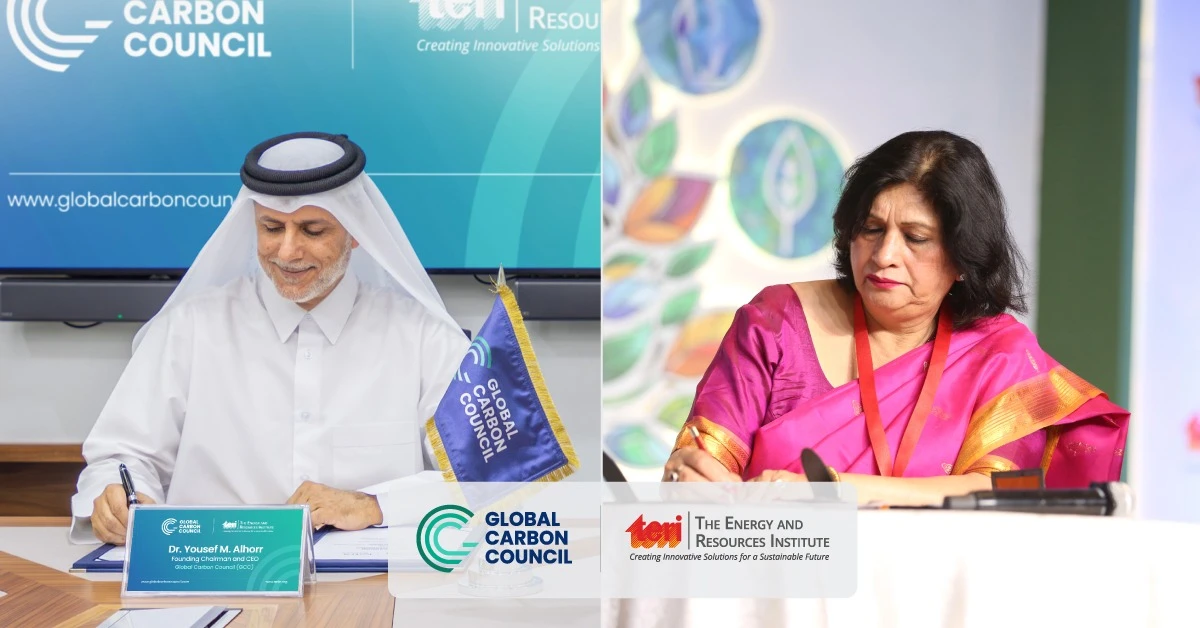
India is taking a significant step toward integrating community-driven climate action with global carbon finance systems following a landmark partnership between the Global Carbon Council (GCC) and The Energy and Resources Institute (TERI).
The two organizations have signed a Memorandum of Understanding (MoU) to establish India’s first digital carbon marketplace focused on household and livelihood-based clean energy projects. The initiative will operate under TERI’s flagship program LaBL 2.0 – Lighting a Billion Livelihoods, which promotes decentralized renewable energy solutions in rural and underserved communities.
By linking distributed renewable energy projects with international carbon markets, the collaboration aims to convert small-scale climate actions—such as solar lighting, clean cooking technologies and renewable-powered livelihood tools—into verified and tradable carbon credits.
The partnership marks an important milestone in expanding access to carbon finance in the Global South and could create a new pathway for community-level climate solutions to participate in global climate markets.
Build the future you deserve. Get started with our top-tier Online courses: ACCA, HESI A2, ATI TEAS 7, HESI EXIT, NCLEX-RN, NCLEX-PN, and Financial Literacy. Let Serrari Ed guide your path to success. Enroll today.
A New Model for Community-Based Climate Finance
Carbon markets have traditionally focused on large industrial or infrastructure-scale projects such as renewable power plants, forest conservation initiatives and industrial emissions reduction programs.
However, millions of smaller climate actions—particularly those occurring at the household and community level—have often remained excluded from carbon finance due to the complexity and cost of measuring emissions reductions.
The GCC–TERI partnership aims to address this challenge by creating a system capable of aggregating thousands of small projects into a unified digital carbon marketplace.
Through this approach, household-level clean energy solutions will be able to generate carbon credits that meet international standards and can be traded on global carbon markets.
The initiative is expected to unlock new financial resources for distributed renewable energy (DRE) technologies, which are increasingly seen as essential for expanding energy access in developing economies.
These technologies include:
- Solar home lighting systems
- Clean cooking solutions
- Solar-powered irrigation systems
- Renewable energy appliances used for small businesses
- Productive-use renewable technologies that support rural livelihoods
By turning everyday clean energy adoption into climate assets, the initiative seeks to create new income streams for rural households and micro-enterprises.
Addressing India’s Energy Access and Livelihood Challenge
India has made remarkable progress in expanding renewable energy in recent years.
In 2025, the country achieved a major milestone when more than 50% of its installed electricity capacity came from non-fossil fuel sources, enabling India to meet its Paris Agreement clean energy target five years ahead of schedule.
Despite this progress, energy access challenges remain significant.
More than 250 million people in India still lack access to clean, reliable and affordable energy solutions, particularly in rural and remote regions.
In these areas, centralized power infrastructure often struggles to reach scattered communities or provide reliable electricity.
Distributed renewable energy systems have therefore become a critical component of India’s energy transition.
These decentralized technologies allow communities to generate power locally, reducing dependence on centralized grids while supporting economic activities such as agriculture, small-scale manufacturing and local enterprises.
However, many distributed energy projects face financial constraints that limit their ability to scale.
The new digital carbon marketplace aims to address this funding gap by linking these projects with international carbon finance mechanisms.
Turning Household Climate Action Into Carbon Assets
A key feature of the GCC–TERI initiative is its ability to transform household-level climate interventions into measurable, verified and tradable carbon credits.
These credits represent reductions in greenhouse gas emissions that occur when households adopt clean energy solutions instead of relying on fossil fuels or traditional biomass.
For example:
- Solar lighting systems reduce reliance on kerosene lamps.
- Clean cooking technologies reduce the use of firewood and charcoal.
- Solar-powered equipment reduces diesel consumption.
Each of these actions contributes to lower carbon emissions.
By aggregating thousands of such interventions across communities, the digital marketplace can generate significant volumes of carbon credits.
These credits can then be sold to companies, institutions or governments seeking to offset emissions as part of their climate strategies.
The resulting carbon finance can be reinvested into community projects, improving the long-term financial sustainability of distributed energy systems.
Building a Digital Carbon Marketplace
At the core of the partnership is the development of a fully digital Energy Access and Carbon Marketplace.
The platform will allow projects under the LaBL 2.0 program to register, monitor and verify emissions reductions through digital technologies.
The system may either operate as an independent platform or be integrated into the ASCENT Energy Access Portal, a digital infrastructure developed by GCC with support from the World Bank.
The digital platform will rely on Digital Monitoring, Reporting and Verification (MRV) systems, which use data analytics and automated monitoring tools to track emissions reductions in real time.
This technology-driven approach offers several advantages.
It helps:
- Lower transaction costs for small-scale projects
- Improve transparency and traceability of carbon credits
- Enhance efficiency in the credit generation process
- Ensure environmental integrity throughout the credit lifecycle
From project registration to credit issuance and retirement, the digital system will maintain transparent records of all activities associated with carbon credit generation.
This helps address one of the most common criticisms of carbon markets—lack of transparency.
One decision can change your entire career. Take that step with our Online courses in ACCA, HESI A2, ATI TEAS 7, HESI EXIT, NCLEX-RN, NCLEX-PN, and Financial Literacy. Join Serrari Ed and start building your brighter future today
Preventing Double Counting and Ensuring Market Integrity
Maintaining credibility in carbon markets is essential for attracting investors and buyers.
The new marketplace will therefore operate within the Global Carbon Council’s digital Carbon Market Infrastructure (CMI).
This system ensures that carbon credits generated through the program are properly tracked, verified and accounted for.
One key feature of the system is its ability to prevent double counting, a risk that occurs when the same emissions reduction is claimed by multiple parties.
The infrastructure tracks carbon credits throughout their lifecycle—from generation to trading and retirement—ensuring that each credit represents a unique emissions reduction.
This approach helps maintain high standards of environmental integrity while building trust among market participants.
Supporting Women-Led Enterprises and Rural Economies
Beyond climate mitigation, the partnership aims to generate social and economic benefits for rural communities.
TERI’s LaBL 2.0 program has long focused on linking energy access with livelihood opportunities.
Through the new carbon marketplace, clean energy projects will be able to support activities such as:
- Women-led micro-enterprises
- Rural small businesses
- Agricultural productivity improvements
- Community infrastructure development
Carbon finance generated through the marketplace could help fund equipment, training programs and entrepreneurial initiatives in rural regions.
Dr. Vibha Dhawan, Director General of TERI, emphasized the importance of linking climate action with development outcomes.
“LaBL 2.0 reflects TERI’s commitment to move beyond energy access toward energy-enabled livelihoods,” Dhawan said.
“Through the collaboration with GCC, we aim to channel carbon finance into women-led enterprises, rural micro-industries and community infrastructure.”
By aligning climate finance with socio-economic development, the program aims to ensure that environmental initiatives also generate tangible benefits for communities.
Capacity Building and National Implementation
Under the agreement, TERI will act as the national focal point for implementing the Energy Access Program in India.
The organization will coordinate with communities, project developers and government stakeholders to deploy distributed renewable energy systems.
In addition, GCC and TERI will jointly conduct capacity-building initiatives aimed at training households, micro-enterprises and project developers.
These programs will help participants understand how carbon markets operate and how they can participate effectively.
Training activities may include:
- Clean energy technology deployment
- Carbon credit generation processes
- Monitoring and reporting procedures
- Financial management for community projects
Such efforts are expected to ensure that local communities are not only beneficiaries but also active participants in the carbon marketplace.
Linking the Program With International Carbon Markets
The initiative also includes engagement with Indian government institutions to explore potential recognition of LaBL 2.0 carbon credits under compliance carbon markets, including mechanisms under Article 6.2 of the Paris Agreement.
Article 6 allows countries to cooperate on emissions reductions by transferring carbon credits between national climate programs.
If recognized under these frameworks, credits generated through the digital marketplace could be used to support national climate targets or traded internationally.
This would significantly expand the potential value of community-based carbon projects.
A Replicable Model for the Global South
While the initiative is initially focused on India, the GCC–TERI partnership is designed to serve as a replicable model for other developing countries.
Many countries across Africa, Asia and Latin America face similar challenges in expanding energy access while meeting climate goals.
Distributed renewable energy systems offer an effective solution for addressing both challenges simultaneously.
By linking these systems with carbon markets through digital platforms, governments and development organizations may be able to unlock new financing sources for community-level climate projects.
Dr. Yousef Alhorr, Founding Chairman of the Global Carbon Council, described the initiative as an important step toward democratizing carbon markets.
“Our partnership with TERI represents a decisive step toward making carbon markets work for people at the grassroots level,” Alhorr said.
“By combining GCC’s digital carbon market infrastructure with TERI’s expertise in energy access, we are creating a scalable model that transforms household clean energy actions into verified climate assets.”
Outlook:
As global efforts to address climate change intensify, the need for inclusive climate finance solutions is becoming increasingly clear.
Many of the most impactful climate actions occur at the community level, yet traditional carbon markets have often struggled to capture these contributions.
The GCC–TERI partnership seeks to close this gap by connecting grassroots climate initiatives with global carbon finance mechanisms.
If successful, the digital carbon marketplace could demonstrate how innovative technology, international collaboration and community participation can reshape the carbon market landscape.
For India, the initiative supports both climate mitigation and rural economic development, aligning with the country’s broader goals of sustainable growth and energy access.
For the global climate community, it offers a promising blueprint for ensuring that carbon markets serve not only corporations but also communities on the frontlines of the energy transition.
Ready to take your career to the next level? Join our Online courses: ACCA, HESI A2, ATI TEAS 7 , HESI EXIT , NCLEX – RN and NCLEX – PN, Financial Literacy!🌟 Dive into a world of opportunities and empower yourself for success. Explore more at Serrari Ed and start your exciting journey today! ✨
Track GDP, Inflation and Central Bank rates for top African markets with Serrari’s comparator tool.
See today’s Treasury bonds and Money market funds movement across financial service providers in Kenya, using Serrari’s comparator tools.
photo source: Google
By: Rosemary Wambui
6th March 2026