










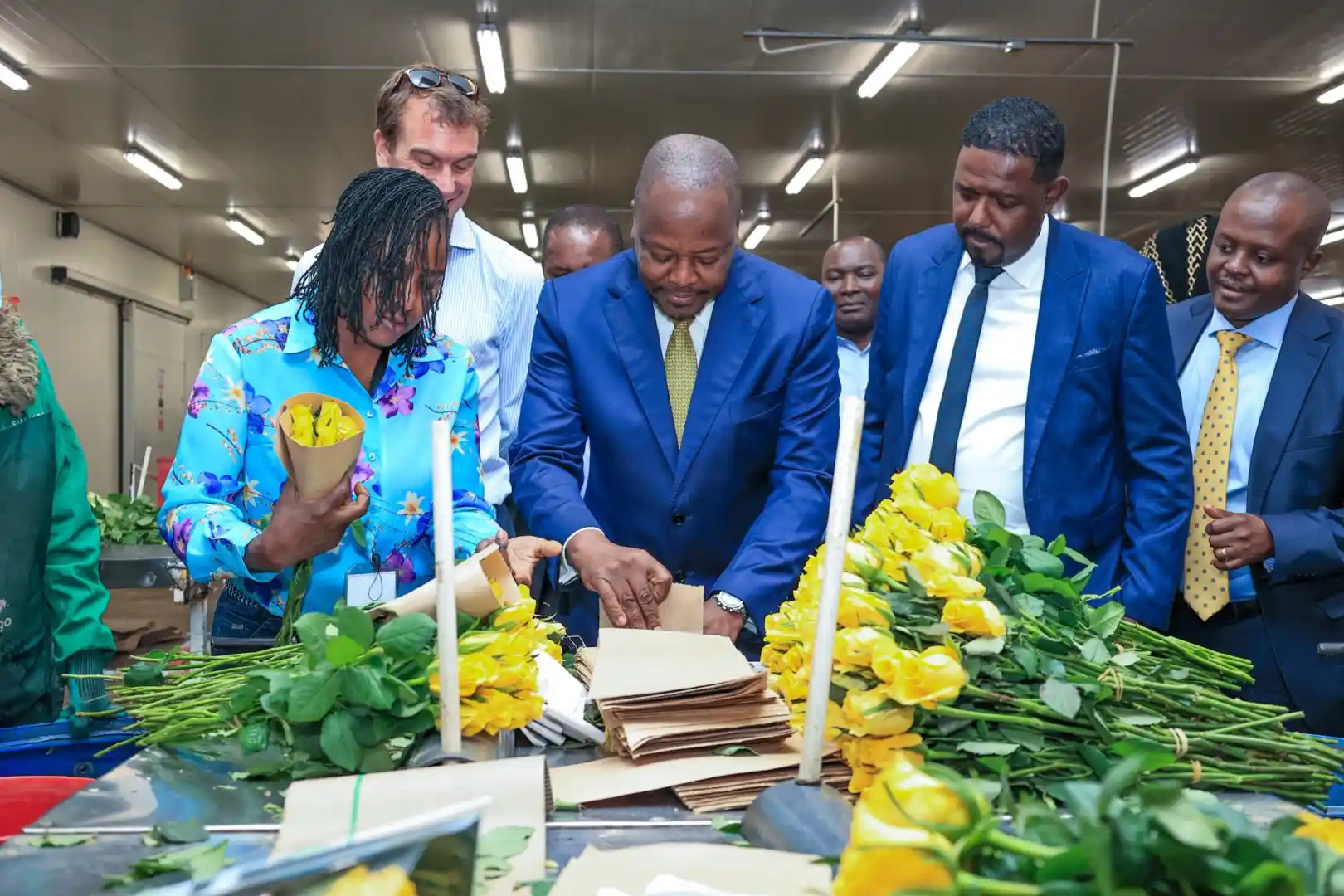
In a strategic move that highlights both the promise and pain points of Kenya’s agricultural export sector, Flamingo Horticulture Kenya is plowing government-owed VAT refunds back into a major expansion of its Naivasha operations—a decision that will create approximately 2,000 new jobs while underscoring the critical importance of resolving the country’s persistent tax refund delays.
The expansion, unveiled at the 2025 Kenya Investment Forum in the United Kingdom with President William Ruto in attendance, marks a deliberate shift toward deepening local value addition rather than simply exporting unprocessed flower stems through European auction houses. For an industry that currently faces over Sh12 billion in delayed VAT refunds, Flamingo’s reinvestment strategy represents a calculated bet that Kenya’s horticulture sector can overcome systemic tax administration challenges to become a more competitive regional agribusiness hub.
The company, a subsidiary of Flamingo Group International, currently exports more than 750 million flower stems annually and directly employs around 12,000 workers while supporting more than 6,000 supply chain partners and out-growers across its 1,630 hectares of farmland in the Naivasha region. The expansion will focus on scaling up production of Fairtrade-accredited bouquets destined primarily for the United Kingdom and European markets, with infrastructure investments including packhouse upgrades and adoption of climate-smart technologies such as water-efficient systems and integrated pest management.
Build the future you deserve. Get started with our top-tier Online courses: ACCA, HESI A2, ATI TEAS 7, HESI EXIT, NCLEX-RN, NCLEX-PN, and Financial Literacy. Let Serrari Ed guide your path to success. Enroll today.
The VAT Refund Dilemma: When Owed Money Becomes Investment Capital
Flamingo’s decision to reinvest VAT refunds rather than await their payment illuminates a fundamental challenge facing Kenya’s export-oriented manufacturers: the yawning gap between the pace at which businesses incur input taxes and the glacial speed at which the Kenya Revenue Authority processes refunds.
Under Kenya’s VAT system, exporters pay 16% VAT on inputs—everything from fertilizers and packaging materials to energy and logistics services—upfront. Because exports are zero-rated for VAT purposes, these companies should receive refunds on the input taxes they’ve paid. The law stipulates that refunds should be processed within 90 days of lodging a claim, with interest payable if payment is delayed beyond two years.
In practice, the system operates far less smoothly. The Kenya Flower Council has repeatedly highlighted that the government owes flower farmers more than Sh12 billion in outstanding VAT refunds—money that represents working capital trapped in bureaucratic processes rather than circulating through farm operations, supplier payments, and expansion investments.
Clement Tulezi, Chief Executive Officer of the Kenya Flower Council, has emphasized the severity of the problem. “The government should prioritise tax refunds to the flower farmers to enable them to meet their financial obligations,” he told Business Daily, noting that delayed refunds have forced some growers to scale down production amid rising operational costs and financial constraints.
The structural causes of Kenya’s VAT refund backlog are multiple and interconnected. A critical mismatch exists between the volume of claims and allocated budget: while refund claims total approximately Sh5 billion per month, only Sh2.5 billion is budgeted for processing, creating an inevitable shortfall. System integration problems compound the challenge—import VAT remains locked within the customs system due to communication failures between KRA’s integrated Customs Management Systems and iTax platforms, preventing businesses from accessing rightful refunds simply because different government databases cannot talk to each other effectively.
Heightened scrutiny aimed at curbing fraudulent claims has also introduced delays for legitimate businesses. While preventing fraud is essential, the KRA’s approach has often failed to adequately distinguish between high-risk and low-risk claims, subjecting compliant exporters to the same intensive verification processes as suspected fraudsters.
Source Packing and Value Addition: The Strategic Shift
Flamingo’s expansion strategy centers on what industry insiders call “source packing”—processing and packaging bouquets in Kenya rather than shipping loose stems to European auction houses for assembly elsewhere. This approach represents a fundamental rethinking of Kenya’s role in the global floriculture value chain.
Historically, a significant portion of Kenya’s flower exports followed a well-worn path: stems cut and cooled at farms around Lake Naivasha, airfreighted to Amsterdam, auctioned at Dutch flower markets, then distributed to retailers across Europe for final packaging. While this model capitalized on Kenya’s natural advantages in year-round flower production, it left substantial value—and jobs—on the table in Europe rather than Kenya.
The shift toward value addition at source through sleeving, labeling, and bouquet production has gained momentum as Kenyan producers recognize that processing locally can improve profit margins while differentiating their products in increasingly competitive global markets. Over 25% of exported flowers are now delivered directly to UK supermarkets and other retailers, bypassing auction houses entirely and creating opportunities for premium pricing through direct relationships.
For Flamingo, this strategic pivot means investing in packhouse infrastructure capable of handling the delicate work of assembling mixed bouquets—combining roses with complementary flowers like gypsophila, hypericum, and summer varieties—while maintaining the cold chain integrity essential for preserving freshness during the journey from Naivasha farms to London grocery shelves.
Agriculture Cabinet Secretary Mutahi Kagwe welcomed Flamingo’s reinvestment, emphasizing that enhancing local processing capability is critical to expanding employment not only at individual companies but across the broader horticulture value chain serving regional and global markets. “The reinvestment reflects growing confidence in the horticulture sector and underscores the importance of local value addition in driving employment and long-term sustainability,” Kagwe said.
Kenya’s Floriculture Sector: A Foreign Exchange Powerhouse Under Pressure
To understand the significance of Flamingo’s expansion, it’s essential to appreciate the scale and importance of Kenya’s floriculture industry to the national economy. The sector has evolved into one of the country’s leading foreign exchange earners, generating revenues forecast to reach Sh110 billion (approximately $851 million) in 2025, with flowers alone contributing the lion’s share of that total.
Kenya has established itself as the dominant exporter of roses to the European Union, commanding a 38% market share and exporting over 100 varieties of flowers to more than 60 countries worldwide. Roses account for 66% of Kenya’s floriculture market value, making them the undisputed revenue generator, though summer flowers now represent a growing 30% of total production with rising demand from Middle Eastern markets.
The industry provides direct employment to over 100,000 people and supports an estimated 2 million livelihoods when factoring in supply chain participants, outgrowers, logistics providers, and ancillary services. This employment impact is concentrated in regions around Lake Naivasha, Mt. Kenya, and the highlands where altitude and climate create ideal growing conditions for premium flowers year-round.
Yet this economic success story faces mounting headwinds. Beyond VAT refund delays, flower farms contend with rising electricity costs—some major operations have been paying up to Sh10 million per month for power, prompting increased adoption of solar energy. The sector also faces what growers characterize as double taxation, where different levies hit the same economic activity multiple times, compressing already thin margins.
Environmental sustainability pressures add another dimension. Water abstraction from Lake Naivasha—the heart of Kenya’s flower industry—has become increasingly contentious, with conservationists warning that potential abstraction caps could limit acreage expansion and force investment in water-saving technologies. Flamingo’s expansion plans acknowledge this reality through commitments to water-efficient irrigation systems and integrated pest management that reduces chemical inputs.
The Climate-Smart Agriculture Imperative
Flamingo’s expansion incorporates what the industry terms “climate-smart technologies”—practices designed to maintain or increase productivity while building resilience to climate variability and reducing greenhouse gas emissions. For a sector heavily dependent on consistent weather patterns and water availability, adaptation has become survival.
Water efficiency stands at the forefront. Modern Kenyan flower farms employ drip irrigation, fertigation systems, and greenhouse ventilation technologies that dramatically reduce water consumption per stem produced compared to traditional methods. Some operations have established wetlands for wastewater treatment, creating closed-loop systems that recycle irrigation water and prevent pollutants from reaching Lake Naivasha.
Integrated pest management represents another critical component. Rather than relying solely on chemical pesticides, progressive farms increasingly deploy beneficial insects and naturally-occurring products to control pests. This approach aligns with tightening European regulations on pesticide residues while reducing input costs and environmental impact.
The emphasis on Fairtrade certification in Flamingo’s expansion plans reflects growing market demand for flowers grown under ethical labor standards with fair wages and safe working conditions. Many European and American buyers specifically seek Fairtrade-certified products, creating premium pricing opportunities for compliant producers.
Additional certifications including GlobalG.A.P., Rainforest Alliance, and the Kenya Flower Council’s Flowers and Ornamental Sustainability Standard (F.O.S.S.) have become de facto market entry requirements for premium segments. Royal FloraHolland, a major European flower marketplace, aims to procure 100% FSI-compliant product by 2026, underscoring how sustainability credentials increasingly determine market access.
One decision can change your entire career. Take that step with our Online courses in ACCA, HESI A2, ATI TEAS 7, HESI EXIT, NCLEX-RN, NCLEX-PN, and Financial Literacy. Join Serrari Ed and start building your brighter future today.
Government Policy Response: Tax Relief on the Horizon?
The persistent challenges facing horticulture exporters have not gone unnoticed by policymakers. Trade and Investment Cabinet Secretary Lee Kinyanjui has repeatedly warned that delayed VAT refunds are undermining investor confidence and constraining expansion plans across manufacturing and export-oriented sectors, pressing the KRA to accelerate outstanding refunds while reviewing VAT rates on exports to sustain competitiveness.
In January 2026, the Ministry of Agriculture announced plans to cut VAT on agricultural inputs to 8% under the 2026 Finance Bill—a reduction from the standard 16% rate that could significantly lower production costs for flower farms. The proposal forms part of a broader package of tax reliefs aimed at stimulating agricultural exports.
Additional measures under consideration include removing excise duties and export promotion taxes on packaging materials used by horticulture exporters, accelerating VAT refunds through offset mechanisms, and granting fully export-oriented operators the same tax treatment as firms operating in Export Processing Zones and Special Economic Zones by eliminating VAT on local purchases.
“These reforms should unlock billions of shillings in capital currently tied up with exporters and accelerate investment in horticulture, tea, coffee and livestock value chains,” the Ministry of Agriculture stated, “strengthening Kenya’s competitiveness and consolidating its position as an African horticultural powerhouse.”
However, implementation remains the critical test. Kenya has seen numerous policy announcements aimed at easing business burdens only to encounter difficulties in execution. The Treasury’s recent decision to block implementation of Finance Act 2025 provisions allowing businesses to offset tax dues using excess payments illustrates the ongoing tensions between revenue collection imperatives and private sector cashflow needs.
The KRA has introduced some positive innovations, including a “green channel status” aimed at easing processing and approval of VAT refunds for taxpayers operating in low-risk sectors. Horticulture, floriculture, fish products, dairy, milling, and pharmaceuticals qualify for this preferential treatment, which promises faster verification and payment processing for compliant businesses.
Yet structural budget constraints persist. As long as monthly refund claims substantially exceed allocated budgets, even well-intentioned administrative improvements will struggle to eliminate backlogs entirely.
The Competitive Landscape: Kenya Versus Regional Rivals
Flamingo’s expansion unfolds against a backdrop of intensifying regional competition for global flower markets. Ethiopia has emerged as a significant challenger, leveraging similar altitude and climate advantages while offering lower labor costs and aggressive government incentives for agricultural exports. Colombian and Ecuadorian producers maintain strong positions in North American markets where proximity confers shipping advantages.
Kenya’s competitive edge rests on several foundations: decades of accumulated expertise in rose cultivation and post-harvest handling; robust air cargo infrastructure connecting Nairobi to major European markets; and established relationships with UK and European retailers built over years of consistent quality and reliability.
The elimination of tariffs for entry into the European Union since July 2024 and the UK’s temporary zero-tariff policy through June 2026 have reduced duty costs by approximately $0.08 per stem, improving margins and competitive positioning. Brexit has actually increased UK demand for Kenyan flowers as direct trade relationships replace EU-mediated arrangements.
However, phytosanitary compliance has become more challenging. The false codling moth (Thaumatotibia leucotreta, FCM), listed as an EU quarantine pest since 2017, has triggered more than 90% of phytosanitary notifications concerning Kenyan roses since 2018. Interceptions of infested consignments have led to increased inspection frequency—from 10% to 25% of lots at points—and stricter EU rules that took effect in April 2025.
Managing these compliance risks requires substantial investment in pest monitoring, treatment protocols, and quality assurance systems. Flamingo’s expansion plans will need to incorporate rigorous phytosanitary controls to maintain market access as European standards continue tightening.
Employment Impact and Social Development
The creation of 2,000 new jobs through Flamingo’s expansion carries particular significance in a country where youth unemployment remains stubbornly high and rural communities struggle with limited economic opportunities. The floriculture sector has historically provided pathways to formal employment for populations with limited educational qualifications, particularly women who comprise a majority of flower farm workers.
Jobs in modern flower farms offer relative stability compared to subsistence agriculture or informal sector work. Many larger operations provide housing, healthcare services, and childcare facilities for workers—benefits rare in Kenya’s agricultural sector. Fairtrade certification requirements mandate community development premiums that fund schools, health clinics, and water projects in surrounding areas.
The 6,000 supply chain partners and outgrowers that Flamingo supports represent an additional dimension of economic impact. Outgrower arrangements allow smallholder farmers to participate in export markets through guaranteed purchase agreements, technical support, and access to inputs they could not otherwise afford. This model has proven effective at raising rural incomes while diversifying revenue sources for farming households.
Combined with the 1,400 positions created by Flamingo’s earlier $7 billion HBM advanced packaging facility announcement, the company’s total expansion will support approximately 3,000 new jobs—a meaningful contribution to Kenya’s employment landscape, particularly in the economically vital Naivasha region.
The Broader Implications: Can Kenya’s Export Sector Scale?
Flamingo’s reinvestment of VAT refunds to fund expansion raises a fundamental question about Kenya’s industrial development trajectory: can the country create conditions where export-oriented manufacturers not only survive but thrive and scale?
The answer hinges critically on resolving systemic policy challenges that extend well beyond VAT refunds. Electricity costs that drive flower farms toward expensive solar installations; logistics bottlenecks that threaten the cold chain integrity essential for perishable exports; regulatory unpredictability that complicates long-term investment planning; and infrastructure deficits in roads, ports, and digital connectivity all constrain the sector’s growth potential.
Yet the fundamentals remain compelling. Kenya’s equatorial position delivers year-round production seasons that temperate competitors cannot match. Proximity to European markets via overnight flights provides time-to-market advantages over South American producers. A large, youthful labor force offers demographic dividends if skills development and job creation can keep pace.
President Ruto’s attendance at the UK investment forum where Flamingo unveiled expansion plans signals high-level government recognition of horticulture’s strategic importance. Whether this translates into sustained policy reforms—particularly accelerated VAT refunds, reduced input taxation, and streamlined trade logistics—will determine if Flamingo’s bet represents an isolated example of corporate resilience or the leading edge of sector-wide transformation.
Agriculture Cabinet Secretary Kagwe framed the challenge in terms of choice: “Enhancing local processing ability is critical to expanding jobs not only at Flamingo itself but across the broader horticulture value chain that serves both regional and global markets.” The alternative—continuing to export unprocessed products for value addition elsewhere—leaves Kenya perpetually positioned as a raw material supplier rather than a knowledge-intensive producer capturing premium margins.
Looking Ahead: The Promise and Peril of Reinvestment
Flamingo Horticulture’s decision to reinvest government-owed VAT refunds into expanding Naivasha operations embodies both the promise and peril of Kenya’s export-led growth strategy. The promise: a globally competitive horticulture sector leveraging natural advantages, accumulated expertise, and improving infrastructure to create thousands of jobs while generating hundreds of billions in foreign exchange. The peril: persistent policy dysfunction that forces even successful exporters to navigate bureaucratic delays, unpredictable taxation, and systemic inefficiencies that competitors in better-governed countries simply do not face.
The expansion will test whether Kenya can deliver the “predictable tax administration” and “robust policy frameworks” that Trade and Investment Cabinet Secretary Kinyanjui and Agriculture Cabinet Secretary Kagwe have identified as essential for private sector-led job creation and economic growth.
For the 12,000 existing Flamingo workers, 6,000 supply chain partners, and 2,000 prospective new employees, the stakes are deeply personal. These are not abstract policy debates but questions of livelihoods, household incomes, and community development in regions where formal employment opportunities remain scarce.
More broadly, Flamingo’s reinvestment strategy offers a template—and a challenge—for Kenya’s industrial ambitions. The template: demonstrating that even amid policy imperfections, strategic private sector investments can drive value addition, employment creation, and competitive positioning in global markets. The challenge: forcing recognition that without resolving structural impediments like VAT refund delays, Kenya risks squandering natural advantages and accumulated capabilities that could otherwise propel broad-based development.
As export markets evolve and competition intensifies from Ethiopia, Colombia, Ecuador, and other rivals, the window for capitalizing on Kenya’s floriculture leadership may prove finite. Flamingo’s 2,000-job expansion, powered by reinvested government refunds, stands as both an expression of confidence in Kenya’s potential and an urgent reminder of the reforms still needed to fully realize it.
Ready to take your career to the next level? Join our Online courses: ACCA, HESI A2, ATI TEAS 7 , HESI EXIT , NCLEX – RN and NCLEX – PN, Financial Literacy!🌟 Dive into a world of opportunities and empower yourself for success. Explore more at Serrari Ed and start your exciting journey today! ✨
Track GDP, Inflation and Central Bank rates for top African markets with Serrari’s comparator tool.
See today’s Treasury bonds and Money market funds movement across financial service providers in Kenya, using Serrari’s comparator tools.
photo source: Google
By: Montel Kamau
Serrari Financial Analyst
28th January, 2026
Article, Financial and News Disclaimer
The Value of a Financial Advisor
While this article offers valuable insights, it is essential to recognize that personal finance can be highly complex and unique to each individual. A financial advisor provides professional expertise and personalized guidance to help you make well-informed decisions tailored to your specific circumstances and goals.
Beyond offering knowledge, a financial advisor serves as a trusted partner to help you stay disciplined, avoid common pitfalls, and remain focused on your long-term objectives. Their perspective and experience can complement your own efforts, enhancing your financial well-being and ensuring a more confident approach to managing your finances.
Disclaimer: This article is for informational purposes only and does not constitute financial advice. Readers are encouraged to consult a licensed financial advisor to obtain guidance specific to their financial situation.
Article and News Disclaimer
The information provided on www.serrarigroup.com is for general informational purposes only. While we strive to keep the information up to date and accurate, we make no representations or warranties of any kind, express or implied, about the completeness, accuracy, reliability, suitability, or availability with respect to the website or the information, products, services, or related graphics contained on the website for any purpose. Any reliance you place on such information is therefore strictly at your own risk.
www.serrarigroup.com is not responsible for any errors or omissions, or for the results obtained from the use of this information. All information on the website is provided on an as-is basis, with no guarantee of completeness, accuracy, timeliness, or of the results obtained from the use of this information, and without warranty of any kind, express or implied, including but not limited to warranties of performance, merchantability, and fitness for a particular purpose.
In no event will www.serrarigroup.com be liable to you or anyone else for any decision made or action taken in reliance on the information provided on the website or for any consequential, special, or similar damages, even if advised of the possibility of such damages.
The articles, news, and information presented on www.serrarigroup.com reflect the opinions of the respective authors and contributors and do not necessarily represent the views of the website or its management. Any views or opinions expressed are solely those of the individual authors and do not represent the website's views or opinions as a whole.
The content on www.serrarigroup.com may include links to external websites, which are provided for convenience and informational purposes only. We have no control over the nature, content, and availability of those sites. The inclusion of any links does not necessarily imply a recommendation or endorsement of the views expressed within them.
Every effort is made to keep the website up and running smoothly. However, www.serrarigroup.com takes no responsibility for, and will not be liable for, the website being temporarily unavailable due to technical issues beyond our control.
Please note that laws, regulations, and information can change rapidly, and we advise you to conduct further research and seek professional advice when necessary.
By using www.serrarigroup.com, you agree to this disclaimer and its terms. If you do not agree with this disclaimer, please do not use the website.
www.serrarigroup.com, reserves the right to update, modify, or remove any part of this disclaimer without prior notice. It is your responsibility to review this disclaimer periodically for changes.
Serrari Group 2025