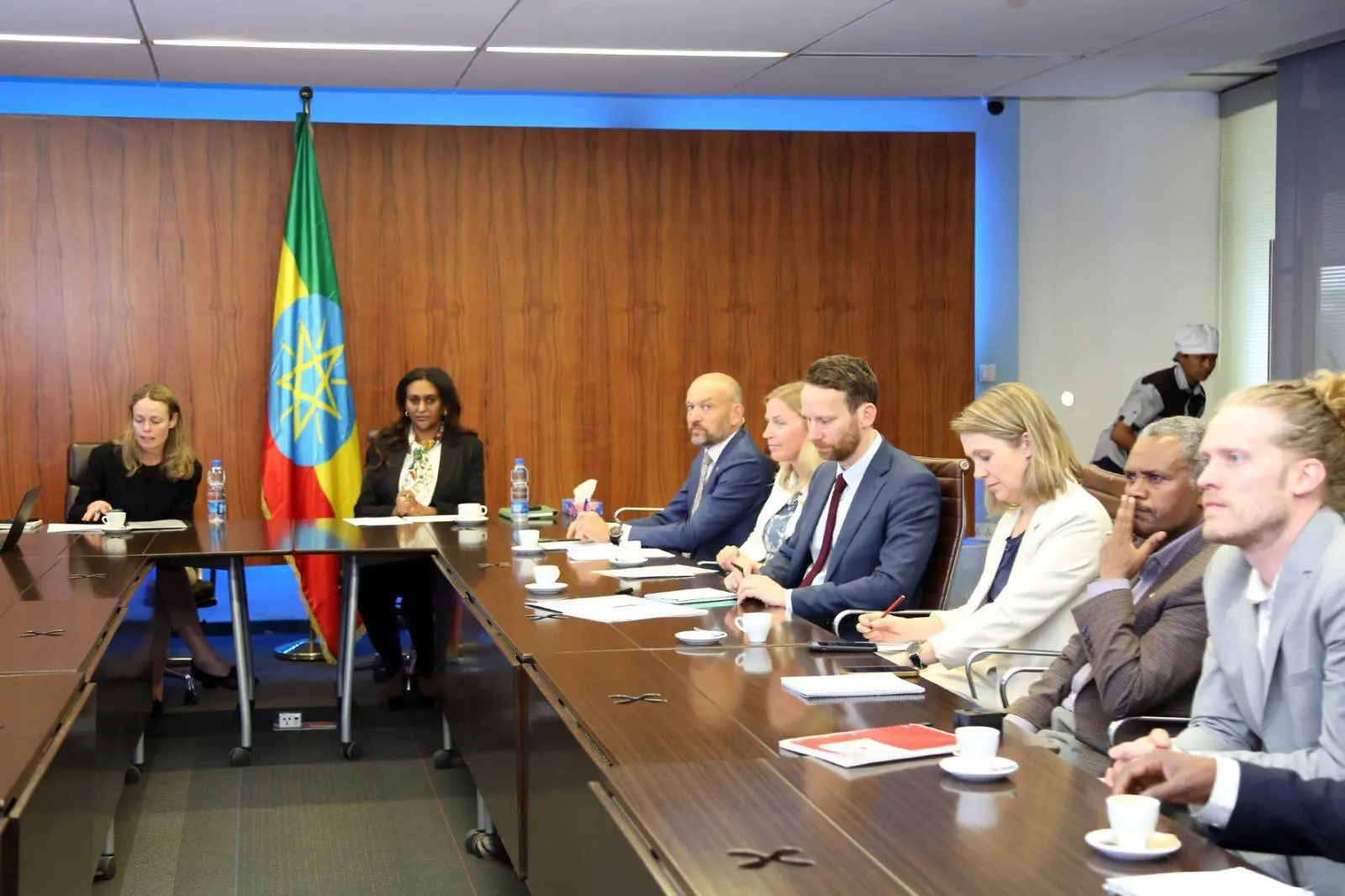
Ethiopia and Norway are strengthening their decade-long collaboration on forest conservation and climate finance as both countries look beyond 2026 toward a more mature, market-linked phase of results-based forest financing. Senior officials from both governments convened in Addis Ababa under the Joint Consultation Group of the Ethiopia–Norway Partnership on Forest and Climate Change to review progress under the 2024 Partnership Agreement and define the future direction of Ethiopia’s REDD+ Investment Program.
The January 2026 meeting was co-chaired by State Minister of Finance Semereta Sewasew and Norway’s Ambassador to Ethiopia, Stian Christensen. Discussions focused on how Ethiopia can continue to translate forest protection into measurable climate, economic, and social outcomes as climate risks intensify across the country. The consultation marks a critical juncture as Ethiopia transitions from capacity-building and readiness activities toward results-based payments that reward verified environmental outcomes rather than inputs.
Build the future you deserve. Get started with our top-tier Online courses: ACCA, HESI A2, ATI TEAS 7, HESI EXIT, NCLEX-RN, NCLEX-PN, and Financial Literacy. Let Serrari Ed guide your path to success. Enroll today.
Climate Pressure and Strategic Forest Management
State Minister Semereta Sewasew underscored that climate change is no longer a distant threat for Ethiopia but an immediate challenge disrupting livelihoods, undermining food security, and weighing on economic stability. The country has experienced recurrent droughts and floods with frightening regularity, placing it at the front line when climate change strikes with full force.
Against this backdrop, forests are increasingly viewed as strategic assets rather than environmental side projects. She emphasized Ethiopia’s commitment to sustainable and participatory forest management, highlighting the role of local communities in forest stewardship. By linking conservation outcomes with economic incentives, the government aims to reduce deforestation pressures, strengthen social cohesion, and protect long-term forest productivity.
This approach is central to ensuring that climate action delivers tangible benefits for rural communities while supporting national development goals. Well-managed forest landscapes help stabilize water systems, reduce land degradation, support agricultural productivity, and improve resilience to climate shocks—functions that are critical for Ethiopia’s predominantly agrarian economy where agriculture accounts for the majority of employment and national income.
Green Legacy Initiative and International Recognition
The consultation recognized the role of Prime Minister Abiy Ahmed’s Green Legacy Initiative in elevating forest restoration to a national priority. Since its launch in 2019, the initiative has seen the planting of over 48 billion seedlings, representing one of the world’s most ambitious reforestation campaigns. This massive effort has multiple benefits, including cooling the land, protecting soil, restoring watersheds, and creating employment opportunities—particularly for women and youth in rural areas.
The initiative has improved coordination across federal, regional, and local institutions and contributed to Ethiopia’s growing international profile on climate and nature issues. Ethiopia’s selection as host of COP32 in 2027 was cited as a reflection of this strengthened leadership and institutional coherence. The African Union Commission’s chairperson emphasized that “under the leadership of Prime Minister Abiy Ahmed, Ethiopia has championed bold climate initiatives—including ambitious reforestation efforts and the Green Legacy programme—that continue to inspire action across Africa and beyond.”
The November 2027 summit scheduled for Addis Ababa is expected to draw over 60,000 delegates, including government officials, civil society representatives, academics, and private sector leaders. Prime Minister Abiy has positioned the conference as an opportunity to demonstrate that Ethiopia is capable and reliable in managing foundational responsibilities, while showcasing Africa not merely as a victim of climate change but as a central architect of solutions.
Norway’s Foundational Role in Building Climate Finance Systems
Norway’s contribution to Ethiopia’s forest and climate architecture was repeatedly highlighted as foundational during the consultation. According to State Minister Semereta, Norway has supported Ethiopia’s REDD+ framework since 2013, going well beyond direct financial support. Norwegian assistance has focused on building institutional, technical, and fiduciary capacity across agencies responsible for forest management, land administration, climate policy, and environmental protection.
In 2011, Norway decided to support Ethiopia’s ambitious Climate Resilient Green Economy (CRGE) Strategy, initially promising to pay $60 million annually to the forestry, energy, and agricultural sectors. In 2013, the two countries signed a REDD+ partnership agreement where Norway pledged to assist Ethiopia’s efforts to reduce climate emissions from deforestation and forest degradation. Norway contributed roughly $10 million in the first phase to assist Ethiopia in getting ready to implement REDD+.
In 2017, Norway and Ethiopia signed an agreement worth $80 million to help Ethiopia implement its REDD+ Investment Plan, with money mainly channeled through Ethiopia’s national climate fund—the CRGE Facility. This long-term engagement has helped Ethiopia strengthen Measurement, Reporting, and Verification (MRV) systems, safeguards, and carbon accounting frameworks—technical infrastructure essential for credible participation in international carbon markets.
A functional MRV system is a prerequisite before countries can claim results-based payments or finance for their REDD+ activities. The system must follow technical guidelines painstakingly set out by the Intergovernmental Panel on Climate Change that cover the national emissions baseline, types of greenhouse gases being measured, and how emission reductions will be verified. As a result of Norwegian capacity-building support, Ethiopia is now approaching a stage where forest protection efforts can be translated into results-oriented climate finance that meets international credibility standards.
Transition to Results-Based Payments
State Minister Semereta noted that carbon credit transactions under the partnership are nearing completion. Their finalization would mark a significant milestone, signaling Ethiopia’s readiness to engage more fully with market-linked forest climate finance and to attract a broader range of public and private capital. After eight years of hard work, Ethiopia joined the roster of countries that have submitted Forest Reference Emissions Levels for REDD+, establishing the baseline against which future emissions reductions can be measured and verified.
Ambassador Stian Christensen reaffirmed Norway’s commitment to supporting Ethiopia’s transition toward results-based payments. He emphasized that this approach rewards verified outcomes rather than inputs, reinforcing accountability while encouraging long-term sustainability. In Norway’s view, Ethiopia’s strong ownership of the program and progress to date provide a solid foundation for scaling this model in the coming years.
Results-based payments represent a fundamental shift from traditional development assistance. Rather than funding activities with uncertain outcomes, donors pay for measurable results—in this case, verified reductions in deforestation and forest degradation or increases in forest carbon stocks. This creates powerful incentives for effective implementation while reducing risks for financing entities that their investments will generate genuine environmental benefits.
The first payout under REDD+ globally was approved for Brazil in February 2019: $96.5 million in return for reducing deforestation in 2014 and 2015, representing 18.8 million tons of carbon not released into the atmosphere. Ethiopia’s progress toward similar results-based financing demonstrates the maturation of its forest governance systems and technical capacities developed through the partnership with Norway.
Third Phase of REDD+ Investment Program
Looking ahead, Dyveke Rogan, Deputy Director of Norway’s International Climate and Forest Initiative, outlined plans for the third phase of Ethiopia’s REDD+ Investment Program covering 2026 to 2030. The next phase will adopt a blended financing model, combining $60 million in Norwegian support, $40 million from Ethiopia’s Green Legacy Initiative Special Fund, and additional carried-over resources—creating a total program budget exceeding $100 million.
The program is expected to deepen participatory forest management, strengthen institutional coordination, accelerate land restoration, and further develop Ethiopia’s capacity for results-oriented forest finance. A key objective is to mobilize greater private sector investment, building on the credibility of Ethiopia’s monitoring and governance systems developed through earlier phases.
The REDD+ Investment Program Phase II, launched in November 2023 with $25 million from the Norwegian government and running until 2026, focused on reducing greenhouse gas emissions, increasing forest cover, and contributing to GDP growth. National REDD+ Coordinator Yitebitu Moges noted that over the past years, Ethiopia achieved significant progress in conservation and restoration, with communities granted responsibility to protect forests in and around their surroundings, supporting over 100,000 people to benefit from forestry restoration activities.
“What we have achieved as an impact is we have reduced deforestation. It has been dramatically reduced in this country, which is a great achievement,” Yitebitu stated. This reduction of deforestation brought revenue to the country through emission reduction carbon trading, creating a demonstration of how forest conservation can generate financial returns while delivering environmental benefits.
Addressing Forest Pressures and Drivers of Deforestation
Ethiopia’s forest sector faces immense pressures that make conservation challenging. A century ago, about one-third of Ethiopia was covered with forests. Today forests cover only about 15% of Ethiopia’s total land area—approximately 170,000 square kilometers—and the remaining forest is under immense pressure requiring urgent action to save what is left.
Small-scale farmers have been clearing forest for decades to grow food for their households, collecting firewood, burning charcoal, and felling trees to construct houses. The country’s massive cattle population—the fifth largest in the world—mainly grazes freely, disturbing forests and hindering regrowth. Infrastructure development including roads, railroads, and dams has gradually reduced forest cover, while coffee plantation expansion, mining operations, and population growth create additional pressures.
Every twelve seconds the Ethiopian population increases by one person, according to UN estimates, meaning that pressure on forests, biodiversity, and water resources is enormous. Ethiopia is Africa’s second most populous country with one of the world’s fastest growing economies, putting immense pressure on natural resources as the rising population raises demand for agricultural expansion, fuelwood, and more cattle requiring land, fodder, and water.
Addressing these drivers requires the multi-sector approach that stakeholders discussed at a National Policy Dialogue in Bishoftu in November 2024. About 25 delegates from sectors including agriculture, energy, water, biodiversity, finance, livestock, mining, and wildlife agreed that stronger enforcement mechanisms for preventing illegal logging and deforestation are essential, along with clearer incentives to promote private sector involvement in sustainable forestry and economic incentives such as tax breaks and subsidies for forest-friendly practices.
One decision can change your entire career. Take that step with our Online courses in ACCA, HESI A2, ATI TEAS 7, HESI EXIT, NCLEX-RN, NCLEX-PN, and Financial Literacy. Join Serrari Ed and start building your brighter future today.
Benefit Sharing and Community Participation
Ensuring forests’ benefits are equitably shared through participatory management is seen as critical to maintaining political and social support for forest protection. Ethiopia has received $40 million from Norway and the Danish Government to support REDD+ implementation for 2022-2026, with this financial support enabling transition to the results-based payment phase from 2026 aided by an already established benefit sharing plan that will see forest communities receive 75% of future payments.
This community-focused benefit sharing mechanism recognizes that local communities are both critical to forest conservation success and among those most affected by conservation restrictions. By ensuring the majority of financial benefits flow directly to communities managing and protecting forests, the system creates sustainable incentives aligned with community interests rather than imposing conservation as an external mandate.
The approach reflects international best practices recognizing that top-down forest conservation programs often fail without genuine community ownership and economic benefits. As one forestry expert noted, control of deforestation and land degradation can be a matter of life and death in Ethiopia, where forests provide essential ecosystem services including water regulation, soil protection, and agricultural support for communities whose livelihoods depend on healthy landscapes.
Private Sector Engagement and Sustainable Forestry Markets
Building on past successes, Ethiopia is working to expand private sector engagement in sustainable forestry. Between 2017 and 2022, a $14.3 million investment from Sweden helped Ethiopia reimagine its forestry sector with striking results: 24,000 hectares of new productive forests, 173,000 hectares of restored land, and over 51,000 jobs created—almost half for women. Farmers gained access to financing, forestry-based businesses flourished, and modern forestry practices replaced outdated seasonal tree-planting efforts.
The “Sustainable Private Sector Engagement in Developing Inclusive Forest Products Markets in Ethiopia” initiative aims to treat forests as an economic engine rather than an environmental casualty, bringing in the private sector, creating green jobs, and putting sustainable forestry at the heart of Ethiopia’s development strategy. For smallholder farmers, sustainable forestry could offer a lifeline by providing access to value-added forestry markets including timber, bamboo, and non-timber forest products.
Dr. Motuma Tolera, Deputy Director General of Ethiopian Forestry Development in the Ministry of Agriculture, emphasized that “this exciting and transformative project aims to develop a sustainable market system for forest products in Ethiopia, building on the solid foundation laid by the two previous forestry projects that have made significant achievements.” Over 653 development agents have received specialized forestry training, equipping them to lead local initiatives and support community-based forest management.
Positioning for Market-Linked Climate Finance
In closing the Joint Consultation Group meeting, State Minister Semereta Sewasew expressed appreciation for Norway’s sustained partnership and innovative financing approach. She emphasized that Norway’s support has been instrumental in positioning Ethiopia as a credible actor in forest climate finance, capable of empowering communities while delivering measurable environmental and economic outcomes.
The partnership illustrates how long-term capacity building, institutional reform, and blended finance can move forest conservation from donor-driven programs toward durable, market-linked climate solutions. As Ethiopia prepares for the next phase of its REDD+ program, the model demonstrates that patient, sustained support focused on building systems and capacities can create foundations for countries to access international climate finance at scale.
Ethiopia’s forest coverage has jumped to over 17% due to massive tree seedling planting carried out through the Green Legacy Initiative, with the country planting 32.5 billion seedlings over five years through this initiative. Forestry is among the four pillars of Ethiopia’s Climate Resilient Green Economy Strategy, which aims to reduce national emissions significantly while supporting economic growth and poverty reduction.
Integration with National Climate Commitments
The REDD+ Investment Program is expected to contribute significantly to Ethiopia’s nationally determined contribution (NDC) targets under the Paris Agreement, supporting emission reductions, increased forest cover, and GDP growth. The program aligns with Ethiopia’s National Long-Term Low Emission Development Strategy, which aims to decouple economic growth from environmental degradation—allowing the country to develop from low to middle-income status without depleting natural resources and while keeping climate gas emissions stable.
Ethiopia has attracted an additional $35 million from Norway under the REDD+ Investment Program, scaling up efforts to protect and restore forests across 35 districts. This expansion demonstrates how successful program implementation can leverage additional resources, creating a virtuous cycle where demonstrated results attract further investment.
The integration of forest conservation with broader development objectives reflects Ethiopia’s recognition that environmental sustainability and economic development are complementary rather than competing priorities. Well-managed forests enhance agricultural productivity through watershed protection and microclimate regulation, reduce disaster risks from flooding and landslides, and provide sustainable livelihoods through forest products—all contributing to poverty reduction and economic resilience.
Challenges and Path Forward
Despite substantial progress, significant challenges remain in achieving Ethiopia’s forest conservation objectives. Measuring avoided deforestation is not straightforward, and the international scientific community continues supporting countries like Ethiopia with data, analysis, and recommendations to help build robust systems and policies. The Center for International Forestry Research has published comprehensive reviews of REDD+ MRV implementation in Ethiopia, providing technical guidance for continued system strengthening.
Questions about benefit sharing mechanisms persist. While the policy framework envisions communities receiving 75% of results-based payments, implementation on the ground has yet to fully operationalize this system. As one analyst noted, “it remains to be seen whether the Ethiopian government will pass on the benefits to local communities if and when it starts to receive payments through REDD+,” though stakeholders express hope that communities will receive most benefits as intended.
Regular income from REDD+ carbon sales remains a development goal rather than a current reality, though the finalization of carbon credit transactions mentioned by State Minister Semereta suggests this transition is approaching. Top-down approaches like REDD+ require going through “a complex set of rules and regulations, both global and local, before you see the light,” and their effects take many years to reveal themselves fully.
The third phase of the REDD+ Investment Program (2026-2030) will test whether the institutional foundations, technical systems, and community engagement structures built through Norwegian support can translate into sustained results-based finance at scale. Success will require maintaining strong coordination across government agencies, continued community participation, effective enforcement of forest protection regulations, and development of sustainable economic alternatives to deforestation-driving activities.
Regional and Global Implications
Ethiopia’s REDD+ partnership with Norway offers lessons for other African countries seeking to access climate finance while protecting natural resources. The emphasis on long-term capacity building rather than quick results, the focus on building robust MRV systems meeting international standards, and the commitment to participatory approaches involving local communities provide a model that could be replicated elsewhere.
The selection of Ethiopia to host COP32 in 2027 creates additional opportunities to showcase the country’s forest conservation achievements and to advocate for climate justice and equitable climate finance for climate-vulnerable nations. As Prime Minister Abiy emphasized at the Second Africa Climate Summit, “we are not here to negotiate our survival. We are here to design the world’s next climate economy.”
Ethiopia’s positioning at the forefront of global climate negotiations provides a platform for Africa to influence future climate action and to ensure that African countries are seen not solely as victims of climate change but as central architects of solutions. The Green Legacy Initiative and REDD+ Investment Program demonstrate practical climate action that can inform international negotiations on forest conservation, climate finance mechanisms, and community-based natural resource management.
Conclusion
The deepening partnership between Ethiopia and Norway on forest protection and climate finance represents a maturing relationship moving from readiness and capacity building toward results-based payments and market-linked climate finance. The $100 million-plus blended financing framework for 2026-2030 combines Norwegian support, domestic resources from the Green Legacy Initiative, and carried-forward funds to create a substantial program aimed at deepening participatory forest management, strengthening institutional coordination, and accelerating land restoration.
As carbon credit transactions near finalization and Ethiopia approaches full engagement with international carbon markets, the partnership demonstrates how sustained international support focused on building systems, capacities, and community ownership can position developing countries to access climate finance while delivering genuine environmental and social benefits. The emphasis on results-based payments creates accountability for outcomes while the 75% community benefit-sharing mechanism ensures that those managing and protecting forests receive the majority of financial returns.
With climate change no longer a distant threat but an immediate challenge affecting livelihoods, food security, and economic stability across Ethiopia, the strategic importance of forest conservation has never been clearer. Forests provide critical ecosystem services stabilizing water systems, reducing land degradation, supporting agricultural productivity, and improving climate resilience—functions essential for Ethiopia’s development and the well-being of its rapidly growing population.
As Ethiopia prepares to host COP32 in 2027 and implements the third phase of its REDD+ Investment Program, the country is positioning itself as a credible actor in forest climate finance capable of empowering communities while delivering measurable environmental and economic outcomes. The Ethiopia-Norway partnership illustrates that patient, sustained collaboration focused on building foundations can create pathways for moving forest conservation from donor-driven programs toward durable, market-linked climate solutions that benefit both people and planet.
Ready to take your career to the next level? Join our Online courses: ACCA, HESI A2, ATI TEAS 7 , HESI EXIT , NCLEX – RN and NCLEX – PN, Financial Literacy!🌟 Dive into a world of opportunities and empower yourself for success. Explore more at Serrari Ed and start your exciting journey today! ✨
Track GDP, Inflation and Central Bank rates for top African markets with Serrari’s comparator tool.
See today’s Treasury bonds and Money market funds movement across financial service providers in Kenya, using Serrari’s comparator tools.
photo source: Google
By: Montel Kamau
Serrari Financial Analyst
27th January, 2026