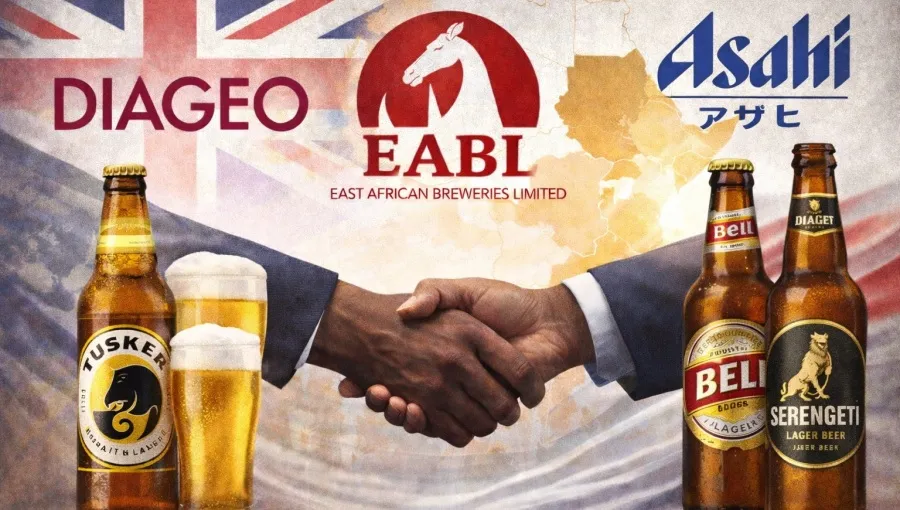
British multinational beverage company Diageo Plc has agreed to sell its entire 65 percent stake in East African Breweries Limited and its controlling interest in spirits maker UDV Kenya to Japanese beverage firm Asahi Group Holdings in a transaction valued at $2.3 billion, net of tax and transaction costs. The landmark deal marks Diageo’s complete exit from the East African market and represents the largest investment by a Japanese brewing company in the African alcoholic beverages sector.
Under the agreement announced on December 17, 2025, Asahi will take full control of Diageo Kenya Limited, the investment vehicle through which the British firm holds its EABL stake. The Japanese group will also acquire Diageo’s 53.68 percent holding in UDV Kenya, with EABL retaining ownership of the remaining stake and management control of the spirits unit. The transaction, subject to regulatory approvals in Kenya, Uganda, and Tanzania, is expected to conclude in the second half of 2026.
Build the future you deserve. Get started with our top-tier Online courses: ACCA, HESI A2, ATI TEAS 7, HESI EXIT, NCLEX-RN, NCLEX-PN, and Financial Literacy. Let Serrari Ed guide your path to success. Enroll today.
Strategic Rationale Behind Diageo’s African Withdrawal
The transaction values EABL at $4.8 billion, representing 3.1 times the company’s current valuation of Sh198.78 billion at the Nairobi Securities Exchange. The deal equates to a multiple of 17 times adjusted EBITDA, signaling strong confidence in EABL’s operational performance and market position. For Diageo, the disposal is expected to reduce leverage by approximately 0.25 times, supporting the company’s commitment to returning its leverage ratio to within the target range of 2.5 to 3.0 times earnings.
Diageo is exiting EABL less than three years after raising its stake to 65 percent from 50.03 percent in a deal valued at Sh22.7 billion completed in 2023. This rapid reversal reflects Diageo’s broader strategic pivot away from African brewing operations as the company faces mounting pressure to strengthen its balance sheet and refocus on core markets where it commands premium brand positioning and higher margins.
“This transaction delivers both significant value for Diageo shareholders and accelerates our commitment to strengthen our balance sheet,” stated Nik Jhangiani, Diageo’s Interim Chief Executive Officer, in the official announcement. “We remain committed to returning the group to well within our target leverage ratio range of 2.5 to 3.0 times through disposals of non-strategic, non-core assets, alongside delivering positive operating leverage and tighter capital discipline.”
The disposal forms part of Diageo’s broader strategy of shedding non-core assets, which has witnessed systematic withdrawal from key African beer markets over the past three years. Industry analysts have characterized the strategy as a deliberate dismantling of Diageo’s African brewing empire, driven by challenging operating environments, foreign exchange volatility, regulatory complexity, and relatively lower profit margins compared to the company’s spirits-focused operations in developed markets.
Systematic Withdrawal From African Brewing Operations
The EABL transaction represents the culmination of Diageo’s methodical retreat from African brewing, following a series of strategic disposals across the continent. In 2024, Diageo sold its majority stake in Guinness Nigeria to Singapore-based Tolaram Group, ending direct control of one of its largest African beer operations. Earlier in January 2025, the company completed the sale of its 80.4 percent stake in Guinness Ghana Breweries Plc to Castel Group for $81 million.
The African divestment strategy extends further back. In 2022, Diageo sold Guinness Cameroon operations to Castel Group and disposed of Meta Abo Brewery in Ethiopia to BGI, which is owned by Castel Group. In April 2025, Diageo sold its entire stake in Seychelles Breweries Limited to Phoenix Beverages, completing its exit from that market.
The pattern of disposals reflects fundamental challenges facing multinational consumer goods companies operating in Africa’s volatile markets. In Nigeria, where Guinness Nigeria swung to a loss of N18.16 billion from a profit of N15.65 billion in 2022, economic headwinds including surging inflation, borrowing costs, and foreign exchange access difficulties forced Diageo’s hand. The naira devalued massively against the dollar, losing more than 50 to 60 percent of its value in the space of a year, making it increasingly difficult for multinational companies to repatriate profits or source imported inputs economically.
Industry analysts had long anticipated the EABL disposal. In May 2025, speculation intensified following Diageo’s announcement of a $500 million cost-cutting program and asset disposal plan, which Chief Financial Officer Nik Jhangiani described as involving “opportunities for substantial changes” that would go “above and beyond the usual smaller brand disposals.” Market observers pointed to EABL, where Diageo held a commanding 65 percent stake worth approximately Sh100 billion, as the most likely candidate for divestment given the company’s systematic exit strategy from African brewing operations.
Brand Licensing Arrangements Ensure Continuity
Despite the complete disposal of its equity stake, Diageo has committed to enter into long-term licensing agreements with EABL to secure the continued production and distribution of Guinness, local spirits, and ready-to-drink brands, as well as the distribution of Diageo’s international spirits portfolio across East African markets. These licensing arrangements represent a strategic compromise that allows Diageo to maintain brand presence and royalty income streams while shedding the capital-intensive brewing operations and associated operational risks.
Local brands such as Tusker beer and Kenya Cane will remain under the ownership of EABL, ensuring continuity for these culturally significant products that command deep market penetration in Kenya. The multinational will renew agreements with EABL to produce certain Diageo spirits including Smirnoff vodka and Captain Morgan rum, as well as ready-to-drink brands such as Smirnoff Ice and Origin. The licensing model allows Diageo to maintain brand visibility and collect royalties without bearing the operational complexities and capital requirements of manufacturing and distribution.
“We are incredibly proud of the achievements of EABL and our colleagues across Kenya, Uganda and Tanzania,” Jhangiani stated. “EABL and Diageo have built the largest beer business in East Africa, a testament to driven people with a passion for the consumers and communities they serve. We are excited to partner with Asahi through the licensing of Diageo brands in the region going forward.”
This licensing approach mirrors Diageo’s strategy in other African markets from which it has withdrawn. When Diageo sold Guinness Cameroon to Castel, it maintained the right to license the Guinness brand to the new owners. Similarly, Diageo licenses Guinness in Mauritius to Phoenix Beverages, part of Mauritian conglomerate IBL Group, demonstrating the company’s preference for asset-light brand management in African markets rather than direct operational control.
Asahi’s Strategic Entry Into African Beverages Market
For Asahi Group Holdings, which is listed on the Tokyo Stock Exchange, the acquisition represents a landmark entry into the African alcoholic beverages sector. The Japanese beverage giant, which produces a diverse range of beer, alcohol, non-alcoholic beverages, and food brands, maintains operations in Japan and East Asia, Europe, and the Asia Pacific region, generating annual revenue of $19 billion.
“This business is a high-quality, leading company in Kenya, Uganda, and Tanzania, with an unrivalled brand portfolio and marketing capabilities, state-of-the-art production facilities and strong market shares,” said Atsushi Katsuki, President and Group Chief Executive Officer of Asahi, in the official statement. “Together with its excellent management team and employees, we will pursue sustainable growth and medium- to long-term enhancement of corporate value, while contributing to the development of the local economies.”
Asahi’s objective is to establish a foundation for medium- to long-term growth by acquiring a leading platform in Kenya and the East African market, which is expected to deliver sustained expansion driven by population growth and economic development. The Japanese group believes the business “offers high growth potential and stable profitability,” characteristics that have become increasingly difficult to find in mature developed markets where Asahi faces intense competition.
Until now, the Peroni brand owner has only exported to Africa. The EABL acquisition marks Asahi’s first purchase of brewing and distribution assets on the continent, signaling the company’s ambition to establish direct operations in what it perceives as a high-growth emerging market. The transaction represents a significant strategic bet on Africa’s demographic dividends and rising middle-class consumption patterns, despite the operational challenges that drove Diageo’s withdrawal.
The Japanese firm is expected to introduce some of its best-known global brands into the Kenyan and East African market following completion of the share purchase. These include Asahi Super Dry, the company’s flagship beer that transformed the modern beer industry in Japan with its crisp, dry taste; Peroni Nastro Azzurro, the premium Italian lager; and Pilsner Urquell, the original Czech pilsner. These premium international brands will complement EABL’s strong portfolio of local favorites, potentially creating opportunities for premiumization and margin expansion.
Asahi expects EABL to remain listed on the Kenya, Uganda, and Tanzania stock exchanges following completion of the transaction, maintaining the company’s public float and providing liquidity for minority shareholders. The Japanese group has indicated it has no plans to acquire the publicly traded shares of EABL beyond the 65 percent shareholding being purchased from Diageo, and will seek exemptions from mandatory takeover offer requirements in the three jurisdictions.
One decision can change your entire career. Take that step with our Online courses in ACCA, HESI A2, ATI TEAS 7, HESI EXIT, NCLEX-RN, NCLEX-PN, and Financial Literacy. Join Serrari Ed and start building your brighter future today.
EABL’s Market Position and Financial Performance
East African Breweries Limited stands as the leading beer producer in East Africa, with long-established and dominant market positions in Kenya, Uganda, and Tanzania. The company commands strong market shares across its three core markets, supported by culturally resonant local brands, extensive distribution networks, and state-of-the-art production facilities. Although operations are concentrated in these three countries, EABL’s products are sold in more than 10 countries across Africa and beyond.
The brand portfolio represents an exceptional combination of local market leaders and international premium spirits. Local jewels include Tusker, Kenya’s iconic beer brand with deep cultural significance; Bell Lager, a leading brand in Uganda; Serengeti Lager in Tanzania; Kenya Cane spirits; and Chrome Vodka. These are complemented by international premium brands including Guinness, Johnnie Walker scotch whisky, Captain Morgan rum, and Smirnoff vodka, providing EABL with positioning across multiple price segments and consumer demographics.
For the fiscal year ended June 30, 2025, EABL reported net sales of $996 million, earnings before interest, tax, depreciation, and amortization of $258 million, and net income of $94 million, with net debt standing at $229 million. These financial metrics demonstrate EABL’s position as one of Diageo’s most profitable African ventures, historically contributing approximately 65 percent of the group’s regional revenue.
The company’s recent performance has been encouraging. EABL’s net profit rose 19.6 percent to Sh8.1 billion in the six months ended December 2024, reflecting strong operational execution and favorable market conditions. EABL shares have gained 8.3 percent year-to-date at the time speculation about the sale intensified, demonstrating investor confidence in the Kenyan market’s resilience despite broader African economic volatility.
EABL’s Managing Director and CEO Jane Karuku expressed optimism about the acquisition’s potential. “This acquisition marks a significant step in accelerating our growth ambition of becoming the most celebrated beverage business in Africa,” Karuku stated. “The new majority owner brings significant knowledge and expertise in innovation and growing successful brands globally that will help us achieve that ambition.”
Regulatory Approval Process and Transaction Timeline
The transaction is subject to regulatory clearances in multiple jurisdictions. Approvals are required from the Capital Markets Authority in Kenya and Uganda, and the Capital Markets and Securities Authority in Tanzania, reflecting EABL’s listing status on exchanges in all three East African countries. Additionally, competition and foreign investment regulatory reviews may be necessary, given the strategic importance of the alcoholic beverages sector and the transaction’s size.
Diageo has indicated that completion is expected in the second half of calendar year 2026, providing sufficient time for comprehensive regulatory review processes across the three jurisdictions. During this interim period, Diageo will continue operating EABL as usual while working alongside Asahi to ensure smooth transition planning and operational continuity.
In a cautionary announcement issued by EABL on December 17, 2025, the company informed shareholders that its board was notified by Diageo on the afternoon of December 16, 2025, of the imminent transaction. The company advised that “the transaction may have a material effect on the price of EABL’s securities,” encouraging shareholders, investors, and the public to exercise caution when trading EABL shares on the Nairobi Securities Exchange, Uganda Securities Exchange, and Dar es Salaam Stock Exchange pending completion of the deal.
EABL noted that public shareholders hold 35 percent of its shares. Diageo has informed the board that Asahi intends to apply to capital markets authorities in Kenya, Uganda, and Tanzania for an exemption from the requirement to make a mandatory takeover offer for those publicly held shares. This approach allows Asahi to acquire control of EABL without triggering costly and time-consuming mandatory offers to minority shareholders, provided regulators grant the requested exemptions.
Implications for East African Beverage Sector
The change in ownership carries significant implications for East Africa’s beverage alcohol industry. Asahi’s entry brings a well-capitalized international operator with deep expertise in brewing operations, brand management, and distribution logistics. The Japanese company’s global network and technical capabilities could accelerate EABL’s innovation efforts, particularly in product development, packaging technology, and sustainability initiatives where Asahi has demonstrated leadership.
The introduction of Asahi’s premium international brands creates both opportunities and competitive dynamics. Brands like Asahi Super Dry and Peroni Nastro Azzurro target different consumer segments than EABL’s existing portfolio, potentially opening new premium price points and attracting consumers seeking imported or craft-style products. However, success will depend on Asahi’s ability to navigate local market preferences, regulatory requirements, and price sensitivity in markets where affordability remains paramount for mass-market beer consumption.
For EABL’s employees and stakeholders, the transaction offers continuity with potential for enhanced resources and global best practices. Asahi has committed to working with “its excellent management team and employees” to pursue sustainable growth, suggesting retention of local leadership and operational autonomy. The company’s emphasis on contributing to local economic development aligns with expectations from governments and communities that foreign investors should generate local employment, skills transfer, and supply chain development.
The deal also validates East Africa’s attractiveness as an investment destination for international consumer goods companies, despite the challenges that prompted Diageo’s exit. Asahi’s willingness to commit $2.3 billion to enter the region sends positive signals about long-term growth prospects driven by favorable demographics, rising incomes, and increasing urbanization. Kenya, Uganda, and Tanzania collectively represent a market of more than 170 million people with relatively young populations and expanding middle classes.
Comparative Analysis: Diageo’s Global Portfolio Realignment
The EABL disposal must be understood within the broader context of Diageo’s global portfolio strategy. While the company has systematically withdrawn from African brewing operations, it has maintained and even strengthened positions in spirits categories where it commands premium brand equity and higher margins. Diageo’s spirits portfolio includes globally recognized brands such as Johnnie Walker scotch whisky, Smirnoff vodka, Captain Morgan rum, Baileys liqueur, Don Julio tequila, and Tanqueray gin.
Africa represented Diageo’s only region where beer was more important in value terms than spirits. The continent also generated the lowest net profit margin across Diageo’s geographic segments. While net margin in North America reached 38 percent, 30 percent in Europe, 14 percent in Asia-Pacific, and 37 percent in Latin America and the Caribbean, Africa achieved only 10 percent net margin. These structural profitability challenges made African brewing operations increasingly difficult to justify within a portfolio where management faces pressure to improve returns and strengthen the balance sheet.
The disposals align with Diageo’s articulated strategy of appropriate and selective disposals of non-core assets to strengthen the balance sheet. Beyond Africa, Diageo’s United Spirits Limited has announced plans to conduct a strategic review of its ownership of the Royal Challengers Bengaluru cricket franchise, representing another potential disposal of non-core assets. The company has also disposed of various spirits brands in recent years, focusing the portfolio on global priority brands with clear growth trajectories.
Industry observers debate whether Diageo might eventually exit beer entirely. While the company retained Guinness Ghana Breweries after the Nigeria and Cameroon disposals, the subsequent sale to Castel in early 2025 suggested continued willingness to shed beer assets. Some analysts believe EABL was always likely to be disposed of as the logical conclusion of the African beer withdrawal, while others viewed it as a prized asset given its profitability and market strength that might be retained long-term. The Asahi transaction has resolved that debate definitively.
Looking Forward: New Chapter Under Asahi Ownership
As EABL prepares for life under Asahi ownership, multiple stakeholders will watch closely how the transition unfolds. For employees, the change brings both uncertainty and opportunity. Japanese companies generally take long-term approaches to acquisitions, often maintaining existing management teams and operational structures while gradually introducing best practices and strategic direction from headquarters. Asahi’s stated commitment to working with EABL’s “excellent management team and employees” suggests continuity rather than disruptive restructuring.
For consumers, changes may be gradual. The licensing arrangements ensure continued availability of Guinness and Diageo’s international spirits brands, while Tusker and other local favorites remain under EABL ownership. The potential introduction of Asahi’s Japanese and European premium brands offers new choices for consumers seeking variety or willing to pay premium prices. Success will depend on Asahi’s ability to adapt these brands to local tastes, price points, and consumption occasions while maintaining the authenticity and quality that define them in their home markets.
For the beverage alcohol industry in East Africa, the transaction represents a significant ownership consolidation. EABL’s dominant market positions mean Asahi will immediately become the largest brewer in the region, a responsibility that comes with expectations for responsible business practices, community investment, and sustainable operations. Competitors including Heineken’s African operations, Anheuser-Busch InBev’s holdings, and local brewers will need to assess how Asahi’s entry affects competitive dynamics, particularly if the Japanese company successfully introduces premium imported brands or invests heavily in marketing and distribution.
For Diageo, the transaction marks the end of an era in East African brewing while opening a new chapter as brand licensor rather than operator. The company maintains exposure to the market through licensing fees and distribution arrangements for its spirits portfolio, but without the capital requirements, operational risks, and margin pressures associated with brewing operations. Whether this asset-light approach proves more profitable long-term than direct ownership will become clear in coming years as licensing revenues are weighed against the equity returns and strategic control surrendered through the disposal.
The regulatory approval process will provide the first test of whether stakeholders across East Africa embrace Asahi’s entry. Governments will weigh the benefits of Japanese investment and technical expertise against concerns about foreign control of strategically important beverage production capacity. Consumer protection regulators may scrutinize whether the transaction affects prices or product quality. Competition authorities will assess market concentration implications, though Diageo’s exit and Asahi’s entry represents ownership change rather than consolidation that reduces the number of market participants.
Ultimately, the $2.3 billion transaction represents a pivotal moment for East Africa’s beverage sector. It demonstrates the region’s ability to attract substantial foreign investment from respected global companies while highlighting the operational challenges that drove a major multinational’s withdrawal. As Asahi takes the reins of East Africa’s brewing leader, the company’s success or struggles will influence perceptions of the region as an investment destination and shape the strategies of other international beverage companies assessing African market opportunities. The coming years will reveal whether Asahi’s long-term approach and operational expertise can navigate the complexities that proved insurmountable for Diageo’s regional brewing ambitions.
Ready to take your career to the next level? Join our Online courses: ACCA, HESI A2, ATI TEAS 7 , HESI EXIT , NCLEX – RN and NCLEX – PN, Financial Literacy!🌟 Dive into a world of opportunities and empower yourself for success. Explore more at Serrari Ed and start your exciting journey today! ✨
Track GDP, Inflation and Central Bank rates for top African markets with Serrari’s comparator tool.
See today’s Treasury bonds and Money market funds movement across financial service providers in Kenya, using Serrari’s comparator tools.
photo source: Google
By: Montel Kamau
Serrari Financial Analyst
18th December, 2025