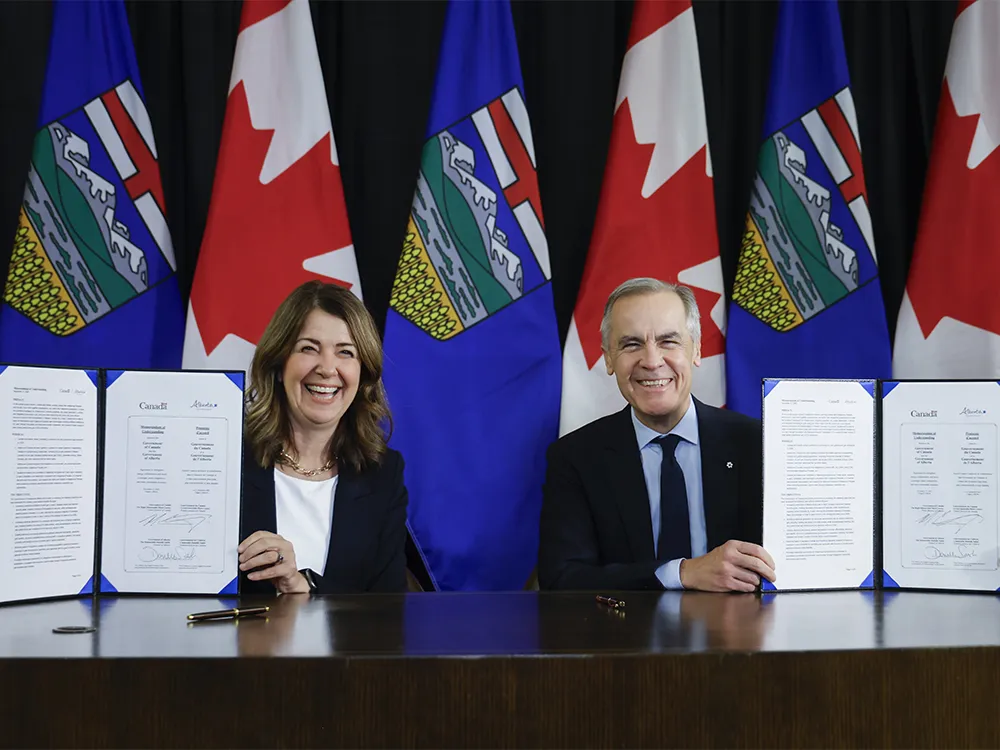
Prime Minister Mark Carney signed a landmark memorandum of understanding with Alberta Premier Danielle Smith on Thursday that fundamentally reshapes Canada’s approach to energy development and climate policy, scrapping several signature environmental regulations implemented under his predecessor Justin Trudeau in exchange for commitments to strengthen industrial carbon pricing and advance what would be the world’s largest carbon capture project.
The agreement, announced at a signing ceremony in Calgary, clears the path for construction of a new oil pipeline to British Columbia’s northwest coast capable of transporting one million barrels per day of Alberta bitumen to Asian markets. In exchange, the federal government will suspend the Clean Electricity Regulations in Alberta, abandon the proposed oil and gas sector emissions cap, and commit to adjusting the Oil Tanker Moratorium Act to facilitate crude exports.
The deal represents a dramatic pivot in Canada’s climate strategy just eight months after Carney assumed office, prioritizing economic diversification away from dependence on U.S. markets while attempting to maintain credibility on emissions reduction commitments. However, the agreement triggered immediate controversy, with Environment Minister Steven Guilbeault resigning from cabinet hours after the announcement, citing irreconcilable differences with the government’s direction on climate policy.
Build the future you deserve. Get started with our top-tier Online courses: ACCA, HESI A2, ATI TEAS 7, HESI EXIT, NCLEX-RN, NCLEX-PN, and Financial Literacy. Let Serrari Ed guide your path to success. Enroll today.
Economic Context Driving the Policy Shift
Carney’s willingness to roll back climate regulations stems from urgent economic pressures facing Canada’s energy sector and broader economy. The Prime Minister is counting on energy production to help the Canadian economy weather uncertainty from U.S. President Donald Trump’s tariff threats, and is seeking to diversify from the U.S. market which currently absorbs 90 percent of Canada’s oil exports.
Speaking at an industry event in Calgary, Carney warned that U.S. tariffs and resulting uncertainty will wipe $50 billion from Canada’s economy—the equivalent of $1,300 for every Canadian—stressing the need to build projects that can spur growth and reduce American reliance. The Prime Minister has repeatedly pledged to make Canada an “energy superpower,” a vision that requires new export infrastructure to access premium Asian markets.
The agreement turns the page on more than a decade of acrimony between Alberta and Ottawa that intensified under Trudeau’s government. Premier Smith has consistently accused the federal government of implementing policies that strangle Alberta’s energy sector, threatening national unity and constitutional challenges if her demands were not met. Thursday’s deal gives Alberta nearly its entire wish list while extracting commitments that Carney argues will advance Canada’s climate objectives through different mechanisms.
Core Elements of the Memorandum of Understanding
At the heart of the agreement lies a complex trade: federal regulatory concessions in exchange for Alberta’s commitment to strengthen carbon pricing and advance carbon capture technology. The MOU commits both governments to working toward construction of one or more private-sector financed pipelines, with Indigenous co-ownership and economic benefits, capable of transporting at least one million barrels per day of “low emission Alberta bitumen” with routes prioritizing increased export access to Asian markets.
Alberta has committed to present its pipeline proposal to the Major Projects Office by July 1, 2026. Critically, the agreement stipulates that no pipeline can proceed without simultaneous construction of the Pathways Alliance carbon capture, utilization, and storage project, designed to capture emissions from Canada’s oil sands and make Alberta oil “among the lowest carbon intensity produced barrels of oil in the world,” according to the MOU text.
On the regulatory rollback side, Ottawa will suspend the Clean Electricity Regulations in Alberta and will not implement the oil and gas sector emissions cap that Trudeau’s government had been developing. Reuters first reported in September that Carney’s government was in discussions with Smith on a potential deal to eliminate the emissions cap, a policy that Alberta has vigorously opposed as unconstitutional federal overreach.
In exchange, Alberta will strengthen its Technology Innovation and Emissions Reduction (TIER) industrial carbon pricing system, ramping it up to a minimum effective credit price of $130 per tonne. The federal government had previously demanded that price rise to $170 per tonne by 2030, making the compromise a significant concession from Ottawa’s original position. However, at $130 per tonne, the industrial carbon price would still represent a substantial increase from the current $95 per tonne.
The Pathways Alliance Carbon Capture Project
Central to Carney’s argument that the deal advances climate objectives is the Pathways Alliance carbon capture project, which the Prime Minister has dubbed “Pathways Plus” when combined with new pipeline infrastructure. The $16.5 billion plan involves capturing carbon dioxide from more than 20 oil sands facilities in northern Alberta and transporting it through 400 kilometers of pipeline to a terminal in the Cold Lake area, where it will be injected into deep underground geological formations for permanent storage.
The Pathways Alliance consortium comprises Canada’s largest oil sands producers—Suncor Energy, Canadian Natural Resources, Cenovus Energy, Imperial Oil, MEG Energy, and ConocoPhillips Canada—which collectively represent 95 percent of oil sands production. According to project proponents, the carbon capture network could reduce emissions by approximately 12 million tonnes per year by 2030, expanding to 62 million tonnes per year by 2050 if fully developed.
However, environmental groups have sharply criticized the economics and climate efficacy of the project. Environmental Defence characterized it as “a pathway to another wasteful industry handout,” noting that the federal government offers carbon capture tax credits covering up to 50 percent of construction costs, while Alberta provides an additional 12 percent tax credit—meaning governments would fund more than 60 percent of the project despite the oil companies’ massive profitability.
Critics also point out that capturing 12 million tonnes annually by 2030 represents only about 5-6 percent of the oil and gas sector’s total emissions, which were estimated at 212 million tonnes of CO2 in 2024. Moreover, if the carbon capture project enables increased oil production through a new pipeline—as the MOU explicitly envisions—total emissions could actually rise compared to the status quo, undermining the climate rationale for the entire arrangement.
The Pathways Alliance has faced scrutiny for spending hundreds of thousands of dollars on advertising campaigns promoting their carbon capture plans while making minimal actual investments in construction. In June 2024, as federal anti-greenwashing legislation was about to take effect, the consortium removed all content from their website regarding the benefits of their proposed carbon capture system, raising questions about the credibility of their environmental claims.
Oil Tanker Ban and Indigenous Opposition
Among the most contentious elements of the agreement is the commitment to modify the Oil Tanker Moratorium Act, legislation that has protected British Columbia’s north coast from large oil tanker traffic since 2019. The Act prohibits tankers carrying more than 12,500 metric tonnes of crude oil from stopping, loading, or unloading at ports along the northern coast of British Columbia, from the northern tip of Vancouver Island to the Alaska border.
The tanker ban, which became law under Trudeau, has deep historical roots. Efforts to protect BC’s northern coast from oil tanker traffic date back more than 50 years to concerns about Alaska pipeline proposals and the catastrophic environmental and economic consequences that a major spill could have for the ecologically sensitive region. The moratorium protects the waters of Dixon Entrance, Hecate Strait, and Queen Charlotte Sound—areas critical to Indigenous communities, commercial fishing, and tourism.
British Columbia Premier David Eby, who opposes a new pipeline through his province, said on Wednesday the tanker ban legislation should stay in place. Eby warned that repealing the ban would risk upsetting the “fragile consensus” in British Columbia over resource development. The MOU commits Alberta to “collaborate with B.C.” on the pipeline, but does not require provincial consent, raising questions about whether Ottawa would approve construction over BC’s objections.
Indigenous opposition has been even more categorical. A coalition of Coastal First Nations in British Columbia announced this week that they will not allow oil tankers on the northwest coast and that the pipeline project “will never happen.” The president of Coastal First Nations stated unequivocally that an oil pipeline to the province’s north coast is a non-starter, reflecting decades of Indigenous leadership in protecting these waters.
The MOU states that the federal government will “collaborate with B.C. to ensure British Columbians share substantial economic benefits” and commits both governments to consulting and “where appropriate” accommodating Indigenous peoples and rights. However, critics note that the pipeline plan was developed and announced without meaningful consultation with either BC First Nations or the provincial government, undermining claims of collaborative federalism.
Political Fallout: Guilbeault’s Dramatic Resignation
The immediate political cost of Carney’s Alberta deal became apparent Thursday afternoon when Steven Guilbeault announced his resignation from cabinet in a three-page statement expressing “profound disagreement” with the memorandum of understanding. Guilbeault, who served as Environment and Climate Change Minister under Trudeau from 2021 to 2025, had been one of the Liberal government’s most prominent environmental voices for more than six years.
“When I entered politics, it was because I had a deep conviction that I could make a difference in fighting climate change and protecting our environment,” Guilbeault wrote in his resignation statement. “Over the past few months, several elements of the climate action plan I worked on as minister of the environment have been, or are about to be, dismantled.”
Guilbeault specifically criticized the decision to exempt Alberta from Clean Electricity Regulations “in exchange for stricter industrial carbon pricing rules” and the Pathways Alliance carbon capture project as “a serious mistake.” He also objected to the environmental impacts of the new pipeline, the absence of consultation with BC First Nations and the provincial government, and the prospect of lifting the tanker ban.
The resignation represents a significant blow to Carney’s attempt to maintain environmental credibility while pursuing energy expansion. Guilbeault had endorsed Carney during the Liberal leadership race in January, calling him the right person to build a strong economy while fighting climate change. That Guilbeault—a former Greenpeace activist who once climbed Toronto’s CN Tower to protest Canada’s climate inaction—felt compelled to resign signals deep disquiet within the party’s environmental wing.
Green Party Leader Elizabeth May told reporters that Guilbeault’s departure “dashes the last hope that Mark Carney is going to have a good climate record, ever” and invited the former minister to join her party. May had previously voted to support the Liberal budget after Carney confirmed the government remained committed to meeting Paris Agreement targets.
Alberta Justice Minister Mickey Amery celebrated the resignation in the provincial legislature, saying Thursday was “full of incredibly good news” when he announced Guilbeault’s departure—a reaction that underscores the deep provincial divisions the agreement exposes rather than resolves.
One decision can change your entire career. Take that step with our Online courses in ACCA, HESI A2, ATI TEAS 7, HESI EXIT, NCLEX-RN, NCLEX-PN, and Financial Literacy. Join Serrari Ed and start building your brighter future today.
Industry and Environmental Group Reactions
The oil and gas industry hailed the agreement as a breakthrough that could unlock billions in investment and position Canada as a global energy leader. Canadian Association of Petroleum Producers (CAPP) President and CEO Lisa Baiton said: “CAPP welcomes the memorandum of understanding between the federal and Alberta governments, which reflects an earnest commitment to collaborate and grow Canada’s oil and natural gas industry. The elimination of the emissions cap, changes to the Competition Act, and the commitment to work together on new market access are all significant steps towards unlocking Canada’s vast natural energy resources.”
However, Baiton’s optimism was tempered by industry realism about the challenges ahead. Enbridge CEO Greg Ebel said in a speech last month his company wouldn’t build a “pipeline to nowhere,” citing the industry’s inability to export oil off the BC coast because of the tanker ban. Even with the MOU’s commitment to adjust the Act, significant regulatory, political, and legal hurdles remain before any pipeline could actually be constructed.
Environmental organizations condemned the agreement in stark terms. The Pembina Institute, a clean energy think tank, warned: “With this agreement, the federal government risks doing significant damage to minimum national standards that will have broader impacts on Canada’s climate change efforts.” Sabaa Khan, the foundation’s climate director, said “The federal government can’t claim to respect its climate commitments under international law while underwriting fossil fuel expansion that locks Canada into decades of avoidable emissions.”
Environmental Defence characterized the MOU as “a blow to Canada’s climate ambitions and a gift to the oil industry and Alberta Premier Smith, at the expense of practically everyone else.” Rick Smith, President of the Canadian Climate Institute, said the MOU’s exemption for Alberta on Clean Electricity Regulations could trigger a race to the bottom on climate policy, with other provinces demanding similar carve-outs.
The Industrial Carbon Pricing Gambit
Central to Carney’s defense of the agreement is the argument that strengthening Alberta’s industrial carbon pricing system will deliver greater emissions reductions than the policies being suspended. The Canadian Climate Institute noted in a 2024 report that industrial carbon pricing was expected to deliver the bulk of Canada’s emissions reductions through 2030 and beyond.
However, industrial carbon pricing in Alberta has been undermined by the province’s deliberate attempts to dilute the effective carbon price through generous credit allocations. By forcing Alberta to commit to a minimum effective credit price of $130 per tonne, Carney is betting he can secure more reliable emissions reductions than the emissions cap would have delivered—while avoiding the constitutional battles and national unity crisis that imposing federal regulations over Alberta’s objections would have triggered.
The government’s climate competitiveness strategy, released earlier this month with the federal budget, relies heavily on strengthening the industrial carbon price and plots a course for the price per tonne beyond 2030. Carbon pricing systems work by capping maximum allowable emissions and allowing companies that come in under the cap to generate credits they can sell to companies that exceed it. The credits are meant to make emissions reduction investments more cost-effective than simply buying credits, but that means the credit price matters enormously.
Critics question whether an agreement with Alberta can be trusted, given the province’s history of undermining carbon pricing mechanisms. Saskatchewan ended its industrial carbon price altogether in April, and Alberta has consistently pushed back against federal climate policies. The MOU commits the parties to conclude an agreement on industrial carbon pricing by April 1, 2026, but implementation details remain unclear and enforcement mechanisms uncertain.
The Trans Mountain Context
The new pipeline proposal comes against the backdrop of the recently completed Trans Mountain pipeline expansion. The Trans Mountain pipeline from Alberta to the British Columbia coast tripled its capacity last year with a $34 billion expansion, making it currently the only option to ship Canadian oil directly to Asian markets. The federally-owned pipeline represented a massive public investment in export infrastructure.
The MOU envisions the new pipeline as being in addition to Trans Mountain, with expansion potential of 300,000 to 400,000 barrels per day destined for Asian markets. However, unlike Trans Mountain, which the federal government ultimately purchased and built after private sector proponents abandoned the project due to regulatory challenges and opposition, the new pipeline must be “private sector constructed and financed” according to the agreement.
Carney jokingly asked during his Calgary Chamber of Commerce speech that if there were any pipeline proponents in the room, “please” come see him afterwards—acknowledging that no private company has yet committed to building a new pipeline. Pipeline companies and the Alberta government have repeatedly said that removing federal regulatory obstacles was merely the first step; actual construction decisions would depend on economic viability, Indigenous support, regulatory certainty, and market access.
Federal Designation as “National Interest” Project
To expedite approvals, Ottawa is prepared to designate the pipeline as a project of “national interest” under the Building Canada Act, which Carney’s government passed in June. This designation triggers special powers that could exempt the pipeline—and possibly associated tankers—from provisions of the Fisheries Act, the Species At Risk Act, and the Impact Assessment Act.
The national interest designation would enable an expedited review process through the Major Projects Office, potentially compressing timelines that have historically stretched to years or even decades. However, the designation cannot override constitutional requirements for Indigenous consultation, provincial jurisdiction over natural resources, or international treaty obligations.
The Canadian Chamber of Commerce called for all provinces to pull “in the same direction,” arguing that current geopolitical shifts require “unprecedented levels of federal-provincial collaboration.” However, BC’s opposition and Indigenous resistance suggest that cooperative federalism may be more aspirational than operational on this file.
Climate Commitments and Contradictions
Both Carney and Smith emphasized their continued commitment to achieving net-zero greenhouse gas emissions by 2050, despite the agreement’s potential to significantly increase oil production and associated emissions. The MOU includes a requirement for a 75 percent cut in methane emissions over the next decade, which would represent substantial progress on a potent greenhouse gas if actually implemented.
The agreement also commits both governments to constructing thousands of megawatts of AI computing power with a “large portion” dedicated to sovereign cloud infrastructure, and building large transmission interties with British Columbia and Saskatchewan to improve western provinces’ ability to supply low-carbon power to oil, LNG, critical minerals, agricultural, data centers, and carbon capture industries.
However, Carbon Tracker International poured cold water on Canada’s high-cost oil production prospects in a world moving toward decarbonization. “In a world of declining demand, prices are likely to be lower than many forecasts suggest,” Carbon Tracker found. “Canada’s high-cost production is particularly at risk, with provincial governments facing substantially lower tax-take in the coming decades, placing pressure on budgets.”
The analysis projects that Alberta’s revenues from oil and gas would fall from $153 billion to $23 billion—a staggering 85 percent drop—if governments can limit global warming to 2 degrees Celsius as required under the Paris Agreement. The report also found that “CCUS investments risk delivering poor value for money and absorbing public subsidies that could be better used elsewhere.”
Political Landscape and Conservative Response
Conservative Leader Pierre Poilievre dismissed the MOU as inadequate, saying a pipeline would be approved by a Conservative federal government immediately without the conditions and commitments Carney has required. “Prime Minister Mark Carney stands in the way of it all, with federal rules and taxes that drive production out, paycheques down and cost of living up,” Poilievre said, attempting to outflank Carney from the pro-development side.
Liberal MPs have been privately expressing concerns about how to defend the deal to environmentally-conscious constituents, particularly in urban ridings where climate action is a top priority. Some MPs questioned whether the government’s claims to maintain climate ambition while enabling major fossil fuel expansion can be credibly sustained.
However, other Liberal MPs defended Carney’s approach as pragmatic given economic pressures from Trump’s trade policies. Liberal MP Rob Oliphant said Carney is “walking a difficult but fine line” between resource extraction and safeguarding Indigenous and provincial rights, arguing that decisive action is necessary to respond to U.S. economic aggression.
What Comes Next
The agreement sets in motion a complex sequence of negotiations, consultations, and regulatory processes that will determine whether the vision outlined in the MOU can actually be implemented. Key milestones include:
- Conclusion of an industrial carbon pricing agreement by April 1, 2026
- Alberta’s submission of a pipeline proposal to the Major Projects Office by July 1, 2026
- Negotiations with British Columbia on economic benefits and project approvals
- Indigenous consultation and accommodation processes
- Trilateral negotiations with Pathways Alliance on carbon capture project implementation with “effective enforcement mechanisms”
- Federal legislative amendments to adjust the Oil Tanker Moratorium Act
Each of these steps faces significant political, legal, and practical obstacles. BC Premier Eby has made clear his opposition to pipeline expansion. Indigenous nations have stated categorically that tanker traffic will not be permitted. Environmental groups are preparing legal challenges. And private sector companies remain uncommitted to financing a project that faces enormous risks.
Carney called the MOU “a first step” and emphasized that much work remains. Premier Smith said she was pleased the federal government heard Alberta’s concerns and expressed optimism about finding a path forward together. “In order for Alberta to find its way to prosperity within a united Canada, we need the federal government to partner with us instead of fighting against us,” Smith said.
Whether that partnership can deliver actual infrastructure, meaningful emissions reductions, and sustained prosperity—or whether it represents an expensive gamble that satisfies neither economic nor environmental objectives—will become clear in the months and years ahead. What is already clear is that Carney has fundamentally reoriented Canadian energy and climate policy, accepting short-term political costs, including the loss of his most prominent environmental minister, in pursuit of an economic and strategic vision that remains deeply contested.
Catch Up With Our Other Headlines
28th November, 2025
Meta reportedly negotiating multi-billion dollar deal for Google chips,The Information reports
European Commission Plans Financial Relief for Baltic States Hit by Russia Sanctions
DR Congo Commits $500,000 to UN Partnership for Economic Transformation and Capacity Building
Ghana Central Bank Cuts Interest Rate to 18 Percent as Inflation Falls to Four-Year Low
Mars Wrigley Commits Sh4.3 Billion to Kenya Manufacturing Expansion, Shifts Production from Poland
Ready to take your career to the next level? Join our Online courses: ACCA, HESI A2, ATI TEAS 7 , HESI EXIT , NCLEX – RN and NCLEX – PN, Financial Literacy!🌟 Dive into a world of opportunities and empower yourself for success. Explore more at Serrari Ed and start your exciting journey today! ✨
Track GDP, Inflation and Central Bank rates for top African markets with Serrari’s comparator tool.
See today’s Treasury bonds and Money market funds movement across financial service providers in Kenya, using Serrari’s comparator tools.
Photo source: Google
By: Montel Kamau
Serrari Financial Analyst
28th November, 2025