










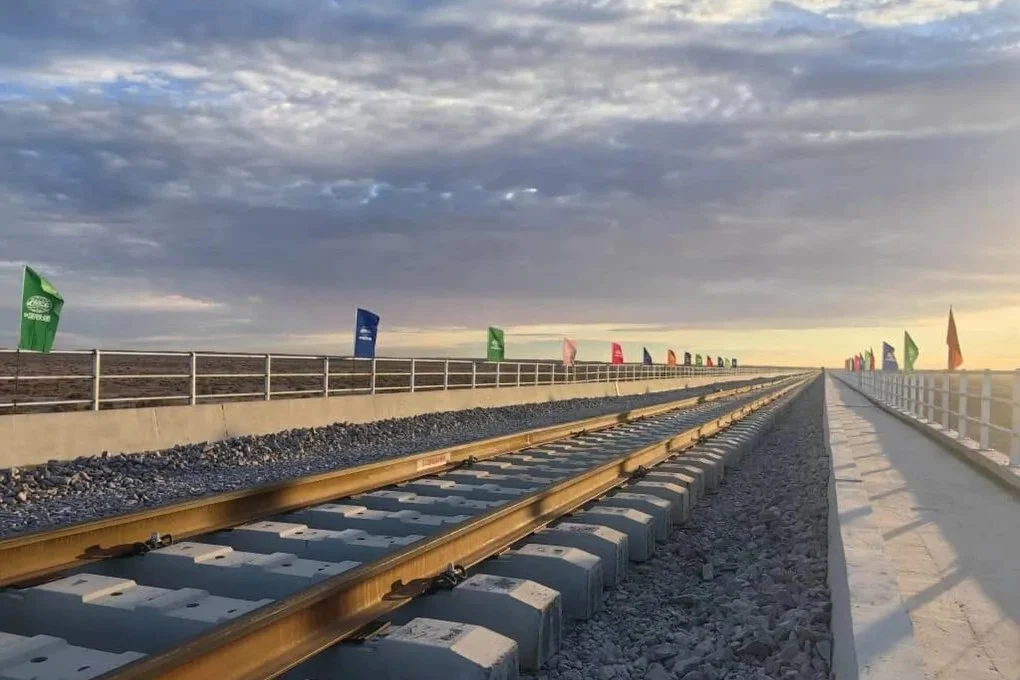
Algeria has achieved a transformative infrastructure milestone with the completion of track installation on the Western Mining Railway, Africa’s first heavy-haul desert railway specifically designed to unlock the vast mineral wealth buried beneath the Sahara. The 575-kilometer line, jointly constructed by China Railway Construction Corporation (CRCC) and Algerian state-owned partners, represents the largest single infrastructure project built by a Chinese firm in Algeria and highlights deepening economic cooperation under Beijing’s Belt and Road Initiative.
The railway, which construction crews completed three months ahead of schedule despite working for more than 24 months under harsh desert conditions including extreme heat, shifting sands, and limited water supplies, is designed to handle 32.5-tonne axle-load freight trains and passenger services of up to 160 kilometers per hour. The project marks a critical step in Algeria’s strategy to diversify its economy beyond oil and gas, which currently contribute 19 percent of GDP and 93 percent of export earnings, by developing its dormant mining sector.
Build the future you deserve. Get started with our top-tier Online courses: ACCA, HESI A2, ATI TEAS 7, HESI EXIT, NCLEX-RN, NCLEX-PN, and Financial Literacy. Let Serrari Ed guide your path to success. Enroll today.
Gara Djebilet: Unlocking One of the World’s Largest Iron Ore Deposits
At the heart of the Western Mining Railway project lies the Gara Djebilet iron ore mine in Tindouf Province, discovered by French geologist Pierre Gevin in 1952 but left unexploited for decades due to logistical challenges and technical complexities. The deposit, one of the world’s largest iron ore reserves with an estimated 3.5 billion tonnes, has remained largely untapped despite its immense potential to transform Algeria’s industrial landscape.
The mine is expected to begin full-scale exploitation in the first quarter of 2026, according to announcements made during a Council of Ministers meeting presided over by President Abdelmadjid Tebboune. Initial production will start with 2 to 3 million tonnes per year through 2025, before ramping up dramatically to 40 to 50 million tonnes annually from 2026, with projections to eventually reach 50 million tonnes per year by 2040.
The scale of production contemplated represents a fundamental transformation of Algeria’s economic structure. Financial projections indicate that Gara Djebilet is expected to generate close to $3.9 billion in revenue from the export of 30 million tonnes of ore, with net national profit estimated at nearly $1 billion after deductions and partner shares. Equally significant, Algeria anticipates slashing its annual bill for imported mining raw materials by $2 billion once domestic needs are fully met by local production.
The technical challenge that has delayed exploitation for decades centers on the ore’s high phosphorus content. Gara Djebilet is characterized by phosphorus levels that require expensive and complex dephosphorization operations to obtain quality ore suitable for steel production. However, Algerian laboratories achieved a dephosphorization rate of around 0.1 percent by 2015, demonstrating technical feasibility, and the government has since established partnerships with Chinese, American, and Indian companies to develop advanced phosphorus-reduction technologies.
Engineering Achievement: Conquering the Sahara’s Challenges
The Western Mining Railway’s completion represents a remarkable engineering achievement accomplished under some of the world’s most challenging construction conditions. The project required innovative solutions to overcome extreme temperatures as high as 50 degrees Celsius (122 Fahrenheit), sandstorms, shifting sand dunes, and acute water shortages that made conventional construction methods impractical.
A centerpiece of the railway’s engineering prowess is the 6-kilometer PK330 Bridge in Tindouf Province, Africa’s longest heavy-haul railway bridge, which crosses shifting sand and gravel terrain in one of the most technically complex sections of the entire line. Chinese and Algerian construction teams completed the bridge’s main structure in just one year, adapting their operations by carrying out nighttime concrete pours and using refrigeration units and ice-cooling techniques to ensure quality and safety despite daytime temperatures that would compromise concrete curing.
The railway project introduced advanced technology previously unseen in Algeria. CRCC adapted technical solutions to Algerian standards, designing prestressed concrete sleepers capable of supporting the heavy freight loads while accommodating high-speed passenger service. The project also introduced Algeria’s first CPG500 track-laying machine and its first automated rail-welding line, significantly increasing construction efficiency and setting new standards for railway development across the continent.
To ensure track stability and durability in desert conditions, the project team incorporated innovative design features, such as waist-thinning in the sleeper’s middle section and sand-drainage holes. These improved sleeper designs were approved by Algeria’s National Railway Investment Design and Implementation Supervision Administration and will be used throughout the entire line. The innovation demonstrates how Chinese engineering expertise, adapted to local regulatory frameworks and environmental conditions, can produce solutions suitable for Africa’s unique infrastructure challenges.
A new railway sleeper plant built by CRCC began operations in Hassi Hebbi, Tindouf Province, representing the first time that Chinese-designed railway sleeper solutions have been used in a local heavy-duty railway project. The plant’s establishment ensures local production capacity to support ongoing maintenance and potential future expansion of Algeria’s rail network.
Strategic Economic Impact and Industrial Development
The Western Mining Railway’s economic significance extends far beyond its function as a transportation corridor. The project is central to Algeria’s comprehensive strategy to develop a vertically integrated mining and steel industry that can compete globally while reducing dependence on hydrocarbon exports that have defined the national economy for decades.
President Abdelmadjid Tebboune has identified the Gara Djebilet project as a cornerstone of Algeria’s industrial sovereignty and economic diversification strategy. The project includes construction of 10 iron ore processing units, with six located in Tindouf dedicated to primary ore treatment. These units, with individual capacities of 4, 8, 10, and 18 million tonnes annually, will collectively enable the mine to reach its full production capacity.
A mining and processing plant managed by Sonarem, Algeria’s national mining industrial group, is set to launch by the end of April 2026, with capacity to process up to 4 million tonnes of ore per year using advanced crushing technologies and achieving a recovery rate of over 85 percent. A second unit, developed through partnership between Feraal (a Sonarem subsidiary) and the Tosyali steel group, will produce high-grade iron concentrate (63 percent) while reducing phosphorus content, a crucial step before producing semi-finished materials for Tosyali’s steel complex in Oran.
The first rail shipments are expected to reach the Tosyali steel complex, 40 kilometers east of the city of Oran, in the first quarter of 2026. This integration of mining, processing, and steel production within a domestic supply chain represents Algeria’s ambition to capture value at multiple stages of the industrial process rather than simply exporting raw materials.
Beyond the direct economic value, the project has created more than 7,000 local jobs and trained over 1,000 skilled workers, earning praise from senior Algerian officials for its economic and social impact. This employment creation and skills transfer addresses critical developmental needs in Algeria’s underdeveloped southwestern regions while building technical capacity that will support future industrial expansion.
The railway’s capacity to transport bulk commodities efficiently is expected to reduce logistics costs dramatically, making Algerian iron ore competitive in international markets despite the technical complexities of dephosphorization. Current transport costs in Algeria represent approximately 35 percent of total costs, but the government’s strategy aims to reduce this to 15 percent through improved infrastructure connectivity.
One decision can change your entire career. Take that step with our Online courses in ACCA, HESI A2, ATI TEAS 7, HESI EXIT, NCLEX-RN, NCLEX-PN, and Financial Literacy. Join Serrari Ed and start building your brighter future today.
Belt and Road Initiative: Deepening China-Algeria Cooperation
The Western Mining Railway exemplifies the deepening economic relationship between China and Algeria within the framework of the Belt and Road Initiative (BRI). The project represents the largest undertaken by Chinese companies in Algeria in recent years and demonstrates how BRI facilitates large-scale infrastructure development in countries seeking to modernize their economies.
China Railway Construction Corporation brings extensive experience working in challenging environments across Africa. CRCC spent 16 years building parts of Algeria’s 1,216-kilometer East-West Highway, giving the company deep familiarity with Saharan construction conditions, local regulatory environments, and partnerships with Algerian state enterprises. This accumulated expertise enabled CRCC to deliver the Western Mining Railway ahead of schedule despite formidable technical and environmental obstacles.
The bilateral relationship between Algeria and China dates back to the Afro-Asian Bandung Conference in 1955 and was strengthened by China’s establishment of diplomatic relations with Algeria’s pre-independence provisional government in 1958. However, trade and investment relations accelerated in earnest during the 2000s during the era of high hydrocarbon rents, evolving into a relationship characterized by significant economic complementarity.
China has been Algeria’s major economic partner in recent years, with bilateral trade volume reaching approximately $9 billion annually. Chinese investments and contracts in Algeria totaled $23.85 billion between 2005 and 2020, with flagship projects including the East-West Highway and the Grand Mosque of Algiers demonstrating the breadth of Chinese involvement in Algeria’s development.
About 1,000 Chinese companies now operate in Algeria, assisted by the Algerian government’s waiving of the 51/49 ownership rule for non-strategic sectors. This regulatory reform has facilitated increased Chinese investment across multiple sectors including construction, telecommunications, energy, and manufacturing.
For China, Algeria offers multiple strategic advantages. First, Algeria occupies an important geostrategic location with proximity to Europe and access to the Sahel and Sub-Saharan regions, making it an important hub for the Belt and Road Initiative. Second, Algeria’s political influence in the Mediterranean and African Union provides diplomatic benefits for Chinese engagement across the continent. Third, Algeria has become a key arena for government contracts and commercial opportunities for Chinese companies seeking to expand their international presence.
Most critically for the Western Mining Railway, Algeria’s mining plans provide new opportunities for China’s perpetual pursuit of raw materials to feed its massive industrial economy. The Algerian iron ore will come online amid China’s efforts to diversify iron ore supply sources and reduce dependence on Australian producers that currently dominate global markets.
Technical Innovation and Technology Transfer
Beyond physical infrastructure, the Western Mining Railway project facilitates significant technology transfer that enhances Algeria’s domestic technical capabilities. Adapting to the local Eurocode system, CRCC has conducted extensive research on critical rail technologies, blending Chinese heavy-haul railway track bed standards and domestic rail materials into the project’s technical framework. This integration of international standards with proven Chinese engineering solutions creates a comprehensive heavy-haul railway track technology system adaptable to other African contexts.
The introduction of Algeria’s first CPG500 track-laying machine and automated rail-welding technology represents a quantum leap in domestic railway construction capabilities. These technologies, now demonstrated and proven in Algerian conditions, can be deployed on future railway projects across the country, reducing dependence on foreign contractors and accelerating infrastructure development timelines.
Mustapha Dahou, governor of Tindouf Province, expressed gratitude for the joint efforts of CRCC and local partners, noting the substantial resources invested and satisfying progress achieved. The project’s collaborative approach, combining Chinese technical expertise with Algerian workforce participation, ensures knowledge transfer that will benefit Algeria’s development trajectory long after the railway’s completion.
The railway sleeper plant in Tindouf exemplifies this technology transfer dynamic. By establishing local production facilities using Chinese designs adapted to Algerian conditions and operated by trained Algerian workers, the project builds sustainable industrial capacity rather than simple construction then departure.
Regional Connectivity and Continental Implications
The Western Mining Railway’s significance transcends Algeria’s borders, with potential implications for regional trade networks and continental infrastructure development. The 575-kilometer line will connect mines, industrial zones, and ports in southwestern Algeria, facilitating the movement of raw materials, processed goods, and eventually passengers across previously isolated regions.
Algeria’s strategic location, with Mediterranean ports providing access to European markets and Trans-Saharan Highway connections to Sub-Saharan Africa, positions the country as a potential logistics hub for continental trade. The Western Mining Railway, by linking the remote Sahara regions with coastal infrastructure, creates new possibilities for economic integration across North Africa and potentially beyond.
Experts say the railway could become a model for future heavy-haul desert railways in Africa, combining innovation, speed, and international cooperation to address the continent’s notorious infrastructure deficits. Many African countries possess substantial mineral resources located far from ports and markets, making transportation costs prohibitive and limiting economic development. The Algerian model demonstrates how targeted infrastructure investment can unlock dormant resource wealth.
The railway’s completion also supports broader continental integration initiatives. Algeria is a member of the African Continental Free Trade Agreement (AfCFTA), which came into effect in January 2021 and largely abolished intra-African trade tariffs. Improved infrastructure connectivity, exemplified by projects like the Western Mining Railway, is essential for AfCFTA to achieve its potential by reducing the physical barriers that have historically limited continental trade flows.
Challenges and Future Prospects
Despite the technical and logistical achievements represented by the railway’s completion, significant challenges remain in translating infrastructure into sustained economic transformation. The success of the Gara Djebilet project depends on multiple factors beyond transportation, including effective ore processing to address phosphorus content, market conditions for iron ore globally, environmental management in sensitive desert ecosystems, and continued investment in downstream processing and steel production.
The phosphorus challenge, while addressed through technological solutions, adds costs to Algerian iron ore that competitors with lower-phosphorus deposits do not face. Algerian officials have established joint working groups with companies from the United States, India, and China to develop modern methods of reducing phosphorus content and accelerating local technical trials, recognizing that continued innovation is essential for commercial viability.
Global iron ore markets present both opportunities and risks. Current market conditions, with prices fluctuating based on Chinese demand, global economic growth, and competitor supply, will significantly influence the project’s financial returns. Algeria’s entry into iron ore production occurs amid increasing global supply, including major new production from Guinea’s Simandou project, potentially creating oversupply pressures.
Environmental considerations in the fragile Saharan ecosystem require careful management. Large-scale mining and railway operations consume substantial water resources in an arid region where water scarcity already constrains development. Dust, noise, and ecological disruption from mining and transportation activities need mitigation to prevent long-term environmental degradation.
The project’s financial sustainability depends on maintaining production volumes sufficient to justify the infrastructure investment while generating returns for the Algerian government and private partners. Initial conservative production targets of 2-3 million tonnes annually, while prudent for operational startup, generate revenues insufficient to fully capitalize on the railway’s 20-million-tonne capacity. The planned ramp-up to 40-50 million tonnes by 2026 is ambitious and will test operational, technical, and market capabilities.
Broader Context: Africa’s Infrastructure Needs and China’s Role
The Western Mining Railway fits within a broader pattern of Chinese infrastructure investment across Africa addressing the continent’s massive infrastructure deficit. As of 2020, only 43 percent of Africans had access to electricity, 48 percent had access to paved roads, and 6 percent of agricultural land was irrigated, illustrating the scale of infrastructure needs that constrain economic development.
China has emerged as Africa’s largest funder of infrastructure projects, financially backing around a fifth of all projects and constructing a third of them. Chinese engagement extends across transport infrastructure (railways, highways, ports), energy generation (hydropower, coal, solar), telecommunications, water supply and sanitation, and industrial facilities. This comprehensive approach addresses multiple dimensions of infrastructure need simultaneously.
Critics of Chinese infrastructure investments in Africa raise concerns about debt sustainability, environmental standards, labor practices, technology transfer effectiveness, and geopolitical implications of deepening Chinese influence. The Western Mining Railway, given its scale and strategic importance, will serve as a test case for evaluating these concerns.
Supporters emphasize that Chinese investment fills critical gaps that Western donors and multilateral development banks have proven unable or unwilling to address at comparable scale and speed. The pragmatic, results-oriented approach that characterizes Chinese infrastructure projects contrasts with more conditional Western development assistance, making Chinese partnerships attractive for African governments seeking rapid infrastructure development.
Conclusion: A Transformative Project with Continental Implications
The completion of track installation on Algeria’s Western Mining Railway represents far more than a transportation achievement—it embodies a strategic bet on economic transformation through infrastructure-enabled resource development. By connecting the vast Gara Djebilet iron ore deposits with processing facilities and export ports, Algeria aims to build a diversified industrial economy capable of generating wealth beyond hydrocarbon extraction.
The project demonstrates how targeted infrastructure investment, technical expertise transfer, and sustained financial commitment can overcome formidable environmental and logistical obstacles to unlock economic potential. The railway’s ahead-of-schedule completion despite harsh desert conditions validates the engineering approaches and international cooperation model employed.
For China, the project advances multiple strategic objectives: securing access to mineral resources, demonstrating Belt and Road Initiative success stories, deepening economic relationships with strategically positioned partners, and expanding opportunities for Chinese construction and engineering companies in fast-growing markets.
For Africa, the Western Mining Railway offers a potentially replicable model for developing heavy-haul infrastructure in challenging environments to access stranded mineral resources. If the Gara Djebilet project achieves its production and economic targets, it could inspire similar initiatives across the continent where vast mineral wealth remains unexploited due to infrastructure constraints.
The railway’s true significance will be measured not in kilometers of track or tonnes of ore, but in whether it catalyzes sustained industrial development, creates quality employment at scale, generates fiscal resources for broader development priorities, and demonstrates that African countries can leverage international partnerships to achieve economic transformation on their own terms.
As the railway enters commercial service in early 2026 and iron ore shipments begin flowing toward processing facilities and export markets, the world will watch whether Algeria’s ambitious vision of mineral-led diversification succeeds or whether infrastructure alone proves insufficient to overcome the complex technical, commercial, and institutional challenges of building globally competitive industries from scratch in remote desert regions.
Ready to take your career to the next level? Join our Online courses: ACCA, HESI A2, ATI TEAS 7 , HESI EXIT , NCLEX – RN and NCLEX – PN, Financial Literacy!🌟 Dive into a world of opportunities and empower yourself for success. Explore more at Serrari Ed and start your exciting journey today! ✨
Track GDP, Inflation and Central Bank rates for top African markets with Serrari’s comparator tool.
See today’s Treasury bonds and Money market funds movement across financial service providers in Kenya, using Serrari’s comparator tools.
photo source: Google
By: Montel Kamau
Serrari Financial Analyst
5th January, 2026
Article, Financial and News Disclaimer
The Value of a Financial Advisor
While this article offers valuable insights, it is essential to recognize that personal finance can be highly complex and unique to each individual. A financial advisor provides professional expertise and personalized guidance to help you make well-informed decisions tailored to your specific circumstances and goals.
Beyond offering knowledge, a financial advisor serves as a trusted partner to help you stay disciplined, avoid common pitfalls, and remain focused on your long-term objectives. Their perspective and experience can complement your own efforts, enhancing your financial well-being and ensuring a more confident approach to managing your finances.
Disclaimer: This article is for informational purposes only and does not constitute financial advice. Readers are encouraged to consult a licensed financial advisor to obtain guidance specific to their financial situation.
Article and News Disclaimer
The information provided on www.serrarigroup.com is for general informational purposes only. While we strive to keep the information up to date and accurate, we make no representations or warranties of any kind, express or implied, about the completeness, accuracy, reliability, suitability, or availability with respect to the website or the information, products, services, or related graphics contained on the website for any purpose. Any reliance you place on such information is therefore strictly at your own risk.
www.serrarigroup.com is not responsible for any errors or omissions, or for the results obtained from the use of this information. All information on the website is provided on an as-is basis, with no guarantee of completeness, accuracy, timeliness, or of the results obtained from the use of this information, and without warranty of any kind, express or implied, including but not limited to warranties of performance, merchantability, and fitness for a particular purpose.
In no event will www.serrarigroup.com be liable to you or anyone else for any decision made or action taken in reliance on the information provided on the website or for any consequential, special, or similar damages, even if advised of the possibility of such damages.
The articles, news, and information presented on www.serrarigroup.com reflect the opinions of the respective authors and contributors and do not necessarily represent the views of the website or its management. Any views or opinions expressed are solely those of the individual authors and do not represent the website's views or opinions as a whole.
The content on www.serrarigroup.com may include links to external websites, which are provided for convenience and informational purposes only. We have no control over the nature, content, and availability of those sites. The inclusion of any links does not necessarily imply a recommendation or endorsement of the views expressed within them.
Every effort is made to keep the website up and running smoothly. However, www.serrarigroup.com takes no responsibility for, and will not be liable for, the website being temporarily unavailable due to technical issues beyond our control.
Please note that laws, regulations, and information can change rapidly, and we advise you to conduct further research and seek professional advice when necessary.
By using www.serrarigroup.com, you agree to this disclaimer and its terms. If you do not agree with this disclaimer, please do not use the website.
www.serrarigroup.com, reserves the right to update, modify, or remove any part of this disclaimer without prior notice. It is your responsibility to review this disclaimer periodically for changes.
Serrari Group 2025