Zimbabwe has thrown the global lithium supply chain into uncertainty with a sweeping, immediate suspension of all raw mineral and lithium concentrate exports, announced on February 25, 2026. The ban — indefinite in duration and applying even to shipments already in transit — marks the most aggressive step Harare has taken in its years-long push to force international mining companies to process minerals domestically before they leave the country. The decision, framed by the government in terms of national interest and compliance failures, accelerates a previously scheduled deadline by nearly a year and catches an industry mid-cycle in a way that could reshape procurement strategies from Beijing to Berlin.
Mines Minister Polite Kambamura confirmed the ban at a press briefing in Harare, telling reporters that the export suspension was effective immediately and would remain until further notice. The Mines Ministry simultaneously communicated the move in a letter addressed to Zimbabwe’s Chamber of Mines, the representative body of major mining companies operating in the country. “This review is part of a broader effort to curb leakages and enhance efficiency within our systems,” the ministry wrote on February 17, the date the directive was formally issued before its public announcement. The government said it “expects cooperation of the mining industry on this measure which has been taken in the national interest.”
Build the future you deserve. Get started with our top-tier Online courses: ACCA, HESI A2, ATI TEAS 7, HESI EXIT, NCLEX-RN, NCLEX-PN, and Financial Literacy. Let Serrari Ed guide your path to success. Enroll today.
A Sudden Compression of the Timeline
To understand why the mining industry was caught off guard, it is important to understand what Zimbabwe had previously committed to. As recently as 2025, the government’s stated policy was that a ban on lithium concentrate exports would come into effect in January 2027 — a deadline deliberately designed to give mining companies time to invest in domestic beneficiation infrastructure before raw material exports were prohibited. The 2027 horizon was itself an escalation of an earlier policy introduced in December 2022, which banned exports of raw lithium ore while permitting the export of spodumene concentrates — a semi-processed form of the mineral that still requires significant downstream refining before it can be used in battery production.
That staged approach gave way, in June 2025, to the first public signals that Harare was losing patience. A Bloomberg report at the time indicated that Zimbabwean authorities were signalling the ban could be implemented earlier than 2027, potentially as soon as 2026, due to growing dissatisfaction with the pace of investment in domestic processing capacity. Senior officials were quoted expressing frustration that mining companies continued to prioritise concentrate exports while delaying refinery construction. That signal, treated by many in the industry as a warning shot rather than a firm commitment, proved to be a precursor to the February 2026 action.
The immediate and blanket nature of the ban — applying with no grace period, no phase-out timeline, and no exemption for materials already in transit — represents a fundamental departure from how the policy had previously been communicated. According to analysts at Ainvest, the ban’s compressed implementation timeline leaves little room for adjustment, forcing companies to either halt shipments entirely or find ways to quickly pivot to compliant processing models. The government indicated it would engage the industry “in the near future on new expectations and the way forward,” per Kambamura — a statement that leaves the duration of the ban and the compliance pathway deliberately vague.
Africa’s Largest Lithium Reservoir at a Crossroads
Zimbabwe’s decision carries outsized global weight because of the scale of its lithium endowment. The country holds Africa’s largest lithium reserves and has in recent years emerged as one of the world’s most important hard-rock spodumene producers. Its reserves represent approximately 4.4% of global known lithium stores, according to Yahoo Finance, and the country is estimated to have accounted for around 10% of global lithium concentrate supply in recent years.
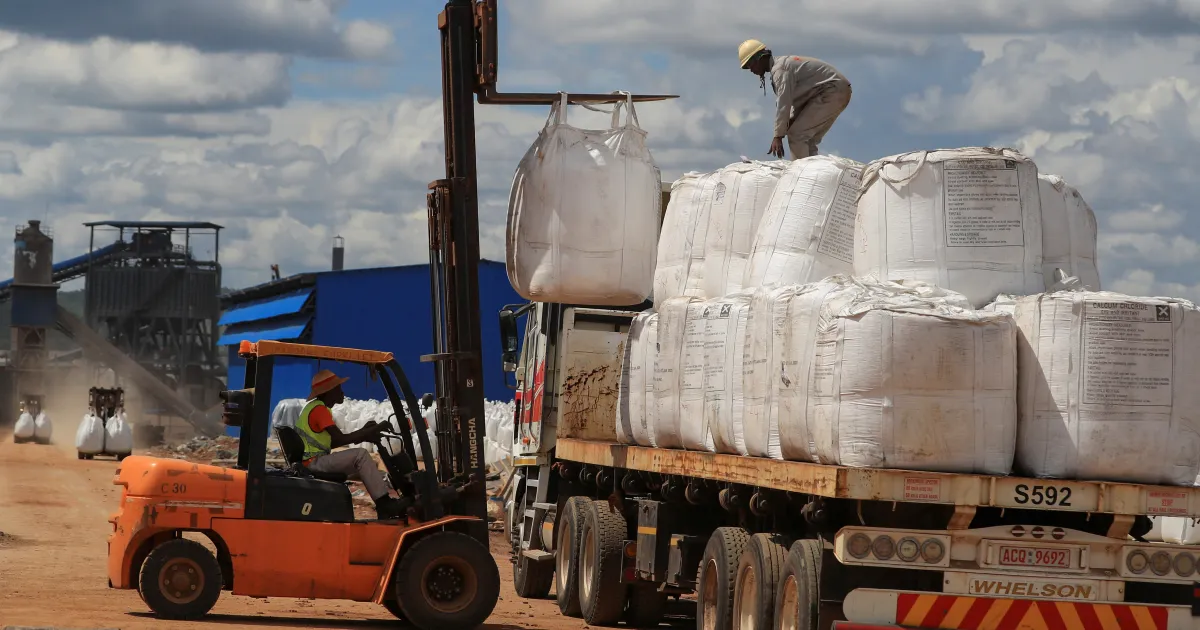
The numbers tell the story of rapid expansion. In the year ended December 2025, Zimbabwe exported 1.128 million metric tons of lithium-bearing spodumene concentrate — an 11% increase from the prior year. In the first half of 2025 alone, 586,197 metric tons of concentrate were exported, a 30% jump compared to the same period in 2024, as miners pushed to maximise shipments ahead of the anticipated ban. The price differential driving that urgency is stark: battery-grade lithium carbonate commands more than $7,000 per ton while raw spodumene concentrate fetches around $570 per ton — a gap that encapsulates exactly why Zimbabwe believes it is ceding enormous economic value by exporting unprocessed material.
The overwhelming majority of this concentrate was shipped to China, which dominates global lithium refining capacity. As Yahoo Finance noted, Zimbabwe “is a major supplier to China, which leads the world in refining the battery metal.” The ban thus directly disrupts a trade flow that has been one of the primary feedstocks for Chinese battery material producers. Mining is Zimbabwe’s second-largest contributor to GDP after manufacturing, and the stakes of getting the beneficiation strategy right are existential for the country’s development trajectory.
Chinese Firms: The Billion-Dollar Bet Now on Hold
The immediate commercial fallout falls most heavily on the Chinese mining companies that have spent over a billion dollars building out Zimbabwe’s spodumene production infrastructure over the past four years, in what was, until this week, a highly productive model of extraction-and-export.
The flagship investor is Zhejiang Huayou Cobalt, which acquired the Arcadia lithium project from Prospect Resources for $422 million in 2022 and subsequently invested a further $300 million in a lithium concentrator plant in Goromonzi — commissioning it in July 2023 with a capacity of 450,000 metric tons per year. More recently, Huayou built a $400 million facility at Prospect Lithium Zimbabwe in Goromonzi specifically designed to process lithium concentrates into lithium sulphate — an intermediate product that can be further refined into battery-grade lithium hydroxide or lithium carbonate. That plant had been targeting production commencement in 2026, meaning it was approaching the moment of becoming operational precisely when the export ban was announced.
Sinomine Resource Group acquired Bikita Minerals — one of Africa’s oldest lithium mines with estimated reserves of 65 million tonnes — for $180 million in January 2022 and subsequently invested $300 million in a spodumene concentrate plant commissioned in July 2023. The company has separately announced plans to invest a further $500 million in a lithium sulphate plant at the Bikita site — a project that, if completed, would place Sinomine squarely within the government’s compliance framework but which remains under construction.
Other significant Chinese investors include Chengxin Lithium Group, which entered the sector in 2021 with a 51% stake in the Sabi Star project and commissioned a lithium concentrator at the mine in May 2023, and Yahua Group, which invested $130 million in the Kamativi lithium project. Collectively, these companies have invested well over $1 billion in Zimbabwe’s mining infrastructure — capital now stranded by an export ban that removes the revenue stream that was supposed to fund the transition to domestic processing.
One decision can change your entire career. Take that step with our Online courses in ACCA, HESI A2, ATI TEAS 7, HESI EXIT, NCLEX-RN, NCLEX-PN, and Financial Literacy. Join Serrari Ed and start building your brighter future today.
The Malpractice Problem: What the Government Is Really Alleging
The official rationale for the immediate ban centres on a specific and documented problem: mineral leakages, malpractices, and revenue losses that have accompanied the export of raw materials. The mines ministry’s February 17 letter to the Chamber of Mines cited “continued malpractices during the exportation of minerals” and framed the ban as a control and compliance measure rather than purely an industrial policy tool.
This framing is not new and is not empty. Researchers at the ISS African Futures programme have documented a long history of smuggling and misdeclaration in Zimbabwe’s mineral sectors — patterns observed across diamonds, gold, chromium, and iron ore, which are similarly dominated by Chinese firms. In 2023, the Centre for Natural Resource Governance reported allegations of 42 trucks of lithium ore per day leaving the Bikita Minerals site, triggering an inter-ministerial audit and a temporary suspension of operations. While such allegations are difficult to verify independently, they reflect a broader governance challenge that state authorities have been grappling with since large-scale lithium mining began in earnest.
The government’s decision to extend the ban beyond lithium to cover all raw minerals — gold ore, platinum group metals, chrome ore, nickel concentrates, and every other category of unprocessed mineral — signals that the malpractice concern is not lithium-specific. This comprehensive scope, according to analyst coverage by Discoveryalert, prevents companies from circumventing regulations by shifting focus between commodity types. It also creates a far more complex operational environment, since multiple mining sectors and their associated export logistics are now simultaneously suspended.
The risk of smuggling intensifying under a total ban is real and acknowledged by analysts. As Ainvest noted, the sector has a documented history of illicit trade practices, and the sudden, total export halt — with no processing pathway yet defined — creates powerful economic incentives for circumvention. With battery-grade lithium chemicals fetching multiples of concentrate prices, the arbitrage opportunity is large enough to motivate significant regulatory risk-taking. The government’s enforcement capacity will be tested immediately.
The Beneficiation Vision: Value Addition as Development Strategy
Beyond the compliance narrative, Zimbabwe’s export ban is the most forceful expression yet of a broader economic philosophy that the government has been building toward for years. The Harare administration views the export of raw and semi-processed minerals as a structural trap — one that keeps the country locked into low-margin commodity dependence while offshore processors capture the majority of the value embedded in Zimbabwe’s natural endowment.
The policy aligns with Zimbabwe’s National Development Strategy (2021–2025), which prioritised beneficiation, local value addition, and stronger linkages between mining and manufacturing. Under this framework, lithium is not merely a mineral to be extracted and sold: it is the feedstock for a domestic battery materials industry that the government hopes will underpin Zimbabwe’s broader industrialisation agenda. The country has set itself the Vision 2030 target of building a $12 billion economy underpinned by its mining sector — an ambition that requires moving up the value chain from raw ore exports to refined chemical products.
The economics of that argument are compelling. The price differential between raw spodumene concentrate and battery-grade lithium hydroxide is substantial even at current suppressed price levels — and the government believes that domestic refining would allow Zimbabwe to capture those value-addition margins rather than surrendering them to Chinese processors. The problem is infrastructure. As Energy Capital Power has reported, Zimbabwe faces a critical power deficit of approximately 700 MW — with peak demand reaching 1,900 MW against available generation of just 1,200 MW. Lithium beneficiation is an energy-intensive process requiring consistent high-capacity electricity supply for roasting, calcination, and chemical processing. Without resolving the power deficit, the government’s beneficiation ambitions face a structural constraint that no export ban can cure by decree.
The 2024 price collapse offered a painful preview of these tensions. When global lithium prices fell dramatically — from peaks exceeding $80,000 per ton in 2022 to approximately $8,450 per ton by mid-2025 — the push for local beneficiation collapsed as mining companies cited infrastructure challenges and policy inconsistency to delay processing investments. Bikita Minerals reduced production and cut jobs during that period. The government’s response then was to adopt a more flexible, case-by-case approach — a concession that the ISS Africa analysis suggests inadvertently exacerbated smuggling and corruption by removing the credible enforcement threat.
Regional Context: Africa’s Broader Resource Nationalism Wave
Zimbabwe’s move does not occur in isolation. Across the continent, resource-rich nations are rethinking the terms on which they allow foreign companies to exploit their mineral wealth, driven by a combination of commodity price optimism, Chinese-investment backlash, and growing awareness of the value embedded in critical minerals for the energy transition.
The Democratic Republic of Congo — the world’s dominant cobalt producer — has maintained export restrictions on unprocessed cobalt as part of its own beneficiation drive. Indonesia set a precedent for the battery metals sector when it banned raw nickel exports in 2020 and then expanded that framework, helping establish a domestic nickel processing industry now central to the global EV supply chain. As Discovery Alert’s analysis noted, the Zimbabwe ban creates a template that other African mineral producers may study closely, particularly given its immediate and comprehensive implementation. The risk of policy contagion — in which other lithium-producing nations in Africa adopt similar frameworks — adds a structural dimension to what might otherwise be treated as a country-specific supply disruption.
For the global battery supply chain, Zimbabwe’s ban injects meaningful uncertainty at a moment when lithium supply-demand dynamics were already in flux. Market analysts have projected 15–25% price increases for lithium concentrates in Q2 2026 as international buyers compete for alternative supply while Zimbabwe’s production exits the market. Australian hard-rock lithium producers — with their regulatory stability and established export infrastructure — are widely seen as the primary beneficiaries of any sustained supply disruption from Zimbabwe.
For the Chinese mining companies that built Zimbabwe’s spodumene industry, the immediate challenge is stark. They face a choice between accelerating the domestic processing investments that the government has long demanded, or watching their Zimbabwean assets become stranded — unable to generate revenue without the export licence that the ban has suspended. The $400 million Huayou sulphate plant and the planned $500 million Sinomine facility are precisely the kind of investments that could eventually satisfy the government’s beneficiation requirements — but they need time, power, and operational certainty that this week’s announcement does not yet provide.
Zimbabwe’s next move — when it engages “the industry in the near future on new expectations and the way forward,” as Kambamura put it — will determine whether the February 25 suspension is remembered as the beginning of a genuine beneficiation era or another episode in the long cycle of policy announcement and reversal that has characterised the country’s mineral governance for years.
Ready to take your career to the next level? Join our Online courses: ACCA, HESI A2, ATI TEAS 7 , HESI EXIT , NCLEX – RN and NCLEX – PN, Financial Literacy!🌟 Dive into a world of opportunities and empower yourself for success. Explore more at Serrari Ed and start your exciting journey today! ✨
Track GDP, Inflation and Central Bank rates for top African markets with Serrari’s comparator tool.
See today’s Treasury bonds and Money market funds movement across financial service providers in Kenya, using Serrari’s comparator tools.
photo source: Google
By: Montel Kamau
Serrari Financial Analyst
26th February, 2026