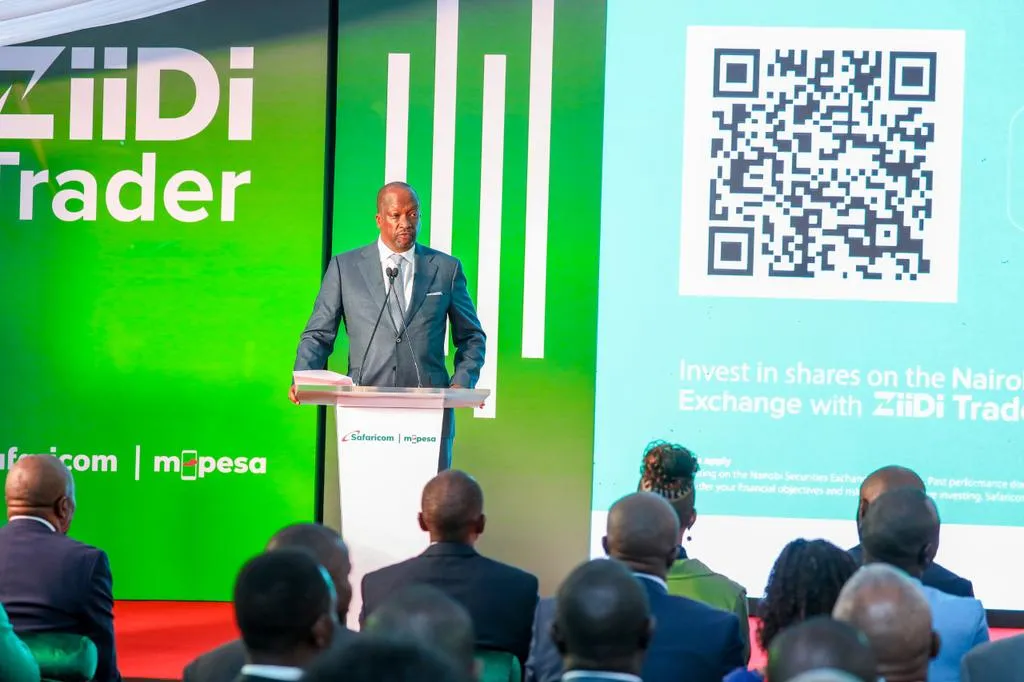
Daily transactions at the Nairobi Securities Exchange (NSE) surged to 26,169 this week — up sharply from 6,761 recorded before February 4. The inflection followed the rollout of M-Pesa-powered share trading via Ziidi Trader.
LIVENSE market summarySee NSE data →In a matter of days, activity multiplied nearly fourfold.
On February 9 alone, 7,962 of 14,300 equity deals were processed via M-Pesa. That represented 55 percent of all trades by count. By value, however, those mobile transactions accounted for approximately 2 percent of total turnover.
The distinction between count and value matters.
But so does the timing.
In the week to February 13, market capitalization rose 6.9 percent to Sh3.419 trillion. Investor paper wealth expanded by Sh220.4 billion. Heavyweight counters — including Safaricom, Equity Group, KCB Group, and Stanbic Holdings — drove much of the value appreciation.
It would be simplistic to attribute the rally solely to mobile retail participation. Earnings expectations, interest rate outlooks, foreign positioning, and macro liquidity remain decisive forces.
Yet the retail pulse arrived — and liquidity thickened.
The question now is structural:
Has the NSE finally unlocked the retail engine it has long pursued?
Or is this merely a temporary spike driven by novelty and curiosity?
To answer that, one must examine Kenya’s market structure, historical participation trends, behavioral finance dynamics, and the broader intersection between fintech and capital markets.
Build the future you deserve. Get started with our top-tier Online courses: ACCA, HESI A2, ATI TEAS 7, HESI EXIT, NCLEX-RN, NCLEX-PN, and Financial Literacy. Let Serrari Ed guide your path to success. Enroll today.
The NSE’s Long-Standing Retail Ambition
For years, the Nairobi Securities Exchange has articulated a bold aspiration: 9 million retail investors — roughly one-third of Kenya’s adult population.
That goal often felt aspirational rather than operational.
Historically, retail participation in Kenya’s equity market has been constrained by:
- Brokerage onboarding friction
- Documentation requirements
- Minimum trade sizes
- Settlement delays
- Limited investor education
- Perception that equities are “elite” instruments
While Kenya is globally recognized for mobile money leadership through M-Pesa, the integration of capital markets into mobile rails lagged.
This created a paradox:
Kenya had one of the most digitized payments ecosystems in Africa — yet retail equity access remained comparatively analog.
Ziidi Trader’s integration with M-Pesa appears to have removed a key bottleneck.
Why 26,169 Transactions Matter
Transaction count is not the same as turnover value.
Institutional trades often account for the majority of value, even if fewer in number.
Yet transaction count serves as a proxy for participation breadth.
When daily transactions jump from 6,761 to 26,169, several dynamics are activated:
- Perceived liquidity improves
- Market depth appears stronger
- Price discovery becomes more dynamic
- Retail visibility increases
Liquidity is not just a technical metric — it is psychological.
Investors are more willing to trade when they believe others are trading.
Activity breeds attention. Attention can breed additional orders.
The Value vs Volume Distinction
On February 9:
- 55% of trades by count were via M-Pesa
- Only 2% of total turnover came from mobile trades
This suggests:
- Retail traders are placing smaller ticket sizes
- Institutions remain dominant in value terms
- The retail surge is participation-driven rather than capital-driven
But this pattern is not unusual.
Globally, retail investors often dominate trade count but not notional value.
The early phase of retail expansion is often characterized by:
- High frequency
- Small ticket sizes
- Learning-driven experimentation
Over time, ticket sizes may increase as confidence grows.
Historical Context: Retail Participation at the NSE
The NSE has experienced retail surges before.
During the Safaricom IPO in 2008, retail enthusiasm was strong. The IPO was oversubscribed and widely distributed.
However, post-IPO volatility and market corrections dampened sustained retail participation.
Between 2011 and 2017:
- Institutional investors dominated flows
- Foreign participation influenced index direction
- Retail engagement stagnated
Subsequent macro shocks — including the 2020 pandemic — further reduced local retail risk appetite.
Retail participation at the NSE has often been episodic rather than structural.
The difference this time lies in distribution infrastructure.
The M-Pesa Effect: Distribution as Market Catalyst
M-Pesa revolutionized financial inclusion in Kenya.
By removing physical banking constraints, it:
- Democratized payments
- Increased transaction frequency
- Embedded digital finance in daily life
Ziidi Trader leverages this embedded infrastructure.
Instead of requiring:
- Separate brokerage accounts
- Physical branch visits
- Complex bank transfers
Retail investors can now execute equity trades directly through mobile money rails.
The friction removal is transformative.
Access — not necessarily appetite — may have been the binding constraint.
Behavioral Finance: Frequency and Perception
Markets are not only driven by fundamentals; they are shaped by perception.
When daily transaction volumes remain around 6,000–7,000, retail investors may perceive the market as thin or inactive.
At 26,000 transactions per day, the market feels alive.
This matters because:
- Liquidity perception reduces entry hesitation
- Visibility on mobile platforms increases engagement
- Social diffusion amplifies participation
Retail trading globally often accelerates when technology lowers barriers.
Consider the U.S. experience:
- Robinhood lowered brokerage commissions to zero
- Retail participation surged
- Trade frequency increased dramatically
The NSE’s mobile integration could represent a similar inflection.
The Heavyweights Still Matter
Despite the surge in retail trade count, large-cap counters carried the majority of value appreciation:
- Safaricom
- Equity Group
- KCB Group
- Stanbic Holdings
These stocks are influenced heavily by:
LIVENSE market summarySee NSE data →- Earnings expectations
- Interest rate outlook
- Foreign institutional positioning
- Dividend forecasts
Retail participation alone cannot drive sustained index appreciation without institutional reinforcement.
The timing of the mobile rollout coincided with improving macro signals — including evolving interest rate expectations and earnings revisions.
Correlation does not imply causation.
Yet access expansion often amplifies existing momentum.
One decision can change your entire career. Take that step with our Online courses in ACCA, HESI A2, ATI TEAS 7, HESI EXIT, NCLEX-RN, NCLEX-PN, and Financial Literacy. Join Serrari Ed and start building your brighter future today.
Market Capitalization Expansion: Structural Signal or Short-Term Spike?
In the week to February 13:
- Market capitalization rose 6.9%
- Total value reached Sh3.419 trillion
- Investor paper wealth increased by Sh220.4 billion
While retail participation likely contributed to liquidity thickness, valuation expansion was influenced by:
- Institutional positioning
- Rate outlook shifts
- Corporate earnings anticipation
The key structural question:
Can daily transaction counts sustain above 20,000 over multiple quarters?
If yes, brokerage economics and research coverage may adapt.
If not, this may represent novelty-driven engagement.
Brokerage Model Implications
If sustained retail participation persists:
Brokerages may:
- Lower minimum trade sizes
- Expand mobile-first research content
- Introduce gamified education tools
- Offer fractional share trading
- Develop simplified portfolio products
Increased frequency also affects revenue models.
Higher trade count:
- Increases commission potential
- Encourages new investor onboarding
- Supports ancillary services like margin trading
Retail-driven frequency may reshape brokerage competition.
Research and Education Evolution
Historically, retail investor education has been peripheral.
Sustained mobile engagement may push it to the center.
Potential developments include:
- Bite-sized research summaries
- Earnings explainers via mobile apps
- Digital investor communities
- AI-driven trade insights
Retail markets mature when education scales alongside access.
Risks to Monitor
While the surge is promising, risks remain.
1. Sustainability Risk
Novelty effects often fade.
If transaction counts decline back toward 7,000, enthusiasm may dissipate.
2. Speculation Risk
Retail trading can increase short-term volatility.
3. Value Concentration
If retail trades remain only 2% of turnover by value, influence remains limited.
4. Infrastructure Reliability
System stability under high-frequency load is critical.
5. Behavioral Overconfidence
Rapid onboarding without education may increase poor decision-making.
Long-Term Outlook: Structural Shift or Episodic Spike?
Several scenarios are plausible.
Scenario 1: Structural Retail Renaissance
If transaction counts stabilize above 20,000 daily:
- Liquidity deepens permanently
- Bid-ask spreads tighten
- Institutional confidence improves
- IPO pipeline strengthens
Scenario 2: Gradual Moderation
Activity declines from peak but remains elevated relative to pre-February levels.
Scenario 3: Reversion
Novelty fades; transaction counts return near prior averages.
Even under reversion, the episode demonstrates latent demand.
Access was the bottleneck.
Once removed, participation surged.
Why This Matters for Kenya’s Capital Market Ambitions
Kenya’s capital market deepening agenda depends on:
- Domestic investor participation
- Reduced reliance on foreign flows
- Broader retail inclusion
- Strong IPO ecosystem
Retail breadth stabilizes markets.
When foreign investors exit, domestic participation can cushion volatility.
The NSE’s long-standing target of 9 million retail investors may no longer feel abstract.
Infrastructure now aligns with aspiration.
Regional Implications
If successful, Kenya’s mobile-integrated capital market model may:
- Influence regional exchanges
- Encourage mobile-first trading adoption
- Increase cross-border retail flows
Kenya’s fintech ecosystem may once again serve as a continental template.
Looking Ahead
Key metrics to monitor:
- Sustained daily transaction count
- Growth in active mobile investor accounts
- Average ticket size evolution
- Brokerage onboarding numbers
- New IPO listings
If activity sustains above 20,000 transactions daily over the coming quarters, this episode may mark a turning point.
If activity moderates, the lesson remains clear: retail appetite exists when access is frictionless.
Conclusion
The surge in daily NSE transactions to 26,169 following M-Pesa share trading integration is more than a data point.
It reflects:
- Access democratization
- Behavioral momentum
- Liquidity perception shifts
- Retail activation
While institutional drivers remain decisive for value, the thickening of transaction count strengthens market vibrancy.
The NSE’s retail ambition may finally align with technological reality.
Whether this moment becomes a sustained renaissance or a temporary spike depends on:
- Education
- Infrastructure stability
- Brokerage adaptation
- Macro conditions
For now, one fact stands out.
When friction disappeared, participation surged.
That alone reshapes the conversation around Kenya’s capital market future.
Ready to take your career to the next level? Join our Online courses: ACCA, HESI A2, ATI TEAS 7 , HESI EXIT , NCLEX – RN and NCLEX – PN, Financial Literacy!🌟 Dive into a world of opportunities and empower yourself for success. Explore more at Serrari Ed and start your exciting journey today! ✨
Track GDP, Inflation and Central Bank rates for top African markets with Serrari’s comparator tool.
See today’s Treasury bonds and Money market funds movement across financial service providers in Kenya, using Serrari’s comparator tools.
photo source: Google
By: Elsie Njenga
26th February,2026