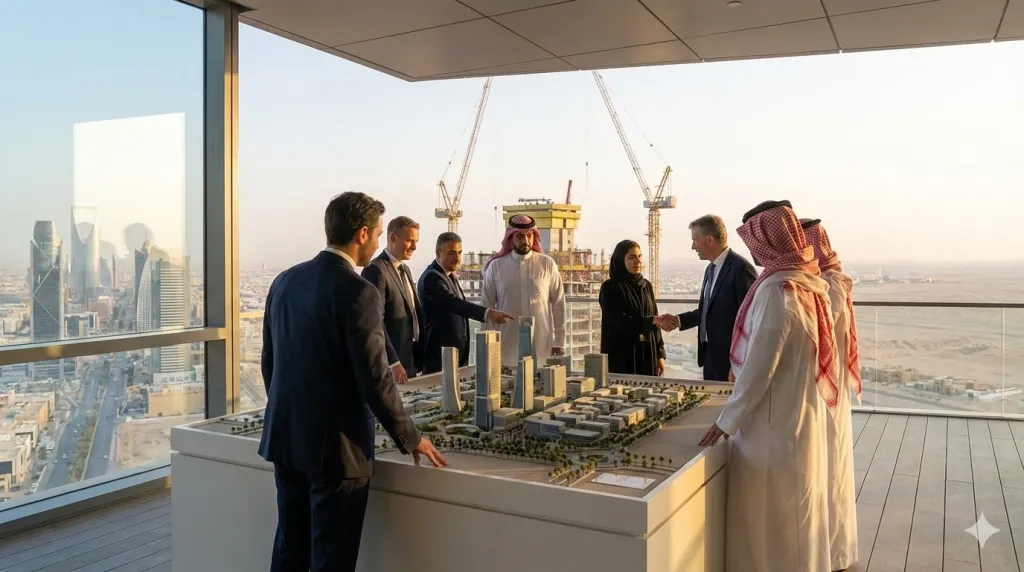
Saudi Arabia has entered a new chapter in its economic transformation with the implementation of a revised real estate ownership law that significantly expands the ability of non-Saudi individuals and entities — both residents and non-residents — to acquire property in the Kingdom.
The updated Law of Real Estate Ownership by Non-Saudis, issued by royal decree on July 14, 2025, published in the Official Gazette on July 25, and effective January 21, 2026, represents one of the most consequential liberalization steps in the country’s property market history. While foreign property ownership was previously allowed in limited and highly controlled forms, the new framework broadens access across designated zones in major cities such as Riyadh and Jeddah.
The reform is not an isolated policy tweak. It is deeply embedded within Saudi Arabia’s Vision 2030 diversification strategy — an ambitious national transformation agenda aimed at reducing dependence on oil revenues, attracting foreign direct investment (FDI), and repositioning the Kingdom as a global capital destination.
At the same time, authorities have introduced a national digital real estate platform — Saudi Properties — designed to centralize browsing, eligibility verification, application submission, and ownership registration into a unified interface. By digitizing what was historically a fragmented and bureaucratic process, Saudi Arabia is signaling that this reform is not merely symbolic but operational.
To understand why this shift matters, one must place it within the broader historical, economic, and geopolitical context shaping the Kingdom’s trajectory.
Build the future you deserve. Get started with our top-tier Online courses: ACCA, HESI A2, ATI TEAS 7, HESI EXIT, NCLEX-RN, NCLEX-PN, and Financial Literacy. Let Serrari Ed guide your path to success. Enroll today.
Historical Background: From Restriction to Gradual Liberalization
Foreign ownership of real estate in Saudi Arabia has historically been tightly regulated. For decades, property acquisition was largely reserved for Saudi nationals, reflecting economic protectionism and the Kingdom’s cautious approach to foreign capital in sensitive domestic sectors.
In the early 2000s, reforms began to cautiously open certain segments of the property market to non-Saudis, primarily resident expatriates who were allowed to purchase a single property for personal use under strict conditions. However, non-residents faced significant barriers, and commercial-scale foreign real estate investment remained highly constrained.
This approach reflected several concerns:
- Maintaining domestic control over strategic urban assets
- Protecting affordability for Saudi citizens
- Preserving cultural and religious sensitivities, particularly in Mecca and Medina
- Avoiding speculative foreign inflows
However, as Saudi Arabia’s economic reform agenda accelerated under Vision 2030, policymakers increasingly recognized that controlled liberalization could serve as a powerful catalyst for capital inflows, urban modernization, and job creation.
The Kingdom had already opened its stock market to qualified foreign investors in 2015, joined global emerging market indices in 2019, and liberalized foreign investment rules across multiple sectors. Real estate reform was therefore a logical next step in a broader economic restructuring.
Vision 2030 and the Role of Real Estate
Launched in 2016, Vision 2030 aims to diversify the Saudi economy away from oil dependency. The plan targets significant growth in non-oil GDP, increased private sector participation, and expanded foreign investment.
Real estate plays a central role in this strategy for several reasons:
- Urban development fuels employment in construction, finance, tourism, and services.
- Property markets attract long-term foreign capital.
- Mixed-use mega-projects create global branding opportunities.
- Real estate underpins tourism growth and expatriate retention.
Saudi Arabia’s large-scale developments — including NEOM, the Red Sea Project, Diriyah Gate, Qiddiya, and King Salman Park — require massive capital mobilization. Allowing broader foreign ownership supports financing diversification beyond sovereign funds and domestic banks.
By expanding ownership rights within designated zones, the government is effectively creating structured channels for international capital to participate in its urban transformation.
The New Law: What Has Changed
Under the revised framework:
- Non-Saudi individuals and entities can acquire property in designated zones.
- Ownership extends beyond personal-use property to include multiple property types.
- Access includes residential, commercial, and potentially mixed-use developments.
- Digital processes streamline compliance and registration.
Importantly, ownership remains regulated geographically. The Real Estate General Authority oversees zoning and eligibility criteria.
The holy cities of Mecca and Medina remain subject to stricter rules. Ownership in these cities continues to be restricted to Muslims, and foreign participation is more tightly controlled, reflecting religious and cultural sensitivities.
This structured liberalization allows Saudi Arabia to balance openness with national priorities.
The Saudi Properties Platform: Digital Infrastructure for Capital
The introduction of the Saudi Properties platform is arguably as significant as the legal reform itself.
Historically, property acquisition involved multiple agencies, approvals, and documentation layers. The new centralized digital gateway consolidates:
- Property browsing
- Eligibility checks
- Application submissions
- Government approvals
- Registration processes
This digitization reduces transaction friction, increases transparency, and improves investor confidence.
In global capital markets, ease of execution is as important as legal permission. By reducing bureaucratic fragmentation, Saudi Arabia enhances its competitiveness against other property investment hubs such as Dubai, London, Singapore, and New York.
Macroeconomic Context: Why Now?
The timing of the reform aligns with several macroeconomic trends:
- Strong fiscal buffers supported by oil revenues
- Large-scale infrastructure rollout
- Population growth and urbanization
- Rising expatriate workforce participation
- Tourism expansion targets exceeding 100 million annual visitors
Saudi Arabia’s GDP has become increasingly diversified. Non-oil activities have expanded in sectors such as tourism, entertainment, logistics, and technology.
The government aims to increase FDI inflows to 5.7% of GDP by 2030. Property liberalization directly supports that objective.
Regional Competition: Positioning Against the UAE
The Gulf region has long featured competitive positioning between major economic hubs.
Dubai has historically attracted international real estate investors through:
- Freehold ownership rights
- Residency-linked investment programs
- Transparent property laws
- Established global marketing networks
Saudi Arabia’s reform signals its intent to compete more directly for global property capital.
However, the Kingdom offers a scale that few markets can match. Riyadh alone is undergoing massive expansion plans, while Jeddah’s coastal development potential remains substantial.
The difference lies in positioning:
- Dubai markets lifestyle and global connectivity.
- Saudi Arabia markets scale, infrastructure depth, and long-term structural transformation.
Foreign ownership reform strengthens Saudi Arabia’s competitive toolkit.
One decision can change your entire career. Take that step with our Online courses in ACCA, HESI A2, ATI TEAS 7, HESI EXIT, NCLEX-RN, NCLEX-PN, and Financial Literacy. Join Serrari Ed and start building your brighter future today.
Potential Capital Flow Impact
Foreign property liberalization can generate:
- Direct property acquisition inflows
- Ancillary financial services growth
- Mortgage market development
- Construction sector expansion
- Asset management product creation
Over time, institutional investors may structure property funds focused on Saudi designated zones.
Global real estate capital pools exceed $10 trillion in investable assets. Even a modest allocation shift toward Saudi property could translate into billions in annual inflows.
Risks to Monitor
Despite optimism, risks remain:
- Oversupply Risk
Rapid development may create temporary supply imbalances. - Regulatory Clarity
Investors require consistent, predictable enforcement. - Currency Stability
Capital inflows must be managed to avoid distortions. - Price Affordability
Domestic housing affordability must remain protected. - Global Rate Environment
Higher global interest rates may temper cross-border appetite. - Geopolitical Perception
Regional tensions can influence foreign investor sentiment.
Saudi policymakers appear aware of these factors, structuring the reform through designated zones rather than blanket liberalization.
Historical Comparisons
International experience shows varied outcomes.
Dubai’s freehold property reform in the early 2000s triggered a property boom that positioned the emirate as a global investment magnet.
However, it also experienced volatility during the 2008 financial crisis.
Singapore allows foreign property ownership under structured limitations, maintaining stability while attracting capital.
China’s property liberalization fueled rapid urban expansion but eventually faced leverage concerns.
Saudi Arabia appears to be pursuing a measured path, combining legal reform with digital oversight and zoning control.
Long-Term Outlook
Over the next decade, several structural outcomes are possible:
- Emergence of Saudi-focused international property funds
- Growth of secondary mortgage markets
- Institutional real estate securitization
- Integration of property into broader capital markets
- Increased expatriate settlement stability
The success of the reform will depend on:
- Consistent implementation
- Transparent dispute resolution
- Continued macro stability
- Urban planning coherence
If executed effectively, foreign ownership reform could become one of Vision 2030’s most enduring structural shifts.
Why This Matters
The expansion of foreign property ownership rights is not just a real estate story.
It signals:
- Confidence in institutional maturity
- Willingness to integrate into global capital flows
- Transition from oil-based fiscal reliance to asset-based capital strategy
- Evolution of Saudi Arabia’s investment identity
Property markets reflect deeper economic structures. By opening this sector more broadly, Saudi Arabia demonstrates commitment to becoming a diversified capital destination rather than a commodity-dependent economy.
Conclusion
Saudi Arabia’s revised Non-Saudi Property Ownership Law marks a significant turning point in the Kingdom’s economic evolution.
By expanding access to designated zones, introducing a centralized digital platform, and embedding reform within Vision 2030, authorities are laying the groundwork for sustained foreign capital participation in urban development.
While risks exist — as they do in any property market liberalization — the structured approach suggests a deliberate strategy rather than speculative opening.
In the coming years, the reform may reshape not only the Saudi property market but also the broader perception of the Kingdom as an investable, diversified economic hub.
Ready to take your career to the next level? Join our Online courses: ACCA, HESI A2, ATI TEAS 7 , HESI EXIT , NCLEX – RN and NCLEX – PN, Financial Literacy!🌟 Dive into a world of opportunities and empower yourself for success. Explore more at Serrari Ed and start your exciting journey today! ✨
Track GDP, Inflation and Central Bank rates for top African markets with Serrari’s comparator tool.
See today’s Treasury bonds and Money market funds movement across financial service providers in Kenya, using Serrari’s comparator tools.
photo source: Google
By: Elsie Njenga
24th February,2026