In a continent where motorcycle taxis carry millions of people through city traffic and rural roads every day, a quiet but rapidly accelerating revolution is underway. Financing for electric vehicle transport is ramping up across Africa, and this week that momentum reached a new high as Spiro, the continent’s largest electric mobility operator, announced it had secured $50 million in debt financing from a consortium of development-focused investors to extend its battery-swapping network across existing and new markets.
The round was led by the African Export-Import Bank, known as Afreximbank, with participation from Nithio, a U.S.-based climate fintech platform, and the Africa Go Green Fund, managed by Cygnum Capital. For a company that has staked its model on dense physical infrastructure, the new capital will fuel more swap stations, technology upgrades, and deeper integration of renewable energy into the network.
“This new funding reinforces our vision of building a robust, scalable energy network tailored for Africa by Africans,” said Kaushik Burman, CEO of Spiro.
Build the future you deserve. Get started with our top-tier Online courses: ACCA, HESI A2, ATI TEAS 7, HESI EXIT, NCLEX-RN, NCLEX-PN, and Financial Literacy. Let Serrari Ed guide your path to success. Enroll today.
A Company Built on Swaps, Not Charging
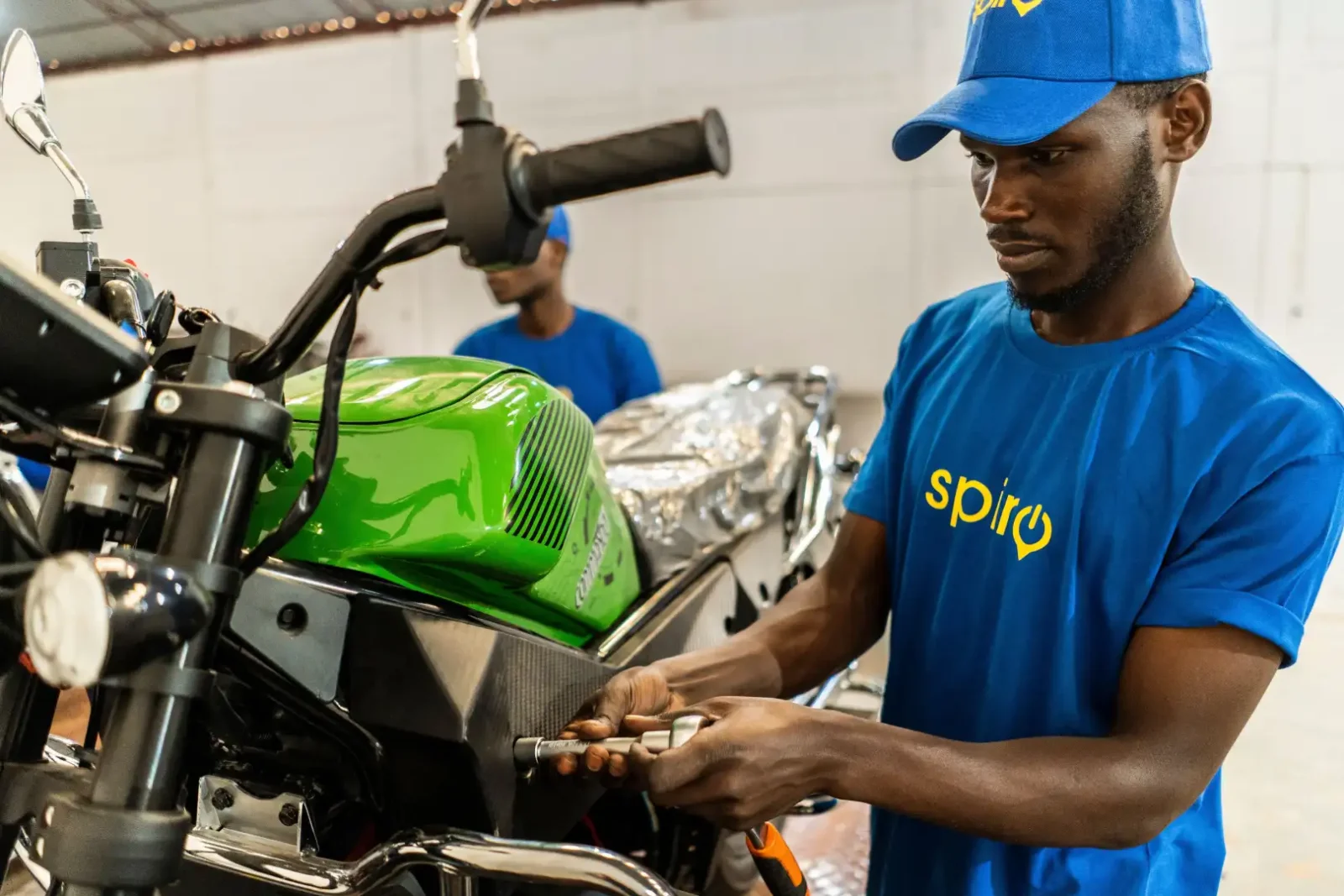
Spiro’s business model is deliberately designed around one of Africa’s most persistent infrastructure challenges: unreliable grid access. Rather than asking riders to plug in and wait hours for their batteries to charge, Spiro operates a network of battery-swapping stations where a depleted battery is exchanged for a fully charged one in minutes. Riders pay for the energy they consume, billed through a proprietary algorithm, and never own the battery at all.
The company currently operates in Kenya, Uganda, Rwanda, Nigeria, Benin, and Togo, with active pilot programs running in Cameroon and Tanzania. Its operational footprint as of February 2026 stands at over 80,000 electric motorcycles deployed, more than 300,000 batteries circulated across the network, 30 million completed battery swaps, and more than 2,500 swap stations. Riders have collectively logged over one billion carbon-free kilometres since the company launched.
The economic appeal for riders is straightforward. In Kenya, where the typical boda boda rider spends up to 700 shillings daily on fuel, switching to electric slashes that to around 200 shillings on electricity — a saving that can nearly double daily take-home pay. Electric motorcycles also cost roughly 40% less upfront than new petrol equivalents and cost around 30% less per kilometre to operate, making the economic case compelling even before climate considerations enter the picture.
“These drivers spend 10 to 12 hours on the road every day, covering 150 to 200 kilometers while paying high fuel costs. At the end of each day, most barely save anything,” Burman has said previously. “That’s why electric mobility, especially through a battery-swapping model, fits this segment perfectly.”
$50 Million as Part of a Larger Capital Story
This latest round does not arrive in isolation. It follows Spiro’s landmark $100 million raise in October 2025 — the largest investment ever made in Africa’s electric mobility sector — which was led by the Fund for Export Development in Africa (FEDA), Afreximbank’s impact investment arm, contributing $75 million, with the remaining $25 million from private equity investors.
Before that round, Spiro had already raised more than $180 million from Equitane Group, its parent company, and Société Générale. In total, since its founding in 2022, Spiro has now raised well over $230 million, deploying capital into production and assembly facilities across Nigeria, Kenya, Uganda, and Rwanda.
The February 2026 raise of $50 million is the company’s second major funding event in less than four months, a pace that reflects both the capital intensity of building physical battery infrastructure at scale and the sharpening investor appetite for the sector.
“The back-to-back deals point to rising capital needs in a business that depends on dense physical infrastructure and working batteries on the ground,” noted TechCabal in its analysis of the funding round.
Importantly, the new $50 million arrives as structured debt rather than equity — a marker of operational maturity. Debt financing allows Spiro to scale its fleet and infrastructure without diluting existing ownership, a milestone that analysts say signals the sector’s transition from early-stage venture bets to infrastructure-grade investment.
The capital will specifically be used to expand battery-swapping stations into existing and new markets, advance automated battery swap technology, build out fast-charging capabilities, and deepen renewable energy integration at swap stations to reduce dependence on grid power during outages.
One decision can change your entire career. Take that step with our Online courses in ACCA, HESI A2, ATI TEAS 7, HESI EXIT, NCLEX-RN, NCLEX-PN, and Financial Literacy. Join Serrari Ed and start building your brighter future today.
The Investors: What Each Brings to the Table
The three-way consortium backing this round reflects a deliberate mix of development finance, climate-focused fintech, and green fund capital — each bringing a different mandate to the same underlying bet on Africa’s clean transport future.
Afreximbank, which already participated in Spiro’s previous $100 million raise through its FEDA arm, has now directly committed to this new round as well. The institution has framed its repeated backing of Spiro in terms of African industrial strategy, not merely climate finance. “Driving Africa’s transition to electric mobility is central to how we view sustainable economic development across the continent,” said Oluranti Doherty, Afreximbank’s Managing Director for Export Development. By financing e-mobility infrastructure, Afreximbank aims to stimulate local vehicle manufacturing, reduce the continent’s dependence on imported second-hand petrol motorcycles, and build a green industrial value chain.
Nithio, the U.S.-based climate fintech firm joining as a new investor in this round, brings a data-driven approach to climate finance in emerging markets. “Spiro has demonstrated that electric mobility can scale rapidly while delivering real economic value to riders and meaningful emissions reductions,” said Raghav Sachdeva, Nithio’s Chief Investment Officer. “We see e-mobility as a critical pillar of Africa’s clean energy transition.”
The Africa Go Green Fund, also joining Spiro’s cap table for the first time, represents another category of institutional capital that is increasingly directing resources toward African clean energy ventures. Laurène Aigrain, Managing Director of Africa Go Green Fund, said the transaction reflects the fund’s commitment to “backing commercially robust businesses that combine innovation with measurable environmental and social impact.”
“We will use it to deploy energy infrastructure that will contribute meaningfully to a greener future in Africa,” added Gagan Gupta, Spiro’s founder.
A Sector-Wide Wave: Arc Ride and Gogo Electric Also Raise New Capital
Spiro’s announcement is the largest of a cluster of funding events that have hit Africa’s e-mobility sector in rapid succession, a pattern that points to a structural shift in investor confidence rather than isolated deal-making.
Days before Spiro’s announcement, Arc Ride, a Nairobi-based electric mobility startup operating a Battery-as-a-Service (BaaS) model, secured a $5 million equity commitment from the International Finance Corporation (IFC), the private sector arm of the World Bank Group. The IFC investment anchors Arc Ride’s planned Series A round and will be used to deepen battery-swapping station density in Kenya, expand into new East African markets, and fund research and development to upgrade its infrastructure to internationally compliant standards.
Founded by Joseph Hurst-Croft, Arc Ride has adopted a model that decouples the battery from the motorcycle purchase entirely, allowing riders to buy the vehicle at a lower price and lease the battery separately through a subscription-style arrangement. This structure has proven effective at lowering the barrier to entry for low-income boda boda operators, who cannot afford the high upfront cost of a fully equipped electric motorcycle. The company’s earlier capital raises include a $5 million debt facility from British International Investment in early 2025 and a $10 million senior secured loan from Mirova International in September 2025.
“IFC proposes an equity investment of up to $5 million to support Arc Ride’s Series A financing round, which aims to scale network density and service capacity in Kenya; support expansion into new markets across Africa, and strengthen technology capabilities through Research and Development,” the institution said in its disclosures.
Also in the same week, Uganda’s Gogo Electric raised $1 million from EDFI ElectriFI, the European Union-backed electrification financing initiative managed by EDFI Management Company. The latest injection brings EDFI’s total investment in Gogo Electric to $2.6 million, following an initial $1.6 million commitment in 2024. Founded in 2017, Gogo Electric operates over 2,500 electric motorcycles and 120 battery-swap stations across Uganda. It is also building what it describes as Africa’s first semi-automated lithium-ion battery plant, with an annual production capacity of 60,000 units.
“This additional investment from EDFI MC is proof that GOGO Electric is on the right path to electrify Uganda’s public transport,” said Parth Shah, Gogo Electric’s Chief Financial Officer. “It shall boost our battery production capacity, allowing us to deploy more electric motorcycles on the Ugandan roads.”
A Market Maturing Fast: Kenya Leads the Way
The wave of investment is both a cause and a consequence of rapidly changing market conditions on the ground. Kenya has emerged as the clearest proof point that mass-market electric mobility can work in Africa. According to data from the Electric Mobility Association of Kenya, electric motorcycles reached a 15.3% share of all new motorcycle registrations in Kenya in 2025 — up from 7.1% in 2024 and fewer than 1,000 total registered units in 2022. By the end of 2025, more than 30,000 electric motorcycles were on Kenyan roads.
Within that market, Spiro’s dominance is striking. The company accounted for over 15,000 of the 25,277 electric motorcycles sold in Kenya in 2025, giving it approximately 60% of new electric motorcycle sales in the country. Data from motorcycle industry analysts also shows that Spiro jumped to second place overall in Kenya’s motorcycle sales rankings in 2025, behind only India’s Bajaj Auto.
Kenya’s electricity mix offers a structural advantage: with nearly 90% of the national grid powered by renewable sources — including geothermal, hydro, and increasingly wind — the emissions reduction from switching to electric motorcycles is far greater than in markets dependent on coal or gas. Each electric motorcycle deployed is estimated to save approximately 2 tonnes of CO2 annually compared to a petrol equivalent.
The Kenyan government has also moved to formalise its support for the sector with the launch of the National E-Mobility Policy 2026, which aligns climate ambitions with industrial strategy and aims to reduce the country’s dependence on fuel imports that cost the economy close to $500 million a month.
Development Finance Meets Industrial Strategy
What distinguishes the current phase of e-mobility investment in Africa from earlier rounds is the nature of the capital now flowing in. Early-stage venture capital bets on individual startups are being joined — and increasingly replaced — by development finance institution money, structured debt facilities, and multilateral equity stakes. These forms of capital are better suited to the capital-intensive, infrastructure-heavy reality of scaling battery-swapping networks across multiple countries.
“For years, Africa’s EV shift was powered by venture capital and small-scale pilots. The entry of Nithio (debt) and the IFC (equity) suggests a transition toward infrastructure-led financing,” noted analysts at TechLabari. “Investors are no longer just betting on ‘cool bikes’; they are betting on the battery-swapping networks that function like decentralized utility grids.”
Afreximbank officials have repeatedly framed their backing of e-mobility companies as central to Africa’s broader industrialisation agenda. By financing the expansion of local assembly and manufacturing — Spiro currently assembles motorcycles from locally-sourced components in Kenya, Rwanda, Uganda, and Nigeria — these institutions are also addressing a long-standing structural weakness: Africa’s reliance on imported, second-hand petrol motorcycles that do nothing to build local industrial capacity.
The continent has an estimated 30 million motorcycle taxis operating across the “boda belt” — a stretch of high-density motorcycle taxi markets running from Tanzania through Kenya, Uganda, Rwanda, Nigeria, and Benin to Senegal. Nearly all of them still run on petrol. The opportunity for electrification is vast, and the economics of battery swapping — with its lower operating costs, faster refuelling time versus charging, and lower capital requirements for riders — make it uniquely well suited to this market.
Spiro CEO Burman has noted that the company’s biggest competitor is not other e-mobility startups but the petrol motorcycle segment itself: both new and second-hand bikes, and the millions of potential riders who do not yet own a motorcycle at all. The battery-swapping model, he argues, addresses the key friction points that have historically held back electric adoption — range anxiety, charging downtime, and the high upfront cost of the battery — and does so at a price point that works for low-income gig workers.
As the market matures, questions around battery supply, grid reliability, and currency risk will continue to test the companies operating in it. But with more than $230 million raised, a growing manufacturing base across four countries, and a network of 2,500-plus swap stations already operational, Spiro heads into the next phase of expansion with the infrastructure, the capital, and the institutional backing to make its pan-African ambitions a reality.
Ready to take your career to the next level? Join our Online courses: ACCA, HESI A2, ATI TEAS 7 , HESI EXIT , NCLEX – RN and NCLEX – PN, Financial Literacy!🌟 Dive into a world of opportunities and empower yourself for success. Explore more at Serrari Ed and start your exciting journey today! ✨
Track GDP, Inflation and Central Bank rates for top African markets with Serrari’s comparator tool.
See today’s Treasury bonds and Money market funds movement across financial service providers in Kenya, using Serrari’s comparator tools.
photo source: Google
By: Montel Kamau
Serrari Financial Analyst
25th February, 2026