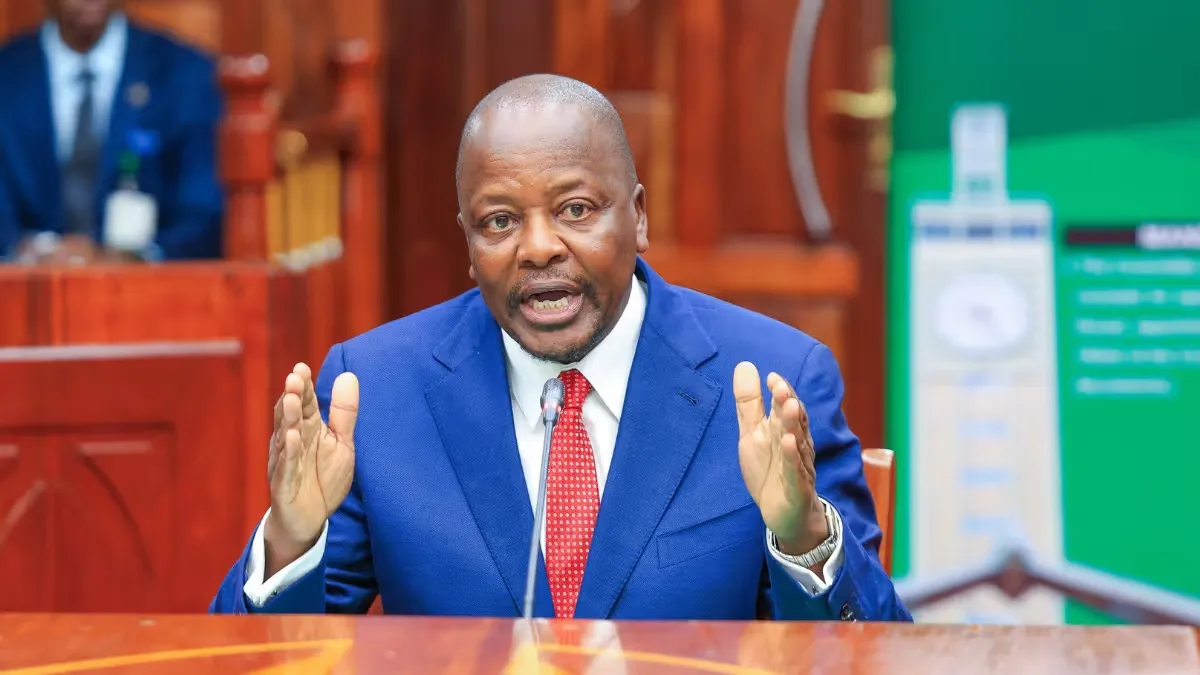
Kenya’s agriculture sector — the engine that directly powers 22.5% of the nation’s GDP, employs more than 40% of its labour force, and feeds over 53 million people — is being asked to operate on a budget allocation that amounts to just 2.7% of national government spending. That is the uncomfortable arithmetic that Agriculture Cabinet Secretary Mutahi Kagwe placed before Parliament on February 19, 2026, in testimony that was equal parts policy brief and urgent appeal.
Appearing before the National Assembly Departmental Committee on Agriculture and Livestock, Kagwe presented the Ministry’s priorities under the 2026 Budget Policy Statement (BPS), warning lawmakers that the current allocation falls far short of what the sector needs — and, critically, far short of the continental commitments Kenya has already signed onto. His central demand: raise the Ministry’s allocation from Ksh75.49 billion to at least Ksh140 billion, equivalent to five percent of the national government budget. It was a call rooted not in ambition alone, but in the arithmetic of a country that cannot afford to let its primary productive sector wither.
Build the future you deserve. Get started with our top-tier Online courses: ACCA, HESI A2, ATI TEAS 7, HESI EXIT, NCLEX-RN, NCLEX-PN, and Financial Literacy. Let Serrari Ed guide your path to success. Enroll today.
The Numbers Behind the Argument
Under the 2026 Budget Policy Statement, the Ministry of Agriculture and Livestock Development has been allocated Ksh75.49 billion — comprising Ksh29.74 billion for recurrent expenditure and Ksh45.74 billion for development. Against a national budget of Ksh2.8 trillion, that represents a 2.7% share. Against the draft 2026/27 budget that Cabinet endorsed at Ksh4.7 trillion — with education receiving Ksh658.5 billion (15.7%), national security Ksh373.8 billion, and health Ksh235.2 billion — agriculture’s allocation reveals a structural imbalance that Kagwe described to MPs as unsustainable.
The contrast is stark. Agriculture is the highest contributor to Kenya’s economic growth, accounting for 22.5% of GDP directly and an additional 25–30% through indirect linkages in food processing, transport, retail, and agro-industrial activity. In the most recent full-year data, the sector contributed a nominal GDP of Ksh16.224 trillion, making agriculture Kenya’s single most important economic pillar. Yet it receives less than three cents from every government shilling spent.
“Despite contributing a staggering 50 percent to our GDP — 22.5 percent directly and an additional 25 to 30 percent through indirect linkages — agriculture currently receives only 3 percent of the national budget,” Kagwe told Parliament’s agriculture committee. “This is unacceptable.”
His immediate demand before the Committee was an increase to at least five percent — roughly Ksh140 billion — with a longer-term aspiration toward ten percent in line with continental commitments. “This is the best practice for any industrialized nation serious about feeding its people and transforming its economy,” he said.
A Continent Left Behind on Its Own Commitments
The gap between Kenya’s agricultural budget allocation and its international commitments is not a new discovery — but Kagwe’s testimony before Parliament brought it into sharp legislative relief. In 2014, African heads of state adopted the Malabo Declaration on accelerated agricultural growth and transformation, which set an explicit target of allocating 10% of national budgets to agriculture. The Malabo Declaration also committed member states to ending hunger by 2025 — a goal that has not been met across the continent.
Kenya has compounded that commitment with more recent obligations. In May 2024, President William Ruto hosted African heads of state in Nairobi for the Africa Fertilizer and Soil Health Summit, whose final outcome — the Nairobi Declaration on Fertilizer and Soil Health — included specific pledges to triple domestic production and distribution of organic and inorganic fertilizers by 2033, provide targeted agronomic recommendations to at least 70% of smallholder farmers by 2033, and restore soil health on at least 30% of degraded soil by 2033. In August 2025, Kenya went further, preparing to formally adopt its Kenya Fertilizer and Soil Health Action Plan 2026–2035 — a ten-year national roadmap developed in partnership with IFDC and multiple ministries to domesticate the AFSH Summit’s continental targets.
The Kampala Declaration of January 2025 similarly reaffirmed continental commitments to the 10% budget target. Against this backdrop, Kenya’s Agriculture, Rural and Urban Development sector allocation has stagnated at approximately 3% — a figure Kagwe described as evidence that declarations without funding are hollow. Delivering on the Nairobi Declaration and its affiliated action plans while the Ministry operates at less than 3% of the national budget would require either a dramatic reallocation or a fundamental rethinking of how Kenya finances agricultural transformation.
A Demographic Time Bomb in the Fields
The urgency of Kagwe’s appeal is underscored not just by current deficits, but by future projections that are unforgiving. Kenya’s population currently stands at approximately 53.5 million people. By 2045, according to Ministry projections, that figure is expected to reach 70.2 million — an increase of nearly 17 million people in under two decades. Every additional person will need to be fed, and the existing agricultural system — already strained by chronic underinvestment — will not automatically scale to meet that demand.
The agriculture sector already employs more than 40% of Kenya’s labour force and provides livelihoods for over 70% of rural households. These are people who depend directly on the productivity and competitiveness of a sector that receives a budget share less than that allocated to Parliament’s own operational budget. The arithmetic of underinvestment here is not just an economic problem — it is a social one, with food insecurity, rural unemployment, and poverty all tracking closely with agricultural performance.
“We cannot continue using the same agricultural practices that fed 35 million Kenyans to feed over 53 million today,” Kagwe told the Committee. His message was clear: the country is not just facing a budget allocation problem; it is facing a structural agricultural transition challenge that requires a step-change in public investment if it is to be resolved before the demographic pressure becomes a food security crisis.
Climate, Pests, and External Shocks: The Threats Multiplying Against Farmers
Kagwe’s testimony catalogued a formidable array of structural and external threats confronting Kenya’s agricultural sector: climate change, frequent droughts and floods, pest invasions including Quelea birds and giant rats, global conflicts affecting supply chains, currency volatility, delayed government funding disbursements, high input costs, and weak agricultural extension services.
The climate dimension is particularly acute. Kenya’s farming system remains predominantly rain-fed — a structural vulnerability that makes productivity directly hostage to the unpredictability of rainfall patterns. The CS emphasized the need to transition from “analog to digital agricultural systems” and to dramatically expand irrigation infrastructure to reduce overreliance on seasonal rain. This is a directional commitment backed by the government’s own programs, but one that requires sustained capital investment to deliver at meaningful scale.
In July 2025, Kenya took a significant step toward embedding climate resilience into existing programs when the Ministry of Agriculture launched climate-smart insurance integrated into the National Fertilizer Subsidy Program, in partnership with Pula, Bayer Foundation, Lemonade Foundation, SOMPO Digital Lab, and Etherisc. Under the scheme, farmers registered on the Kenya Integrated Agriculture Management Information System (KIAMIS) automatically receive coverage worth Ksh7,000 — equivalent to the cost of two subsidised fertiliser bags — when collecting their inputs. The initiative represents exactly the kind of integrated, digital-first, climate-resilient programming that Kagwe is advocating. But it can only be scaled with increased budget resources.
In the financial year 2025/26, Kenya’s National Treasury allocated Ksh47.6 billion for agriculture sector programmes — including Ksh8 billion for the Fertilizer Subsidy Programme, Ksh10.2 billion for the National Agricultural Value Chain Development Project, Ksh1.2 billion for the Food Security and Crop Diversification Project, and Ksh5.8 billion for the Food Systems Resilience Project. While these programmes target real sectoral priorities, they collectively represent a fraction of the investment required to transform Kenya’s agriculture from a smallholder-dominated subsistence system into the productive, export-competitive sector Kagwe envisions.
One decision can change your entire career. Take that step with our Online courses in ACCA, HESI A2, ATI TEAS 7, HESI EXIT, NCLEX-RN, NCLEX-PN, and Financial Literacy. Join Serrari Ed and start building your brighter future today.
The BETA Framework and Value-Chain Priorities
Kagwe outlined the Ministry’s approach through the lens of the Bottom-Up Economic Transformation Agenda (BETA) — President Ruto’s flagship economic programme that places agriculture at the centre of inclusive growth strategy. Under BETA, the Ministry’s agricultural value-chain approach is organized around three interconnected pillars: food security, reducing imports, and growing exports.
For food security, the Ministry is prioritizing maize, Irish potatoes, pulses, bananas, dairy, beef, indigenous poultry, mutton, chevon, fish, and pork — commodities that form the staple diet of Kenyan households and that have high potential for productivity gains through improved inputs, irrigation, and extension services. The fertilizer subsidy programme, now running as the National Fertilizer Subsidy Programme (NFSP, 2022–present), has been central to the food security pillar, providing subsidized inputs to smallholder farmers through a digital voucher system tied to the KIAMIS platform, which has already digitally profiled over 6.4 million farmers.
For import reduction, the government is targeting commodities where Kenya currently runs large import bills: rice, wheat, edible oils, sugarcane, sorghum, honey, and textiles. Each of these commodities is produced domestically but at insufficient volumes to meet demand, creating a structural import dependency that drains foreign exchange reserves and exposes the country to global commodity price volatility.
For export growth, the Ministry is focusing on coffee, tea, avocado, mango, nuts, garden peas and African bird’s eye chilies, pyrethrum, leather, bixa, and miraa — products where Kenya already has established international market positions or strong growth potential. Kenya’s horticulture sector is already a major earner, but improving value addition, cold chain logistics, and compliance with export market standards requires precisely the kind of coordinated public investment that a better-funded Ministry could deliver.
Extension Services and the JASCOM Gap
One of the more specific and operationally grounded proposals Kagwe put to Parliament was the need to recruit 1,450 Ward Agricultural Liaison Officers to strengthen coordination between the Ministry, county governments, and farmers. This proposal targets a real and documented weakness in Kenya’s agricultural service delivery architecture.
Agricultural extension services — the provision of technical advice, agronomic information, and market linkages to farmers — have been chronically underfunded across Kenya for decades. The devolution of agricultural services to county governments in 2013 fragmented what was previously a national extension system, creating coordination challenges between the national Ministry and county agriculture departments that the Joint Agricultural Sector Steering Committee (JASCOM) was designed to address.
Kagwe’s call for a clear delineation between the State Departments for Agriculture and Livestock Development in budget planning — and his concern about the “delink” between Ministry proposals and final Treasury allocations — points to a governance challenge that compounds the underfunding problem. Even when the Ministry identifies priority programmes, budget ceiling negotiations with the National Treasury often result in allocations that fall short of what the sector strategies require. Addressing this structural misalignment is as important as the headline budget figure itself.
Kenya’s Agricultural Bank Credit Gap
Beyond the government budget, Kagwe has repeatedly highlighted a parallel financing gap in the commercial banking sector. At the Financing Agri-Food Systems Sustainably (FINAS) 2025 conference held at KICC in Nairobi in May 2025, he revealed a damning statistic: only 3% of the US$49 billion in loans issued by Kenyan banks in 2023 went to the agriculture sector. For an economic sector that contributes half of GDP directly and indirectly, that credit allocation is a profound structural failure.
The reasons are well documented: high perceived risk in agricultural lending, lack of traditional collateral among smallholder farmers, underdeveloped rural capital markets, and the mismatch between bank repayment schedules and agricultural production cycles. Kagwe has proposed reinstating policies requiring financial institutions to allocate a fixed percentage of their assets to agriculture — a rule that existed in Kenya’s banking regulations in earlier decades but was removed as part of financial sector liberalization. He has also backed the recapitalisation of the Agricultural Finance Corporation (AFC) and its merger with the Commodities Fund as a vehicle for scaling up institutional agricultural lending.
Parliament’s Role: The Recommendations Ahead
The National Assembly Departmental Committee on Agriculture and Livestock now holds a critical juncture in this budget cycle. Under Kenya’s budget process, the BPS — which sets the resource envelope and sector priorities for the coming financial year — must be reviewed, deliberated upon, and adopted by Parliament within fourteen days of submission by the National Treasury. The Committee’s recommendations will inform the House’s resolution on the BPS, which in turn guides the Cabinet Secretary for Treasury in finalizing the budget.
Kagwe’s appeal to the Committee is thus a direct intervention in the formal budget process — an attempt to use parliamentary engagement to shift what Treasury’s ceiling would otherwise determine. Whether MPs respond with a recommendation that meaningfully raises the agriculture sector’s allocation remains to be seen, but the political economy of the argument is in Kagwe’s favour: food prices, input costs, and rural livelihoods are visible, proximate concerns for constituencies across the country.
The trajectory of the 2026/27 budget cycle — where agriculture has been provisionally allocated Ksh196.4 billion in the draft budget — suggests that some movement in the right direction may already be underway, though whether that figure reflects the Ministry’s stated priorities or represents a different definitional scope for “the agricultural budget” requires careful analysis before conclusions are drawn.
Conclusion: The Cost of Inaction
Agriculture’s chronic underfunding in Kenya is not a new problem. It is a persistent one, compounded by demographic pressure, climate disruption, and the accumulated deferred investment of successive budget cycles that treated agriculture as a residual claimant rather than a strategic priority. CS Kagwe’s testimony before Parliament on February 19, 2026 is the latest — and among the most direct — official acknowledgements that the status quo is unsustainable.
The World Bank projects Kenya’s GDP growth to recover to 4.9% on average during 2026–2027, driven by easing inflation, accommodative monetary policy, and a pickup in credit growth. But for that growth to be inclusive and sustainable — reaching the more than 40% of Kenyans who depend on agriculture for their livelihoods — the sectoral investment architecture must change. A budget allocation of 2.7% for a sector that delivers half the economy’s productive base is not just suboptimal. According to the man now charged with fixing it, it is unacceptable.
Parliament’s response in the coming weeks will reveal whether that characterisation prompts action or becomes another unfulfilled appeal in Kenya’s long agricultural policy history.
Ready to take your career to the next level? Join our Online courses: ACCA, HESI A2, ATI TEAS 7 , HESI EXIT , NCLEX – RN and NCLEX – PN, Financial Literacy!🌟 Dive into a world of opportunities and empower yourself for success. Explore more at Serrari Ed and start your exciting journey today! ✨
Track GDP, Inflation and Central Bank rates for top African markets with Serrari’s comparator tool.
See today’s Treasury bonds and Money market funds movement across financial service providers in Kenya, using Serrari’s comparator tools.
photo source: Google
By: Montel Kamau
Serrari Financial Analyst
20th February, 2026